Third-party booking platforms (Venue Scanner, Square Meal, Design My Night, Chili Sauce, Cluck) send booking enquiries to restaurant groups in a consistent, structured format every time. Automating these emails means using an integration layer to parse that structured data, check availability via your booking system's API, and create the booking without anyone copying a field. Most restaurant groups are still doing this by hand not because automation is impossible, but because the integration layer between the inbox and the booking system has not existed. That is changing.
The most repetitive task in your reservations operation
The email arrives. You open it. Guest name, date, time, party size, occasion, dietary requirements, contact details: all there, in the same order they always are. You open the booking system. You enter each field. You check availability. You send the confirmation. You move to the next email.
A head of sales at a karaoke and gaming venue group described it precisely: "We get an email from the third party which looks exactly the same all the time: 'This is a booking for Karan. He's coming to celebrate his stag do on this day.' Please put the booking in place — and we do that manually right now."
Their group receives around 900 enquiries per week. Roughly 30% arrive by email. That is approximately 270 manual entries per week from email alone, all from platforms sending the same structured format, all requiring a team member to act as a human relay between the inbox and the booking system.
The scale compounds quickly. A head of group bookings at a restaurant group managing five brands across 240 sites summed up the scope of it: "About 75% of our business is third parties. They come through via email and we just punch that form into both booking systems."
Both booking systems. Every third-party booking entered manually, twice.
A two-site gastropub group's owner described the daily rhythm: "Everything that comes through Design My Night has to be entered manually. It's every day."
At a fine dining group, 35 to 40% of all reservations arrive by email and require full manual entry. Each one is a separate act of copying the same fields into the same system. The question to ask is not whether this is familiar. The question is how many times your team did it yesterday.
Which third-party platforms send these emails (and why they are automatable)
The main UK third-party platforms sending structured booking emails are:
Venue Scanner — corporate events and private hire enquiries
Square Meal — restaurant discovery and group bookings
Design My Night — bars, restaurants, and ticketed experiences
Chili Sauce — group and event bookings
Cluck — private dining and experience bookings
Bookatable — restaurant reservations and group dining
Travel agents and corporate account managers — typically via unbranded email with their own consistent template
Each of these platforms sends booking enquiries in a structured format. That structure exists by design: the platforms need your team to be able to action a booking the moment the email arrives. Every enquiry from Venue Scanner contains the same fields. Every Square Meal booking alert follows the same layout. The fields are always: guest name, date, time, party size, occasion, dietary requirements, contact details.
That standardisation is exactly what makes these emails automatable. Structured input is parseable input. When an email always contains the same fields in the same format, a system can read it just as reliably as a person can.
The emails do not need to be messy for automation to be difficult. They are already clean. The gap is the connection between the inbox and the booking system, not the complexity of the email itself.
What's actually stopping the automation
The technical gap is not the email. The emails are structured. The gap is the API connection between the inbox and the booking system.
Booking systems were built to manage reservations. They were not built to receive structured data from email. When a team member reads a Venue Scanner email and enters the details into Collins or OpenTable, they are acting as the integration layer, manually bridging a gap the systems were never designed to close.
A sales director at a multi-venue entertainment group identified this exactly: "We need to nudge Collins and OpenTable to get API access. That's the unlock."
Their group operates across venues using both Collins and OpenTable. API access is what makes this possible. Not a new booking system. Not a major technical project. A commercial conversation with the booking system vendor.
A 3-site pizza group described where the absence of that connection leads: "We have to manually export from OpenTable and import into SevenRooms. It's ridiculous."
Manual CSV export. Manual import. Every day. Because the systems do not talk to each other, someone has to act as the bridge.
Three things have prevented most groups from automating this:
1. Booking systems do not have email parsing built in. The system receives the booking once a human has entered it. The email-to-system step has always been manual by default.
2. API access requires a formal request. For Collins, OpenTable, Resy, and similar systems, API access is available but not active unless requested through your account manager. Most teams have never asked because they never believed automation was possible.
3. Teams have accepted manual entry as a fixed cost. When there is no visible alternative, the workaround becomes the workflow.
One honest note: SevenRooms has a restricted API. For groups running SevenRooms as their sole system, the integration path involves additional complexity and a formal access request. The email parsing layer can still be put in place independently. The API connection is a separate step.
What the automated flow looks like, step by step
The gap between the current manual workflow and the automated version is clearest when the steps are laid side by side.
Current manual flow (typical for a group receiving 75% of bookings via third-party email):
Third-party email arrives in shared inbox
Team member reads the email
Manually enters booking details into the reporting system
Manually re-enters the same details into the restaurant communication system
Emails the restaurant to confirm availability
Waits for the restaurant's reply
Sends booking confirmation to the guest
Seven steps. A human required at each one. If the team is at capacity, the booking waits in the queue. If the email arrives on a Friday evening, it waits until Monday morning.
The automated flow:
Third-party email arrives
AI layer reads the email and extracts the structured fields: guest name, date, time, party size, occasion, dietary requirements, contact details
Queries the booking system's API to check availability
Creates the booking in the system
Sends confirmation to the guest
Notifies the venue
Logs the booking in the reporting system
Seven steps. No human required for a standard structured booking. The email arrives at 9pm on a Friday. The booking is created, confirmed, and logged before the team opens their laptop on Monday morning.
The two workflows are identical in what they produce. The difference is who does the work, and when. Manual entry creates a hard dependency on human availability. The automated flow removes that dependency for structured, routine bookings.
Enquiries that are too complex for automation
Not every third-party email arrives in a form that can be processed automatically. Some will not.
Custom menu requests, venue hire proposals with unusual requirements, last-minute changes to large bookings, enquiries that ask a question before committing to a date: these involve judgment. They require a person who understands the venue's capacity, pricing, and constraints.
A head of sales at a competitive socialising venue group described the pricing complexity his system faces: "Dynamic pricing by day, time, and group size — AI needs to query the booking system's API to quote correctly."
Even this is not a reason to step back from automation. It is a reason to be precise about what the automation handles. For bookings where the date, time, party size, and occasion are confirmed and the pricing is straightforward, the flow is fully automatable. For bookings that require a quote, a negotiation, or a custom arrangement, the automation flags the email for human handling.
The same head of sales articulated the intended outcome: "I'd like to minimise how much admin is done so my guys can focus on driving group bookings of 10s, 20s, 30s — rather than putting through a booking of two people."
The automation does not need to handle every case. It needs to handle the cases that are structured and routine, which are the majority. The team's attention then goes to the bookings that actually need it: the large venue hires, the complex events, the high-value group bookings that deserve a human response.
The business case
The numbers are straightforward. The cost is mostly invisible until you total it.
Email volume at a mid-sized restaurant group: 20 to 50 third-party booking emails per day.
Time per manual entry: 5 to 10 minutes, including reading the email, opening the booking system, entering each field, checking availability, and sending the confirmation.
Weekly time consumed: 100 to 500 minutes per person. That is between 1.5 and 8 hours of a working week spent on mechanical data entry.
Annual labour cost at £15/hour: £1,300 to £6,500 per year, per person. At a 3-person team, that is £3,900 to £19,500 per year in pure data entry, before any productivity multiplier.
The revenue risk adds a separate line. At a 3-site pizza group, a 30 to 40 cover booking arrived via Square Meal. It sat unread. The guest booked elsewhere. At typical per-head spend, that booking was worth £500 to £1,500 in direct revenue. One email. One missed entry. Gone.
The same risk exists at every group that receives third-party booking emails out of hours. A structured email that arrives on Saturday evening sits in the inbox until Monday morning. Guests typically contact two or three venues at once. The first to confirm takes the booking.
An automated integration processes the email the moment it arrives. 9pm on a Saturday. The booking is in the system. The confirmation is sent. The guest stops looking elsewhere.
What you need before this works
The requirements are minimal. This is not a long IT project.
1. Identify your booking system and check API availability.
Collins, OpenTable, Resy, and most major booking platforms offer API access through their developer programmes. For SevenRooms, API access requires a formal request. If you are unsure, your account manager is the starting point.
2. List the third-party platforms sending you structured emails.
Venue Scanner, Square Meal, Design My Night, Chili Sauce, Cluck, and travel agent contacts are the typical sources. Map which ones account for the most volume.
3. Request API access from your booking system vendor.
For most systems, this is a commercial conversation with your account manager, not a technical project. One group described it as needing to "nudge Collins and OpenTable" — the access exists, it just needs to be formally requested.
4. Confirm the email format each platform uses.
Most platforms are already consistent. If you are unsure, ask the platform for a sample or pull three recent emails and compare. The structure is almost always identical.
5. Identify which categories of email are routine vs. complex.
Routine structured bookings are the automation candidates. Custom enquiries, pricing negotiations, and venue hire proposals with open questions stay with the team.
For groups in the middle of a booking system migration, the time to establish this integration layer is before the migration completes. Setting up the connection during the transition avoids rebuilding it after.
Frequently asked questions
Which third-party booking platforms send structured emails to restaurants?
The main UK platforms are Venue Scanner, Square Meal, Design My Night, Chili Sauce, Cluck, and Bookatable. Travel agents and corporate account managers also send booking enquiries by email. Each platform uses a consistent format: guest name, date, time, party size, occasion, dietary requirements, and contact details. That consistency is what makes automation possible.
How do I integrate Venue Scanner emails with my booking system?
Venue Scanner emails follow a consistent format. An integration layer reads the email, extracts the booking fields, and pushes them to your booking system via API. This requires API access to your booking system. For most systems — Collins, OpenTable, Resy — API access is available through your vendor's developer programme. For SevenRooms, access is more restricted and requires a formal request.
Can I automate Square Meal booking emails into SevenRooms or OpenTable?
Square Meal sends structured booking enquiry emails. Automating these into a booking system requires an API connection to that system. OpenTable has an API available for integrations. SevenRooms has a restricted API, and access is not available on all plans. The email parsing layer (reading the email and extracting the fields) is independent of the booking system connection and can be set up first.
What does it cost restaurant groups to manually enter third-party booking emails?
A group receiving 20 to 50 third-party booking emails per day and spending 5 to 10 minutes on each entry is consuming 100 to 500 minutes of team time per day on data entry alone. At a loaded rate of £15 per hour, that is £1,300 to £6,500 per year per person, before factoring in errors and the revenue risk of emails that sit unread during evenings and weekends.
Do I need API access to automate third-party booking emails?
To push booking data directly into a reservation system, yes. Without it, an integration layer can still parse the email and generate a pre-filled draft for your team to review, which removes manual reading and field-by-field entry. Full end-to-end automation, where the booking is created and the confirmation sent without team involvement, requires API access. For most booking systems, requesting access via your account manager is the first and main step.
RevVue handles this integration layer for UK restaurant groups. If your team receives structured booking emails from Venue Scanner, Square Meal, Design My Night, or any other third-party platform, book a demo to see how the automation works with your current setup.
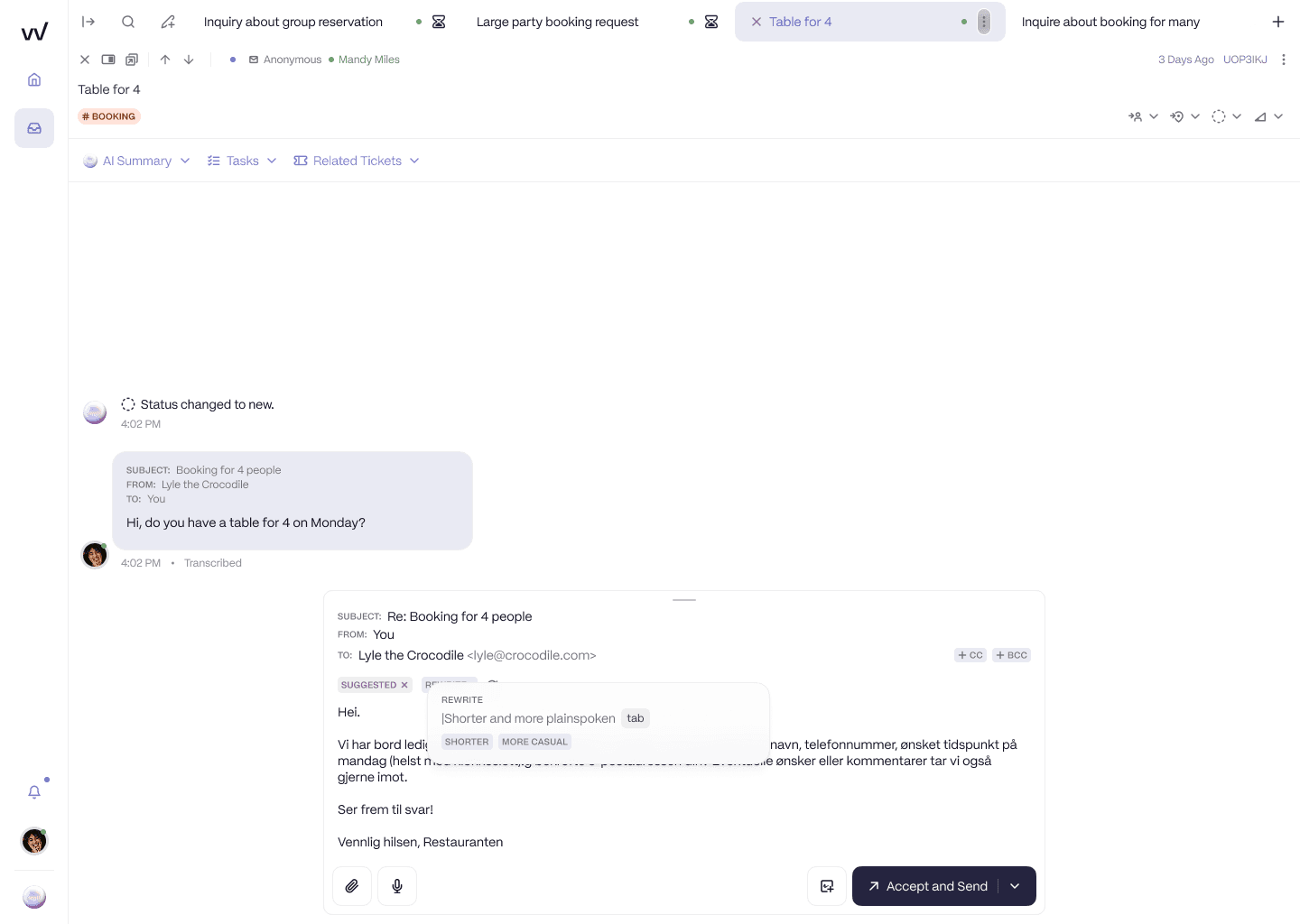
The AI reads the inbound enquiry, drafts the reply in the venue's tone, and waits for one-click approval, so the team reviews instead of retyping.
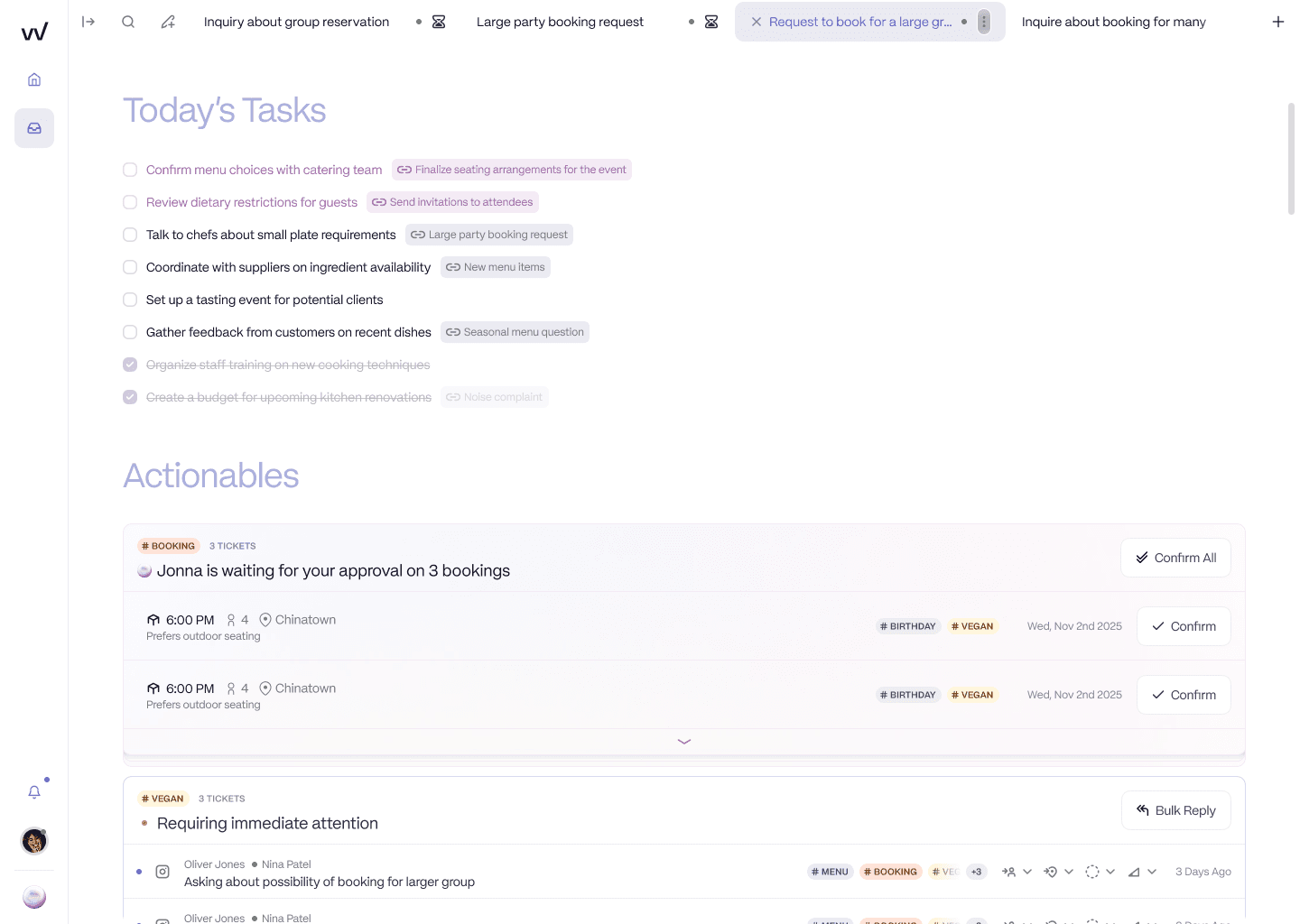
Parsed third-party enquiries become prepared bookings the AI holds for approval, so routine requests do not sit unread over a weekend.