Why restaurant groups outgrow Help Scout
Help Scout is a clean, affordable support inbox. It has a tidy interface, a built-in knowledge base, email and live chat, a lower price than the big helpdesks, and it is genuinely less complex to run than Zendesk or Freshdesk. For a small team handling low customer-service volume, it is a good tool, and there is nothing wrong with using it.
The best Help Scout alternative for a restaurant group depends on which workload you are solving. For more capable customer-service support, Freshdesk is the affordable step up, Front is the closest like-for-like shared inbox, Zendesk is the enterprise option, and Intercom is the premium AI and chat platform. For booking enquiries, none of those fit, because like Help Scout they do not integrate with restaurant booking systems. A hospitality-native tool like RevVue is built for that workload.
Growing restaurant groups tend to outgrow Help Scout on the same predictable points. It is not location-aware, so routing and reporting by site rely on manual tagging that gets fragile as you add venues. It does not integrate with the booking system, so booking enquiries never fit. Its AI is generic. It has no review or survey management, so the wider guest relationship lives elsewhere. And per-seat pricing means every site manager who needs to see their own inbox is another seat, so lean teams end up limiting access.
One honest caveat before the list. Help Scout is not represented in our customer conversations the way Freshdesk and Zendesk are. The view here is category-level, based on the tool's positioning and where it sits in the market, not on watching a specific restaurant group run it. Here is the honest shortlist, ranked by fit for a multi-location group.
Two workloads, two different tools
Before you pick an alternative, separate your two inboxes, because most of the options below are support inboxes and only one is built for booking enquiries.
A restaurant group has two distinct inbound flows. Customer-service support is structured and often post-visit: a voucher will not redeem, a guest was charged twice, a complaint needs the finance team, a routine FAQ needs answering. This is the workload Help Scout and every other support inbox was built to serve.
Booking enquiries are different. They are conversational and pre-visit: a table for 30 on Saturday, a dietary question, a request to move a booking from 7pm to 8pm. To handle one properly the tool has to talk to your booking system, check availability, create the booking, and attach the notes. None of the support inboxes, Help Scout included, can do that, because none integrate with the booking system. This is why even groups running Help Scout for support still run their booking enquiries through a separate Outlook or Gmail.
So the first question is not which tool, it is which workload. If you are replacing a support inbox, several options below fit. If you are solving booking enquiries, only one does.
1. RevVue, purpose-built for restaurant booking enquiries
RevVue is the only option on this list built for the booking-enquiry workload rather than adapted to it. It is the right answer when booking enquiries are the pain, and the wrong answer if all you need is a small support desk.
What makes it fit: Location is the foundational data model, so every message is pinned to the right venue automatically, with no manual tagging to maintain. The AI talks to the booking system inside the conversation thread: it checks availability, creates the booking, and handles amendments. Each venue gets its own knowledge base and brand tone, learned automatically from that venue's historical Outlook or Gmail replies. The interface is email-first, matching how reservations teams already work. Pricing is per location at £75 per month, not per seat, so adding a site does not mean adding a seat and site managers see their own inbox at no extra cost. And it includes online reviews and post-visit surveys by location, which is the part of the guest relationship Help Scout leaves out entirely.
Limits, plainly: RevVue is not a customer-service ticketing tool. It is also not the right tool for a small single-site support desk, which is exactly where Help Scout is fine and where you do not need any of this. The AI agent is live and in pilot across more than 60 locations in Norway, handling 15% to 35% of inbound volume autonomously, with UK pilots running now, but it is not yet fully generally available in the UK. There is no inbound phone channel. The SevenRooms integration is in active development rather than live today.
Best for: Multi-location and multi-brand groups whose primary pain is booking enquiries, location-level reporting, per-venue tone, or pulling the guest relationship across reviews and surveys into one view. Not for: Replacing a small support desk, or single-site businesses.
The phrase that captures the difference from Help Scout and every other support inbox: they can write a reply, they cannot book the table.
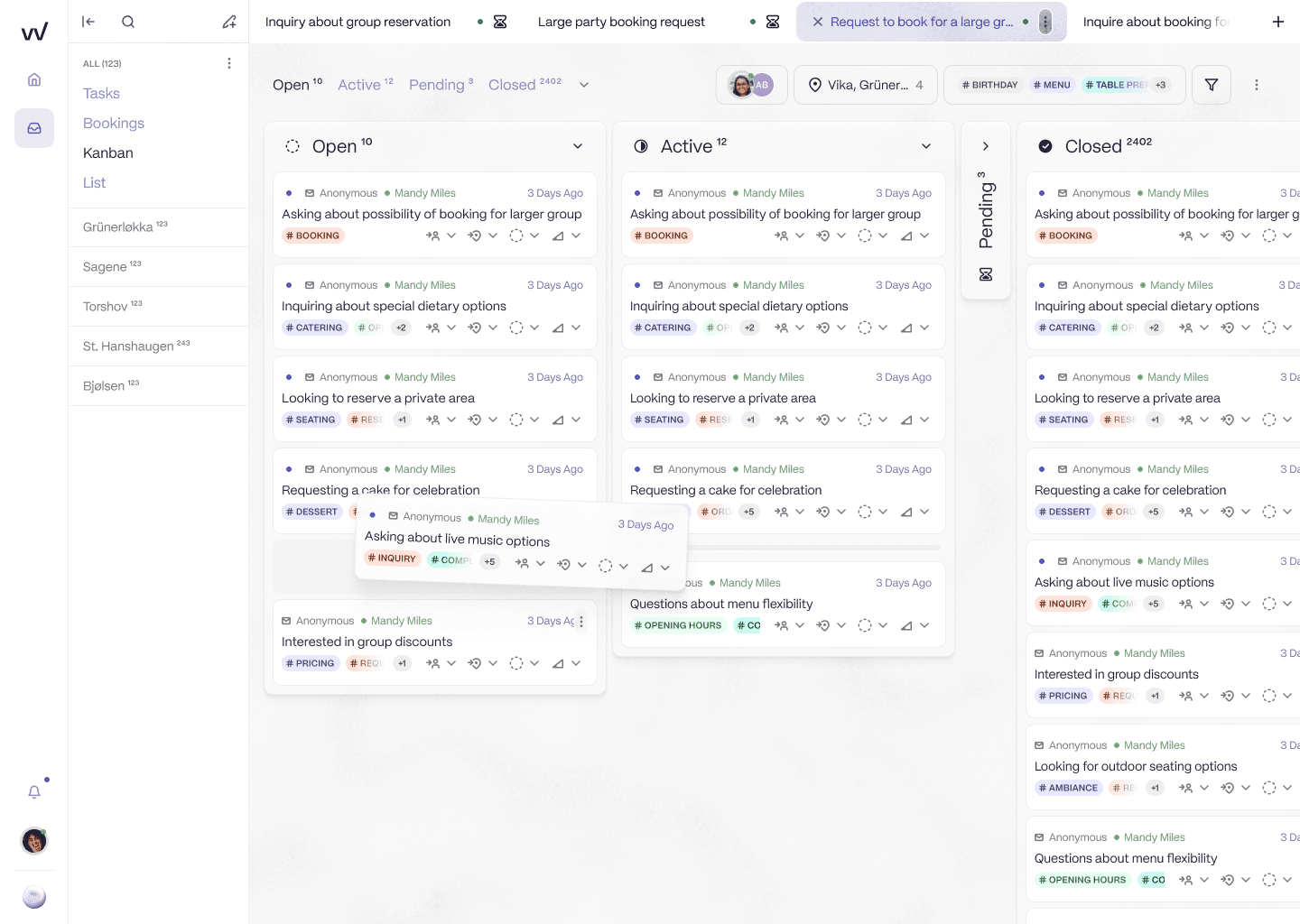
The venue sidebar is the data model: every enquiry routes to the right site on arrival, so there is no manual tagging to keep reporting honest as you add locations.
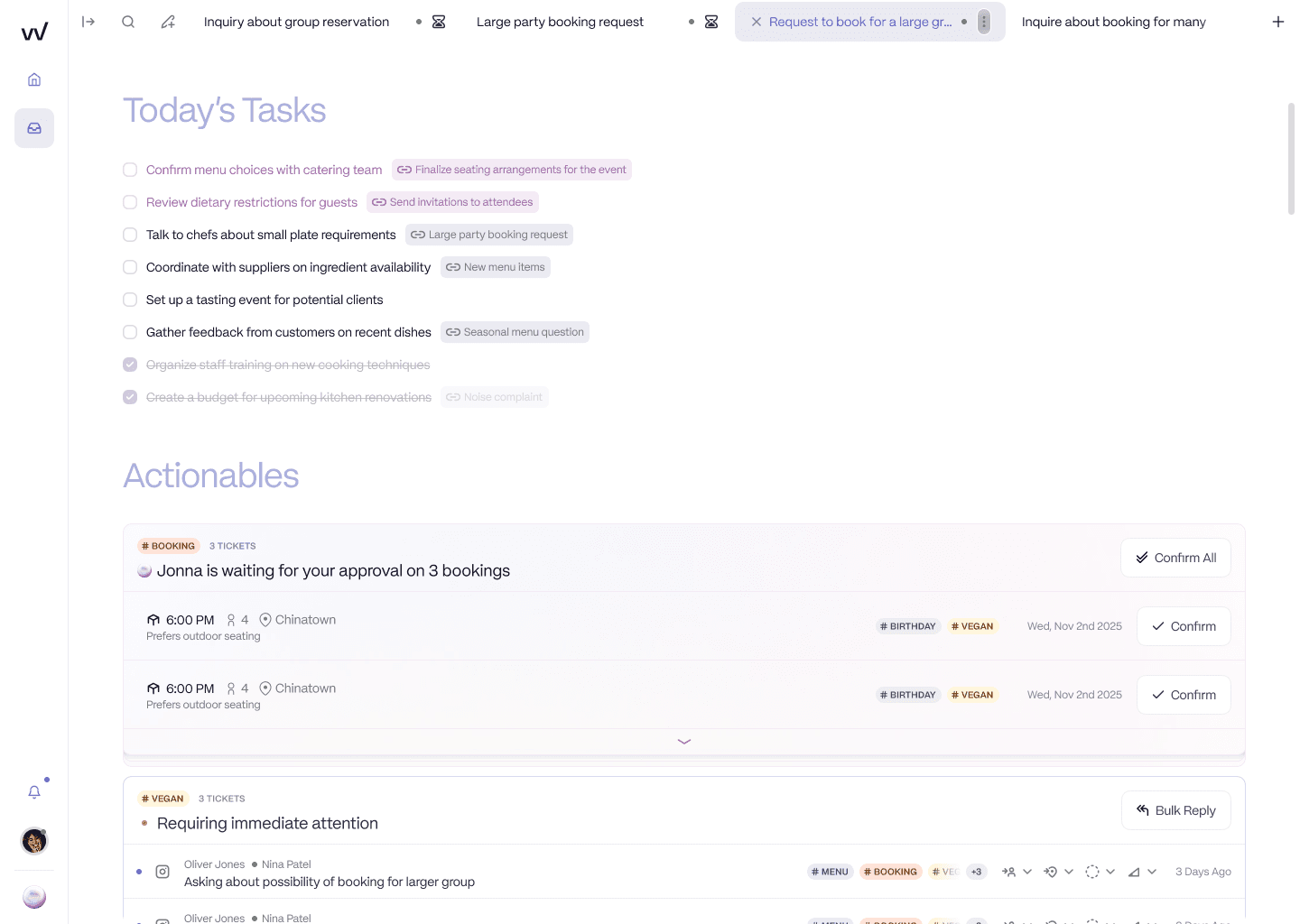
The AI has already checked availability and prepared the booking, leaving the team to approve rather than retype, the step a support inbox cannot take.
2. Freshdesk, the affordable step up in support
Freshdesk is the natural step up for a group that wants more support capability than Help Scout without enterprise cost or complexity.
What makes it fit: It is still affordable, at £15 to £69 per agent per month. It is email-first, with live chat and phone linked alongside and shared guest history across them. A guest excellence lead at a roughly 60-location UK brasserie group valued exactly that: "I love how it's all together, the phones, the tickets, the live chat. We can catch out scammers and fakers quite well." Freddy AI does a decent job of triage, and there is more omnichannel depth than Help Scout offers.
Limits: Freddy does not process website contact-form submissions, only direct email, which is a problem when the contact form is the primary channel for most groups. Reporting breaks down by category, not location, so "which sites" is a manual question. Sharing complaint reports means redacting personal data by hand. And like Help Scout, it has no booking system integration and is not location-aware.
Best for: Groups outgrowing Help Scout's simplicity who want fuller omnichannel support on a budget. For the detail, see RevVue vs Freshdesk and the six-month Freshdesk review.
3. Front, the closest like-for-like shared inbox
Front is the nearest peer to Help Scout: a lightweight, email-first shared inbox for teams that want collaboration tooling without a helpdesk's complexity.
What makes it fit: An email-first interface closer to Outlook or Gmail than to a ticketing system. Good shared-inbox coordination: assignment, collision detection, internal notes. Lighter than the big helpdesks. Integrations with common CRM and calendar tools.
Limits: No booking system integration. No native location model, so custom rules and tagging are required. No hospitality-trained AI. Per-seat pricing. No review or survey management.
Best for: Groups that liked Help Scout's simplicity but want better shared-inbox collaboration, typically four to ten sites. Not for: Groups of 15 or more sites, groups whose primary pain is location-level reporting, or groups who need AI to handle booking enquiries end-to-end.
Same caveat as Help Scout: Front is not represented in our customer conversations. Our view is based on the tool's general positioning, not on observation of a specific restaurant group running it.
4. Zendesk, enterprise depth if you are scaling up fast
Some groups outgrow Help Scout in the other direction, toward enterprise complexity. Zendesk is the option there.
What makes it fit: The deepest enterprise feature set of any tool here, a marketplace of more than 1,000 integrations, strong SLA management and audit trails, and the established IT trust that makes it an easy internal sell.
Limits: Per-agent pricing at £55 to £115 per month, plus a configuration cost most groups underestimate, since location handling requires custom fields and triggers a consultant usually builds and maintains. No booking system integration. No native location model. Generic AI. A multi-site UK leisure venue group running Zendesk describes it as functional but expensive, and is hunting for an AI layer just to reduce ticket volume enough to justify the cost.
Best for: Groups scaling fast with mature IT and genuinely complex multi-team workflows. Not for: Lean teams whose primary pain is booking enquiries. For the detail, see RevVue vs Zendesk and what you actually pay for Zendesk at 10+ sites.
5. Intercom, premium AI and chat
For digital-first groups that want the best AI agent and web chat rather than a simpler inbox, Intercom is the premium option.
What makes it fit: Fin, its AI agent, is the best general-purpose agent of the tools here. It is fully omnichannel across chat, email, WhatsApp, and social, and it does proactive outbound messaging well.
Limits: No booking system integration. No per-venue knowledge base or branding, since it is built around a single knowledge base. It is web-chat-first, which sits awkwardly against the reality that booking enquiries are still around 90% email. Its supervision features are enterprise overhead a lean team will not use. And at £74 or more per seat, it is expensive.
Best for: Web-chat-led, digital-first groups with the budget for it. For the detail, see Freshdesk vs Intercom and RevVue vs Intercom.
6. Staying on shared Gmail or Outlook, the default for the smallest groups
Before buying any of the above, it is worth naming the option that sits right next to Help Scout: doing nothing, and staying on a shared Outlook or Gmail.
What makes it fit: It is free or close to it, completely familiar, requires no migration, and the team already knows how to use it. For a genuinely small operation it works, which is the same niche Help Scout occupies. So the real question is whether you have outgrown that scale at all.
Limits: No location model, no SLA, no reporting, no AI, no booking system integration. It works at two sites and becomes organised chaos by ten.
Best for: Groups under four or five sites with a tight central team. Not for: Groups already feeling the pain that sent them looking for a Help Scout alternative in the first place.
How to choose: questions to answer before you demo
Six questions will narrow this list to two options worth demoing:
Are you replacing a support inbox, or solving booking enquiries? This is the question that splits the list. Most of it is support inboxes, one of it is booking-native.
How many sites, and how many people on the central team? Under five sites with one person: Help Scout or shared Outlook often works. Four to ten: Front or RevVue. Ten or more: RevVue or a configured horizontal helpdesk. Thirty-plus and multi-brand: only a per-venue tool fits.
Is your primary channel email, a website contact form, or web chat? Email points to RevVue or Front. A contact form is a warning sign for Freshdesk's AI. Web chat points to Intercom.
Do you need location-level reporting and per-venue tone? Neither Help Scout nor its support-inbox alternatives do this natively. RevVue does.
Do you need reviews and surveys? Help Scout does not offer them, and neither do the other support inboxes. RevVue includes both, by location.
What is your budget, per seat or per location? Per-seat pricing punishes lean teams that want broad access. Per-location pricing scales with the estate.
What restaurant groups actually do after they outgrow Help Scout
The common outcome is not a like-for-like swap. Groups that outgrow Help Scout either move to a more capable support inbox for tickets, or they realise the pain was always the booking-enquiry inbox and adopt a booking-native tool for it, keeping a lightweight support tool, or none, for tickets. The honest framing is that moving from one support inbox to a better support inbox changes your features and your bill, but not whether the tool can book a table.
One UK restaurant group did exactly this, moving its booking-enquiry workload off a horizontal helpdesk and onto a location-aware tool, after concluding the helpdesk could not report by site, route by location, or talk to the booking system.
Pick two options from this list and demo both. Structure the pilot around booking-enquiry handling specifically, because that is the workload most likely to expose the difference. If you want to see what a booking-native inbox does with a real enquiry, bring one, a group booking, a complaint, a dietary question, and we will show you. No slides.