Restaurant groups lose group bookings every week not because the guest changed their mind, but because no one replied before they moved on. The response window on a group booking enquiry is 24 hours at most. For entertainment venues and event bookings, closer to five hours. Guests contact two or three venues simultaneously. The first to reply captures the booking. Most restaurant inboxes have no out-of-hours coverage, no way to surface high-value enquiries above the queue, and no measurement of how many opportunities have already slipped through.
The £40,000 email that nobody replied to
An enquiry arrived late in the evening. A large event. The kind of booking that shifts a week's revenue. Nobody picked it up until the next morning. By then, the guest had booked elsewhere.
The cost: £40,000. Not an estimate. A figure a venue enquiries lead at a UK entertainment group with around 40 venues put on a real booking, from a real enquiry, that sat unread until the window had closed.
"We lost a £40k booking because no one replied in time."
It wasn't negligence. The team knew the standard. Their internal target was a five-hour response window. The enquiry arrived when nobody was watching the inbox, and there was nothing in place to catch it.
"The ideal response window is five hours. We can't always do that."
The harder question isn't what that single booking was worth. It's this: how many times has the same thing happened in your inbox that nobody ever found out about?
When an enquiry goes cold and the guest books elsewhere, it leaves no trace in a shared email inbox. No missed booking report. No unanswered message flag. Just silence. And a booking your competitor took instead.
"When you've got a lot of enquiries coming in, the big ones can get lost."
The £40,000 figure is vivid because someone named it. Most groups can't name theirs. Not because it hasn't happened, but because the inbox has never recorded it.
When do guests expect a reply?
The 24-hour threshold isn't a benchmark from a software vendor. It's what a head of group bookings managing hundreds of restaurants across five UK brands said, without prompting, when asked how long a group booking window lasts.
"If we don't get back to a customer in 24 hours then we've lost it in my eyes."
For entertainment venues and large event bookings, the window is tighter. A five-hour internal target reflects the reality of corporate events, venue hires, and parties of 50 or more. The booker is comparing options actively and moving fast.
What the two benchmarks share: the assumption that the guest is not waiting. They sent the enquiry. They moved on to the next option on their list. They are not following up. The entire burden falls on the venue to respond before the decision is made elsewhere.
This dynamic is worst during the periods when the inbox is least likely to be monitored. Evenings and weekends are when people plan events. They are also when central reservations teams are offline.
The result: the enquiries worth the most tend to arrive at the moments of lowest coverage. A board game bar group described losing multiple Christmas bookings because guests submitted their enquiry and "just never heard back fast enough." Peak season. Multiple lost bookings. The form worked. The response didn't arrive.
The 24-hour rule is not a high bar. For most restaurant groups, it is a bar they are not consistently clearing. There is no system in place to guarantee it.
Why restaurant inboxes miss bookings (it is not negligence)
Three structural reasons explain why inboxes miss bookings. None of them are about the team not caring.
1. No out-of-hours coverage
Central reservations teams work standard hours. Event and group bookings arrive evenings and weekends. There is no staffing model for most restaurant groups that covers both, and no system to bridge the gap automatically.
The result: an enquiry that arrives at 9pm on a Friday waits until Monday morning. If the guest contacted three venues, the first two to open their inbox on Monday have already won.
The £40,000 booking described above arrived outside working hours. Nobody checked voluntarily. Nobody was blamed. There was simply no mechanism to handle an enquiry that arrived when the team was unavailable.
2. High-value bookings buried in routine volume
A shared inbox does not distinguish between a venue hire for 200 people and a request to change a reservation from 7pm to 7:30pm. Both land in the same queue. Both sit in arrival order.
A head of group bookings described it directly: "I've got four or five venue hires of 200 plus. So they're higher priced bookings that you want to nurture. But it's quite difficult when you've got 40 inquiries sitting there at the same time."
One competitive socialising venue group was receiving between 150 and 400 emails per day across different site-specific inboxes, with no central view. At that volume, triage is manual. Manual triage under pressure means the largest bookings do not consistently surface first.
3. No acknowledgement to the guest
Without an automated acknowledgement, the guest has no signal that their enquiry was received. From their perspective, "we're working on it" and "nobody saw it" are indistinguishable. After two hours with no reply, they contact the next venue.
A board game bar group lost multiple Christmas bookings through this exact sequence. Guests submitted via a web form. The enquiry existed in the system. What didn't exist was any confirmation to the guest that someone had seen it. By the time the team responded, the guests had already heard back from elsewhere.
None of these are failures of individual people. They are failures of a system that was never designed to handle group bookings across multiple locations with a small central team.
The invisible cost: why most groups don't know how many bookings they're losing
Every other part of a restaurant has data.
Covers: you know how many seats you filled last Saturday. Revenue: you know what each location turned over per shift. Reviews: you have a score, a trend, a volume.
"Every other part of a restaurant has data. Covers. Revenue. Reviews. You can see what's working. With the inbox there are no KPIs, no response rate, nothing — just a black box."
That quote came from a head of sales at a UK entertainment venue group. A former sales director at a major UK hospitality group described the same reality in almost identical terms: "Email was just a black hole. I had no control over it — no KPIs, no response rate, nothing."
Two people. Two companies. The same observation. The inbox is the only part of the restaurant operation that has never had a data layer.
This is why most groups don't know how many bookings they're losing. Not because they haven't thought to look. Because the tool they're using was never built to collect the data. Consumer email tools were built for individual users. They were not built to track team response time, enquiry volume by source, or the rate at which enquiries convert to confirmed bookings.
The inbox arrived in Gmail or Outlook by default, not by design. The measurement was never part of the arrangement.
The consequence compounds over time. Without data, you can't set a response time target you know you're hitting. You can't tell leadership which sites are underperforming. You can't see seasonal patterns in inbound volume before they hit. You can't calculate the cost of the current setup, because the enquiries that slipped through left no record.
A head of sales at a UK venue group described a related symptom: before the pandemic, he could forecast Saturday revenue from Monday's booking data. Post-COVID, with enquiries arriving later and the inbox having no trend visibility, that forecasting capability was gone.
The measurement gap prevents every other problem from being fixed. You can't manage response time if you can't measure it. You can't prioritise high-value enquiries if the inbox treats them identically to routine messages. You can't make the case for more resource if you can't show what the current approach is costing.
The inbox is the only part of the operation where the answer to underperformance is guesswork.
What a realistic fix looks like
Three changes turn the inbox from a black box into a managed revenue channel. None of them require rebuilding your operation.
1. Out-of-hours acknowledgement
Every enquiry that arrives outside working hours needs an immediate signal to the guest. Something that says: we have received this, someone will be in touch. That signal keeps the guest from moving on before the team has a chance to respond properly.
An AI layer can do this. It sends a branded acknowledgement within seconds of the email arriving, captures the guest's key requirements, and holds the thread for the team to close in the morning. The team arrives to an organised queue of qualified enquiries, not a pile of unread messages, some of which have already gone cold.
The £40,000 booking above would have been retained by an acknowledgement sent at the point of arrival. The guest would have known their enquiry was received. The team would have had it waiting for them the next morning, with the guest's contact details and requirements already captured.
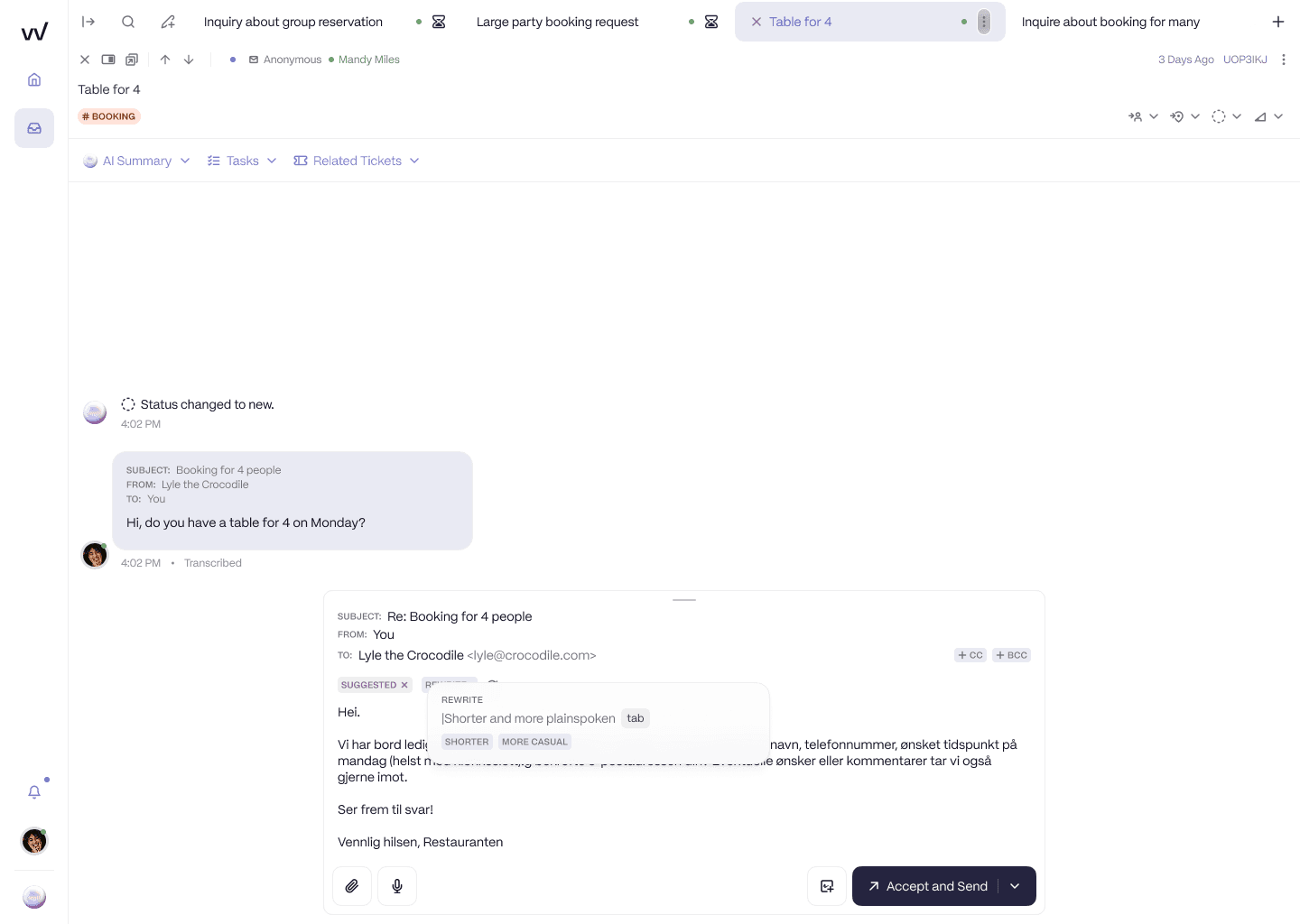
RevVue drafts a branded reply the moment the enquiry lands, so the guest gets an acknowledgement before they move on to the next venue.
2. Inbox triage for high-value bookings
The inbox needs to surface group bookings above a threshold before they disappear into the queue. An enquiry for a party of 30, a venue hire, or a corporate event should appear at the top, not buried in arrival order behind a batch of opening hours questions.
This is pattern recognition applied to enquiry content: party size, occasion type, booking value signals. It doesn't require advanced configuration. It requires a system designed to treat a venue hire for 200 people differently from a table amendment for two.
"The big ones can get lost." They don't have to be.
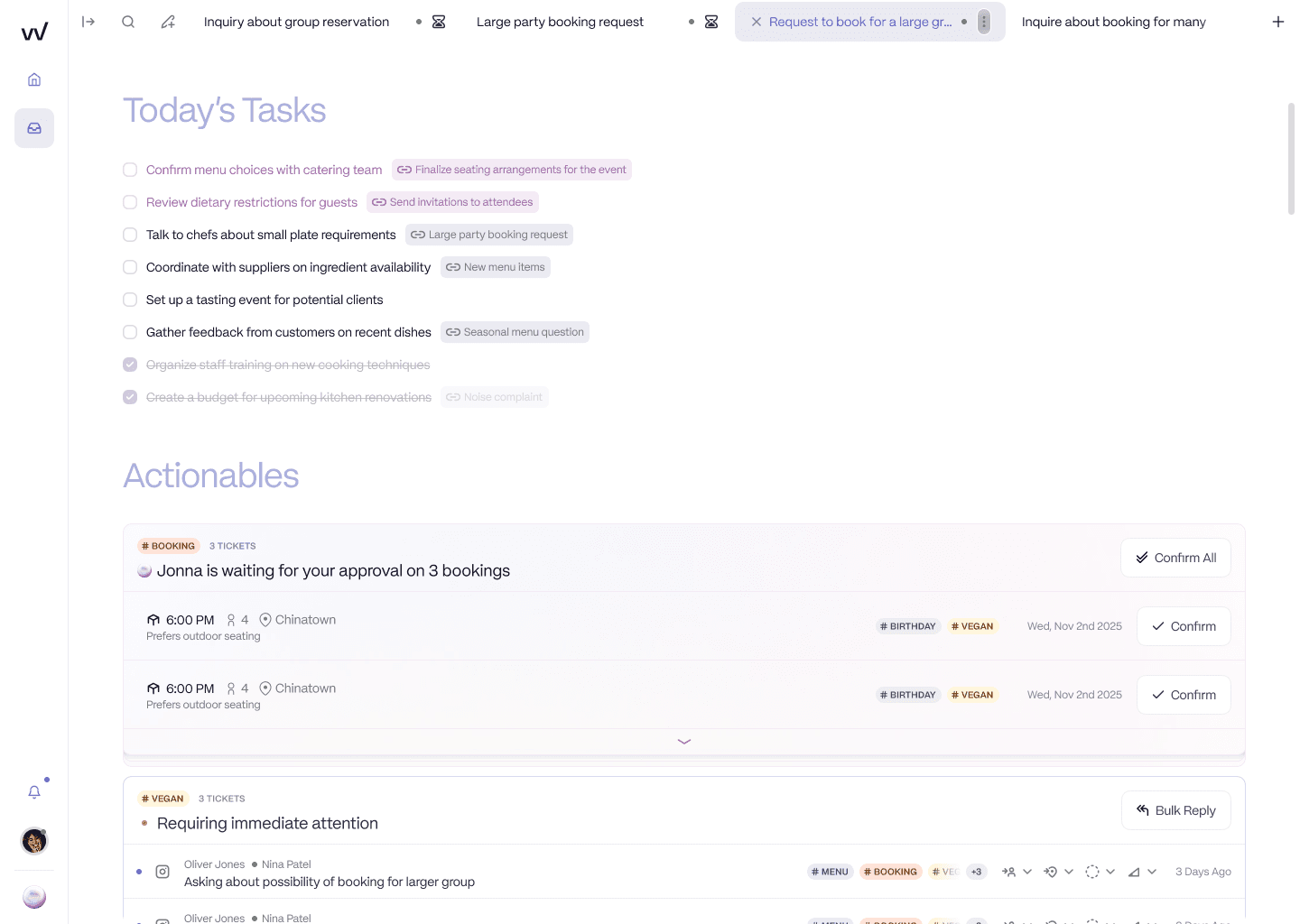
High-value enquiries surface in a Today's Tasks queue the team approves, so a venue hire for 200 never sits behind routine messages.
3. Response rate tracking
You cannot improve what you cannot measure. Response time per enquiry, volume by source, outstanding enquiries by site: these are the minimum metrics that turn the inbox into something you can manage.
When leadership asks how the group is performing on booking response, the answer should be a number. When a specific location starts falling behind, the data should surface it before a guest complains about it on Google.
One restaurant group that made this shift described the outcome directly: "The transition from Zendesk to RevVue has been a game changer." — Nikolaos Kiosses, Founder, Brasilia Group. The Brasilia Group moved from a horizontal helpdesk to a hospitality-built alternative. The difference wasn't features. It was that the measurement was finally in place.
How to calculate what your slow inbox is costing you
The calculation is straightforward. The inputs are estimates, but conservative ones.
Average group booking value: £400 to £1,500 for a party of 10 to 30 covers, depending on venue type and occasion. Entertainment venues and event bookings run higher.
Proportion of enquiries arriving outside working hours: 30 to 40%. Evenings and weekends are when guests plan events. They are also when the inbox is unmonitored.
Proportion of those enquiries where the guest books elsewhere before the team responds: 20 to 30%, conservatively. The actual figure is unknown for most groups, because the inbox has no record of it.
The maths: For a group receiving 50 enquiries per week, 15 to 20 arrive outside working hours. Three to five convert elsewhere before the team responds. At £800 average booking value, that is £2,400 to £4,000 lost per week. Over a year: £125,000 to £208,000. At the conservative end.
Two real incidents anchor this range.
At the upper end: the entertainment group's single missed enquiry was worth £40,000. One booking. One evening. The team acknowledged this had likely happened before. They just had no way to find the record.
At the lower end: a 30 to 40 person booking from a third-party platform sat unread for several days at a restaurant group. The guest booked elsewhere. At typical group booking values, each incident of this kind represents £800 to £1,200 in direct lost revenue.
The harder question isn't what the calculation produces. It's this: how many times has this already happened in your inbox with no record of it?
The answer is almost certainly more than once. The inbox has never had a way to tell you.
Frequently asked questions
How long should a restaurant take to respond to a group booking enquiry?
24 hours is the outside limit for most group bookings. A head of group bookings managing hundreds of restaurants across multiple UK brands described it as: "If we don't get back to a customer in 24 hours then we've lost it." For entertainment venues and event bookings, five hours is a more realistic internal standard. Guests typically contact multiple venues at once. The first to reply captures the booking.
Why do restaurant groups miss group booking enquiries?
Three structural reasons: no out-of-hours coverage when most group bookings are submitted (evenings and weekends), no triage to surface high-value enquiries above routine volume, and no acknowledgement system so the guest receives no signal their enquiry was received and moves on. These are system failures, not individual failures. The tools most groups use (shared Gmail or Outlook) were not designed to handle any of these three problems.
How do restaurant groups measure their inbox response rate?
Most do not. Consumer email tools like Gmail and Outlook were never designed to track team response time or enquiry volume. The majority of UK restaurant groups run their booking inbox through a shared Gmail or Outlook account and have no response rate data of any kind. Purpose-built inbox tools for hospitality collect these metrics automatically.
Why don't restaurant groups know how many bookings they're losing?
Because consumer email tools collect no data on unanswered enquiries. An enquiry that arrives, goes cold, and results in the guest booking elsewhere leaves no trace in a shared Gmail inbox. There is no missed booking report. The cost of slow response is invisible until someone quantifies a specific incident. That happened with the £40,000 booking described above.
What is the average value of a group booking for a UK restaurant?
A party of 10 to 30 covers typically generates £400 to £1,500 in revenue, depending on venue type and occasion. Entertainment venues and event bookings run significantly higher. This is why response time on group and event bookings carries an outsized revenue impact compared to standard table reservations.
RevVue tracks response time, enquiry volume, and conversion by location. For the first time, the inbox has the same data layer as the rest of the restaurant. See how it works →