Best Zendesk alternatives for restaurant groups in 2026
The best Zendesk alternative for a restaurant group depends on which workload you are solving for. Zendesk is built for customer-service tickets, vouchers, refunds, post-visit complaints. It was never built for booking enquiries, and it does not integrate with restaurant booking systems. Different alternatives fit each side, and the wrong choice means paying for a tool that solves the wrong problem.
Why restaurant groups are looking for Zendesk alternatives
TL;DR: Four structural reasons. No booking system integration. Per-agent pricing that punishes lean teams. No native concept of location. AI trained on generic support tickets rather than hospitality.
Zendesk is a capable customer-service helpdesk. It is also one of the most-evaluated and most-rejected tools at multi-location restaurant groups, for the same four reasons.
No booking system integration. Zendesk does not talk to SevenRooms, OpenTable, Collins, or Roller. The AI can write a reply. It cannot check availability, create a booking, or update guest records. A Zendesk ticket on a booking enquiry is an email in a queue.
Per-agent pricing punishes lean teams. Restaurant groups run central reservations teams of two or three people, and want site managers to see their own venue's inbox. Zendesk's £55 to £115 per agent per month forces groups to buy the minimum number of seats, which blocks site managers from the enquiries that affect their own restaurants. The pricing model fights the operating model.
No native concept of location. Routing by site, reporting by site, SLAs by site, all require custom fields, custom triggers, and ongoing maintenance. A Zendesk consultant is often part of the real cost. The thing that matters most to a restaurant group, which message came from which restaurant, is a workaround instead of a foundation.
Generic AI. Zendesk's AI is trained on support tickets. It can write a polite reply to a dietary question or a £4,000 venue hire enquiry. It cannot tell which one needs your senior reservations lead.
A UK leisure venue group currently on Zendesk told us their goal is to reduce Zendesk cost while maintaining ticketing capability, either by deflecting routine volume with AI or by switching outright. They are not unhappy with Zendesk as a ticketing system. They are unhappy with what it costs to use one for a job that requires something different. Our side-by-side comparison of RevVue and Zendesk goes deeper into where the two products coexist and where they do not.
The first question to ask before evaluating any alternative is which workload you are actually buying for.
Two workloads, two different tools
Restaurant groups have two distinct inbound flows. The right Zendesk alternative for one is wrong for the other.
Customer-service tickets are structured, escalation-driven, post-visit. A voucher does not redeem. A guest's card was charged twice. A complaint needs finance. These need an audit trail, an SLA, often a workflow that touches more than one team. Zendesk and Freshdesk handle this well.
Booking enquiries are different. "Table for 30 on Saturday." "Do you have a vegetarian menu." "Can I move my booking from 7pm to 8pm." High volume, conversational, and useful only if it connects to the booking system. Zendesk and Freshdesk do not.
When an Ops Director says "we already use Zendesk, why would we add another tool," the right next question is what for. Most multi-location restaurant groups, including 60+ venue groups, use Zendesk for tickets and shared Outlook for booking enquiries. The Zendesk alternative they are shopping for is either a cheaper customer-service helpdesk or a purpose-built booking-enquiry inbox. These are not the same product.
Here are the five options serious restaurant groups actually shortlist, with the trade-offs that matter.
1. RevVue, purpose-built for restaurant booking enquiries
RevVue is hospitality-native. Location is the foundational data model, the AI talks to the booking system inside the conversation thread, and pricing scales per location instead of per agent.
What makes it fit:
Every message is automatically tagged to the correct location. No custom fields, no manual sorting.
The AI checks availability, creates the booking, adds notes ("vegetarian," "silent area"), and handles amendments, all inside the conversation thread.
Each venue gets its own knowledge base and brand tone, learned automatically from historical Outlook or Gmail replies. A fine-dining concept and a casual concept under the same parent group sound right for each.
Per-location pricing (£75/month), not per agent. Site managers see their own restaurant's inbox without an additional cost line.
Inbox, reviews, and surveys in one tool, with reporting built in.
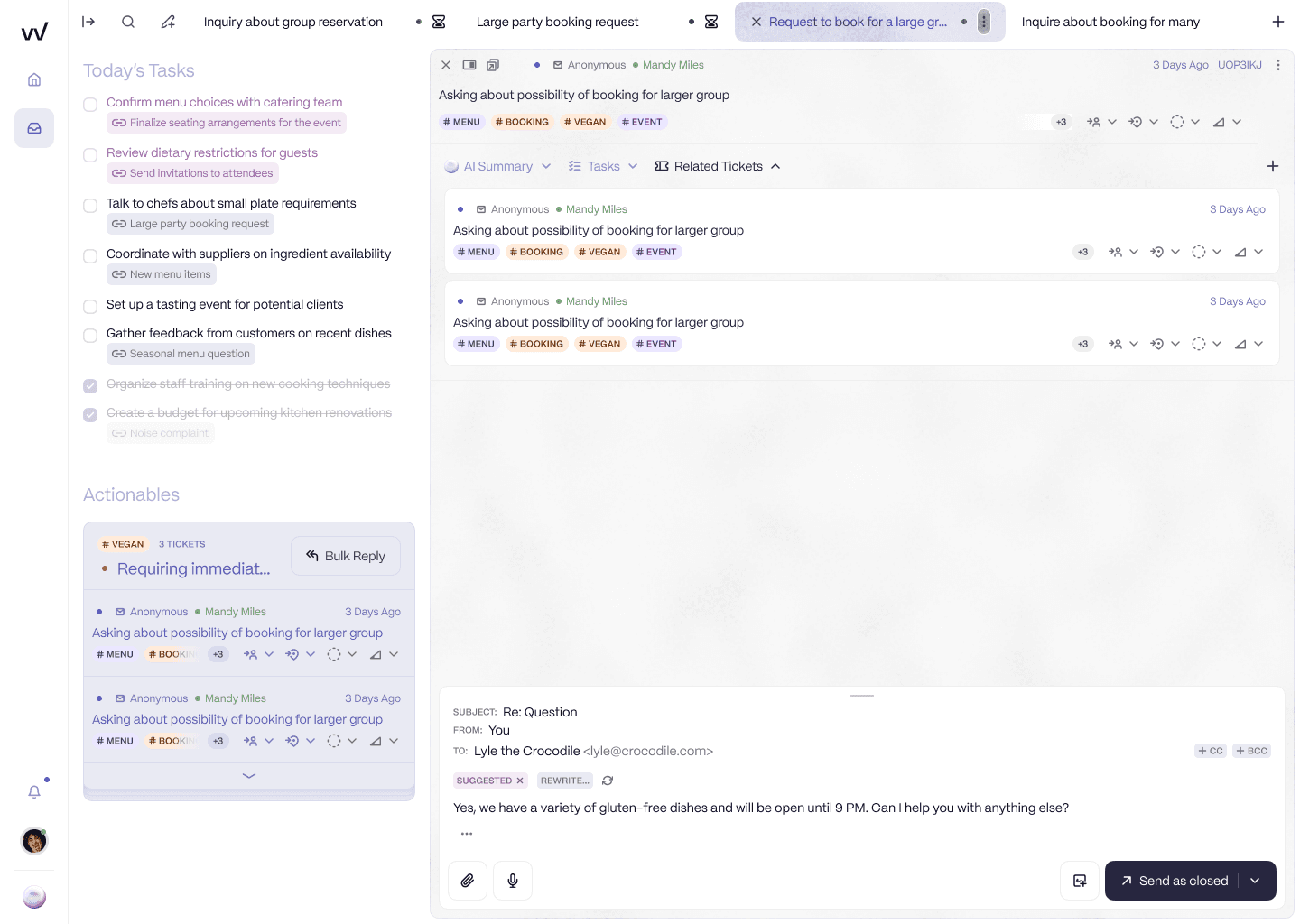
Honest limits: SevenRooms integration is in progress, not yet fully live. We run email-only pilots for groups where SevenRooms is the system of record. No voice channel yet, and limited social. RevVue does not displace Zendesk on the customer-service side, the two tools coexist in groups that want to keep their support function structured.
Best for: Multi-location restaurant or leisure groups whose primary pain is the booking-enquiry inbox. Not for: Single-location venues, groups under four sites, or groups whose whole problem is structured customer-service ticketing.
The Brasilia Group is a UK restaurant group that migrated from Zendesk to RevVue. Their founder, Nikolaos Kiosses, described the outcome as: "The transition from Zendesk to RevVue has been a game changer." The driver was specific. Zendesk could not break down reporting by site, route messages by location without manual configuration, integrate with their booking system, or apply AI that understood hospitality context. None of those are problems a custom field can fix.
If your primary pain is customer-service tickets rather than booking enquiries, Freshdesk is the closest like-for-like Zendesk alternative at a lower price.
2. Freshdesk, cheaper than Zendesk, same structural gaps
Freshdesk is a fair Zendesk alternative if you genuinely need a customer-service helpdesk. It does not solve the booking-enquiry problem.
What makes it fit: Lower price than Zendesk (£15 to £69 per agent per month). Simpler implementation. Decent AI triage with Freddy AI for categorisation and suggested replies. Adopted by hospitality groups including a 60-location UK restaurant brand running Freshdesk Omnichannel.
Limits for restaurant groups:
The contact form blocker. Freshdesk's AI bot only processes direct emails, not website contact form submissions. For most restaurant groups, the contact form is the primary inbound channel. A Guest Excellence Lead at that 60-location group described it: "We hit a bit of a barrier with Freshdesk. Their email bot doesn't work with the contact form. It only works with direct email, and obviously we use the contact form."
No location-level reporting. Reports break down by category, not by site. The question leadership asks, "which brasseries had the most steak complaints last month," is not answerable. The same lead: "I can say we've had a lot of complaints about steaks, but they say: which brasseries? How many complaints out of how much? And I'm like, I can't get that detail."
Manual PII redaction. Sharing complaint summaries with leadership requires manually reviewing every email body to redact guest names and contact numbers. At 725 emails per week that is a compliance burden disguised as a process problem.
Same architectural mismatch as Zendesk. No booking system integration. No location-native data model.
Best for: Restaurant groups who need a customer-service helpdesk and can accept that booking enquiries will still run through Outlook on the side. Not for: Groups where the booking-enquiry inbox is the primary pain.
If your group leans more digital-first and has invested in web chat, Intercom is often next on the shortlist.
3. Intercom, strong AI, wrong shape
Intercom has the best AI of the horizontal options. It was built for software companies running large support operations, and that shows everywhere in the product.
What makes it fit: The Fin AI agent is genuinely good, better than most general-purpose agents on the market. Omnichannel coverage across chat, email, WhatsApp, and social. Proactive messaging tools that the others, including RevVue, do not have.
Limits for restaurant groups:
No per-venue knowledge base or branding. Intercom is built around one product, one customer base, one knowledge base. A 30-venue group running 30 different concepts cannot give each venue its own brand tone, FAQs, menu, and web chat branding inside Intercom.
Web-chat-first, not email-first. Restaurant booking enquiries are still around 90% email. Central teams have used Outlook or Gmail for 20 years and want a tool that mimics that, not one that retrains them around a chat interface.
Enterprise-quality overhead. Intercom's supervision and rule-bound AI features are designed for software companies running large support operations with strict process compliance. A three-person reservations team does not need it, and pays for the complexity.
Same gap as Zendesk and Freshdesk: no booking system integration.
Expensive. £74+ per seat per month. Per-seat pricing creates the same access-versus-cost compromise as Zendesk.
Best for: Single-brand restaurant groups with a strong web-chat preference, or groups already using Intercom for marketing messaging. Not for: Multi-brand groups, email-first inbound, or central teams small enough that enterprise supervision features are dead weight.
For groups whose mental model is "shared inbox, done better" rather than "helpdesk," Front is the credible option.
4. Front, shared inbox for teams who like email
Front is the right Zendesk alternative when the buyer wants better shared-inbox tooling without Zendesk's complexity.
What makes it fit: Email-first interface, closer to Outlook or Gmail. Good shared-inbox coordination: assignment, collision detection, internal notes. Lighter than Zendesk. Integrations with common CRM and calendar tools.
Limits: No booking system integration. No native location model, custom rules and tagging required. No hospitality-trained AI. Per-seat pricing, same trap as Zendesk and Intercom. No review or survey management.
Best for: Smaller restaurant groups (four to ten sites) where the core need is shared-inbox collaboration without enterprise overhead, and booking system integration is a nice-to-have. Not for: Groups of 15+ sites, groups whose primary pain is location-level reporting, or groups who need AI to actually handle booking enquiries end-to-end.
One caveat: Front is not represented in our customer conversations the way Freshdesk and Zendesk are. Our perspective on it is category-level, not based on watching a restaurant group operate inside it. If you are seriously evaluating Front, talk to a peer group running it.
5. Help Scout, simple support inbox for smaller groups
Help Scout is fine for small groups (under five sites) with low customer-service volume. It is not built for hospitality.
What makes it fit: Clean interface, lower price than Zendesk. Built-in knowledge base. Email and live chat. Less complex than Zendesk or Freshdesk.
Limits: No booking system integration. No native location model. Generic AI. Same per-seat pricing pattern.
Best for: Small restaurant groups (under five sites) with low customer-service volume that can be managed with a lightweight tool. Not for: High-volume booking enquiries, multi-brand groups, or anyone whose primary pain is location-level reporting.
Same caveat as Front: not directly represented in our customer conversations. Our view is based on the tool's general positioning, not on observation of a specific restaurant group running it.
Before you buy any of these, it is worth asking whether the option to evaluate first is doing nothing, staying on shared Outlook, and accepting the trade-off.
6. Staying on shared Gmail or Outlook, the option most groups default to
This is what 90% of UK multi-location restaurant groups already do. It is the de facto Zendesk alternative for booking enquiries.
The setup is consistent: shared Gmail or Outlook for the whole group, folder per location, sub-folders by message type, 40+ templates maintained by whoever remembers, no SLA, no KPIs, no automated reporting.
Strengths: Already paid for, bundled with Google Workspace or Microsoft 365. Team knows it. No implementation. For one person on one inbox it works fine.
Weaknesses: No location-awareness. No team coordination features for shared inboxes. No AI for guest comms, and Gmail smart replies are not appropriate for a £1,500 group booking. No reporting. The Head of Reservations at one group put it: "I have no idea what our response rate is. My boss asks me and I say 'pretty good' because I genuinely don't know."
Best for: Groups who have decided not to invest in tooling yet, or who are below the volume threshold where the workaround becomes painful, typically under four sites. Not for: Groups at the point where the Head of Reservations cannot answer "what's our response rate?" without saying "pretty good."
Even 60+ venue groups who adopt Zendesk for customer service still run booking enquiries through shared Outlook, because Zendesk does not integrate with their booking system. Staying on shared inbox is not a failure. It is often a deliberate choice. The question is whether the cost of staying has caught up to the cost of moving.
How to choose: six questions to answer before you demo
Customer-service tickets, booking enquiries, or both? Tickets, Freshdesk is the cheapest like-for-like. Booking enquiries, RevVue. Both, most groups end up running two tools because the workloads are genuinely different.
Does the AI need to actually create a booking, or just write a reply? To create a booking, only tools with a booking system integration qualify (SevenRooms, OpenTable, Collins, Roller). To just draft a reply, any horizontal helpdesk will do.
How many locations, how many people on the central team? Under four sites, one person: shared inbox often works. Four to ten sites: Front or RevVue. Ten+: RevVue or a configured horizontal helpdesk. Thirty+ multi-brand: only a per-venue tool fits.
Per-venue knowledge bases and brand tone, or one tone across the group? Multi-brand groups will only get per-venue tone out of the box from RevVue.
Email, contact form, or web chat? Email: RevVue, Front, or Help Scout. Contact form: avoid Freshdesk's AI. Web chat: Intercom or RevVue.
Pilot appetite? A 60 to 90 day paid pilot is standard. Structure it around booking-enquiry handling specifically, using real enquiries the team has already received.
Three real migration stories make the trade-offs concrete.
What restaurant groups actually do after they leave Zendesk
The Brasilia Group migrated from Zendesk to RevVue. The reasons were the ones above: no site-level reporting, no location routing without manual configuration, no booking system integration, AI that did not understand hospitality. The customer-service ticketing side moved with it because their volume did not justify running two tools.
A UK leisure venue group running multi-site trampoline parks is on Zendesk and actively reviewing options. Their stated job: reduce Zendesk cost while maintaining ticketing capability, either by deflecting routine tickets with an AI layer or by switching to something that understands leisure-specific product complexity (age limits, weight limits, session types, party packages).
A 60-location UK restaurant group on Freshdesk Omnichannel is open to switching. They moved from Zendesk to Freshdesk for cost and hit the same structural problems: no contact form AI, no location-level reporting, manual PII redaction. The cheaper Zendesk alternative did not solve the underlying mismatch.
The pattern: once a restaurant group has tried a horizontal helpdesk, the next decision is almost never another horizontal helpdesk. It is either a hospitality-native tool or a deliberate return to shared inbox.
Pick two options from this list. Demo both. Ask each vendor the six questions above. Structure your pilot around booking-enquiry handling specifically. If you want to talk to a peer group who has made this move, book a demo and we will put you in front of a customer who has lived the migration.
Frequently asked questions
Why do restaurant groups look for Zendesk alternatives?
Zendesk does not integrate with restaurant booking systems (SevenRooms, OpenTable, Collins, Roller), so its AI cannot check availability or create bookings. Per-agent pricing forces groups to limit inbox access. There is no native concept of location, and the AI is trained on generic support tickets rather than hospitality.
What is the best Zendesk alternative for restaurant booking enquiries?
RevVue, the only widely-used option built specifically for restaurant booking enquiries. It integrates with major booking systems, treats location as a foundational data model, and prices per location rather than per agent. The Brasilia Group migrated from Zendesk to RevVue and described the move as a game changer.
Is Freshdesk a good Zendesk alternative for restaurant groups?
For customer-service tickets, yes, at a lower price. For booking enquiries, no, because Freshdesk shares the same structural gaps as Zendesk: no booking system integration, no location-level reporting, and an AI bot that does not process contact form submissions.
Does Intercom work for multi-location restaurant groups?
Intercom has a strong AI agent but was built for software companies. No booking system integration, no per-venue knowledge bases (a limitation for multi-brand groups), and web-chat-first rather than email-first.
How does RevVue compare to Zendesk for restaurant groups?
RevVue is purpose-built for booking enquiries. Zendesk is built for customer-service tickets. RevVue integrates with booking systems and treats location as foundational. Zendesk does neither. Pricing is per location (£75/month), not per agent. The two tools can coexist: RevVue replaces the shared Outlook side, not the Zendesk customer-service side.
Can a restaurant group use Zendesk for booking enquiries?
Technically yes, emails arrive and tickets are created. Practically no, because Zendesk cannot check availability, create bookings, or update guest records. Most restaurant groups with Zendesk for customer service still run booking enquiries through shared Outlook for this reason.