Why booking enquiries don't keep office hours
The reason the out-of-hours gap exists is a mismatch of clocks. Guests plan in the evenings and at weekends, because that is when they have time. Someone organises a birthday dinner after their own working day. A team lead sorts the Christmas party on a Sunday. A group of friends decides on Friday night where they are going Saturday. That is the busiest planning window for your guests, and it is the exact window when the central reservations team is off.
So the enquiry lands, and nobody is there. It waits.
Most teams know this and set themselves a target anyway. A venue enquiries lead at a roughly 40-venue UK entertainment group described theirs plainly: "The ideal response window is five hours. We can't always do that." The reason they can't always do it is structural, not a lack of effort. Their own workflow notes say it directly: peak enquiries arrive outside working hours, when guests are actually planning events, and evenings and weekends go unanswered until the next business day.
The stakes are not small. The same team lost a single booking worth £40,000 because the enquiry arrived out of hours and no one replied in time. One enquiry, one missed window, against a five-hour target they had no way to hold overnight.
The pressure shows up even in groups with a hard internal rule. The head of group bookings at a five-brand group running 240 restaurants put their line in the sand at 24 hours: "If we don't get back to a customer in 24 hours then we've lost it in my eyes." A 24-hour rule sounds generous until you notice it has to cover Friday evening to Monday morning. An enquiry that arrives at 6pm on Friday is already most of the way through its budget before anyone reads it.
The cost of the overnight gap
The reason the gap costs money is simple: the guest is not waiting for you. They are messaging more than one venue, and the first to reply properly tends to win. A delay overnight is not a neutral pause. It is a head start you hand to whoever answers first.
A three-site pizza group watched it happen on a booking they should have had. "We had a booking of 30 to 40 people come through Square Meal. It just sat there. No one saw it. They went somewhere else." The enquiry was not lost to a better pitch. It was lost to silence.
It clusters at the worst possible time. Enquiry volume peaks in the run-up to Christmas and around Valentine's Day, which is exactly when the team is most stretched and least able to watch the inbox out of hours. A board-game bar group lost a run of the highest-value bookings of the year to this: "We lost Christmas bookings because guests filled in the form and then just never heard back fast enough."
The quiet part is that these misses are hard to see. A booking you never replied to leaves no gap in the calendar you would notice, no complaint, often no trace at all. That invisibility is its own problem, and it is worth understanding the full revenue picture separately. For the maths on what slow response actually costs a group over a year, the cost of a slow inbox is the place to start. The point here is narrower: the losses are real, they are largest out of hours, and most groups cannot even count them.
The workarounds teams try (and why they don't hold)
Nobody ignores this problem. Every group that feels it reaches for one of four fixes. Each one helps, and each one has a ceiling.
Staff check the inbox on their own time. The most common patch is unofficial: someone on the team keeps half an eye on the inbox in the evening or over the weekend, on their own phone, for the enquiries that look important. The 40-venue group above runs exactly this, with team members voluntarily checking the inbox outside working hours. It works right up until it doesn't. It depends on goodwill, it burns people out, and because it is informal there is no guarantee the important enquiry is the one that gets seen.
The manager absorbs the hours. At the five-brand group, the head of group bookings was covering the gap personally. "At the minute I'm working a lot of hours." One committed person can hold a lot together, but it is a single point of failure, it does not survive them being ill or on leave, and it gets worse with every new site.
A generic auto-responder. The tidy-looking fix is an out-of-office reply: "Thanks for your enquiry, we'll get back to you Monday." It feels like coverage. It is not. It confirms the message arrived and sets an expectation of delay, at the exact moment the guest is deciding which venue to go with. A canned "we'll reply Monday" does not hold a £2,000 booking. It waves it goodbye politely.
Throw more people at it. The last resort is headcount. An ops director at a UK bar group described hitting the wall: "The volume was really high. And we had no way to deal with it other than throwing people at it." More people extends your coverage, but it is expensive, it is slow to hire, and even a bigger team still goes home at night. The owner of a two-site pub group had already run out of that road: "I'm doing everything. It's getting to a point where I can't keep up with both sites on my own."
All four are reasonable responses. None of them is 24/7, and all of them cost either money or people. The pattern underneath is the same: they try to solve a coverage problem with more human hours, when the enquiries that arrive out of hours are mostly not the ones that need a human at all.
How to cover enquiries 24/7 without overnight staff
The move that actually closes the gap is to stop treating every out-of-hours enquiry the same. Most of what arrives overnight does not need a person. It needs a fast, correct reply. A small share genuinely needs judgement, and that share can wait until morning as long as the guest does not feel ignored. Separate those two, and you can cover the whole clock without a night shift.
Here is the method, in the order to build it.
Acknowledge every enquiry instantly, around the clock. The single highest-value change is that no enquiry ever sits in silence. A guest who gets a real, immediate response knows they have been heard and stops shopping around as urgently. A board-game bar group described the version they wanted: guests should "receive an immediate acknowledgement and partial response before a human takes over." Their current reality was the opposite, and it cost them: form submitted, then nothing, then a human picks it up whenever they are next free, by which point the guest has already left or booked elsewhere.
Auto-answer the routine on arrival. A large chunk of out-of-hours enquiries are simple, repeatable questions: opening hours, parking, dietary options, "can I move my booking from 7 to 8." These do not need to queue for a human at all. A bookings manager at a multi-site brasserie group put it well: "The silly questions that come in, AI can just reply straight away and that would be ticket closed. Move on to the next one." Answered on arrival, they never become tomorrow's backlog.
Handle or prepare the standard bookings. For straightforward bookings below a size your team sets, the always-on layer can do the mechanical work: gather the details, check availability where it connects to your booking system, and either complete the booking or prepare it so a human only has to glance and confirm. The structured enquiries from third-party platforms that also land out of hours are a natural fit here, because they arrive in a consistent format every time.
Keep the high-value ones warm, then hold them for the morning. The large group bookings, the venue hires, the complex events are the enquiries you most want a person to handle, and they are also the ones you most cannot afford to leave silent overnight. The answer is not to have someone awake to close them. It is to send an immediate, genuine acknowledgement so the guest stays warm, then hold the enquiry in a prioritised queue for the right named person to nurture first thing. This is where triage matters, and it is worth being deliberate about how you rank the high-value enquiries so the biggest ones surface first.
Make the threshold a dial you control. How much the automated layer handles on its own is your decision, not a fixed setting. A common starting point is to let it handle bookings up to around eight covers and route anything larger to the team. Autonomy is a dial, not a switch. You can start conservative, watch what it handles well, and open it up as you trust it.
None of this requires the team to work a single extra hour. It requires the routine to be handled where it lands, and the judgement calls to be held, warm, until the people who make them are back at their desks. Even before new software, agreeing which enquiries are "routine" and writing the answers down is work you can start this week on your existing shared Gmail or Outlook inbox.
The honest boundary: when to escalate, not answer
An automated layer that guesses at a complex enquiry out of hours is worse than one that admits it cannot and hands off cleanly. This is the objection worth taking seriously, and an ops director at an activity-bar group put it exactly right: "What happens when the AI can't answer the question? Does the customer just give up? That's worse than waiting for a human."
He is correct, and it is the whole design constraint. Safe out-of-hours coverage is not an AI that answers everything. It is an AI that acknowledges everything, answers only what it can answer confidently, and escalates the rest.
That means three rules working together. Acknowledge always, so no guest is met with silence. Answer only from what the venue actually knows, which is why replies should be grounded in each venue's own knowledge base of FAQs, menus, and policies rather than guessed. And escalate anything outside that to a named human, in a prioritised queue, to be handled first thing. A guest who gets "thanks, we've got your enquiry for a party of 40, our events lead will come back to you first thing tomorrow with options" has been served well, even though no human was awake to write it. A guest who gets a confident wrong answer about a dietary requirement or a deposit has not.
The threshold dial from the previous section is what enforces this. It is the line between what the system closes on its own and what it protects for a person. Set it where you trust it, and the enquiries that genuinely need judgement always get it.
What always-on coverage looks like in practice
Put those pieces together and you get an inbox layer that works while the team sleeps, without pretending to be the team. This is what RevVue does for the out-of-hours window.
It reads and scores every enquiry the moment it arrives, day or night. The routine questions get answered on arrival in the venue's own tone, so the "silly questions" the brasserie bookings manager described are closed before anyone opens a laptop. That is the auto-answer step, done from a per-venue knowledge base so the reply is grounded in that specific venue's information, not a generic guess.
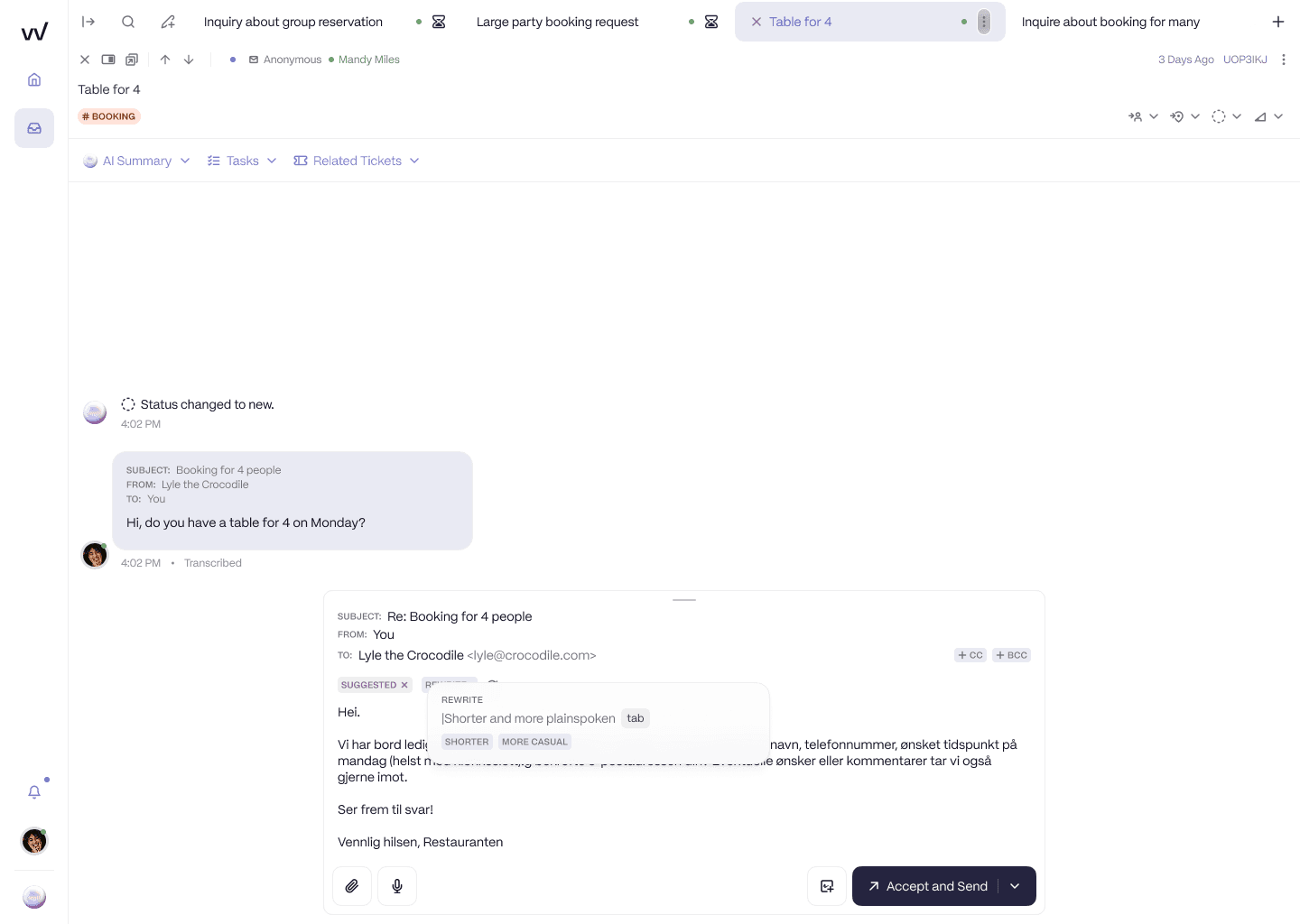
The AI reads the inbound enquiry and drafts the reply in the venue's tone, then waits for one-click approval, so the team reviews instead of retyping.
For the enquiries that need a person, it does the thing a night shift would do and an auto-responder cannot: it sends an immediate, genuine acknowledgement to keep the guest warm, then holds the enquiry in a prioritised queue for the right person in the morning. The £40,000 enquiry that used to arrive to silence now arrives to a reply, and waits in a queue the team actually works.
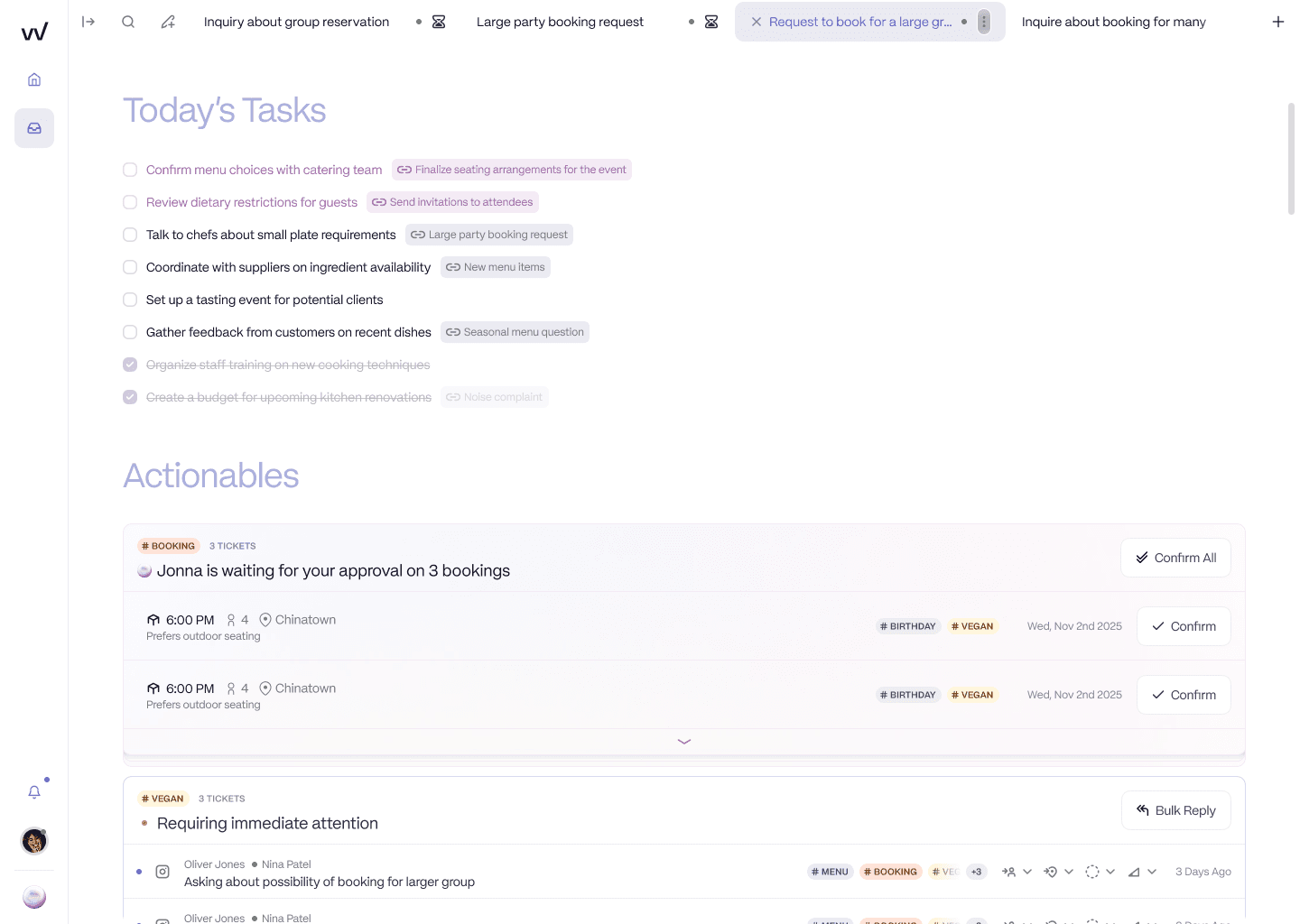
High-value enquiries the AI acknowledged overnight, held and prepared for the team, so a venue hire is waiting in a worked queue rather than buried in the inbox.
And because every enquiry is logged and tracked by location, the out-of-hours misses that used to vanish finally show up as data. The ops director who called email "a black hole, no KPIs, no response rate, nothing" was describing the real cost of invisibility: you cannot manage what you cannot see, and after-hours losses are the least visible of all. When every enquiry is timed and tracked, the overnight gap stops being a black box and becomes a number you can watch close.
How much of this runs autonomously is the dial you set. This is the path the Brasilia Group took, moving its booking workload off a horizontal helpdesk onto a location-aware inbox built for the job. Their founder, Nikolaos Kiosses, put the outcome simply: "The transition from Zendesk to RevVue has been a game changer."
Better out-of-hours cover is worth starting on your own inbox this week. Knowing that goodwill and headcount have a ceiling, and that the ceiling sits right where your biggest bookings arrive, is what tells you when to automate the gap instead. If you want to see what the always-on layer would have said to a real enquiry your team received last weekend, book 20 minutes.
Frequently asked questions
How do restaurant groups answer booking enquiries out of hours without night staff?
They cover the gap with an always-on layer rather than a night team. Every enquiry gets an instant acknowledgement so no guest waits in silence, routine questions are answered automatically on arrival, and high-value or complex enquiries are kept warm with an immediate reply and held for a named person to handle in the morning. Staff hours do not change. The autonomy is set as a threshold the group controls, for example letting the system handle bookings up to eight covers and routing larger ones to the team.
Why do so many booking enquiries arrive in the evenings and at weekends?
Because that is when guests have time to plan. People organise a birthday, a work dinner, or a group night out after their own working day and at weekends. That is the exact window when a restaurant group's central reservations team is off, so the busiest planning hours and the team's quietest staffing hours overlap. Enquiries that land then sit unanswered until the next business day unless something covers the gap automatically.
Does an out-of-office auto-reply count as 24/7 cover?
No. A generic auto-responder that says "thanks, we'll get back to you Monday" confirms the message arrived but sets an expectation of delay. Guests contacting more than one venue simply move on to whoever answers properly first. Real out-of-hours cover acknowledges the enquiry and answers the routine part immediately, or keeps a high-value enquiry warm with a genuine response, rather than parking it until the office reopens.
What happens to a high-value enquiry that arrives overnight?
With manual cover, it usually waits until the next working day, by which point the guest may have booked elsewhere. One entertainment group lost a £40,000 booking because the enquiry arrived outside working hours and no one replied in time. The fix is to acknowledge the enquiry instantly to keep the guest warm, then hold it for the right person to nurture first thing, so the delay in human handling does not cost the booking.
What if the AI can't answer an out-of-hours enquiry?
A well-designed system does not guess. It acknowledges every enquiry, answers only the questions it can answer confidently from the venue's own knowledge base, and escalates anything complex to a named human to handle in the morning. That is safer than either a night-shift guess or total silence: the guest always gets a reply, and the judgement calls still go to a person.
Can you answer booking enquiries 24/7 without hiring more staff?
Yes. The point of an always-on layer is that it removes the need for a night team or for staff to check email on their own time at weekends. It handles the acknowledgement and the routine questions around the clock and prepares the rest for the team, so the same central team covers far more of the week without working more hours.