The short answer
Freshdesk is a solid, affordable customer-service helpdesk that works well for restaurant chains handling support tickets like refunds, vouchers, and post-visit complaints, with email, live chat, and phone linked in one place. Run an honest six-month review and three limits surface reliably for a multi-location group. Freshdesk's Freddy AI does not process website contact-form submissions, which is the primary inbound channel for most groups. Reporting breaks down by ticket category rather than by location. And it cannot handle booking enquiries, because it does not integrate with booking systems like SevenRooms or OpenTable. For most chains the honest verdict is to keep Freshdesk for tickets and use a purpose-built, location-aware tool for the booking-enquiry inbox.
How to run an honest six-month review
Most tool reviews happen at renewal, which is too late and too subjective. Evaluate Freshdesk against the work your chain actually does, not the feature list.
The single most important thing to get right before you start is to separate your two inboxes. A restaurant chain has two distinct inbound flows, and they look almost nothing alike. Customer-service tickets are structured and post-visit: a voucher will not redeem, a guest was charged twice, a complaint needs the finance team. Booking enquiries are conversational and pre-visit: a table for 30 on Saturday, a dietary question, a request to move a booking from 7pm to 8pm. A Freshdesk review that lumps these together will reach the wrong conclusion, because the tool handles one of them well and cannot handle the other at all.
With that split in mind, this framework walks three checkpoints over the first six months:
Months 1 to 2: setup and adoption.
Months 3 to 4: daily use, and where the friction shows.
Months 5 to 6: reporting and scaling.
At each stage, judge Freshdesk against what an operations lead actually needs: a tool that fits the workload, that the team adopts rather than works around, and that leadership can get answers from. Those three tests, applied honestly, tell you more than any list of features.
Months 1 to 2: setup and adoption
The first checkpoint is the one Freshdesk passes most comfortably, and it is worth saying so plainly.
Freshdesk is simple to implement. A small central team can configure it without a consultant, the learning curve is gentle, and it is cheap enough that the initial outlay is not a board-level decision. The strength teams tend to notice first is the linked channels. A guest excellence lead at a roughly 60-location UK brasserie group put it plainly: "I love how it's all together, the phones, the tickets, the live chat. So if someone's on live chat I can see whether they've already submitted a ticket via the website. I love how that's all linked. We can catch out scammers and fakers quite well." That shared guest history across channels is a real, useful thing, and it shows up early.
What to measure in this phase: how long it takes to go live, whether the team actually moves off the old inbox or keeps one foot in it, and whether your routing rules and ticket categories hold up under real volume.
The first restaurant-specific friction also appears here, quietly. Freshdesk is not location-aware. Routing a message to the right site means building custom fields and rules and then maintaining them as the estate changes. It works, but it is configuration you own forever, and it is the first sign that the tool was built for a single support desk rather than a multi-site group.
The honest verdict for this phase: Freshdesk usually passes the setup-and-adoption test for ticketing. If it is failing here, the problem is rarely the tool.
Months 3 to 4: daily use and where the friction shows
The second checkpoint is where real daily use exposes what the demo did not.
The friction most restaurant chains hit first is the contact-form blocker. Freshdesk's Freddy AI processes direct email, but it does not process website contact-form submissions, and for most restaurant groups the contact form is the primary way guests get in touch. So the routine volume that should be the easiest to automate keeps landing on a person. The same guest excellence lead described it directly: "Their email bot doesn't work with the contact form. It only works with direct email and obviously we use the contact form. That's rubbish, because you would want that AI to recognise, oh, they're asking if we allow dogs. I've already got a templated canned response written." Her colleague put the cost in operational terms: "The silly questions that come in, AI can just reply straight away and that would be ticket closed. Move on to the next one." When the AI cannot see the channel those questions arrive on, none of that deflection happens.
What to measure in this phase: what share of routine volume the AI actually deflects, and through which channel. If most of your enquiries come through a web form, expect that number to be low, and check it against what you were promised.
The booking-enquiry friction also starts to show here. Large-party requests and amendments do not fit the ticket model, because answering them properly means working the booking system, and Freshdesk cannot reach it. The team ends up replying in Freshdesk and then opening the booking system in another tab to actually do the work. It functions, but it is two tools doing one job, and the seams show more every week.
Months 5 to 6: reporting and scaling
The third checkpoint is where leadership starts asking harder questions and the estate keeps growing. This is where a restaurant chain feels, concretely, that the architecture was not built for it.
The reporting limit surfaces first. Freshdesk reports by ticket category and by agent, not by location. So when leadership asks which sites are driving complaints, the answer is not on a dashboard. The same lead hit this wall repeatedly: "I can say we've had a lot of complaints about steaks, but they say: which brasseries? How many complaints out of how much? And I'm like, I can't get that detail." Her workaround was to export the data, summarise it with a separate AI tool, and map it to sites by hand.
The compliance limit surfaces next. Sharing a complaint report with leadership means removing guest names and contact numbers first, and Freshdesk does not do that automatically. At her group it meant going through "725 emails to delete contact details manually" before a report could leave the team. That is a recurring time cost and a standing data-protection risk in one task.
The scaling limit surfaces last. Freshdesk prices per agent. As the estate grows, every site general manager who wants to see their own venue's inbox is another seat, so groups tend to limit access rather than let the cost climb, which means the people closest to each site cannot see their own messages.
What to measure in this phase: can you answer location-level questions without manual work, can you share reports without redaction overhead, and does your cost scale with the number of sites or the number of seats.
The test most reviews skip: booking enquiries
Here is the test that decides the whole thing for a restaurant chain, and the one most reviews never run: where do your booking enquiries live, and is that acceptable?
A booking enquiry is not a support ticket. It is a transaction. To handle one properly the tool has to check availability, create the booking in SevenRooms, OpenTable, or Collins, and attach the dietary or seating note. Freshdesk cannot do any of that, because it has no booking-system integration. So even a Freshdesk that the team has adopted well and configured carefully leaves the booking-enquiry inbox running somewhere else entirely, almost always a shared Outlook or Gmail. No amount of further configuration closes that gap, because it is an architectural fact, not a missing setting.
This is the workload RevVue is built for. It is location-aware by default, its AI talks to the booking system inside the conversation thread to check availability and create or amend bookings, and each venue gets its own knowledge base and brand tone, learned automatically from that venue's historical replies. The AI is live and in pilot across more than 60 locations in Norway, handling 15% to 35% of inbound volume autonomously, with UK pilots running now. It is not yet fully generally available in the UK, and that is worth being upfront about.
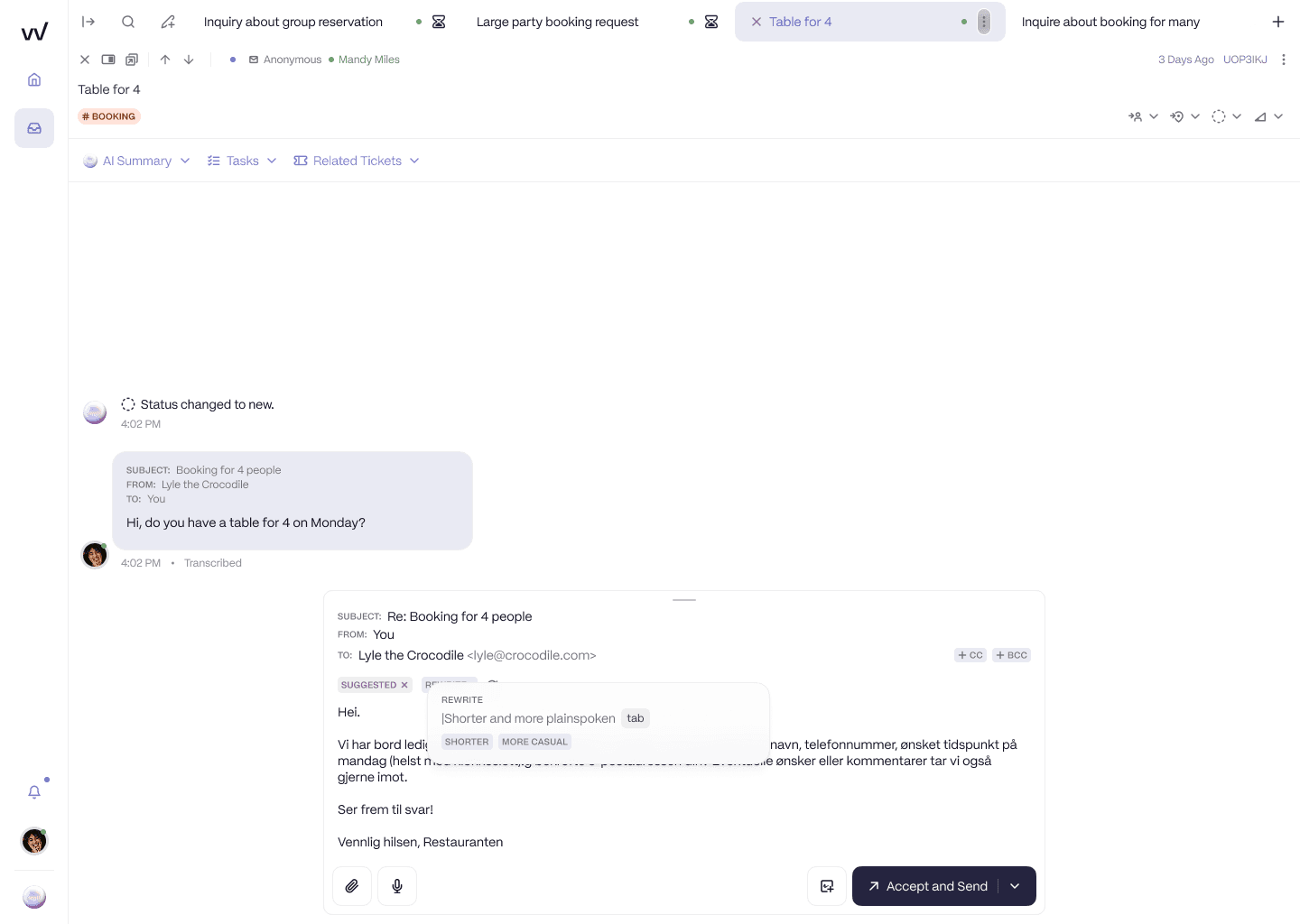
RevVue drafts the reply in the venue's brand tone in the same thread, and the AI checks availability and creates the booking in the booking system. The team can send, edit, or rewrite with one click.
To be clear about what RevVue is not: it is not a customer-service ticketing tool. If your Freshdesk workload is refunds, complaints, and finance escalations, Freshdesk does that well and RevVue does not displace it. The point of running this test is not to replace Freshdesk. It is to notice that the booking-enquiry inbox was never inside Freshdesk in the first place.
Your six-month decision framework
At the six-month mark, five questions settle the decision:
Is the team actually using Freshdesk for tickets, or drifting back to the old inbox? Adoption is the clearest signal that the tool fits the ticketing workload.
What share of routine volume is the AI deflecting, and is your main channel a contact form it cannot read? If the form is your primary channel, the deflection number will disappoint.
Can you answer location-level questions without manual work? If "which sites" is a question you answer by hand, that is the reporting model, not a setting you missed.
Can you share complaint reports without manual redaction? If every report needs hand-editing, that cost recurs forever.
Where do your booking enquiries live, and is that acceptable? This is the question that decides whether Freshdesk is solving half your problem or all of it.
Map the answers. If ticketing is working and booking enquiries are painful, the sensible move is to keep Freshdesk for tickets and add a booking-native tool for enquiries. If nothing is working, reconsider the support tool itself. If everything is working and you genuinely have no booking-enquiry volume, stay as you are.
What restaurant chains actually decide
The common real-world outcome is not a dramatic switch. Chains keep Freshdesk for customer-service tickets, because it does that job well and cheaply, and they move the booking-enquiry inbox to a tool built for it, because that is the part Freshdesk structurally cannot do. The review does not end in "rip it out." It ends in "keep it for what it is good at, and stop asking it to do the job it was never designed for."
One UK restaurant group did exactly this, moving its booking-enquiry workload off a horizontal helpdesk and onto a location-aware tool, after concluding the helpdesk could not report by site, route by location, or talk to the booking system.
If you want to see what that looks like on your own enquiries, bring one real message, a group booking, a complaint, a dietary question, and we will show you what a booking-native inbox would have done with it. No slides.