The short answer
Freshdesk and Intercom are both horizontal customer-support platforms, and for a restaurant group the right choice comes down to channel mix and budget. Freshdesk is the cheaper, email-first option at £15 to £69 per agent per month, with live chat and phone linked into one view and shared guest history across them. Intercom is the premium, web-chat-first option at £74 or more per seat per month, with the stronger general-purpose AI agent, Fin, plus proactive outbound messaging and supervision tooling built for large support teams. Pick Freshdesk for affordable omnichannel support, Intercom for chat-led, AI-heavy support with a bigger budget. Neither integrates with restaurant booking systems, so if your real pain is booking enquiries rather than support tickets, the honest answer is a hospitality-native tool, not either of these.
Before you choose: the two-workload question
Most restaurant groups have two separate inbound flows, and only one of them is what Freshdesk and Intercom were built for.
Customer-service tickets are structured, escalation-driven, and post-visit. A voucher will not redeem. A guest was charged twice. A complaint needs the finance team. A chargeback needs chasing. This work wants an audit trail, a category, an SLA, and an owner, and both Freshdesk and Intercom handle it well. That is the workload they were designed for.
Booking enquiries are different. They are conversational, transactional, and pre-visit. A guest wants a table for 30 on Saturday. They want vegetarian options confirmed. They want to move their booking from 7pm to 8pm. To handle one properly, the tool has to talk to your booking system: check availability, create the booking, attach the dietary or seating note. A reply on its own is not the job. The job is the reply plus the booking action.
Neither Freshdesk nor Intercom can do the booking action, because neither integrates with any restaurant booking system. There is no SevenRooms, OpenTable, or Collins app in either marketplace. This is why even groups that adopt one of these platforms for support typically still run their booking enquiries through a separate Outlook or Gmail. The support platform stays in its lane, handling tickets and chat, and the booking-enquiry inbox sits somewhere else entirely.
So before comparing the two, decide which workload you are buying for. If it is customer-service tickets, read on: the Freshdesk-versus-Intercom decision is a real one. If it is booking enquiries, the more useful comparison is further down.
Freshdesk at a glance
Freshdesk is the mid-market support helpdesk, positioned as the cheaper and simpler alternative to Zendesk. It is email-first, with live chat and phone linked alongside.
The strengths for a restaurant group are real. The price is low, the setup is simple enough that a small central team can configure it without a consultant, and Freddy, its AI, does a decent job of the basics: ticket categorisation, suggested replies, sentiment detection. The standout, and the thing a real customer pointed to first, is the linked channels. A guest excellence lead at a roughly 60-location UK brasserie group put it plainly: "I love how it's all together, the phones, the tickets, the live chat. So if someone's on live chat I can see whether they've already submitted a ticket via the website. I love how that's all linked. We can catch out scammers and fakers quite well." That shared guest history across channels is genuinely useful for a team fielding repeat callers and chancers.
The weaknesses show up when a restaurant group pushes on it. Freshdesk does not integrate with booking systems. It is not location-aware, so routing by site means custom fields and rules someone has to maintain. Freddy does not process website contact-form submissions, only direct email, which is a problem when the contact form is the primary inbound channel for most groups. The same lead hit it directly: "Their email bot doesn't work with the contact form. It only works with direct email and obviously we use the contact form." Reporting breaks down by category, not location, so leadership questions like "which sites" cannot be answered without manual work. And there is no automatic redaction of personal data, which at her group meant going through "725 emails to delete contact details manually" before a complaint report could be shared.
Intercom at a glance
Intercom is the premium customer messaging and support platform, strong in tech and SaaS and built web-chat-first. In hospitality it tends to turn up at newer, digital-first groups with a tech-savvy founder and a web chat or two already deployed.
Its strengths are genuine. Fin, its AI agent, is one of the better general-purpose agents on the market, and it resolves more autonomously and converses more naturally than most. Intercom is fully omnichannel across chat, email, WhatsApp, and social. It does proactive outbound messaging well, the kind of announcements and campaigns that Freshdesk does not match. And it has detailed quality and supervision tooling for tracking who handled what and whether responses stayed within the rules, which is valuable if you are running a large support operation.
The weaknesses for a restaurant group track its origins as a software-support tool. Intercom does not integrate with booking systems, the same gap Freshdesk has and the one that matters most for booking enquiries. It is built around a single product and a single knowledge base, so a group running 30 venues across several concepts cannot give each venue its own tone, FAQs, and branding. It is web-chat-first, which sits awkwardly against the reality that restaurant booking enquiries are still around 90% email and most central teams have run on Outlook or Gmail for 20 years. Its supervision and rule-bound features are designed for software companies with strict process compliance, so a three-person reservations team handling 600 enquiries a week pays for complexity it will not use. And at per-seat pricing, the cost is hard to justify for a lean restaurant team.
Head-to-head on the dimensions that matter
Dimension | Freshdesk | Intercom |
|---|---|---|
Pricing model and starting price | Per agent, £15 to £69/month | Per seat, £74+/month (AI charged on top) |
AI agent | Freddy: decent triage and suggested replies | Fin: stronger general-purpose agent |
Primary channel model | Email-first | Web-chat-first |
Omnichannel breadth | Email, chat, phone linked | Chat, email, WhatsApp, social |
Proactive outbound messaging | Limited | Strong |
Booking system integration | None | None |
Location-awareness | Custom fields and rules | None native |
Per-venue knowledge base and brand tone | Single configuration | Single knowledge base |
Implementation and ease of use | Light, fast to set up | Heavier, built for larger teams |
Best-fit workload | Affordable email-and-phone support | Chat-led, AI-heavy support |
The pattern is consistent. Intercom is the stronger AI and chat platform, with a better agent and richer outbound tooling, but it is heavier to run and considerably more expensive. Freshdesk is the lighter, cheaper, email-and-phone option that a small team can stand up quickly. On the dimensions a software company cares about, Intercom usually wins. On the dimensions a lean, email-first restaurant team cares about, Freshdesk often fits better. But the bottom two rows are the ones that decide a booking-enquiry use case, and there the two tools are identical: neither talks to the booking system, and neither knows what a location is.
Where Intercom is the better pick
There are restaurant groups for which Intercom is the right call, and it is worth being specific about them.
The first is the digital-first group where web chat is genuinely the primary channel, not an afterthought. If most of your guest contact happens in a chat widget and the quality of the AI agent matters more than the monthly cost, Fin earns its keep in a way Freddy does not. The second is the group that wants proactive outbound messaging, running announcements or campaigns to guests rather than only responding to inbound. Intercom does this well and Freshdesk does not. The third is the larger support operation that needs the supervision and quality tooling to manage a sizeable team and prove responses stayed within policy.
The honest limit: most multi-location restaurant groups are email-first and lean-staffed. For them, Intercom means paying premium per-seat prices for chat-first depth and supervision features they will not use.
Where Freshdesk is the better pick
Freshdesk is the better fit for a larger share of restaurant groups, again for specific reasons.
The first is simply that most groups are email-first, and Freshdesk is built around email with chat and phone alongside rather than around a chat widget. The second is budget. The gap between per-agent pricing at £15 to £69 and Intercom's £74-plus per seat is significant for a lean team, and it widens with every person who needs access. The third is the linked phone and shared guest history, which the brasserie group above valued for catching repeat scammers and fakers across channels, something Intercom's chat-first model handles less naturally.
The honest limit: Freddy is the weaker AI agent, and the contact-form blocker bites hard if your website form is the main way guests reach you, because the volume that should be easiest to automate keeps landing on the team.
The question neither tool answers
Here is what the Freshdesk-versus-Intercom comparison quietly skips: both tools are answering the customer-service-ticket question, and a large share of restaurant groups are asking the booking-enquiry question instead.
A booking enquiry needs three things neither tool has. It needs booking system integration, so the AI can check availability and create the booking rather than just describe how. It needs native location-awareness, so a message routes to the right venue without someone maintaining custom fields. And it needs a per-venue knowledge base and brand tone, so a group running a fine-dining wine bar and a casual pizza brand under one roof can make each venue sound like itself.
This is where Intercom's biggest strength stops being relevant. Fin is a strong agent, but a strong agent that cannot reach the booking system can still only write a reply. It cannot book the table. AI quality is not the gap. Booking-system access is.
This is the workload RevVue is built for. It is location-aware by default, its AI talks to the booking system inside the conversation thread to check availability and create or amend bookings, and each venue gets its own knowledge base and brand tone, learned automatically from that venue's historical replies. The AI is live and in pilot across more than 60 locations in Norway, handling 15% to 35% of inbound volume autonomously, with UK pilots running now. It is not yet fully generally available in the UK, and it is worth being upfront about that.
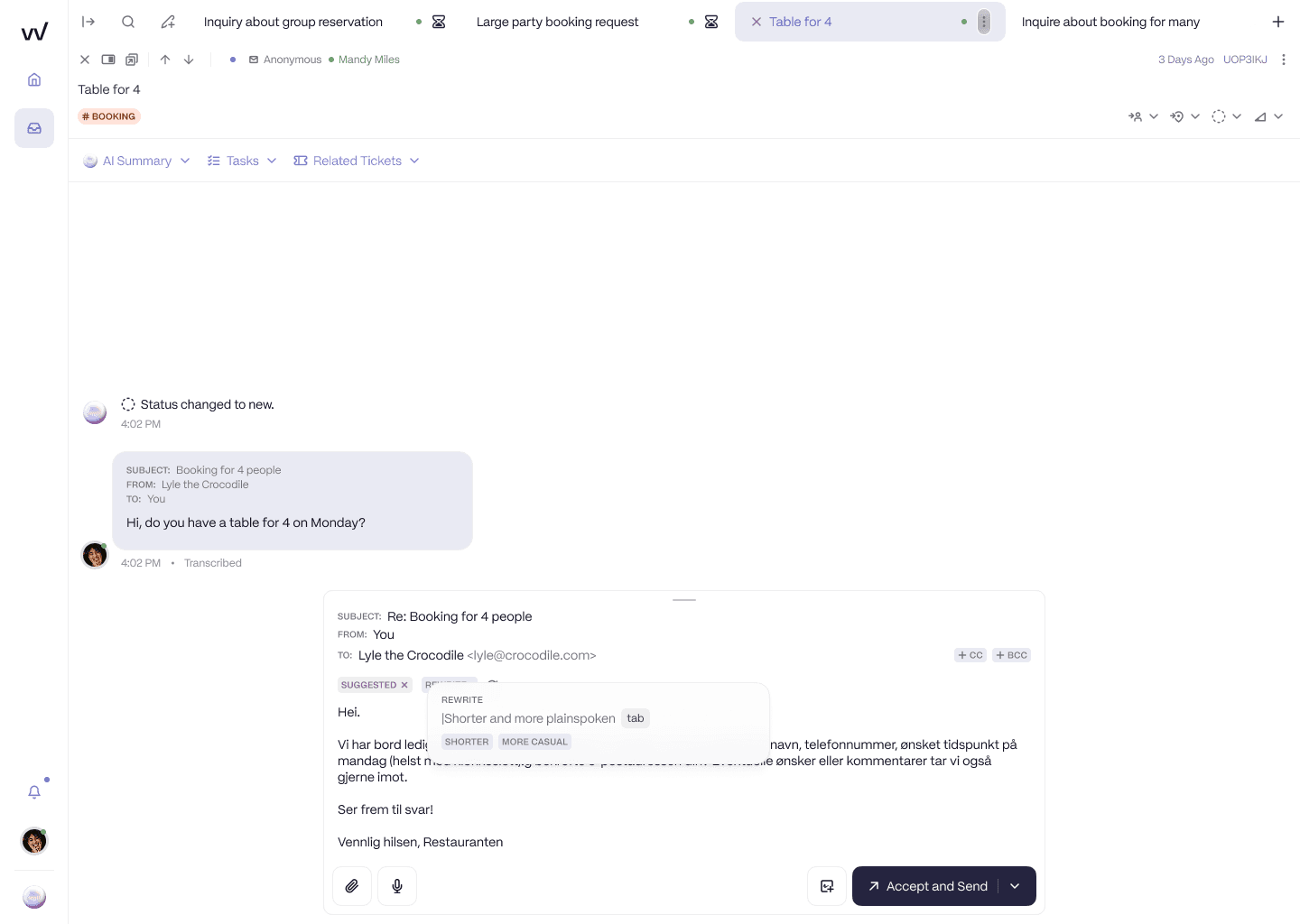
RevVue drafts the reply in the venue's brand tone in the same thread, and the AI checks availability and creates the booking in the booking system. The team can send, edit, or rewrite with one click.
To be clear about what RevVue does not do: it is not a customer-service ticketing tool and not a large-team supervision platform. If your Freshdesk or Intercom workload is refunds, complaints, and finance escalations, keep that where it is. RevVue handles the separate booking-enquiry inbox, the one that on most groups' setups still sits in Outlook.
How to decide
Five questions sort most of this out:
What is your primary channel: email, a website contact form, or web chat? Email points to Freshdesk, chat points to Intercom, and a contact form is a warning sign for Freshdesk's Freddy, which will not process it.
What is your budget per agent or seat per month? The per-agent versus per-seat gap is the single biggest cost difference between the two.
Do you need proactive outbound messaging and heavy supervision tooling? If yes, Intercom. If you only need to answer inbound, Freshdesk is enough.
Is your unsolved pain customer-service tickets or booking enquiries? Tickets keep you in this comparison. Booking enquiries take you out of it.
Do you run multiple concepts that each need their own tone and knowledge base? Neither tool supports per-venue branding, so a multi-concept group should weigh that gap heavily.
Mapping the answers: chat-first, AI-led, and a bigger budget points to Intercom. Email-first and omnichannel-on-a-budget points to Freshdesk. Booking enquiries, location-level reporting, or per-venue tone points to neither, and a hospitality-native tool instead.
What most restaurant groups actually end up doing
The common real-world outcome is not a clean win for either tool. A group picks Freshdesk or Intercom for customer-service tickets and web chat, and then keeps its booking enquiries on a separate Outlook or Gmail, because neither platform talks to the booking system. The support tool and the booking-enquiry inbox end up living in two different places.
The honest recommendation follows from that. Pick the support platform that fits your channel mix and budget, Freshdesk if you are email-first and cost-conscious, Intercom if you are chat-first with the budget for it. Then handle the booking-enquiry inbox separately, with a tool built for it, rather than expecting a software-support platform to do a job it was never designed for. One UK restaurant group did exactly this, moving its booking-enquiry workload off a horizontal helpdesk and onto a location-aware tool, after concluding the helpdesk could not report by site, route by location, or talk to the booking system.
If you want to see what that looks like on your own enquiries, bring one real message, a group booking, a complaint, a dietary question, and we will show you what a booking-native inbox would have done with it. No slides.