The short answer
RevVue and Freshdesk solve different jobs for a restaurant group. Freshdesk is a customer-service helpdesk, priced at £15 to £69 per agent per month, and it handles support tickets well: voucher redemptions, refunds, post-visit complaints, with email, live chat, and phone linked in one place. RevVue, at £75 per location per month, is built for the booking-enquiry inbox. It is location-native, its AI talks to booking systems like SevenRooms, OpenTable, and Collins to create and amend bookings inside the conversation thread, and it reports by venue. Freshdesk does not integrate with booking systems, so most groups run Freshdesk for tickets and a separate inbox for booking enquiries. The two tools coexist. RevVue replaces the booking-enquiry inbox, not the support desk.
At a glance
Here is the snapshot before the detail. Freshdesk wins on a few things, and they are real: linked phone, cross-channel guest history, a lower headline price, and a more mature product. RevVue wins where the work is booking enquiries rather than support tickets.
RevVue | Freshdesk | |
|---|---|---|
Built for | Multi-location restaurant booking enquiries | Customer-service ticket teams |
Booking system integration (SevenRooms, OpenTable, Collins) | Yes, AI acts in the booking system inside the thread | None |
Location model | Native: every message pinned to a site | Custom field plus rules to maintain |
AI behaviour | Replies, checks availability, creates and amends bookings | Drafts replies only (Freddy) |
AI training | Hospitality context, brand tone learned from your historical emails | Generic support tickets |
Contact-form enquiries | Read and handled by the AI | Not processed by the AI bot |
Per-venue knowledge base and brand tone | Yes, per venue | Single configuration |
Linked phone, chat, and email | Email and web chat (phone not offered) | Yes, all three linked with shared guest history |
Pricing model | Per location per month (£75) | Per agent per month (£15 to £69) |
Per-venue access for site GMs | Built in, no extra seats | Per-seat |
Reviews and surveys | Included (Google, TripAdvisor, NPS) | Not available |
Reporting unit | Location | Ticket category and agent |
Implementation time | Days | Weeks |
Two workloads, two tools
Most restaurant groups have two separate inbound flows, and they need different tools.
Customer-service tickets are structured, escalation-driven, and post-visit. A voucher will not redeem. A guest was charged twice. A complaint needs the finance team to look at it. A chargeback needs chasing. These tickets want an audit trail, a category, an SLA, and a clear owner. Freshdesk is built for this work, and it does it well. RevVue is not, and does not try to be.
Booking enquiries are conversational, transactional, and pre-visit. A guest wants a table for 30 on Saturday. They want vegetarian options confirmed. They want to move their booking from 7pm to 8pm. To handle one properly, the tool has to talk to your booking system: check availability, create the booking, attach the dietary or seating note. A reply on its own is not the job. The job is the reply plus the booking action.
Freshdesk cannot do the booking action, because it does not integrate with any restaurant booking system. There is no SevenRooms, OpenTable, or Collins app in the Freshworks marketplace. This is why even groups running Freshdesk for customer service typically still run their booking enquiries through a shared Outlook or Gmail. The helpdesk stays in its lane, handling tickets, and the booking-enquiry inbox sits separately in another lane.
RevVue replaces the Outlook lane. Not the Freshdesk lane. If your Freshdesk tickets are vouchers, refunds, and complaints, keep Freshdesk for that. The question worth asking is what happens with your booking enquiries, which on almost every group's setup sit somewhere else, and whether it is still acceptable that nobody can tell you the response rate by site.
What Freshdesk gets right
It is worth being specific about this, because Freshdesk is a good product and a fair comparison has to say so.
It is cheaper than Zendesk and simpler to set up. A small central team can configure it without a consultant, and the learning curve is gentler. For a group that has decided it needs a proper ticketing tool and finds Zendesk too heavy, Freshdesk is the sensible mid-market choice.
The strongest thing it does, and the thing a real customer pointed to first, is the linked channels. A guest excellence lead at a roughly 60-location UK brasserie group put it plainly: "I love how it's all together, the phones, the tickets, the live chat. So if someone's on live chat I can see whether they've already submitted a ticket via the website. I love how that's all linked. We can catch out scammers and fakers quite well." That cross-channel guest history is genuinely useful, and it is something RevVue does not match today: RevVue covers email and web chat, not inbound phone.
Freddy, Freshdesk's AI, does a decent job of the basics too: ticket categorisation, suggested replies, sentiment detection. For a support-ticket workload, that is a reasonable set of tools.
So this is not an article about a bad product. It is an article about where a good support helpdesk stops fitting a restaurant group, and what to do about the part it was never built for.
Where Freshdesk stops short for a restaurant group
The same brasserie group that praised the linked channels was also, at the time we spoke, evaluating alternatives. That tells you something. Three gaps came up, and none of them are missing features you can request. They are structural.
The AI cannot see your contact form, your busiest channel
Most restaurant groups take the bulk of their enquiries through a website contact form, not direct email. Freddy AI does not process contact-form submissions. It only works on direct email. So the routine questions that should be the easiest to automate, the ones the team has already written canned answers for, still land on a person.
The guest excellence lead described exactly this: "We hit a bit of a barrier with Freshdesk. Their email bot doesn't work with the contact form. It only works with direct email and obviously we use the contact form. That's rubbish, because you would want that AI to recognise, oh, they're asking if we allow dogs. I've already got a templated canned response written. Here you go." Her colleague added the operational version of the same point: "The silly questions that come in, AI can just reply straight away and that would be ticket closed. Move on to the next one."
RevVue's AI reads an enquiry regardless of how it arrived, contact form, email, or web chat, and resolves routine questions autonomously using the venue's own templates and tone. The benefit is the one the team actually wants: the dog-policy and opening-hours questions close themselves, and the team gets the volume that needs judgement. Across more than 60 live locations in Norway, the AI handles 15% to 35% of inbound volume without a person touching it.
Reporting tells you the topic, not the site
Freshdesk reports by ticket category and by agent. It does not aggregate by location. For a single-site business that is fine. For a restaurant group it means the report can tell you what guests are complaining about but not where.
The same lead hit this wall every time leadership asked a follow-up question: "I can say we've had a lot of complaints about steaks, but they say: which brasseries? How many complaints out of how much? And I'm like, I can't get that detail." Her workaround was to export the data and paste it into Microsoft Copilot to summarise it, then map it to sites by hand.
RevVue is location-native: every message is pinned to a venue the moment it arrives. Complaint volume, response rate, and booking conversion all break down by site out of the box, because location is the foundational unit of the data model rather than a tag someone has to maintain. When leadership asks "which sites," the answer is on the dashboard.
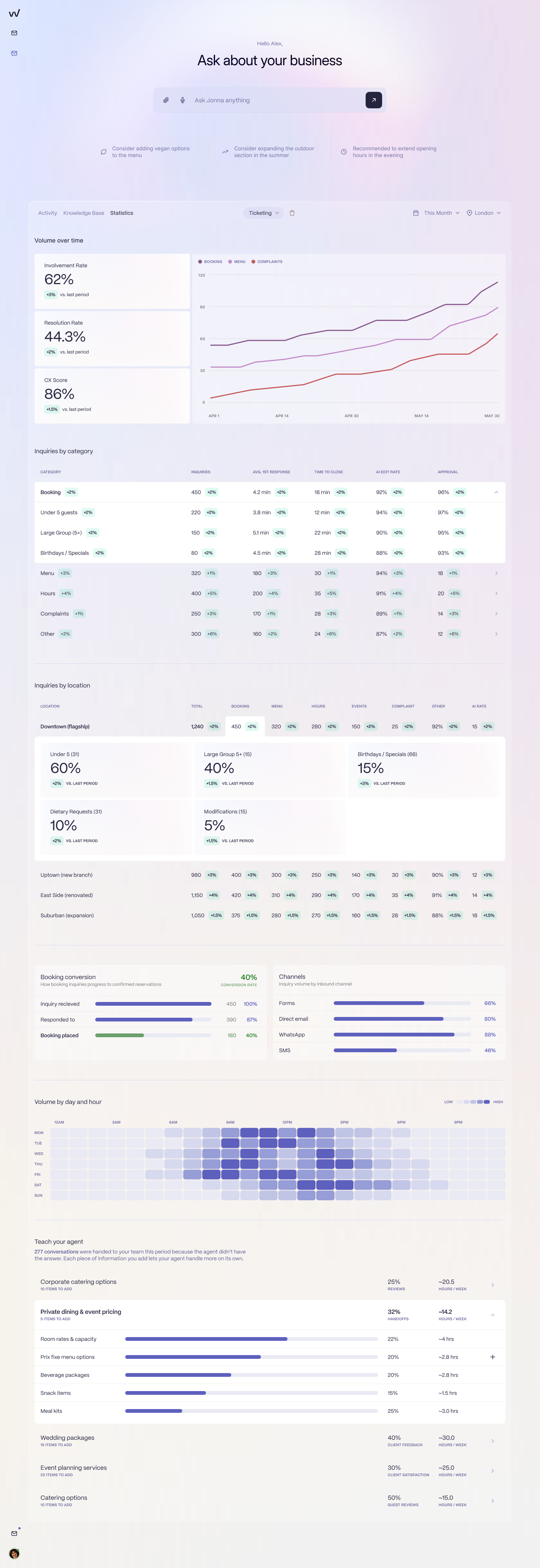
Response rate, complaint volume, and booking conversion, all broken down by venue, out of the box. The part a category-tagged helpdesk report leaves out.
Sharing a report means redacting hundreds of emails by hand
Freshdesk cannot automatically strip personal data out of ticket bodies. So when the central team wants to share a week of complaints with leadership, someone has to remove guest names and contact numbers manually, one ticket at a time.
At the brasserie group, that meant the lead going through "725 emails to delete contact details manually" before any report could be shared. That is a compliance risk and a recurring time sink in one task. RevVue keeps location-level reporting and guest-data handling inside the product, so a report can be produced and shared without hand-redacting every ticket.
A booking enquiry is a transaction, not a ticket
This is the single biggest functional difference between RevVue and any horizontal helpdesk, Freshdesk included. (The same gap drives the RevVue versus Zendesk comparison.) Freddy can draft a reply to a guest enquiry. It cannot do anything in your booking system. So even when it drafts a good reply, a person still has to:
Read the enquiry.
Open the booking system in another tab.
Check availability for the requested date and time.
Reply to the guest.
Go back to the booking system and create the booking.
Add any notes (vegetarian, dietary, occasion).
The drafted reply saves a little time. Most of the manual work remains, because the booking action is the work and Freshdesk has no way to reach the booking system.
RevVue's AI runs the whole flow inside the same conversation thread. A guest emails asking for a table for four on Saturday at 7pm, vegetarian, quiet area. The AI reads the enquiry, checks availability in the booking system, creates the booking, attaches the vegetarian and quiet-area notes, and replies to the guest confirming the table. When the guest comes back to say they are now three, not four, the AI updates the booking and confirms the amendment. No tab-switching, no double entry. For bookings above a threshold the group sets, often around eight people, the AI drafts a first response and routes the enquiry to the team instead, so a person handles the large groups, the venue hires, and the complaints while the routine volume closes itself. The phrase that captures the difference: Freddy can write a reply, it cannot book the table.
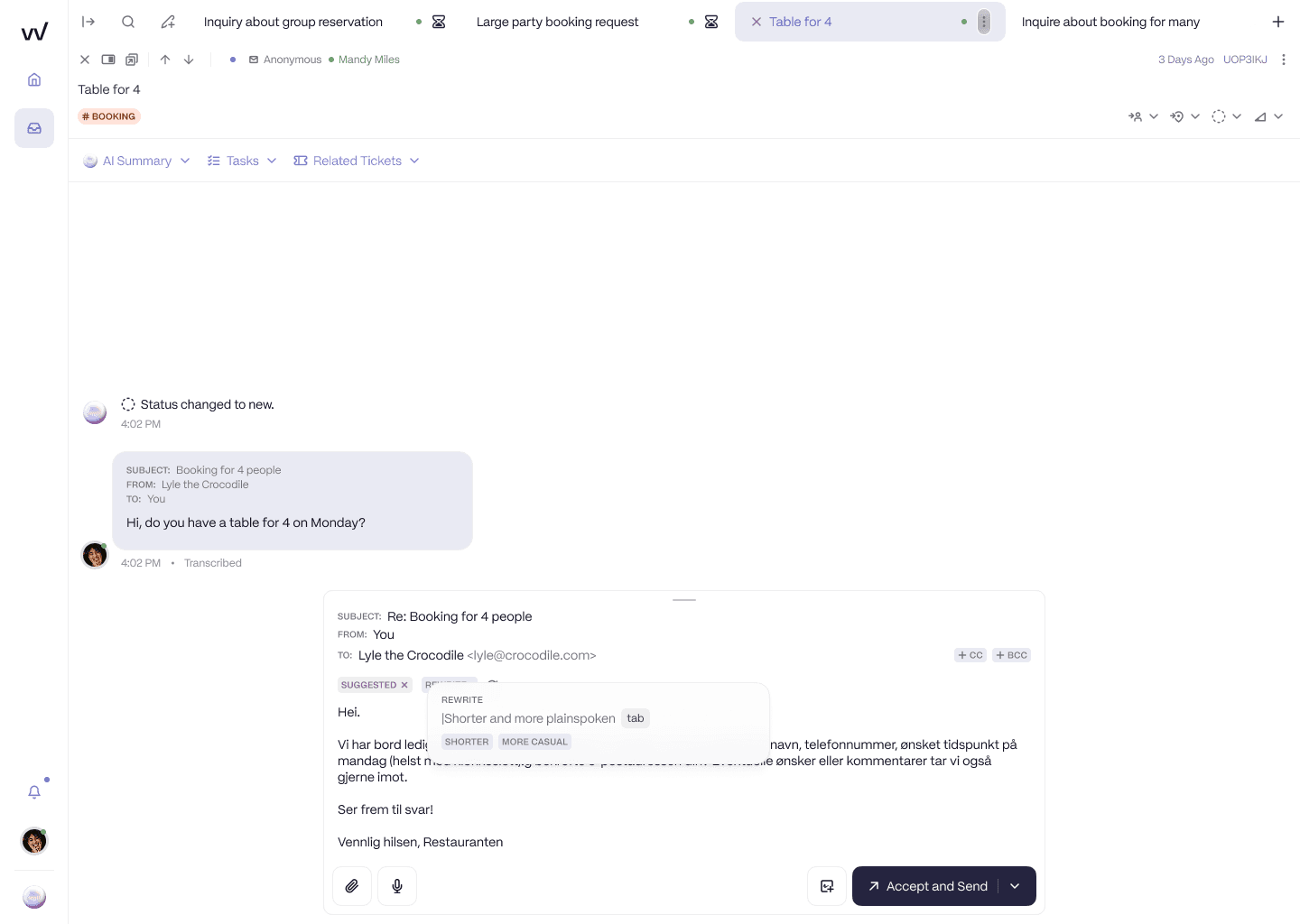
RevVue drafts the reply in the venue's brand tone in the same thread, and the AI checks availability and creates the booking in the booking system. The team can send, edit, or rewrite with one click.
One honest caveat. The AI agent is live and in pilot across more than 60 locations in Norway, and UK pilots are running now. It is not yet fully generally available in the UK. The location-aware inbox itself, the routing, tagging, reporting, and access control, has been in production for over a year. The AI is something you would pilot, not something to assume is mature on day one.
Pricing: the cheaper sticker price isn't always the lower total cost
Freshdesk's headline price is genuinely lower. At £15 to £69 per agent per month, it undercuts RevVue's £75 per location per month on the sticker, and a fair comparison should not pretend otherwise. The difference shows up in total cost and fit.
Per-agent pricing works against a lean restaurant team. Restaurant groups run small central teams: two to four people covering 20 to 50 sites. The moment you want each site's general manager to see their own venue's inbox, every GM is another agent seat. Most groups respond by limiting seats and keeping GMs out, which defeats the point. Then there is the work that does not appear on the invoice: configuration time, the manual location-mapping in Copilot, the hand-redaction of personal data before a report can go out. Those are hours, every week.
RevVue prices per location. Per-venue access is included, so site GMs see their own inbox without an extra seat, and location-level reporting is built in rather than reconstructed by hand.
Group profile | RevVue cost | Freshdesk list cost | Hidden Freshdesk cost |
|---|---|---|---|
25 sites, 3-person team | £1,875/month | £45 to £207/month | Manual location reporting, manual PII redaction, GMs locked out of their own inbox |
Add a new location | +£75/month | £0 | Manual setup of routing and reporting per site |
Be fair about where Freshdesk wins on cost: if you are a small team doing pure email-based customer support and you do not need per-site reporting or per-GM access, Freshdesk may simply be cheaper, full stop. The total-cost argument only flips once locations and the booking-enquiry workload enter the picture.
Side-by-side comparison
RevVue | Freshdesk | |
|---|---|---|
Built for | Multi-location restaurant booking enquiries | Customer-service ticket teams |
Booking system integration | ||
Talks to SevenRooms, OpenTable, Collins, Design My Night, ResDiary | Yes (select systems live, SevenRooms in active development) | None, no marketplace app exists |
AI checks availability inside the thread | Yes | No |
AI creates and amends bookings inside the thread | Yes | No |
Core inbox | ||
Location assigned to every message automatically | Yes | Custom field plus rules required |
Location-level reporting out of the box | Yes | Per-category and per-agent only |
Automatic PII handling in reports | Yes | Manual redaction required |
Per-venue templates | Yes, users see only their venue's | Single template library |
Internal notes and collision detection | Yes | Yes |
AI | ||
Reads contact-form enquiries | Yes | No (direct email only) |
Trained on hospitality context | Yes | Generic (Freddy) |
Brand tone learned from historical emails | Yes | Manual configuration |
Per-venue brand tone for multi-concept groups | Yes | Single configuration |
Handles routine enquiries autonomously | In pilot, 60+ live locations in Norway, UK pilots running | Drafts and triages, resolution still manual |
Channels | ||
Yes | Yes | |
Web chat | Yes (per-venue branded, launching June 2026) | Yes |
Inbound phone | Not offered | Yes (FreshCaller) |
Cross-channel guest history | Within the inbox | Yes, across email, chat, and phone |
Access control | ||
Per-manager, per-venue access (no seat penalty) | Yes | Per-seat |
Reviews and surveys | ||
Google and TripAdvisor review management | Yes | Not available |
Post-visit surveys with NPS | Yes | Not available |
Pricing and implementation | ||
Pricing model | Per location per month (£75) | Per agent per month (£15 to £69) |
Implementation time | Days | Weeks |
Built for restaurant groups | Yes | No |
How to decide
Five questions sort most of this out:
Is your unsolved pain customer-service tickets or booking enquiries? If it is tickets, Freshdesk is doing its job. If it is booking enquiries, that is a different tool.
Is your primary inbound a website contact form? If yes, Freddy will not process it, and your routine volume will keep hitting the team.
Does leadership ask for location-level breakdowns you cannot produce today? If "which sites" is a question you answer by hand, that is the reporting model, not a setting.
Do you need the AI to act in the booking system, or just draft a reply? Drafting is Freddy's ceiling. Acting is the booking-enquiry job.
Do you want every site GM to see their own inbox without a per-seat cost? Per-agent pricing makes that expensive. Per-location pricing includes it.
Mapping the answers: if your workload is tickets and you are happy on price, stay on Freshdesk. If the live problem is booking enquiries, location reporting, contact-form automation, or AI that acts rather than drafts, that is RevVue, and you run it alongside Freshdesk rather than instead of it.
Running RevVue alongside Freshdesk
Most groups do not switch off Freshdesk. They keep it for customer-service tickets and run RevVue for the booking-enquiry inbox in parallel, usually email-only first while any booking-system integration connects. Email forwarding from your current booking-enquiry address is the one technical step on your side, the same setup any IT team has done before. Locations are configured from a list you already have, and the AI picks up each venue's tone from 20 to 30 of your existing replies. Most groups are live within days, not months.
This pattern is not theoretical. A UK restaurant group moved its booking-enquiry workload off a horizontal helpdesk and onto RevVue for exactly the reasons above: no way to report by site, no routing by location without manual configuration, and an AI that understood support tickets rather than the difference between a dietary question and a £4,000 venue hire.
If you want to see what that looks like on your own enquiries, bring one real message, a group booking, a complaint, a dietary question, and we will show you what RevVue would have done with it. No slides.