The short answer
RevVue and Intercom solve different jobs for a restaurant group. Intercom is a premium customer messaging and support platform at £74 or more per seat per month, with the strongest general-purpose AI agent of the horizontal tools, Fin, plus web chat, WhatsApp, and proactive outbound messaging. RevVue, at £75 per location per month, is built for the booking-enquiry inbox: it is location-native, email-first, and its AI talks to booking systems like SevenRooms and OpenTable to check availability and create bookings inside the conversation thread, with each venue getting its own knowledge base and brand tone. Intercom does not integrate with booking systems, so Fin can draft a reply but cannot book the table. The two tools coexist. RevVue replaces the booking-enquiry inbox, not Intercom's support or messaging role.
At a glance
Here is the snapshot before the detail. Intercom wins on things that are genuinely hard to build: the best general-purpose agent here, proactive outbound messaging, and channel breadth across WhatsApp and social. RevVue wins where the work is booking enquiries rather than support conversations.
RevVue | Intercom | |
|---|---|---|
Built for | Multi-location restaurant booking enquiries | Customer support, web chat, and messaging |
Booking system integration (SevenRooms, OpenTable, Collins) | Yes, AI acts in the booking system inside the thread | None |
Location model | Native: every message pinned to a site | None native |
AI behaviour | Replies, checks availability, creates and amends bookings | Drafts and resolves conversations (Fin) |
AI training | Hospitality context, brand tone learned from your historical emails | Strong general-purpose agent |
Channel model | Email-first, web chat | Web-chat-first, plus email, WhatsApp, social |
Per-venue knowledge base and brand tone | Yes, per venue | Single knowledge base |
Proactive outbound messaging | Not offered | Yes, strong |
Pricing model | Per location per month (£75) | Per seat per month (£74+, AI charged on top) |
Per-venue access for site GMs | Built in, no extra seats | Per-seat |
Reviews and surveys | Included (Google, TripAdvisor, NPS) | Not available |
Implementation | Days (UK AI agent in pilot) | Weeks, built for larger teams |
Two workloads, two tools
Most restaurant groups have two separate inbound flows, and only one of them is what Intercom was built for.
Customer-service tickets and web-chat support are structured, conversational, and often post-visit. A voucher will not redeem. A guest was charged twice. A live-chat visitor wants to know about allergens before they book. On top of that, some groups use Intercom to push proactive outbound messages, announcements and campaigns to guests. This is the work Intercom was built for, and it does it well.
Booking enquiries are different. They are conversational, transactional, and pre-visit. A guest wants a table for 30 on Saturday. They want vegetarian options confirmed. They want to move their booking from 7pm to 8pm. To handle one properly the tool has to talk to your booking system: check availability, create the booking, attach the dietary or seating note. A reply on its own is not the job. The job is the reply plus the booking action.
Intercom cannot do the booking action, because it does not integrate with any restaurant booking system. There is no SevenRooms, OpenTable, or Collins app in its marketplace. This is why even groups running Intercom for support and messaging typically still run their booking enquiries through a separate Outlook or Gmail. The platform stays in its lane, handling support and outbound, and the booking-enquiry inbox sits somewhere else.
RevVue replaces that Outlook lane. Not the Intercom lane. If you use Intercom for web-chat support or proactive campaigns, keep it for that. The question worth asking is what happens with your booking enquiries, which on most setups sit separately, and whether it is acceptable that nobody can tell you the response rate by site.
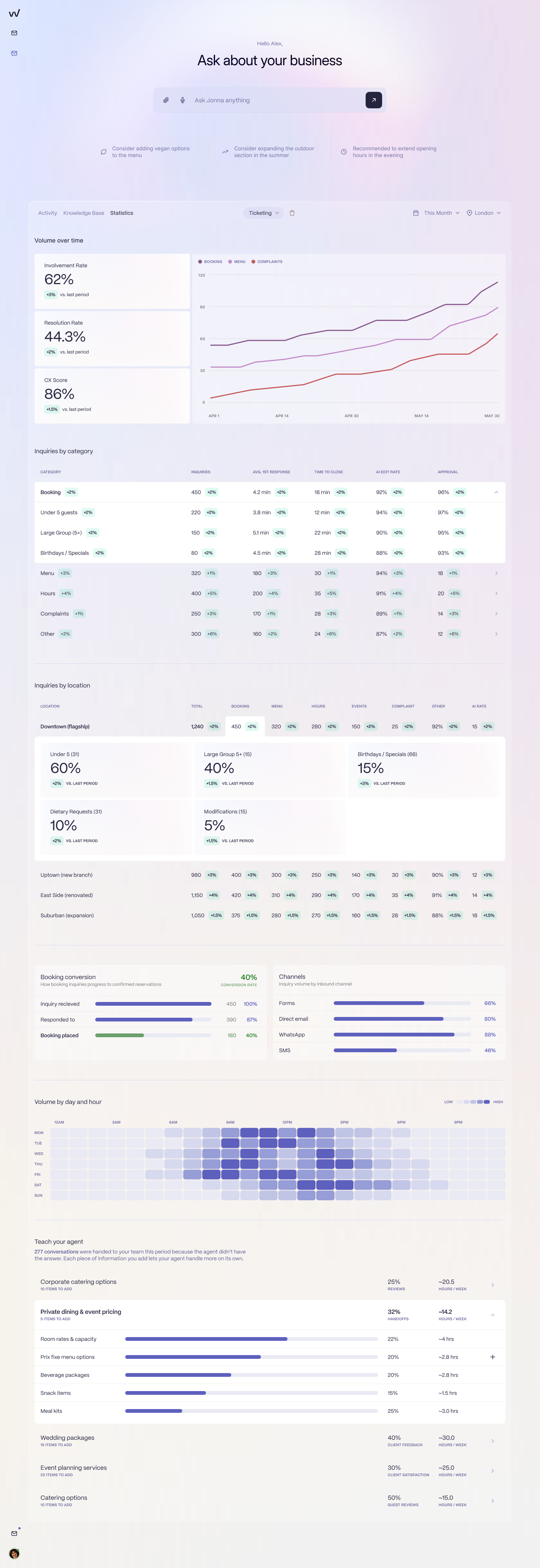
RevVue reports response rate, resolution rate, and booking conversion broken down by venue. Intercom has no native concept of a location, so this view does not exist for a restaurant group's booking enquiries.
What Intercom gets right
It is worth being specific about this, because Intercom is a strong product and a fair comparison has to say so.
Its AI agent is the best of the horizontal options. Fin resolves more enquiries autonomously and holds a conversation more naturally than most general-purpose agents on the market, and for a group that lives in web chat, that quality is real and valuable. Intercom is also genuinely omnichannel, covering chat, email, WhatsApp, and social in one place, which is broader channel coverage than RevVue offers. Its proactive outbound messaging, the announcements and campaigns you send guests rather than only the replies you send back, is something RevVue does not do at all. And its supervision and quality tooling is built for managing large support teams and proving responses stayed within policy.
The honest concession follows from all that. If your operation is web-chat-led support, or you want to run outbound guest campaigns, or you are managing a large support team that needs supervision tooling, Intercom is excellent and RevVue is not trying to be that. This article is not about a weak product. It is about where the best general-purpose support platform stops fitting a restaurant group's booking enquiries, and what to do about that part.
Where Intercom stops short for a restaurant group's booking enquiries
Three gaps surface when a restaurant group tries to run booking enquiries through Intercom. None of them are missing features you can request. They are structural.
It is web-chat-first, and booking enquiries are mostly email
Intercom is built around the web chat widget. That is its native shape, and it is where the product is strongest. But restaurant booking enquiries are still around 90% email, and central reservations teams have worked out of Outlook or Gmail for 20 years. Adopting Intercom for booking enquiries means retraining the team around a chat-style interface for a workload that mostly is not chat. RevVue is email-first, so it matches how the team already works: message threads, a reply box, assignment, the things a reservations team does all day, with the location handling and AI added underneath rather than a new interface bolted on top.
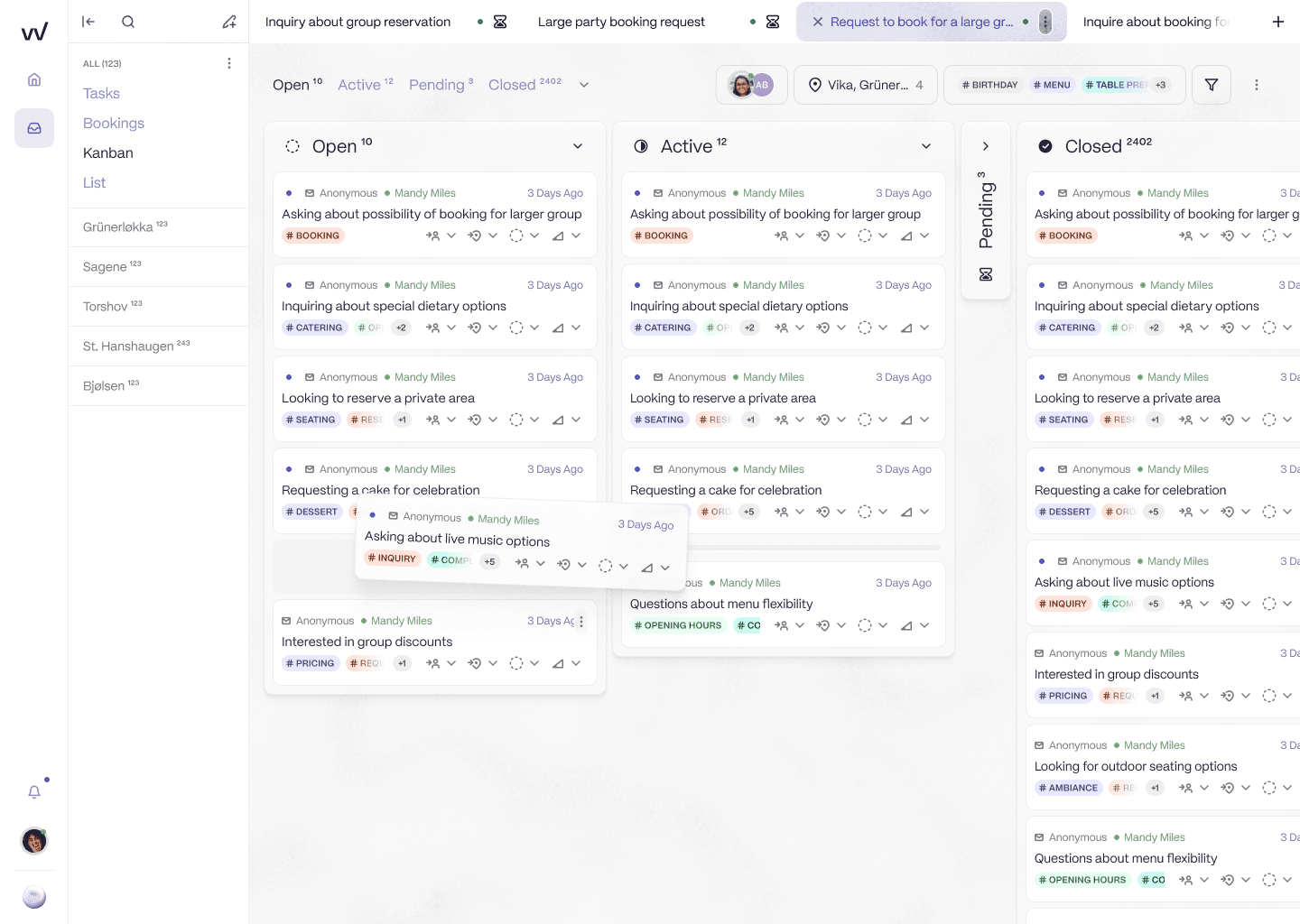
Every message is pinned to the right venue automatically. The reservations team works the threads they already know, with location handling added underneath.
One knowledge base, when a group runs many concepts
Intercom is built around a single product and a single knowledge base. For a software company with one product, that is correct. For a restaurant group running several concepts, it is a real limit: you cannot give a fine-dining wine bar and a casual high-street pizza brand their own tone, their own FAQs, and their own branding inside one Intercom knowledge base. RevVue gives each venue its own knowledge base and brand tone, learned automatically from that venue's historical Outlook or Gmail replies, so a 30-concept group sounds right for every venue rather than uniform across all of them.
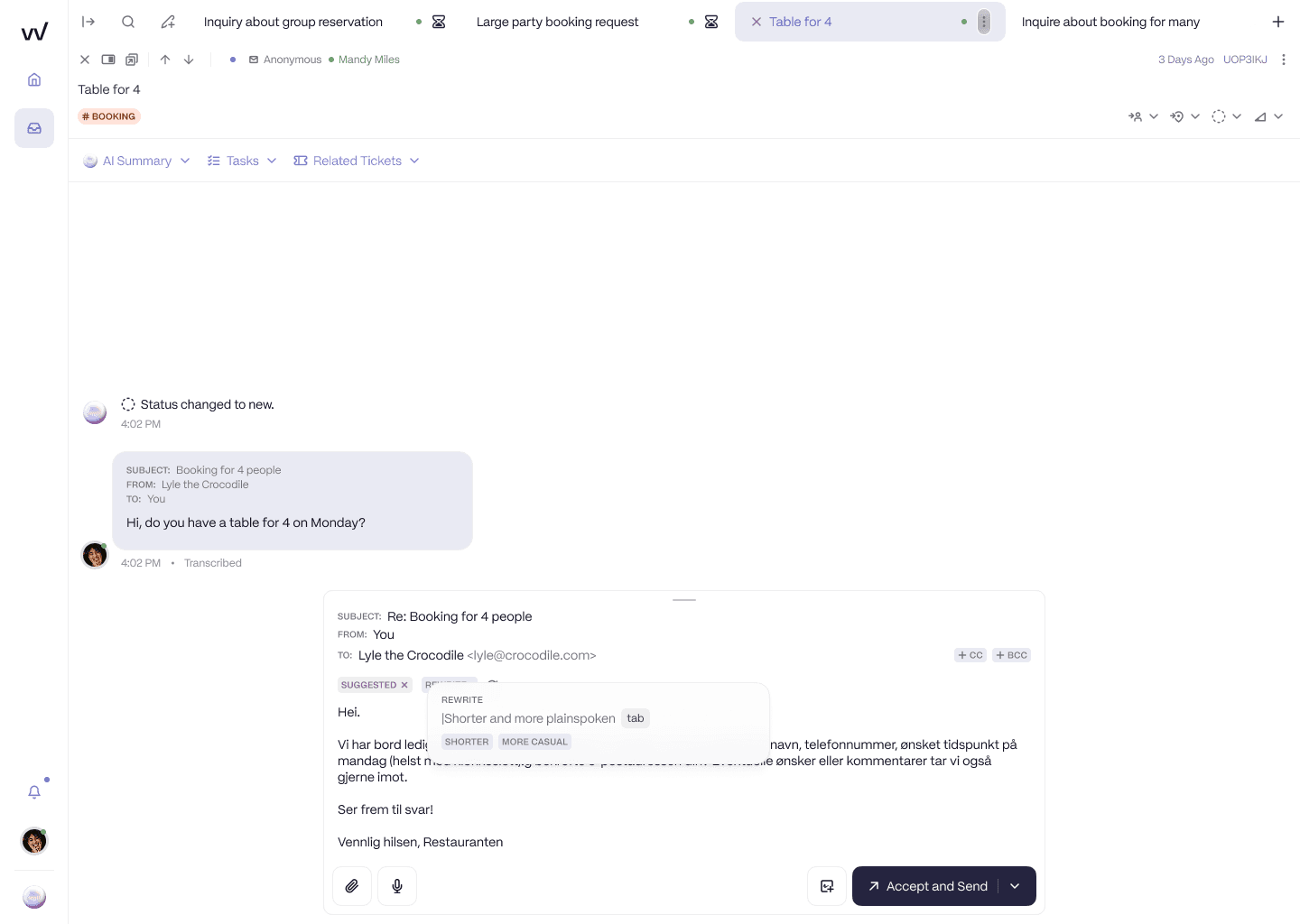
RevVue drafts the reply in each venue's own brand tone, picked up from that venue's historical emails. The team can send, edit, or rewrite with one click.
Per-seat pricing punishes a lean team
Intercom is the most expensive of the horizontal tools, at £74 or more per seat per month with AI features charged on top. Restaurant groups run small central teams and many sites, and the moment you want each site's general manager to see their own venue's inbox, every GM is another seat. Most groups respond by limiting seats and keeping GMs out, which defeats the point. RevVue prices per location, with per-venue access included, so adding a site does not mean adding a seat and a site manager sees their own inbox at no extra cost.
The watershed: a great agent that cannot book the table
This is the point that decides the comparison, and it is sharper here than with any other tool, precisely because Fin is so good. Intercom has the best general-purpose AI agent on this list. It still cannot book a table.
A booking enquiry is a transaction. Handling one means checking availability, creating the booking in SevenRooms, OpenTable, or Collins, and attaching the notes. Fin can hold a great conversation about it, but it has no booking-system integration, so when a guest asks for a table for four on Saturday, the flow looks like this even with Fin involved:
Fin reads the enquiry and drafts a reply.
A person opens the booking system in another tab.
They check availability for the requested date and time.
They confirm back to the guest.
They create the booking in the booking system.
They add any dietary or seating notes.
The conversation quality is excellent. The booking action is still entirely manual, because the agent cannot reach the booking system. That is the gap, and it does not close with a smarter agent.
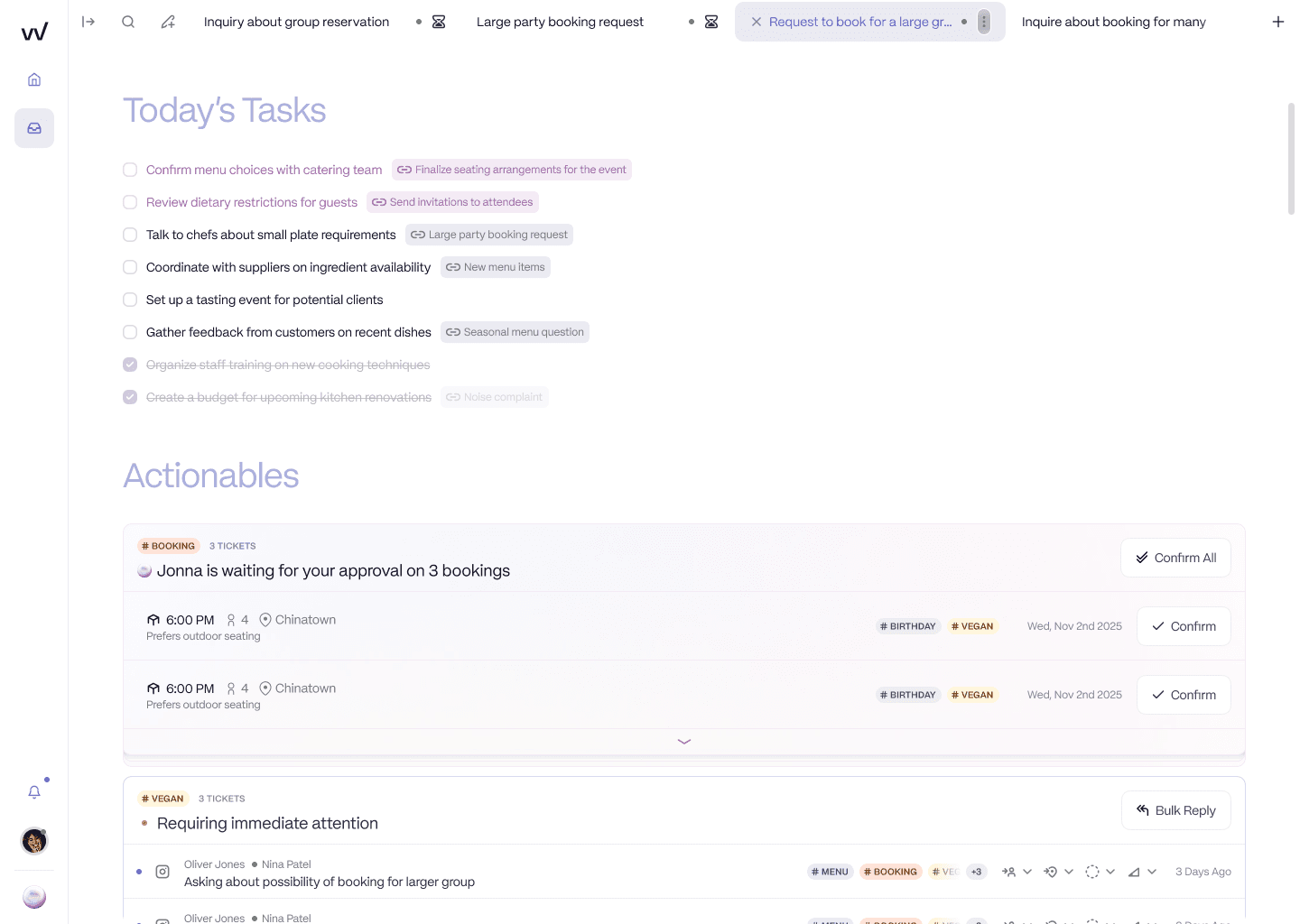
The AI completes the routine bookings and holds the rest for one-click approval, booking details already extracted. This is the action Fin cannot take.
RevVue's AI runs the whole flow inside the same conversation thread. A guest emails asking for a table for four on Saturday at 7pm, vegetarian, quiet area. The AI reads the enquiry, checks availability in the booking system, creates the booking, attaches the vegetarian and quiet-area notes, and replies confirming the table. When the guest comes back to say they are now three, not four, the AI updates the booking and confirms the amendment. For bookings above a threshold the group sets, often around eight people, the AI drafts a first response and routes the enquiry to the team instead, so a person handles the large groups and the complaints while the routine volume closes itself.
The honest framing is this: on booking enquiries, AI quality is not the differentiator. Booking-system access is. A best-in-category agent that cannot reach the booking system produces the same end state as a weaker one, a reply and a human still doing the booking by hand.
One caveat, stated plainly. RevVue's AI agent is live and in pilot across more than 60 locations in Norway, handling 15% to 35% of inbound volume autonomously, with UK pilots running now. It is not yet fully generally available in the UK. The location-aware inbox itself has been in production for over a year. The AI is something you would pilot, not assume is mature on day one.
Pricing: premium per-seat vs per-location
Intercom is the most expensive of the horizontal tools, and a fair comparison should be direct about both sides. At £74 or more per seat per month, with AI agent features charged on top, it is priced for software companies running large, well-funded support operations. RevVue is £75 per location per month.
The difference that matters is the model, not just the headline. Per-seat pricing works against a lean restaurant team: two to four people covering 20 to 50 sites, where every site GM who wants their own inbox view is another seat, so groups limit access. Per-location pricing scales with the estate rather than the headcount, and per-venue access is included.
Group profile | RevVue cost | Intercom list cost | Notes |
|---|---|---|---|
25 sites, 3-person team | £1,875/month | £222+/month for 3 seats, AI extra | Intercom cost rises with every GM who needs access, while RevVue includes per-venue access |
Add a new location | +£75/month | £0 (until someone there needs a seat) | RevVue cost tracks sites, not people |
Be fair about where Intercom's spend makes sense: if you run a large support team that genuinely uses Fin at scale, the proactive messaging, and the supervision tooling, the per-seat cost buys real capability for that workload. For the booking-enquiry inbox specifically, the per-location model fits a restaurant group better.
Side-by-side comparison
RevVue | Intercom | |
|---|---|---|
Built for | Multi-location restaurant booking enquiries | Customer support, web chat, and messaging |
Booking system integration | ||
Talks to SevenRooms, OpenTable, Collins, Design My Night, ResDiary | Yes (select systems live, SevenRooms in active development) | None, no marketplace app exists |
AI checks availability inside the thread | Yes | No |
AI creates and amends bookings inside the thread | Yes | No |
Core inbox | ||
Location assigned to every message automatically | Yes | No native location model |
Location-level reporting out of the box | Yes | Not by location |
Per-venue templates | Yes, users see only their venue's | Single library |
Internal notes and collision detection | Yes | Yes |
AI | ||
AI agent quality (general conversation) | Strong, hospitality-trained | Strongest general-purpose agent (Fin) |
Trained on hospitality context | Yes | Generic |
Brand tone learned from historical emails | Yes | Manual configuration |
Per-venue brand tone and knowledge base | Yes | Single knowledge base |
AI acts in the booking system | Yes | No |
Handles routine enquiries autonomously | In pilot, 60+ live locations in Norway, UK pilots running | Yes, for support conversations |
Channels | ||
Yes | Yes | |
Web chat | Yes (per-venue branded, launching June 2026) | Yes, native strength |
WhatsApp and social | WhatsApp launching June 2026 | Yes |
Inbound phone | Not offered | Not a core channel |
Proactive outbound messaging | Not offered | Yes, strong |
Access control | ||
Per-manager, per-venue access (no seat penalty) | Yes | Per-seat |
Reviews and surveys | ||
Google and TripAdvisor review management | Yes | Not available |
Post-visit surveys with NPS | Yes | Not available |
Pricing and implementation | ||
Pricing model | Per location per month (£75) | Per seat per month (£74+, AI extra) |
Implementation time | Days | Weeks |
Built for restaurant groups | Yes | No |
How to decide
Five questions settle it:
Is your unsolved pain customer-service and web-chat support, or booking enquiries? Support and chat keep you with Intercom. Booking enquiries point to RevVue.
Is your primary channel web chat or email? Web-chat-led operations suit Intercom's native shape. Email-led booking enquiries suit RevVue.
Do you run multiple concepts that each need their own tone? If yes, Intercom's single knowledge base will not give you that. RevVue will.
Do you need the AI to act in the booking system, or just converse? Conversing is Fin's strength. Acting in the booking system is the booking-enquiry job, and only RevVue does it.
Do you want proactive outbound campaigns, or per-location booking-enquiry handling? Outbound messaging is Intercom. Per-location booking-enquiry handling is RevVue.
Mapping the answers: web-chat-led support, outbound campaigns, or a single brand points to Intercom, and if you are weighing the full field, the best Intercom alternatives for restaurant groups cover the rest. Email-first booking enquiries, multiple brands, location-level reporting, or AI that actually books points to RevVue, run alongside Intercom rather than instead of it.
Running RevVue alongside Intercom
Most groups do not switch off Intercom. They keep it for web-chat support and proactive messaging if they use those, and run RevVue for the booking-enquiry inbox in parallel, usually email-first while any booking-system integration connects. Email forwarding from your current booking-enquiry address is the one technical step on your side. Locations are configured from a list you already have, and the AI picks up each venue's tone from 20 to 30 of your existing replies. Most groups are live within days, not months.
This pattern is not theoretical. A UK restaurant group moved its booking-enquiry workload off a horizontal helpdesk and onto a location-aware tool, after concluding the helpdesk could not report by site, route by location, or talk to the booking system.
If you want to see what that looks like on your own enquiries, bring one real message, a group booking, a complaint, a dietary question, and we will show you what RevVue would have done with it. No slides.