Collins is the exception in this category. Most booking systems automate outbound email and leave the inbound enquiry entirely to a person. Collins does not: alongside automated confirmations, deposit and pre-order requests, reminders and follow-ups, it offers an internal reservations mailbox for managing inbound enquiry email, and Access Collins Evo is now marketed as an AI booking system that answers calls around the clock. If you run one venue on private hire, that is a capable answer. The gap that remains is about multi-venue groups and the channels enquiries actually arrive on.
What Collins automates today
Collins was built by DesignMyNight for bars, pubs, event spaces and competitive-socialising venues, which are businesses where the enquiry is the product. That heritage shows.
Capability | What it covers |
|---|---|
Booking confirmations | Automated, on the enquiry being confirmed |
Deposits and pre-orders | Requested and chased automatically |
Reminders and follow-ups | Automated, on your schedule |
Branded customer email | Templated, with your look and feel, menus and photos held centrally |
Reservations mailbox | An internal inbox for managing inbound reservation email inside Collins |
Enquiry tracking | Reminders, progress tracking, packages, function sheets, invoices and VAT receipts |
Collins Evo | Marketed as an AI booking system, including handling calls around the clock |
That reservations mailbox matters, and it is worth being clear about it: Collins is not a system that ignores inbound enquiries. It is a system that put them at the centre. For a single venue running functions and large parties, the enquiry lands in Collins, gets tracked against a booking, carries a package and a deposit, and produces a function sheet at the end. That is a genuinely joined-up workflow, and it is more than most reservation platforms attempt.
What Collins does not automate
Because Collins does more than its peers here, the honest gap is narrower and more specific. It is not "Collins cannot handle enquiries." It is three things.
The channels enquiries actually arrive on. The reservations mailbox handles email routed into Collins. It does not handle the Instagram DM, the WhatsApp message to the number in the footer, the message to a manager's personal address, or the enquiry that came through a general contact form on your own site. For a bar group, that traffic is substantial and none of it reaches Collins.
Group-wide routing across venues. Collins is organised around venues and their diaries. A group running eight sites tends to end up with per-venue mailboxes and per-venue processes, rather than one queue that routes by location and lets an area manager see every enquiry across the estate in one place, with response times compared site by site.
Replies written in each venue's own voice. Templates are templates. They are excellent for confirmations, deposits and reminders, where the content is structured. They are weaker on the open question, the one asking whether the mezzanine can take 60 standing with a pre-order and an invoice, where a good answer draws on that venue's capacity, menu and policies and reads like a person wrote it.
So the split is not automated versus manual. It is that Collins automates the enquiry once it is inside Collins, on email, for one venue. The messages that never get there, and the group-level view across all of them, are still yours to solve.
What actually happens to an enquiry Collins cannot answer
Here is a realistic journey at a group running Collins properly.
An enquiry arrives by Instagram DM on a Saturday night asking about the mezzanine for a 60-person leaving do in November, with a pre-order and an invoice rather than a card.
Nobody is on Instagram. Collins never sees it, because it arrived on a channel Collins does not cover.
On Monday the marketing assistant spots it and forwards it to the events address.
Somebody opens Collins, checks whether the mezzanine is free on the dates offered, its capacity standing versus seated, and the November minimum spend.
They provisionally hold the space and re-key the company name, contact, headcount and the invoicing note.
They write the reply with options and a quote.
Collins takes over properly from here: deposit request, pre-order, reminders and the function sheet all run on its automation.
The organiser replies from a different email address, which starts a second thread nobody links to the first.
Steps four to seven are the part Collins does well, and once the enquiry is inside it the automation is genuinely strong. The loss happens at steps one to three, roughly 40 hours before Collins ever hears about the enquiry, and at step eight, where the conversation fragments across channels the system does not span. One operations director described the inbox behind that gap as "a black hole, no KPIs, no response rate, nothing."
The cost is the same as everywhere else. A roughly 40-venue entertainment group lost a single booking worth £40,000 because the enquiry arrived outside working hours and nobody replied in time. A three-site pizza group put it more bluntly about a 30 to 40 cover enquiry: "It just sat there. No one saw it. They went somewhere else."
Why the gap exists
Collins closed the transactional-versus-conversational gap further than any of its peers, and the reason the remaining gap exists is a boundary question rather than a capability one.
A booking system's natural boundary is the venue and its diary. Everything Collins automates lives inside that boundary: this venue, this space, this booking, this deposit. Its reservations mailbox extends the boundary to email addressed to that venue, which is a real step beyond what SevenRooms, OpenTable or ResDiary attempt.
What sits outside the boundary is everything that is not yet attached to a venue's diary. A DM has no venue on it until somebody reads it. A message to a manager's personal address is invisible. An area manager's question, which site is slowest to answer a party enquiry this month, spans every diary at once and therefore sits above all of them.
Answering that needs a layer that starts from the message rather than from the booking: one that can take any inbound text on any channel, work out which venue it belongs to, then check that venue's diary. Collins starts from the diary and reaches outwards to email. The two approaches meet in the middle and leave a real gap on either side of it.
What automating the enquiry side looks like
The gap closes when the enquiry and the function diary are the same surface, whatever channel the enquiry arrived on. This is what RevVue does, and it is easier to show than to describe.
Every enquiry is tagged to the venue and the space it concerns, whether it came by email, DM or WhatsApp. An area manager sees all eight sites in one queue instead of opening eight mailboxes to find out where the estate is slow.
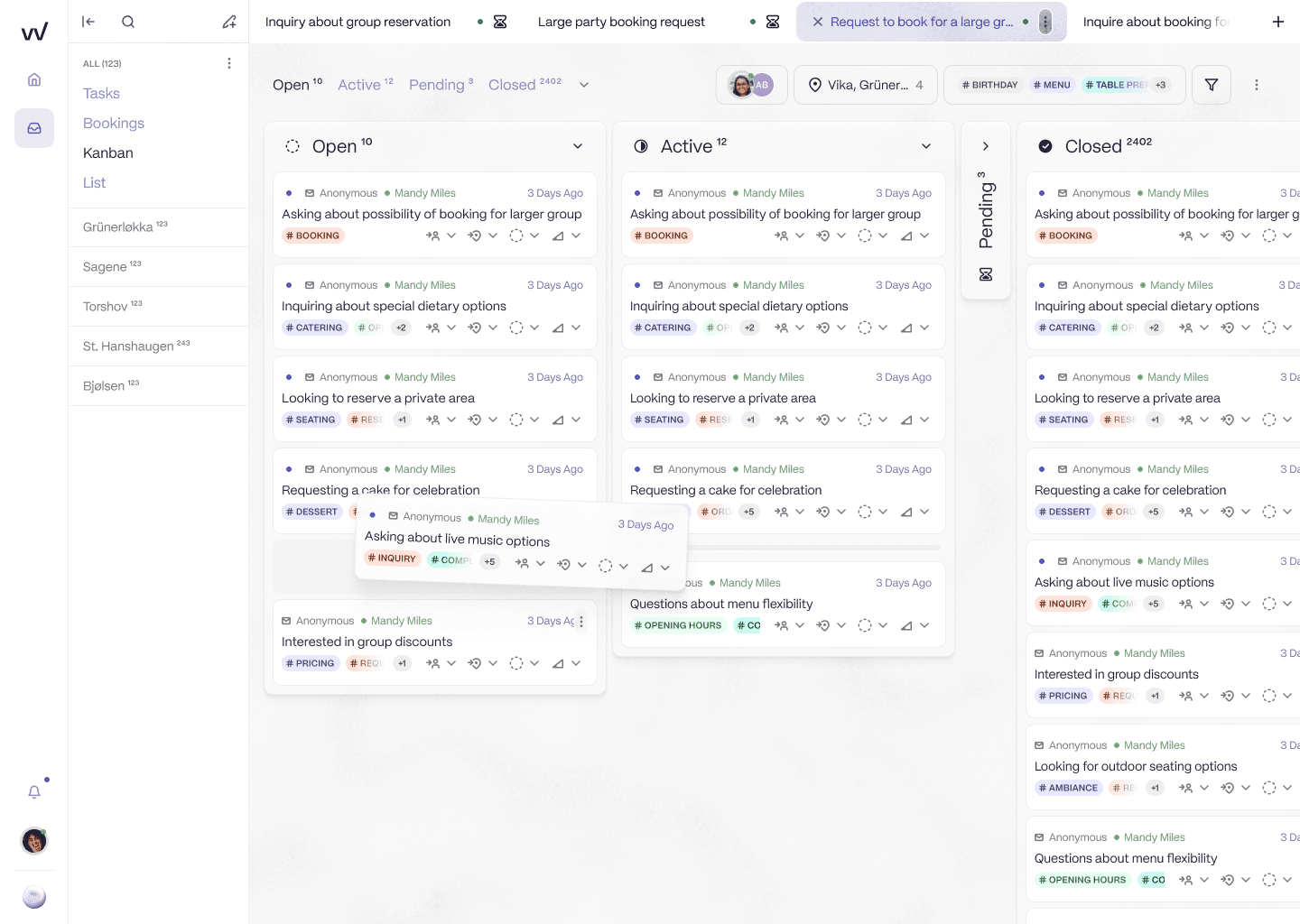
One queue across the whole group, routed by venue, rather than a mailbox per site.
The AI drafts the reply in that venue's voice, using its own capacities, minimum spends and what each room can seat. That is the part a template struggles with, because a function enquiry is an open question rather than a structured confirmation.
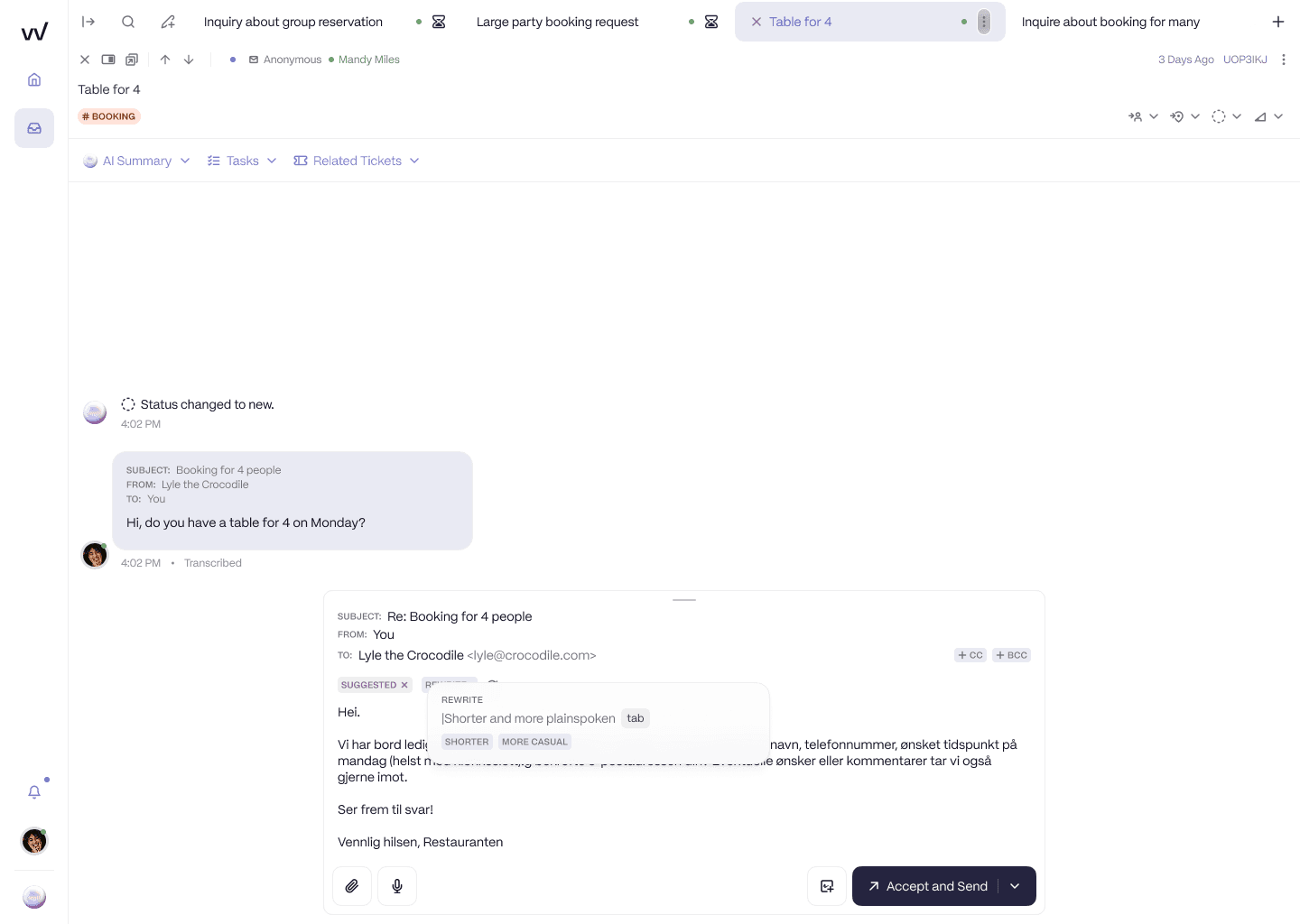
A drafted reply carrying the venue's own capacities and terms, ready to approve.
Routine questions are answered on arrival, including at 10pm on a Saturday when the DM lands, and the enquiries worth thousands are acknowledged within moments and held in a queue a person works through rather than waiting for Monday.
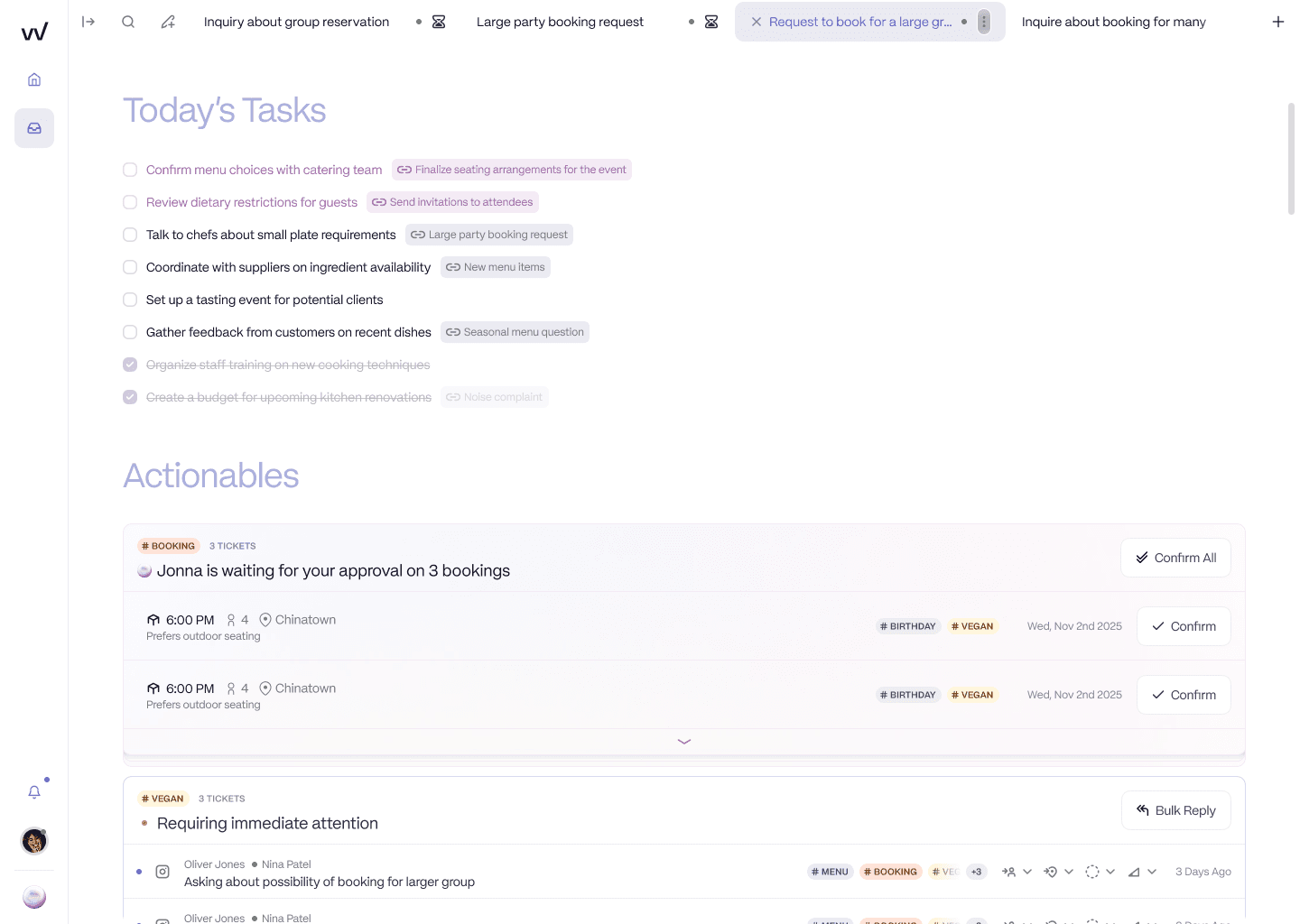
The large-event enquiries held, prepared and visible, instead of sitting in an unwatched channel.
And because every enquiry belongs to a venue from the moment it arrives, private hire finally has a funnel across the group: enquiry volume, reply speed and conversion by site, including the enquiries that never made it into Collins to be counted.
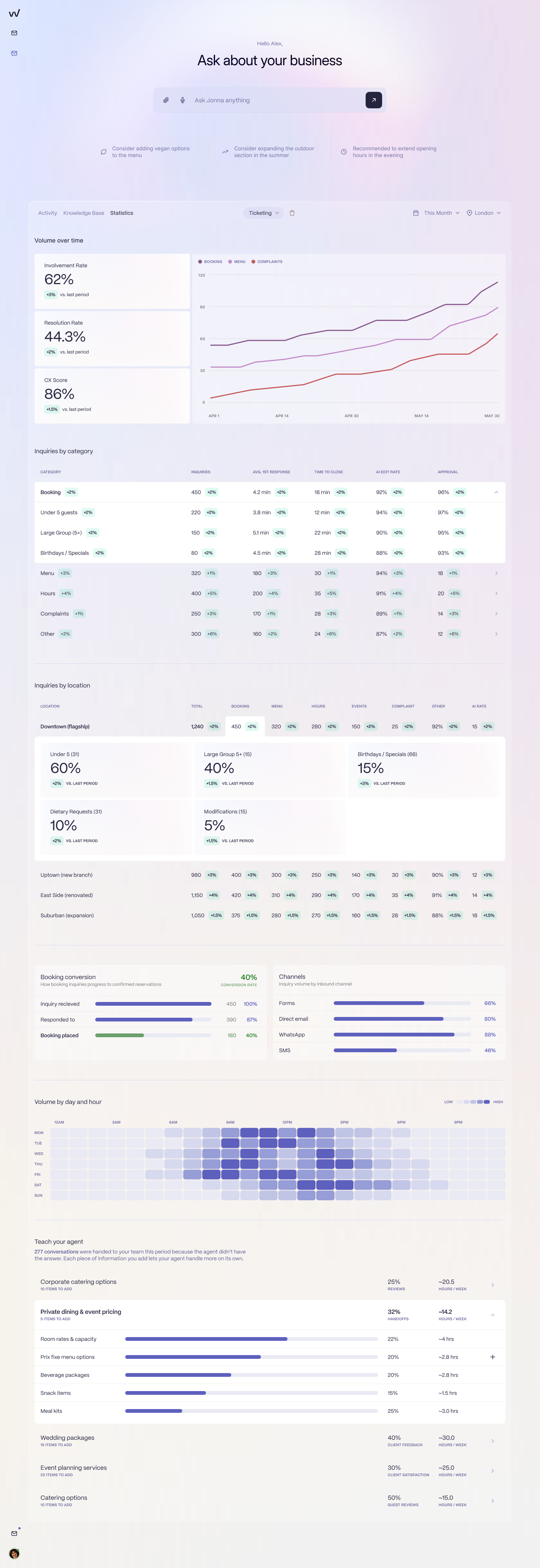
Enquiries, response times and conversion by location, including the ones that never reached the booking system.
An honest note on where RevVue is today
RevVue's Collins integration is on the roadmap and not live. That is the honest status, and it matters more on this page than most, because Collins is the one system in this category already doing part of this job well. Venues run an email-only pilot now, which covers the channel and group-level gaps described above: routing by location, instant acknowledgement out of hours, AI-drafted replies in each venue's tone, and reporting across every site. The direct booking-system connection deepens it when it lands. The UK AI is in pilot.
To be straight about the choice: if you run a single venue and your enquiries already arrive by email, Collins on its own covers a lot of this, and you should configure what you are paying for before adding anything. The case for a separate enquiry layer gets stronger the more venues you run and the more of your enquiries arrive somewhere other than an inbox.
This is the move the Brasilia Group made, off a horizontal helpdesk and onto an inbox built for the job. Their founder, Nikolaos Kiosses, put it plainly: "The transition from Zendesk to RevVue has been a game changer."
Because party and private-hire threads are the highest-value work a venue group handles, triaging high-value group bookings is the most relevant read next, and if you are also weighing a helpdesk, does Zendesk integrate with Collins answers that directly. To see what the AI would have said to a real enquiry your team received last week, book 20 minutes.
Frequently asked questions
What email does Collins automate?
Collins automates booking confirmations, deposit and pre-order requests, reminders and follow-ups, all in branded templates you control, and it produces function sheets, invoices and VAT receipts off the back of a booking. Unusually for a booking system, it also provides an internal reservations mailbox for managing inbound reservation email inside Collins, and Access Collins Evo is marketed as an AI booking system that handles calls around the clock.
Does Collins handle inbound booking enquiries?
Yes, and this is where it differs from most reservation platforms. Enquiries routed to its reservations mailbox are tracked inside Collins against packages, deposits and pre-orders. The limits are scope rather than capability: it covers email addressed into Collins for a given venue, so enquiries arriving by Instagram DM, WhatsApp, a general website form or a manager's personal address do not reach it, and a group gets per-venue mailboxes rather than one queue routed across every site.
What is still missing for a multi-venue group?
Three things. Channel coverage, since a large share of enquiries arrive on social and messaging apps that never reach the booking system. Group-level routing and reporting, so an area manager can see every enquiry across the estate and compare response times site by site. And replies written in each venue's own voice, which templates handle well for structured confirmations and less well for an open question about capacity, menus and minimum spend.
Should I add anything if I already run Collins?
If you run a single venue and your enquiries already arrive by email, configure Collins fully first, because it covers a lot of this. The case for a separate enquiry layer grows with the number of venues you run and the share of enquiries arriving outside email. RevVue's Collins integration is on the roadmap, with an email-only pilot available now that adds cross-channel capture, group-wide routing by location and reporting on the enquiries the booking system never sees.