Intercom is one of the strongest customer-messaging platforms available, and its AI agent Fin is genuinely good at resolving conversations without a human. For a restaurant group, it is still the wrong shape. Intercom is built around web chat for software companies with a large support operation, while booking enquiries in UK hospitality arrive mostly by email, from people who are not logged in to anything. And no matter how good the AI is, it cannot hold a table.
What Intercom is genuinely good at
Do not dismiss this product. If a restaurant group has a real customer-service operation, Intercom does several things better than anything else on the list.
Fin resolves conversations autonomously. It reads your help content and past conversations and answers properly, rather than deflecting to an article. On repetitive questions, opening hours, allergen policies, how to change a gift-card order, it will genuinely clear volume without a person.
The messaging surface is excellent. Intercom pioneered the in-product messenger, and if you run a website where people are already browsing, catching a question at that moment is worth something. Proactive messages and targeted campaigns work well.
And the reporting is mature: conversation volumes, resolution rates, response times and CSAT, broken down properly. For a group with a central customer-care team fielding complaints, feedback and gift-card problems, that is a real capability.
If your problem is customer service, Intercom is a credible purchase. Read on if your problem is bookings.
Where it breaks for a restaurant group
Three structural issues, and none of them is fixable by configuration.
It is chat-first in an email-first business. UK booking enquiries arrive by email, from a group organiser writing on a Sunday evening, or through a website contact form that lands in a mailbox. They are long, detailed and asynchronous. Intercom can handle email, but the product's centre of gravity is a live chat widget, and a chat widget is not where somebody plans a 20-person Christmas lunch.
There is no concept of a venue. Intercom's model is one workspace, one product, one set of customers. A restaurant group is six or 20 venues, each with its own menu, capacity, tone and manager. Getting per-venue routing and per-venue tone out of a single-workspace product means tags and workarounds, and reporting by site is awkward at best.
Fin cannot see your diary. This is the one that matters. Fin is grounded in your help content and conversation history, which means it can explain your cancellation policy beautifully and cannot tell a guest whether Friday at 7.30 is free. The most capable AI in the category has no line into the one system that answers the question guests are actually asking.
There is also the price. Intercom is positioned as a premium platform for software companies with software margins, and hospitality does not have those margins.
The test: what happens to a booking enquiry
Here is one enquiry at a group running Intercom properly.
A group organiser emails the reservations address on a Sunday evening: 20 people for a Friday in December, two vegans, and a question about whether the private room is available.
Intercom receives it as a conversation and routes it by whatever rule you configured.
Fin reads it. It can answer the menu question from your help content. It cannot answer the availability question, so it hands over to a human.
On Monday an agent opens the conversation.
They open the booking system in another tab, because Intercom has no view of it, and check whether 20 can be seated on that Friday and whether the private room is free.
They check the December set menu and what the kitchen does about vegan covers at that size.
They reply, then re-key the whole booking into the booking system by hand.
The guest replies: "Can we make it 24?" Twenty-four may not fit the room. Steps 5 to 7 run again.
Step three is the honest summary of Intercom for hospitality. The AI does the part that was already easy and stops precisely where the value is. One operations director described the inbox behind this workflow as "a black hole, no KPIs, no response rate, nothing."
A roughly 40-venue entertainment group lost a single booking worth £40,000 because the enquiry arrived outside working hours and nobody replied in time. A three-site pizza group put it more bluntly about a 30 to 40 cover enquiry: "It just sat there. No one saw it. They went somewhere else."
Who Intercom actually suits
Being fair about the segmentation matters more than winning the argument.
Buy Intercom if your group runs a genuine customer-service operation at scale: a delivery brand with order problems, a large gift-card and voucher business, a loyalty app with account queries, or an e-commerce arm where customers are logged in and browsing. In those cases Fin will resolve a large share of contacts and pay for itself.
Do not buy Intercom if your inbound is mostly booking enquiries. You would be paying a premium price for a chat-first product to do email triage, and then doing every booking by hand anyway. A cheaper shared inbox would perform the same job, and a purpose-built booking-enquiry tool would do it properly.
The awkward middle is a group with both. The honest answer there is that these are two different problems and one tool will not solve both well. Splitting them is usually cheaper than compromising on either.
If you want the specifics for your stack, does Intercom integrate with SevenRooms and does Intercom integrate with OpenTable answer the integration question directly.
What a booking-enquiry inbox does differently
The gap closes when the inbox and the diary are the same surface, so the enquiry is answered and booked in one place. This is what RevVue does, and it is easier to show than to describe.
Every enquiry is tagged to the venue it is for automatically, so a request for one site is never answered with another site's availability. The team works from one queue by location instead of tags approximating venues in a single workspace.
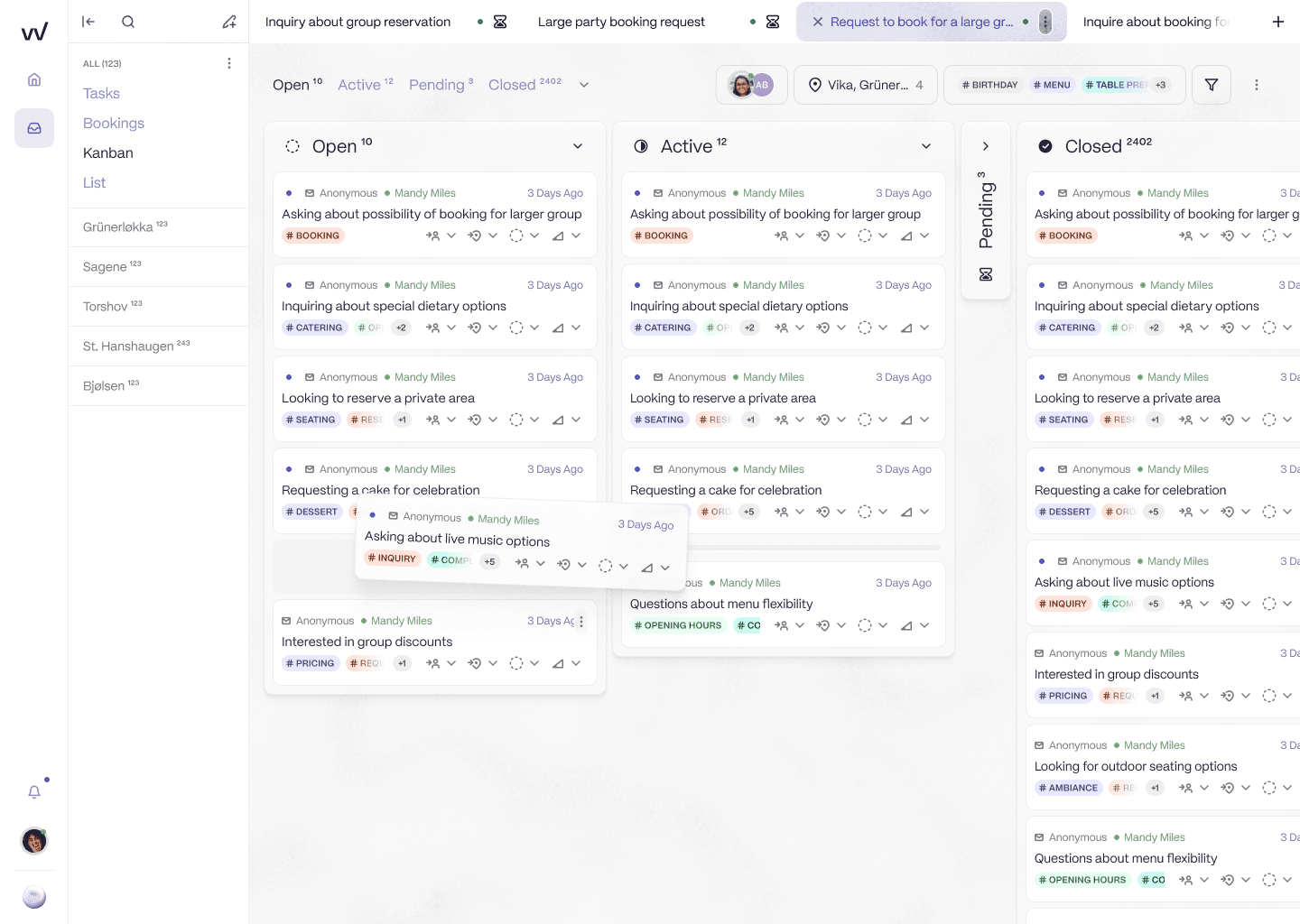
One queue per venue, so a group stops using tags to stand in for sites.
The AI drafts the reply in that venue's own tone, grounded in its menus, policies and FAQs. That is a step beyond answering from a central help centre, because a 20-cover December enquiry needs this venue's set menu and this venue's private room.
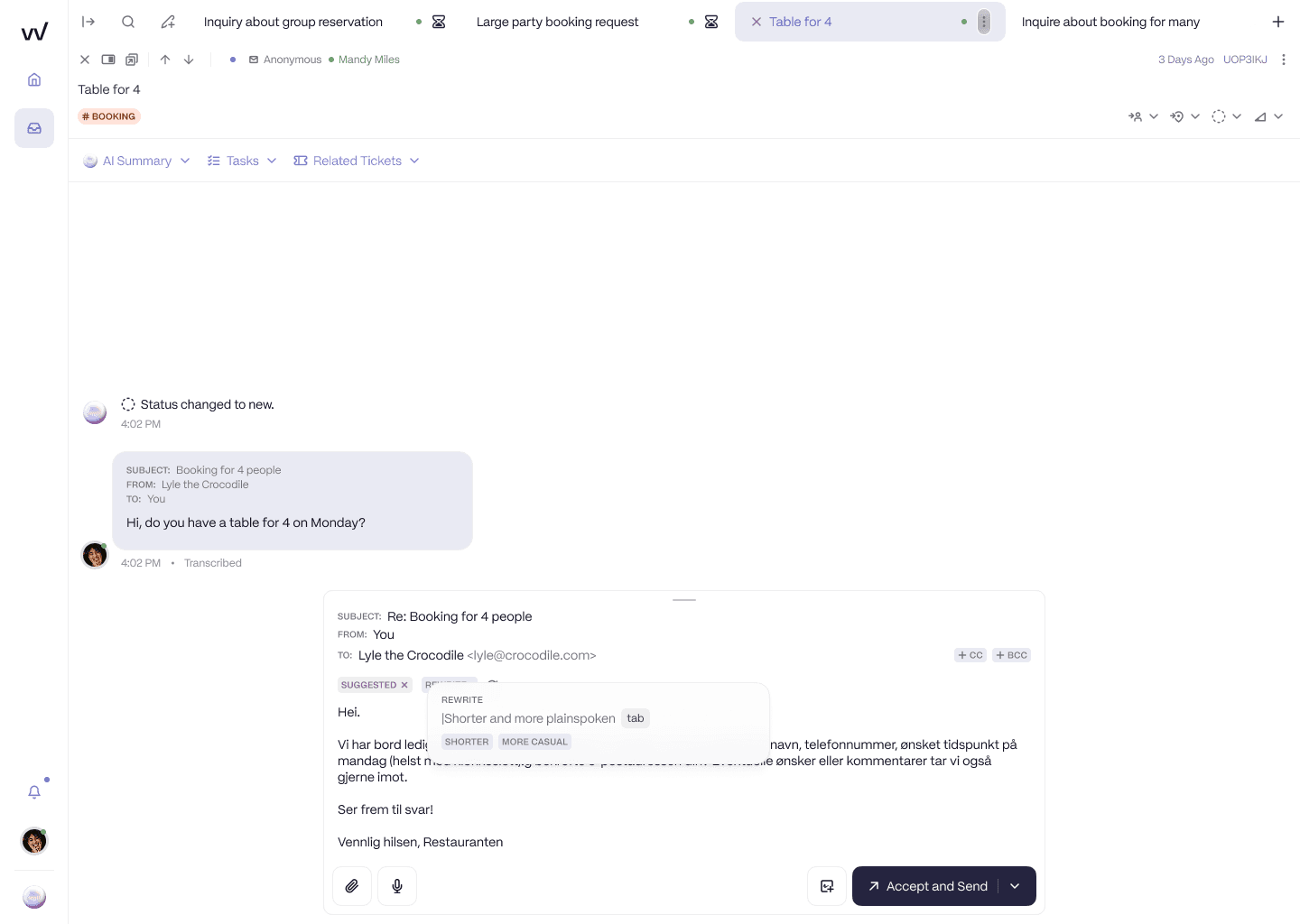
The draft arrives in the venue's own voice, ready for a person to approve or adjust.
Because it connects to the booking system, the AI does the step Fin cannot: it checks availability and prepares the booking inside the same thread. Routine requests are handled on arrival, including on a Sunday evening, and the high-value ones are acknowledged instantly and held in a queue a person actually works.
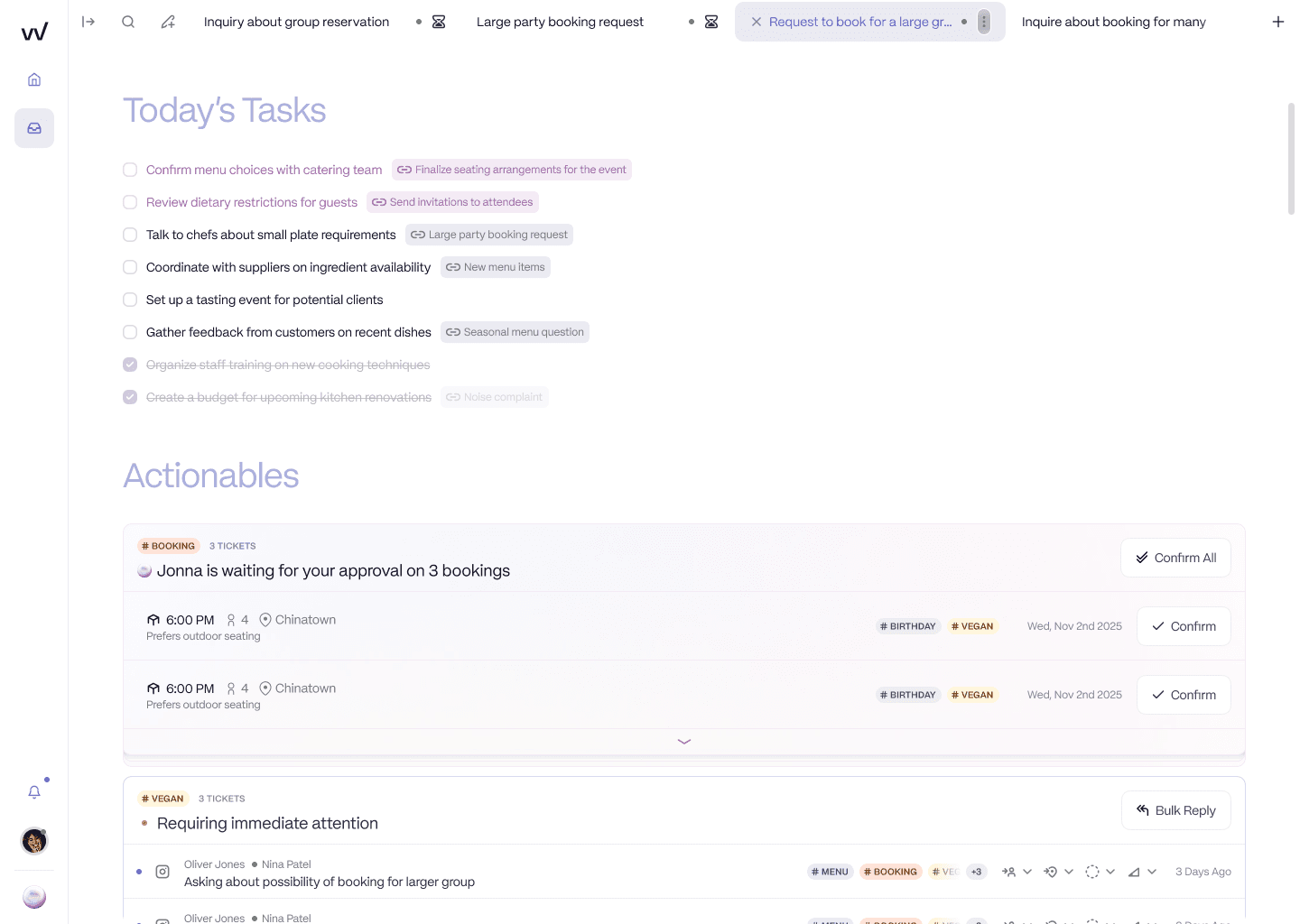
High-value bookings acknowledged and prepared, waiting for approval instead of sitting unread.
And because every enquiry is tracked by venue, reporting finally answers the question a group actually asks. Intercom reports on conversations and resolution rates, which is the right measure for support and the wrong one for bookings.
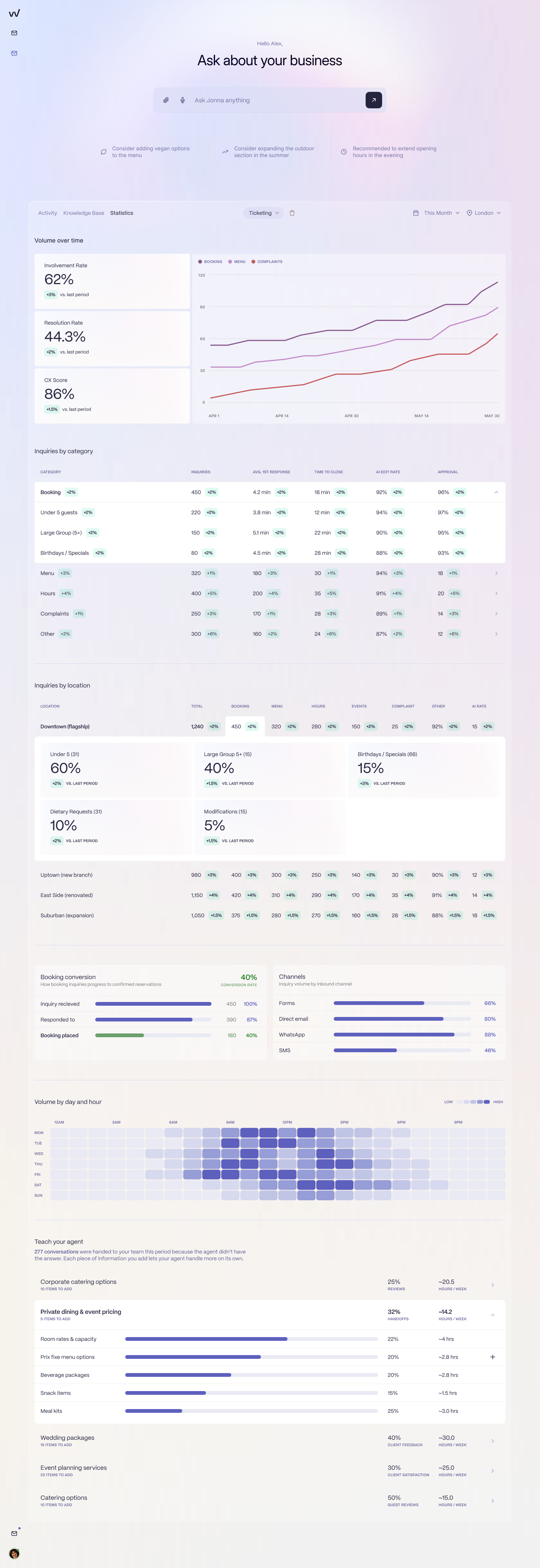
Response rate, volume and conversion by location, rather than conversations closed.
An honest note on where RevVue is today
Being straight about status: RevVue's SevenRooms, OpenTable and DesignMyNight integrations are in active development, and the other booking systems are on the roadmap with an email-only pilot available now. That pilot already delivers what is shown above: location-aware routing, instant acknowledgement, AI-drafted replies in each venue's tone, high-value enquiries surfaced, and reporting by location. The UK AI is in pilot.
This is the move the Brasilia Group made, off a horizontal helpdesk and onto an inbox built for the job. Their founder, Nikolaos Kiosses, put it plainly: "The transition from Zendesk to RevVue has been a game changer."
If you are comparing the category more broadly, shared inbox software for restaurants is the wider view. To see what the AI would have said to a real enquiry your team received last week, book 20 minutes.
Frequently asked questions
Is Intercom good for restaurants?
It is good for restaurant customer service and poorly suited to booking enquiries. Fin resolves repetitive questions well, the messenger is excellent, and the reporting is mature, so a group with a real support operation gets value. But Intercom is chat-first while UK booking enquiries are email-led, it has no concept of a venue, and Fin cannot see your diary, so every actual booking is still done by hand in another system.
Can Fin handle booking enquiries?
Only the parts that do not involve the diary. Fin is grounded in your help content and past conversations, so it can explain menus, policies and opening hours accurately. It has no connection to a booking system, so it cannot check whether a date is free, hold a table or create a reservation. On a booking enquiry it answers the easy half and hands the valuable half to a person.
Is Intercom too expensive for a restaurant group?
Usually, if bookings are the job. Intercom is priced as a premium platform for software companies, and paying that to do email triage while your team still keys every booking in by hand is poor value. It becomes defensible when you have genuine support volume, such as a delivery brand, a large gift-card operation or an e-commerce arm.
What works better for booking enquiries?
Something that treats a venue as a first-class concept and connects to the diary. RevVue routes each enquiry to the right site, drafts replies in that venue's tone, checks availability and prepares the booking inside the conversation, and reports by location. Its SevenRooms, OpenTable and DesignMyNight integrations are in development, with an email-only pilot available now.