If your group runs on Google Workspace and your enquiries already arrive at a shared Gmail address, Hiver asks less of your team than any other option here. Nobody migrates, nobody learns a new interface, and overnight you get assignment, internal notes, SLA rules and reporting on that mailbox. Against an unmanaged shared inbox that is a genuine step up. It is also still a mailbox, and its structure is Gmail's structure: mailboxes, labels and rules. A label is not a venue, and none of it can open your diary.
What Hiver is genuinely good at
Adoption is close to free. This is the real argument for Hiver and it should not be undersold. Changing software in hospitality is hard, because the people using it are busy, part-time and mid-service. Hiver sits inside Gmail, so there is no migration, no new login and no training day. A team that has resisted every helpdesk you have proposed will use this, because it looks like the thing they already use.
It fixes accountability immediately. Assignment, internal notes that guests never see, collision detection, SLA rules and response-time reporting on bookings@. If your current problem is that nobody owns the shared inbox and messages get missed or answered twice, that is solved on day one.
Harvey helps with the routine. Hiver's AI bot suggests relevant templates, closes conversations and marks spam, and Hiver has been adding further AI agents. On repetitive enquiries that removes real keystrokes.
The integration list is broad. More than 100 apps including Salesforce, HubSpot, QuickBooks, Okta, Jira, Slack, NetSuite, Shopify and Asana, plus a Zapier connector and the Hiver API.
Where it breaks for a restaurant group
A label is not a venue. Hiver inherits Gmail's model, so a group running six restaurants ends up with either six shared addresses or one address with a label per site. Neither gives you per-venue tone in replies or a clean per-site view of response time and conversion. There is no native concept of which site an enquiry belongs to, which means a person makes that judgement on every message.
There is no line into the diary. Hiver can make the email accountable. It cannot check availability, hold a table or create a booking. Every enquiry is handled twice: once in Gmail to reply, once in the booking system to book.
One point of precision, because Hiver's own marketing invites confusion. Hiver publishes a hospitality help-desk page that mentions integrating with booking engines and guest-management systems. That is general copy aimed largely at hotels, and what backs it is Hiver's 100-plus business apps, its Zapier connector and its API rather than any named restaurant diary. The accurate statement is not that Hiver ignores hospitality. It is that no restaurant booking system appears in Hiver's app library, and connecting one means Zapier or a custom build, neither of which lets Hiver check availability or create a booking.
Harvey works on conversations. Like every AI in this category, it is grounded in your email and templates. It can surface the right template for a large-party enquiry and cannot tell you whether the back room is free.
The test: what happens to a booking enquiry
Here is one enquiry at a group running Hiver well.
A regular emails
bookings@asking for their usual table for six on a Friday in three weeks, mentions they always sit in the back room, and asks whether the sommelier is in that night. Hiver assigns it.An agent opens it in Gmail and reads it.
They work out which of the six venues "usual" refers to, because the shared address covers all of them.
They open the booking system in another tab, because Hiver cannot see the diary or the guest record.
They look up the guest to find which table "usual" means, check whether it is free that Friday for six, and check the rota for the sommelier.
They create the booking, re-keying the name, date, time, party size, the table preference and the note about the wine.
They switch back to Gmail, write the reply and close the conversation.
The guest replies: "Make it eight, and can we do the tasting menu?" Eight will not fit the back-room table. Steps 4 to 7 run again.
Steps one and seven are Hiver working exactly as intended. Steps three to six are the work, and Hiver is not present for any of it. One operations director described the inbox behind this workflow as "a black hole, no KPIs, no response rate, nothing." Hiver fixes the part about who owns the email. It cannot report on covers, because it never sees one.
A roughly 40-venue entertainment group lost a single booking worth £40,000 because the enquiry arrived outside working hours and nobody replied in time. A three-site pizza group put it more bluntly about a 30 to 40 cover enquiry: "It just sat there. No one saw it. They went somewhere else."
Who Hiver actually suits
Buy Hiver if you are on Google Workspace, your enquiries arrive at a shared Gmail address, you run one or two sites, and your problem is ownership rather than volume. It is the cheapest, fastest fix available and your team will actually adopt it.
Buy Hiver as a stopgap if you know you need something purpose-built but cannot change systems this quarter. It costs little, it improves accountability immediately, and it does not lock you in.
Do not buy Hiver if you run several venues and expect it to handle bookings. You will get six shared addresses or a label scheme, every booking still keyed in by hand, and no reporting that connects enquiries to covers.
And be careful reading Hiver's hospitality marketing. The booking-engine language is general, aimed largely at hotels, and does not mean a restaurant diary is supported.
For the specifics on your stack, does Hiver integrate with SevenRooms and does Hiver integrate with ResDiary answer that directly.
What a booking-enquiry inbox does differently
The gap closes when the inbox and the diary are the same surface, so the enquiry is answered and booked in one place. This is what RevVue does, and it is easier to show than to describe.
Every enquiry is tagged to the right venue automatically, so a request for one site is never answered with another site's availability. The team works from one queue by location rather than labels standing in for venues.
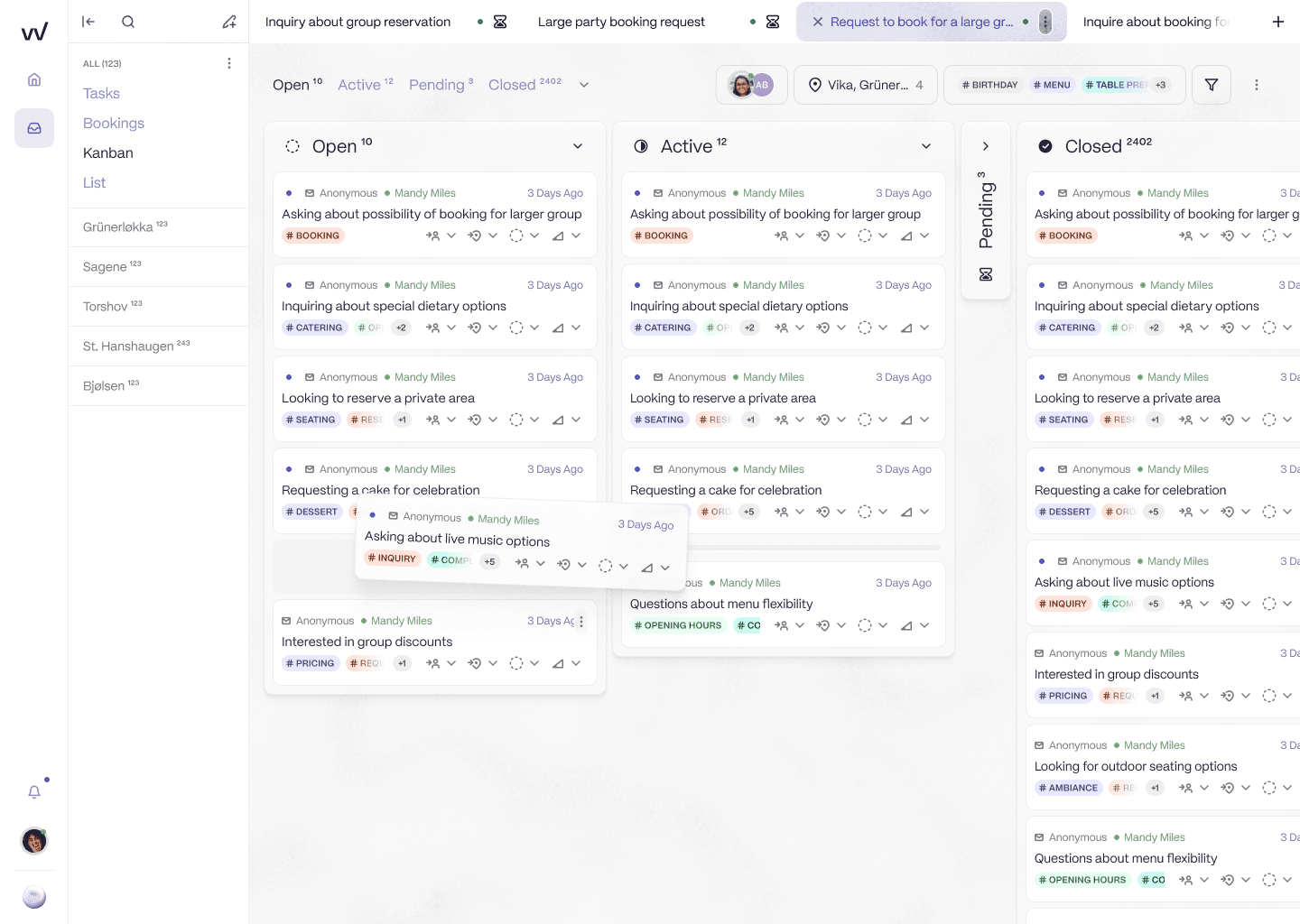
One queue per venue, so nobody has to work out which restaurant a message is about.
The AI reads each enquiry and drafts the reply in that venue's own tone, grounded in its menu, policies and FAQs. That is a step beyond suggesting a template, because the draft already contains the specifics for the site the guest wrote to.
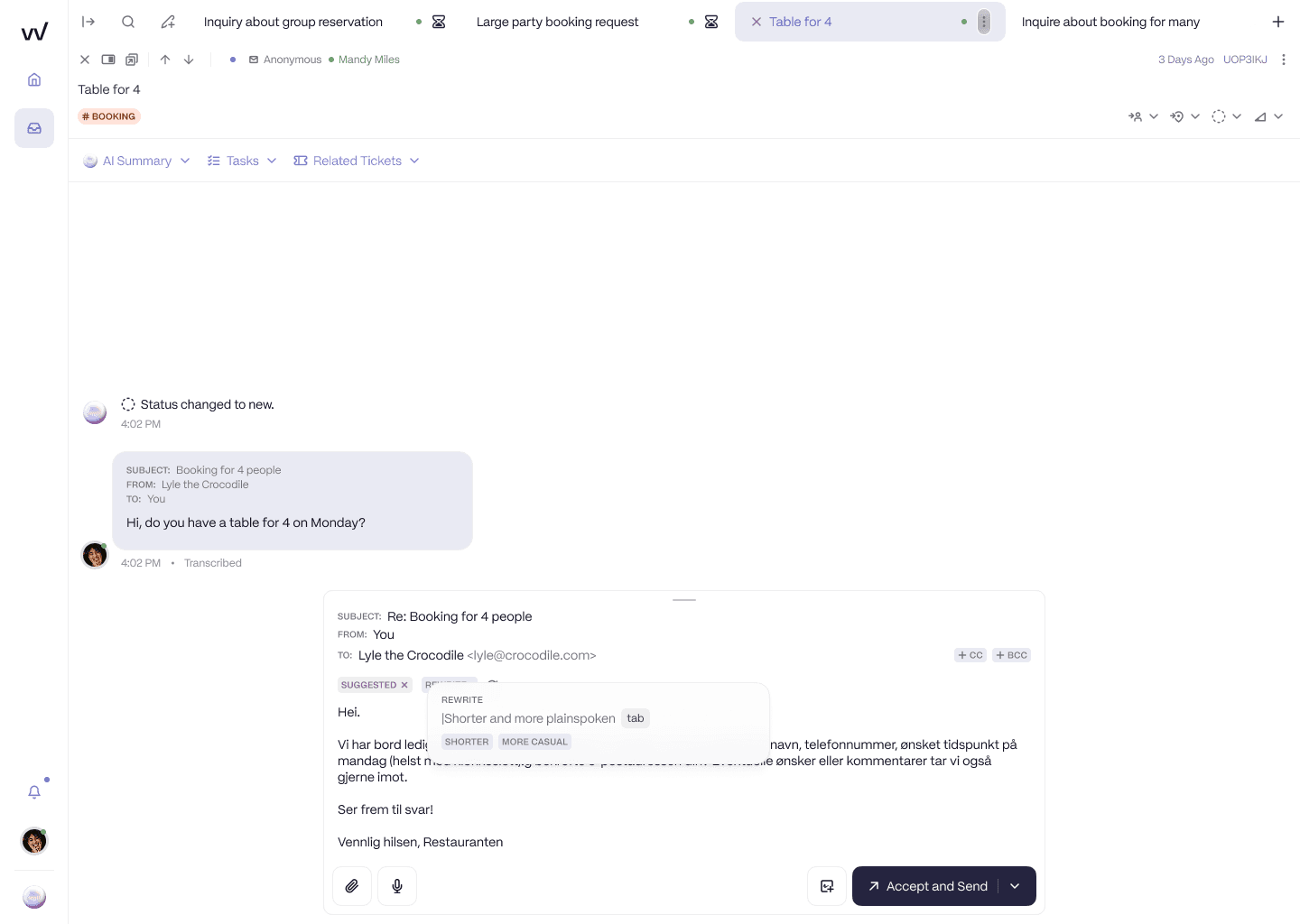
The AI drafts the reply in the venue's voice and waits for one-click approval.
Because it connects to the booking system, the AI does the step Harvey cannot: it checks availability and prepares the booking inside the same thread. Routine requests are handled on arrival, and the high-value ones are acknowledged instantly and held in a prioritised queue for a person to nurture.
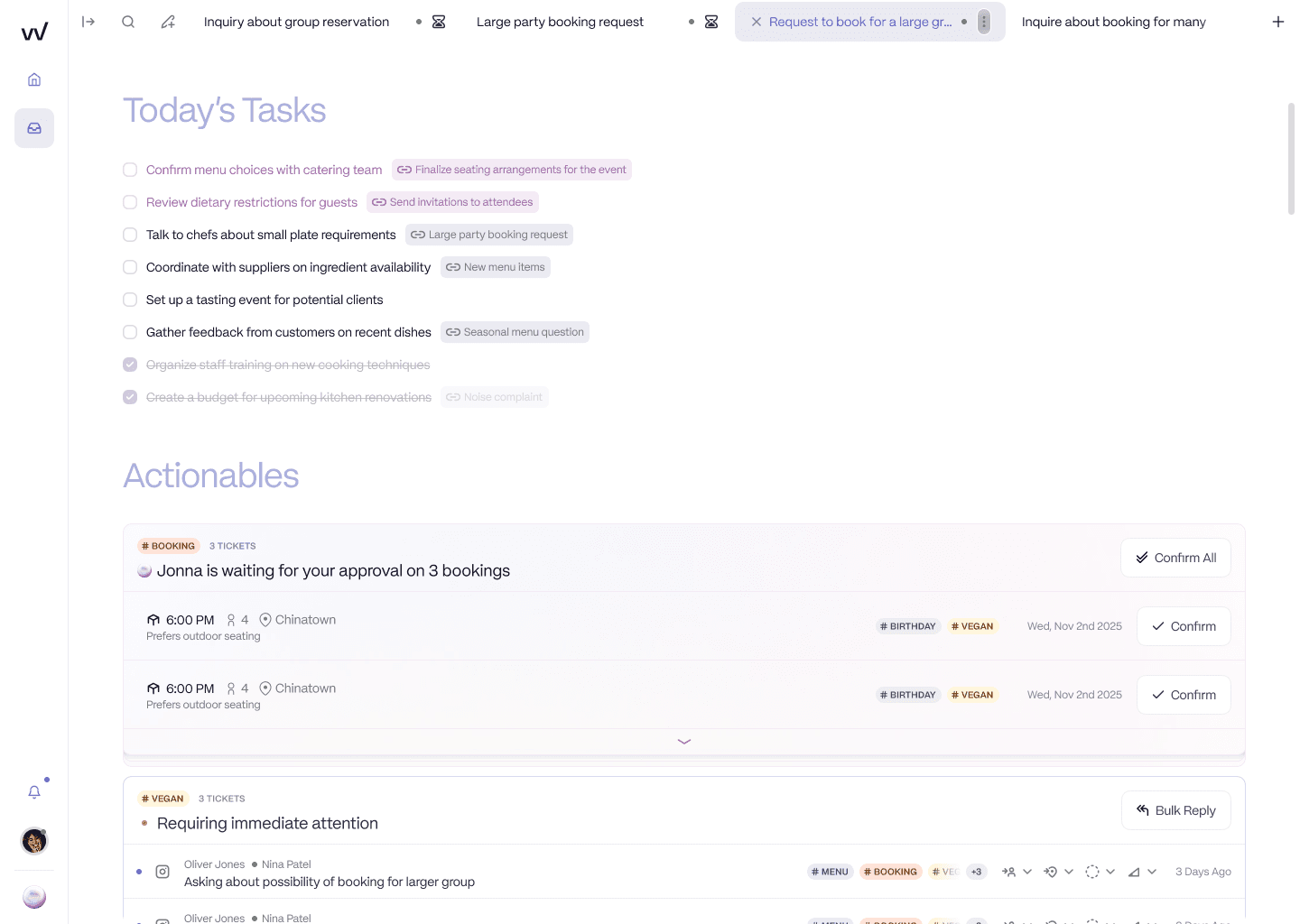
High-value bookings the AI has acknowledged and prepared, waiting in a queue the team actually works.
And because every enquiry is tracked by location, the black box becomes a dashboard. Hiver reports on mailbox SLAs and response times, which measures the email and not the business.
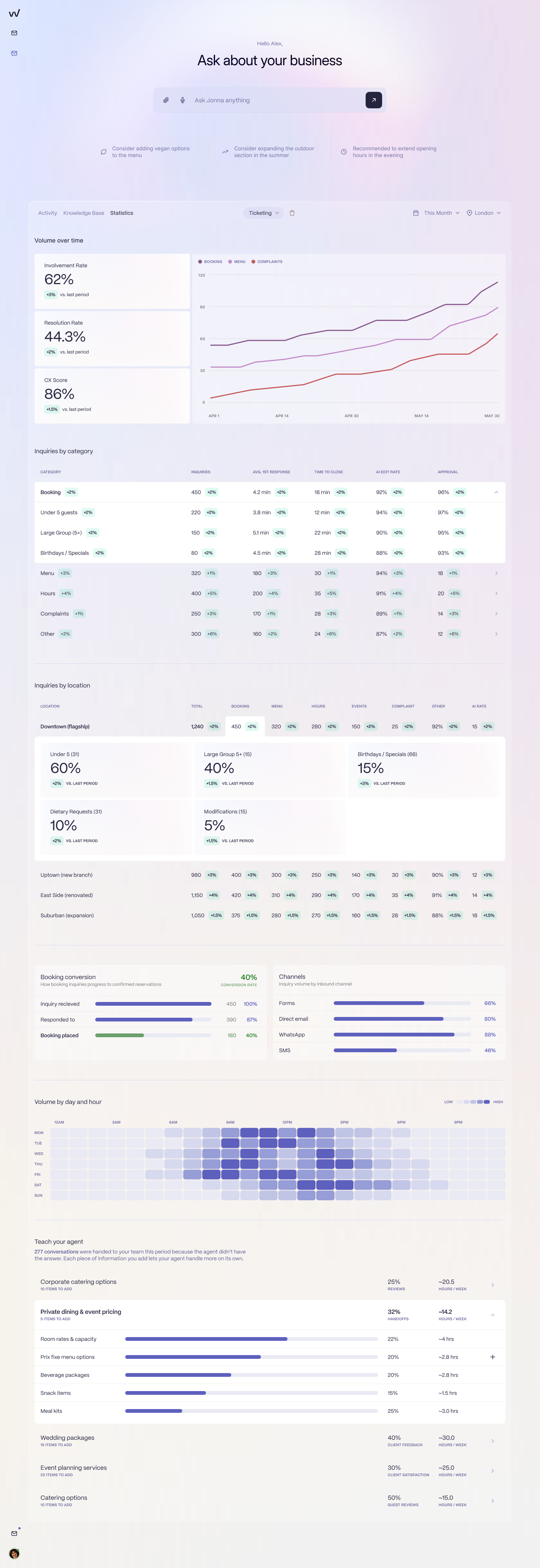
Response rate, volume and conversion by location, so the inbox stops being a black box.
An honest note on where RevVue is today
Being straight about status: RevVue's SevenRooms, OpenTable and DesignMyNight integrations are in active development, and the other booking systems are on the roadmap with an email-only pilot available now. That pilot already delivers what is shown above: location-aware routing, instant acknowledgement, AI-drafted replies in each venue's tone, high-value enquiries surfaced, and reporting by location. The UK AI is in pilot.
This is the move the Brasilia Group made, off a horizontal helpdesk and onto an inbox built for the job. Their founder, Nikolaos Kiosses, put it plainly: "The transition from Zendesk to RevVue has been a game changer."
If your enquiries currently live in a shared Gmail account, replacing a shared Gmail inbox for a restaurant group is the most relevant read next, and shared inbox software for restaurants is the wider category view. To see what the AI would have said to a real enquiry your team received last week, book 20 minutes.
Frequently asked questions
Is Hiver good for restaurants?
For a single site or a small group on Google Workspace, it is the lowest-friction improvement available. Your bookings@ address stays in Gmail and gains assignment, internal notes, SLA rules and response reporting with no migration, and teams adopt it because it looks like the Gmail they already use. For a multi-venue group handling booking enquiries it falls short, because labels stand in for venues and it has no connection to a diary.
Hiver's website mentions booking engines. Does that include restaurant diaries?
Not in any named sense. Hiver publishes a hospitality help-desk page referring to booking engines and guest-management systems, which is general copy aimed largely at hotels, backed by its 100-plus business apps, its Zapier connector and its API rather than by any named restaurant booking system. No restaurant diary appears in Hiver's app library, and connecting one means a zap or a custom build that still cannot check availability or create a booking.
How does Hiver handle multiple venues?
Through Gmail's structure, which means either a shared address per venue or one address with a label per site. Neither gives you per-venue tone or reporting by location, and there is no native concept of which site an enquiry belongs to, so someone makes that call manually on every message.
What works better for a multi-site group?
Something where the venue is a real entity and the inbox reaches the diary. RevVue tags each enquiry to its site automatically, drafts replies in that venue's tone, checks availability and prepares the booking inside the conversation, and reports response rate and conversion by location. Its SevenRooms, OpenTable and DesignMyNight integrations are in development, with an email-only pilot available now.