Re:amaze is the cheapest way to stop losing messages across channels. Email, live chat, SMS, WhatsApp, Instagram, Facebook, VoIP and push all land in one queue, and for a restaurant group that is a more relevant strength than it first appears, because booking enquiries genuinely do arrive by DM at eleven at night. Owned by GoDaddy and built for small e-commerce businesses, it solves the channel problem properly. It does not solve the booking problem, because none of those channels can open your diary.
What Re:amaze is genuinely good at
Channel consolidation is the real product. Most helpdesks in this comparison are email tools that bolted on chat. Re:amaze was built multi-channel, and it shows. A group whose enquiries arrive across four apps and two phones gets one queue with owners, statuses and response tracking. If your current failure is that nobody was watching Instagram at the weekend, this fixes it directly.
The price is right for a small operator. Re:amaze is positioned for small and mid-sized businesses, and it costs a fraction of the premium platforms. For a two- or three-site group that has been told a helpdesk costs thousands a month, this is a genuine alternative.
The e-commerce side is strong. Deep Shopify integration, plus BigCommerce, Magento, WooCommerce and Stripe. If the group sells gift cards, vouchers or merchandise online, agents see order and payment context beside the conversation. More than 5,000 e-commerce brands across more than 100 countries use it, and it rates highly on the Shopify and BigCommerce app stores.
It handles multiple businesses. Re:amaze supports managing several businesses in one place, which is closer to a multi-brand group's shape than most tools of its price.
Where it breaks for a restaurant group
It solves the channel problem, not the booking problem. This is the crux. You can consolidate every channel a guest might use to ask for a table, and not one of them can check availability or hold it. The gap was never which inbox the message lands in. It is that the reply and the booking live in two different systems, and gathering the messages does not change that.
No booking system is in its integration list. Shopify, BigCommerce, Magento, WooCommerce, WordPress, Stripe, Google Workspace, Slack, Jira, Aircall, JustCall, RingCentral, Pipedrive and Zapier. That list is a clear statement of who Re:amaze was built for, and a restaurant group is not it. The absence of a diary integration is the product working as intended for a different market rather than an oversight.
Managing multiple businesses is not managing multiple venues. It separates brands, not the availability behind them. There is no concept of which venue's diary an enquiry needs to be answered from, and reporting counts conversations rather than covers.
The AI is the least mature here. Re:amaze's AI drafts responses, summarises conversations and powers chatbots, and much of that suite has carried a beta label. It is real and improving, and it is behind Fin or the Gorgias AI Agent. Like all of them it works from conversation history and help-centre content, so it cannot tell you whether Saturday is free.
The test: what happens to a booking enquiry
Here is one enquiry at a group running Re:amaze well.
A regular sends an Instagram DM asking to book the counter for four for their partner's birthday, mentioning the wine pairing they had last time. Re:amaze pulls it into the shared queue and assigns it. This is the part that works, and on any other tool the message would still be sitting unread.
An agent opens the conversation and reads it.
They work out which venue the DM concerns, since the group's social accounts feed one queue.
They open the booking system in another tab, because Re:amaze cannot see the diary or the guest record.
They look up the guest, find which pairing "last time" refers to, and check whether the counter has four seats together on that date.
They create the booking, re-keying the name, date, time, party size, the counter preference and the note about the wine.
They switch back and reply on the DM, then close the conversation.
The guest replies on the same thread: "Can we make it six?" Six will not fit at the counter. Steps 4 to 7 run again, now offering a table instead.
Step one is Re:amaze earning its money. Steps three to six are the work, and it is not present for any of it. One operations director described the inbox behind this workflow as "a black hole, no KPIs, no response rate, nothing." Consolidating channels narrows the hole and does not close it.
A roughly 40-venue entertainment group lost a single booking worth £40,000 because the enquiry arrived outside working hours and nobody replied in time. A three-site pizza group put it more bluntly about a 30 to 40 cover enquiry: "It just sat there. No one saw it. They went somewhere else."
Who Re:amaze actually suits
Buy Re:amaze if your problem is scattered channels and a small budget. A two- or three-site group drowning in DMs across Instagram, WhatsApp and a chat widget will get an immediate, cheap improvement, and no other tool at this price covers as many channels.
Buy Re:amaze if the group runs a real online shop alongside the venues. Vouchers, gift cards and merchandise queries get proper order context, and that side of the product is where it is strongest.
Do not buy Re:amaze if the job is booking enquiries across venues. You will have consolidated the channels and changed nothing about the double-handling, with no venue model and reporting that counts conversations rather than covers.
A fair way to put it: Re:amaze fixes the problem you can see, which is messages going missing, and leaves the problem you cannot see, which is bookings not being made.
For the specifics on your stack, does Re:amaze integrate with SevenRooms and does Re:amaze integrate with OpenTable answer that directly.
What a booking-enquiry inbox does differently
The gap closes when the inbox and the diary are the same surface, so an enquiry from any channel is answered and booked in one place. This is what RevVue does, and it is easier to show than to describe.
Every enquiry is tagged to the right venue automatically, whatever channel it arrived on, so a request for one site is never answered with another site's availability. The team works from one queue by location rather than one multi-channel queue that still treats every site the same.
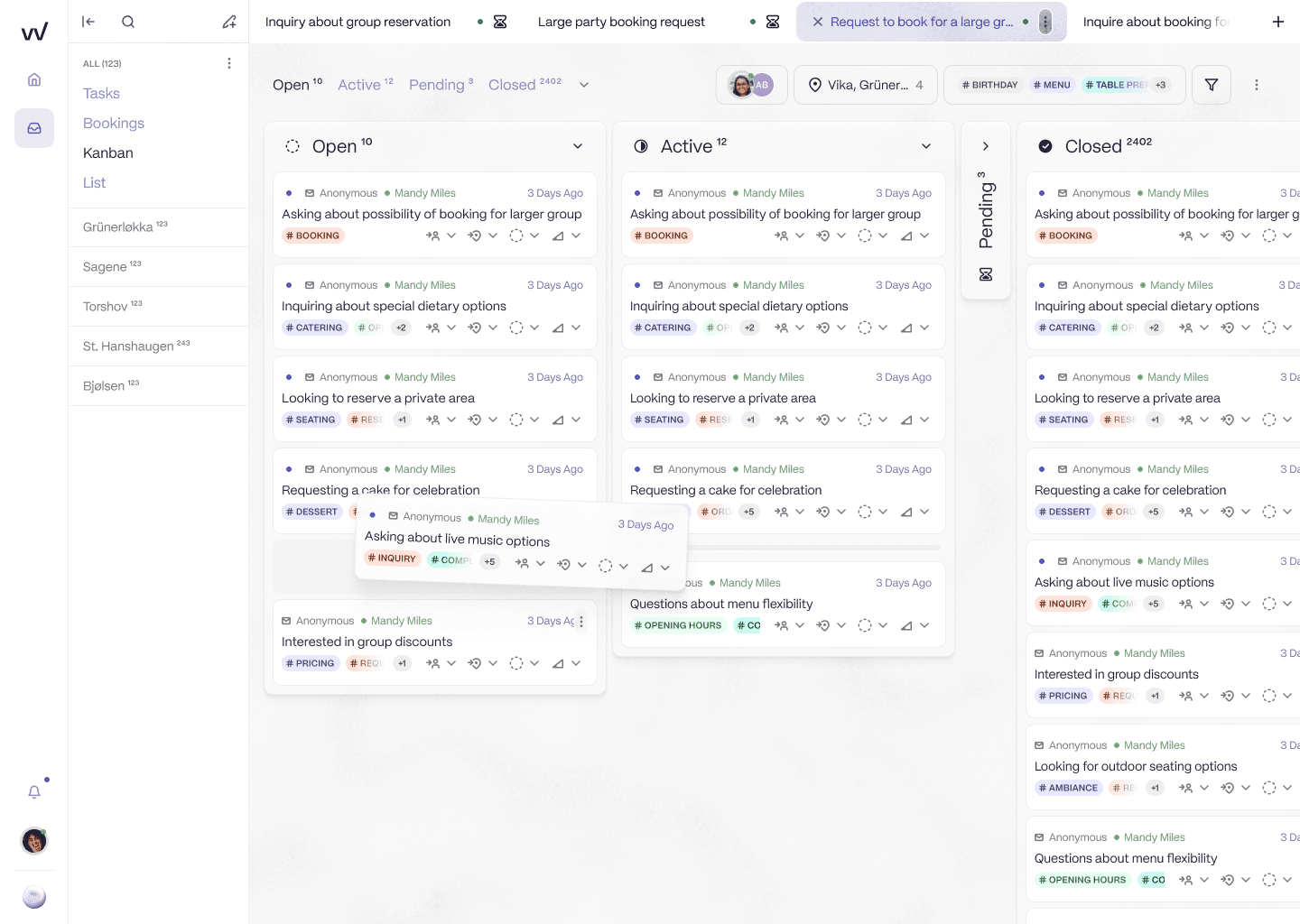
One queue per venue, so consolidating channels does not mean blurring sites together.
The AI reads each enquiry and drafts a reply in that venue's own tone, grounded in its menu, policies and FAQs, which is a step beyond a chatbot answering from a shared help centre.
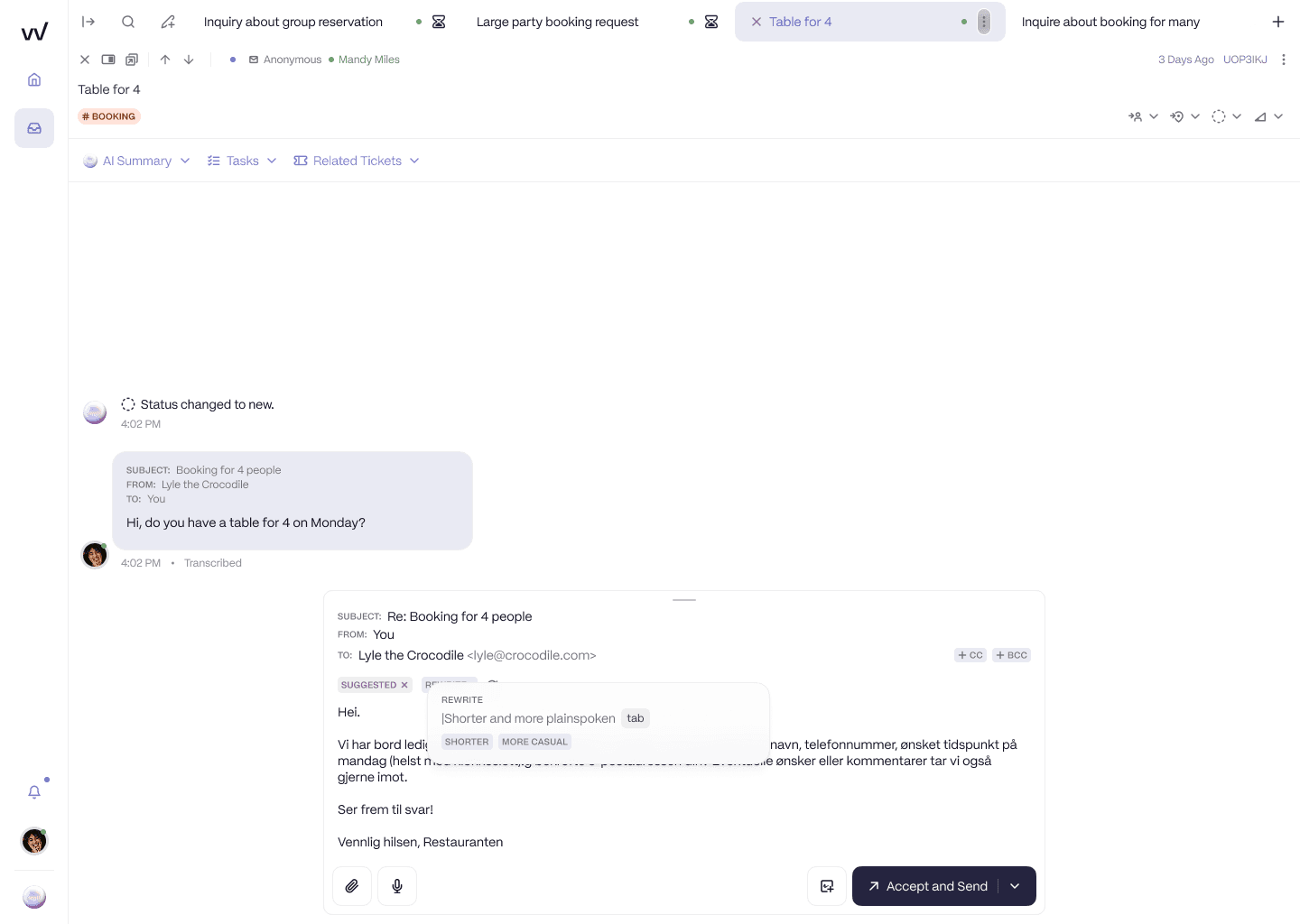
The AI drafts the reply in the venue's voice and waits for one-click approval.
Because it connects to the booking system, the AI does the step no channel can: it checks availability and prepares the booking inside the same thread. Routine requests are handled on arrival, including at eleven at night when the DM lands, and the high-value ones are acknowledged instantly and held in a queue a person works.
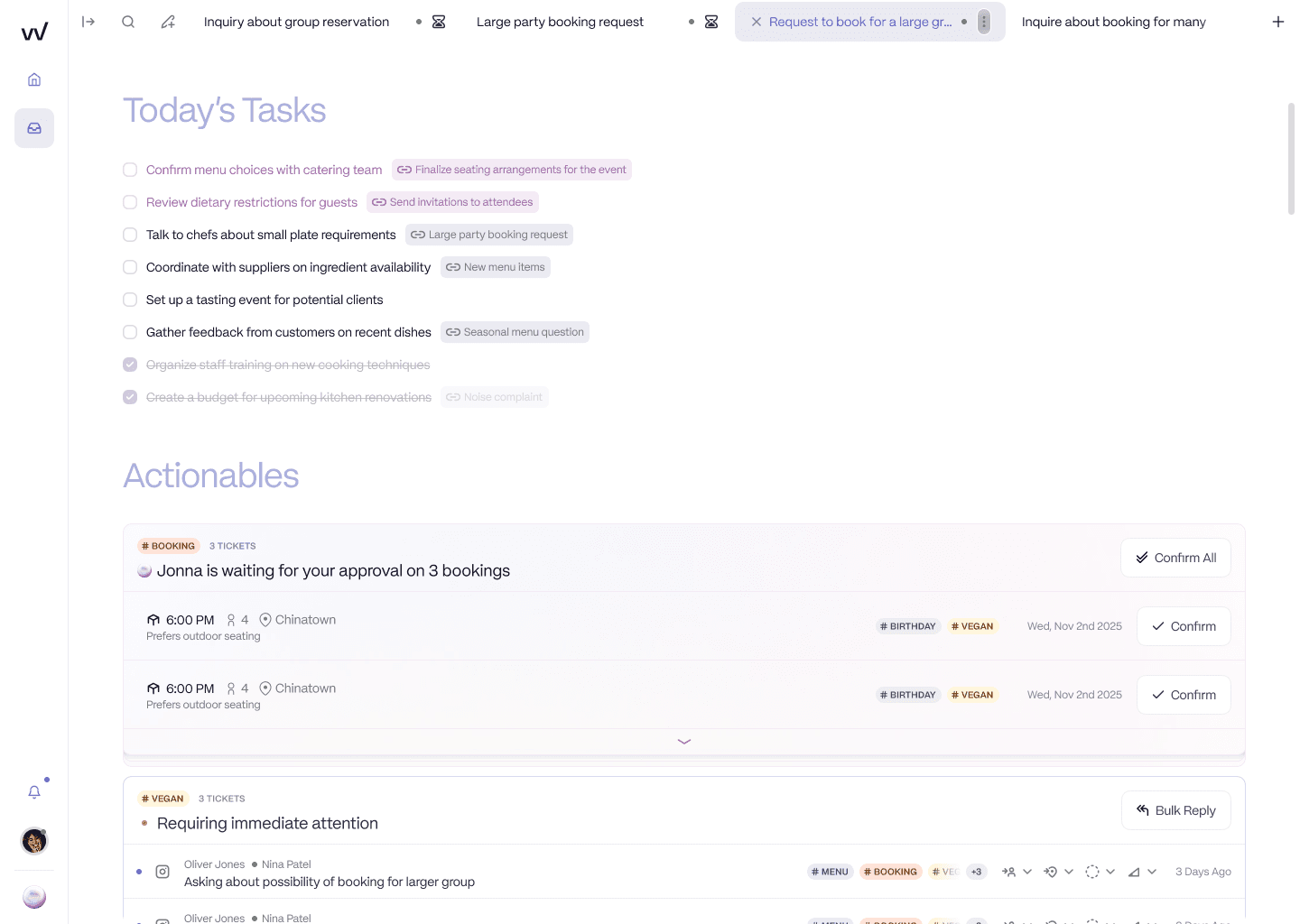
High-value bookings acknowledged and prepared, waiting for approval instead of sitting unread.
And because every enquiry is tracked by location, the reporting answers a question about the business rather than about the queue. Re:amaze reports on conversations, response times and volume per channel, which measures the inbox and says nothing about covers.
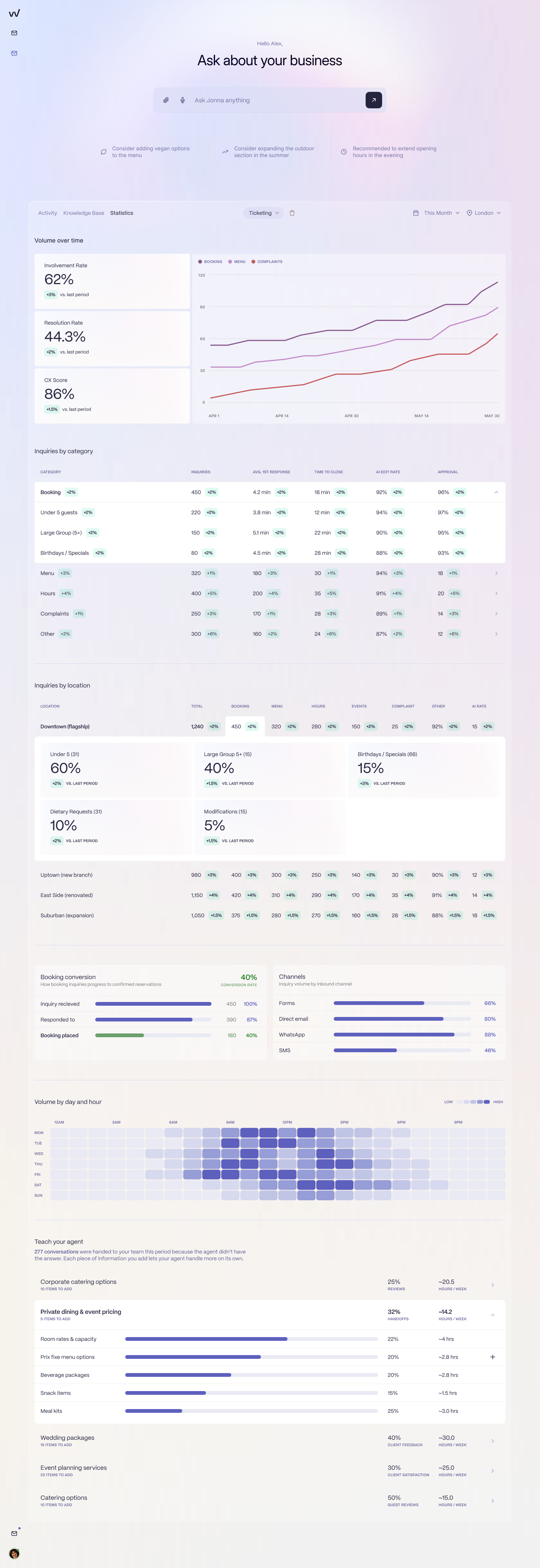
Response rate, volume and conversion by location, rather than conversations per channel.
An honest note on where RevVue is today
Being straight about status: RevVue's SevenRooms, OpenTable and DesignMyNight integrations are in active development, and the other booking systems are on the roadmap with an email-only pilot available now. That pilot already delivers what is shown above: location-aware routing, instant acknowledgement, AI-drafted replies in each venue's tone, high-value enquiries surfaced, and reporting by location. The UK AI is in pilot.
This is the move the Brasilia Group made, off a horizontal helpdesk and onto an inbox built for the job. Their founder, Nikolaos Kiosses, put it plainly: "The transition from Zendesk to RevVue has been a game changer."
Because so many of these messages arrive outside service hours, handling booking enquiries 24/7 is the most relevant read next, and shared inbox software for restaurants is the wider category view. To see what the AI would have said to a real enquiry your team received last week, book 20 minutes.
Frequently asked questions
Is Re:amaze good for restaurants?
It is a good, cheap answer to scattered channels and a poor answer to booking enquiries. Pulling email, chat, SMS, WhatsApp, Instagram and Facebook into one queue with owners and response tracking is genuinely useful, because booking requests do arrive on all of those. But no restaurant booking system appears in its integration list, so every enquiry still ends with a person opening the diary in another tab.
Does handling Instagram and WhatsApp help with bookings?
It helps with half the problem, and it is the half most tools ignore. Capturing DMs and messages so they are owned and answered is a real gain over four separate apps. The other half is untouched: none of those channels can check availability, hold a table or create a booking, so the double-handling is unchanged.
Can Re:amaze handle a group with several venues?
Only loosely. It supports managing multiple businesses in one place, which separates brands rather than the availability behind them, and its reporting counts conversations rather than covers. There is no concept of which venue's diary an enquiry needs to be answered from, so someone makes that judgement manually on every message.
What works better for booking enquiries?
Something that captures every channel and connects to the diary. RevVue tags each enquiry to its venue whatever channel it arrived on, drafts replies in that venue's tone, checks availability and prepares the booking inside the conversation, and reports response rate and conversion by location. Its SevenRooms, OpenTable and DesignMyNight integrations are in development, with an email-only pilot available now.