No. Freshdesk has no native, purpose-built integration with SevenRooms, and any workaround you build still cannot check availability or create a booking inside the conversation. Freshdesk is a customer-support desk. SevenRooms is a reservations and guest-management system built around deep guest profiles. They were built for different jobs, and the gap between them is exactly where restaurant booking enquiries fall, and where they get lost.
The short answer
Freshdesk can receive a booking enquiry as a ticket. It cannot do anything with it in SevenRooms. Checking the table, creating the booking, reading the guest's history and spend, adding the dietary note: all of that still happens by hand, in SevenRooms, by a person.
Freshdesk + SevenRooms | |
|---|---|
Native integration | None |
Best available workaround | A Zapier zap or Marketplace connector that raises a ticket from an enquiry |
What the workaround still can't do | Check availability, create or amend a booking, read the guest's SevenRooms profile |
What actually happens to a booking enquiry
Numbers on a table do not show the cost. The workflow does. Here is the real journey of a single enquiry at a premium, multi-concept group when Freshdesk and SevenRooms do not talk to each other.
A regular emails the group to ask about a table for 24 for an anniversary dinner at one of the flagship concepts. The message becomes a Freshdesk ticket.
An agent opens the ticket and reads it.
The agent opens SevenRooms in another tab, because Freshdesk cannot see the diary or the guest profile.
They check availability for that date, party size, and concept, by hand, and look up the guest's history and preferences.
They type the booking into SevenRooms, re-keying the name, date, time, party size, the champagne-on-arrival request, and the two dietary notes from the email.
They switch back to Freshdesk and write the reply in that concept's voice.
They mark the ticket solved.
The guest emails back: "Can we move to 26 and add a private area?" The agent repeats steps 3 to 7.
Every enquiry is handled twice, in two systems, by a person who is copying the same fields from one screen to another. For a premium group whose whole promise is that guests feel recognised, that double-handling is where the recognition slips. Multiply it by hundreds of enquiries a week and the cost is not a rounding error, it is a role. One operations director we spoke to described the inbox behind this as "a black hole, no KPIs, no response rate, nothing," because the work all happened in tabs and tickets that no report could see.
The sharper cost is the one you never find out about. A booking enquiry is only worth anything if you answer it before the guest books elsewhere, and the double-handling above takes time you often do not have out of hours. A roughly 40-venue entertainment group lost a single booking worth £40,000 because the enquiry arrived outside working hours and no one replied in time. A three-site pizza group put it more bluntly about a 30 to 40 cover enquiry: "It just sat there. No one saw it. They went somewhere else." Freshdesk did not cause those losses. But routing bookings through a system that cannot book anything is what makes the delay inevitable.
What Freshdesk actually connects to
Freshdesk is positioned as the simpler, lower-cost alternative to Zendesk, and its integration story is similar: CRMs, e-commerce platforms, telephony, team-chat tools, all listed in the Freshworks Marketplace. What it does not have is a connection to restaurant booking systems, because those are not tools its core market (general customer support for SMB and mid-market companies) uses. SevenRooms sits even further out of reach, because its guest data and diary are partner-gated rather than open to a general connector.
Teams who want the two to talk usually try a Zapier zap or a Marketplace connector that opens a Freshdesk ticket whenever an enquiry arrives. It gives you a tidy queue of tickets. It does not give you a booking. The connector moves information in one direction and treats it as a support ticket. It cannot let an agent see live availability, read a guest profile, or write a booking back to SevenRooms.
Freddy, Freshdesk's AI, does not close the gap either. Freddy AI Agent and Freddy Copilot can suggest a reply, categorise the ticket, and read sentiment, but they are trained on generic support and knowledge-base data. Freddy has no awareness of SevenRooms and cannot take an action in it. So the "integration" is really a copy of the enquiry sitting in a second system, and the actual booking work, steps 3 to 7 above, is unchanged.
Why this matters for booking enquiries
A support ticket and a booking enquiry look similar and behave nothing alike. A support ticket is resolved by a reply. A booking enquiry is only resolved when a table is held in the booking system. That difference is the whole problem.
The helpdesk can write a polished reply. It cannot book the table, and it certainly cannot pull the guest's SevenRooms profile to make that reply feel personal. The transaction, the part that actually earns the revenue, still lands on your team, one enquiry at a time. This is why most restaurant groups that run Freshdesk for customer service (vouchers, refunds, complaints that need finance) still run their booking enquiries through a shared Gmail or Outlook inbox. The helpdesk never solved the booking side, so the old inbox stayed, and with it the double-handling and the black box.
What it looks like when the tool is built for booking enquiries
The gap closes when the inbox and the booking system are the same surface, so the enquiry is answered and booked in one place. This is what RevVue does, and it is easier to show than to describe.
Every enquiry is tagged to the right concept automatically, so an anniversary party for one flagship is never answered with another concept's availability. The team works from one queue, by location, instead of a folder maze.
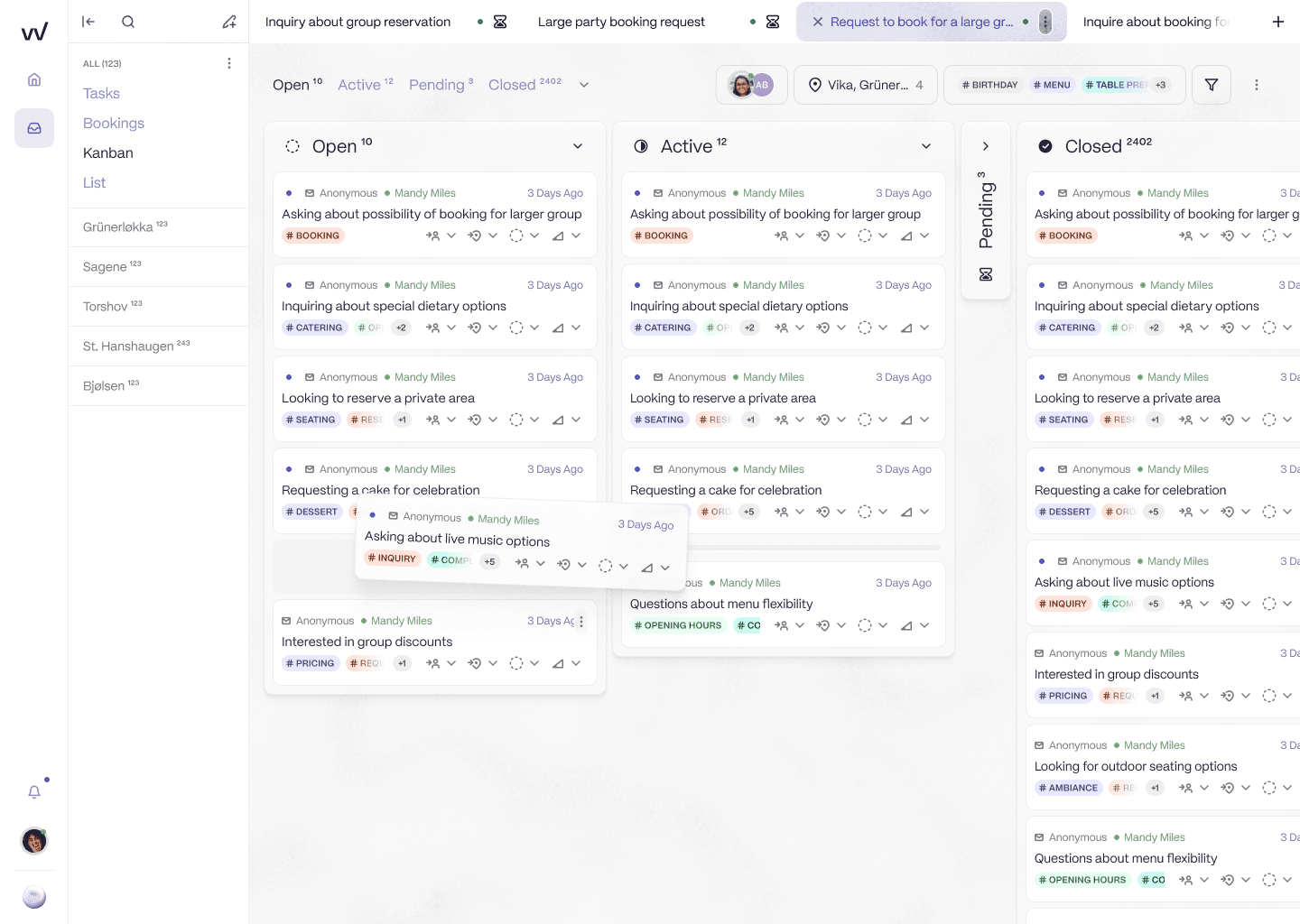
Every enquiry lands in one place, tagged to the venue it is for, instead of scattered across tickets and tabs.
The AI reads each enquiry and drafts the reply in that concept's own tone, grounded in its menu, policies, and FAQs. The agent reviews and sends with one click rather than retyping from scratch.
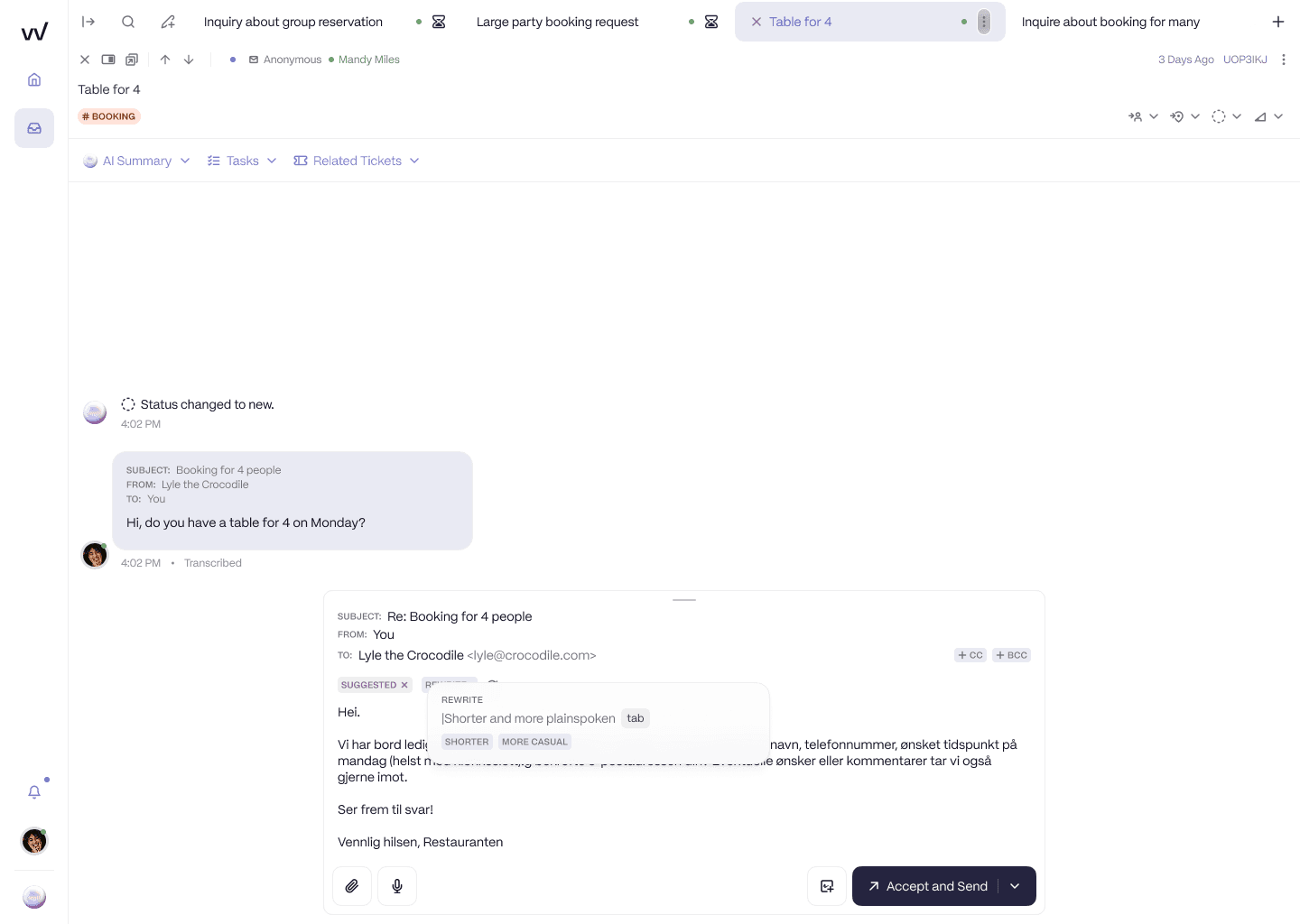
The AI drafts the reply in the venue's voice and waits for one-click approval, so the team reviews instead of re-keying.
Because it connects to the booking system, the AI does the step Freshdesk cannot: it checks availability and prepares or creates the booking inside the same thread. Routine bookings are handled on arrival, and the high-value ones, the anniversary dinners and private-area parties, are acknowledged instantly and held in a prioritised queue for a person to nurture, so the £40,000 enquiry is never the one that sits unseen.
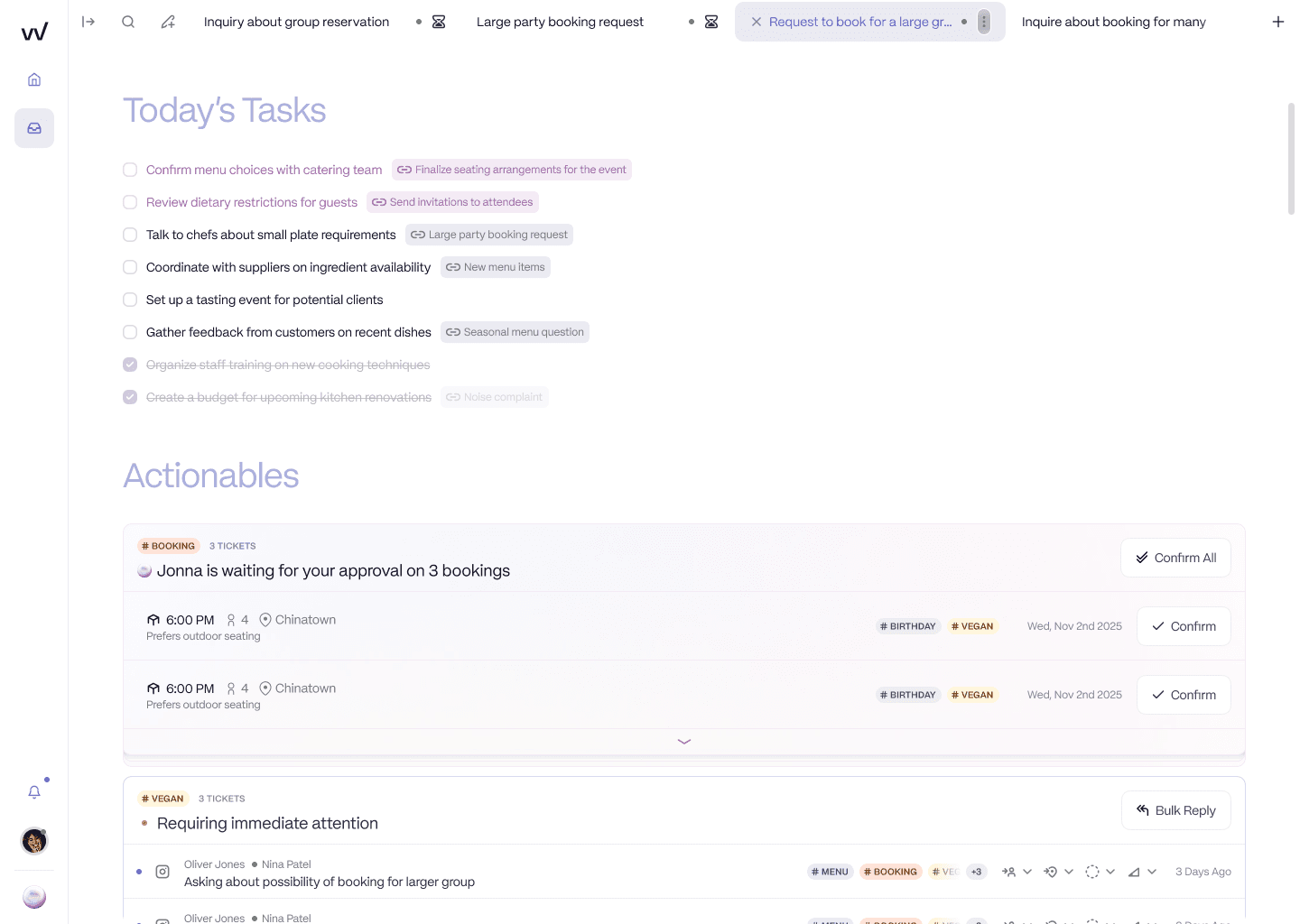
High-value bookings the AI has acknowledged and prepared, waiting in a queue the team actually works rather than buried in an inbox.
And because every enquiry is tracked by location, the black box becomes a dashboard: response rates, volumes, and conversion by concept, the numbers the ticket-and-tabs workflow could never produce.
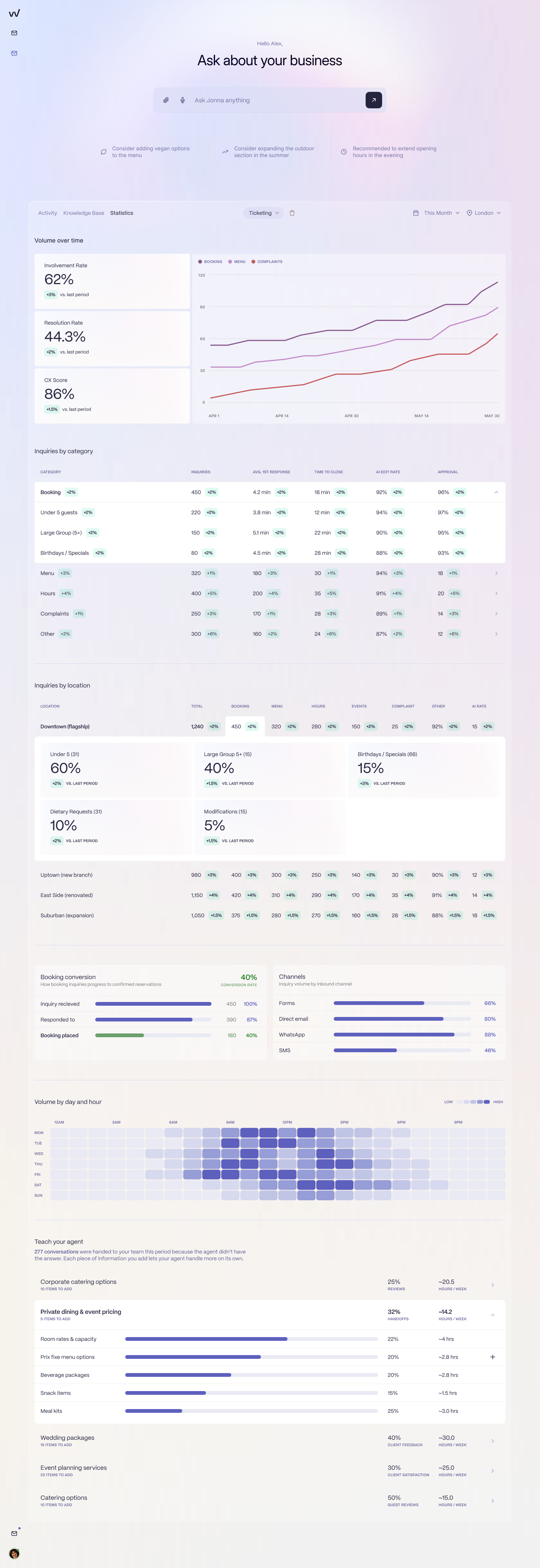
Response rate, volume, and conversion by location, so the inbox stops being a black box and starts being something you can manage.
An honest note on where RevVue is today
RevVue's SevenRooms integration is in active development, and SevenRooms is the most-requested connection on the roadmap. That is the honest status. Where the direct booking-system link is not yet live for a group, they run an email-only pilot that already delivers the inbox value shown above: location-aware routing, instant acknowledgement, AI-drafted replies, high-value bookings surfaced, and reporting by location. The booking-system connection deepens that, it does not gate it. The UK AI is in pilot now.
This is the move the Brasilia Group made, off a horizontal helpdesk and onto an inbox built for the job. Their founder, Nikolaos Kiosses, put it plainly: "The transition from Zendesk to RevVue has been a game changer."
If Freshdesk is on your shortlist, the Freshdesk alternative for restaurant groups piece goes deeper, RevVue vs Freshdesk is the head-to-head, and shared inbox software for restaurants covers the category. To see what the AI would have said to a real enquiry your team received last week, book 20 minutes.
Frequently asked questions
Does Freshdesk integrate with SevenRooms?
No. Freshdesk has no native integration with SevenRooms. You can build a Zapier zap or a Marketplace connector that raises a Freshdesk ticket from an enquiry, but it cannot check availability, create a booking, or read the guest's profile in SevenRooms. That work still has to be done by hand in SevenRooms.
Does Freshdesk's Freddy AI work with booking systems?
No. Freddy can suggest replies, categorise tickets, and detect sentiment, but it is trained on generic support and knowledge-base data and has no connection to SevenRooms or any other booking system. It can help you answer an enquiry faster, but it cannot check the diary, pull the guest profile, or place the booking.
Can Zapier connect Freshdesk to SevenRooms?
Only for moving data. Zapier can open a Freshdesk ticket when an enquiry arrives, but it cannot perform a live availability check or create a real reservation inside the conversation, because that requires acting in the booking system rather than passing records between tools. SevenRooms also gates its diary and guest data to partners, so even the data flow is limited. The booking is still made manually.
What do restaurant groups use instead for booking enquiries?
Most keep booking enquiries in a shared Gmail or Outlook inbox even while using Freshdesk for customer service, because the helpdesk never handled the booking side. A purpose-built option is RevVue, which is location-aware and whose AI checks availability and creates the booking inside the conversation. Its SevenRooms integration is in development and the most-requested on the roadmap, with an email-only pilot available now.