No. Gorgias has no native, purpose-built integration with SevenRooms, and no restaurant booking system appears in its App Store. Gorgias is a helpdesk built for e-commerce, wired deeply into Shopify. SevenRooms is a reservations, guest-CRM and events platform used by premium and multi-concept restaurant groups. Gorgias is the most interesting no in this whole comparison, because Gorgias can genuinely complete transactions inside a conversation. It just does that against a shop, not a diary.
The short answer
Gorgias can receive a SevenRooms enquiry as a ticket. It cannot do anything with it in SevenRooms. Checking the diary, holding a table, reading the guest's spend history, adding the occasion note: all of that still happens by hand, in SevenRooms, by a person.
Gorgias + SevenRooms | |
|---|---|
Native integration | None |
Best available workaround | A Zapier or custom-API bridge that copies enquiry text into a ticket |
What the workaround still can't do | Check availability, create or amend a booking, read the guest's SevenRooms profile and spend history |
Both ends are reachable. Gorgias has a Zapier app, a public developer API and even a Gorgias MCP server on Zapier. SevenRooms is on Zapier too. Connectivity is not the constraint here, and that is exactly what makes this pairing instructive.
What actually happens to a booking enquiry
Here is where a restaurant group using Gorgias hits something genuinely awkward, because a single email often contains both a shop question and a booking question.
A guest emails to say they bought a tasting-menu gift voucher from your online shop for an anniversary, wants to redeem it for two people on a Saturday in six weeks, and asks whether the voucher covers the wine pairing. The message becomes a Gorgias ticket.
An agent opens the ticket. Gorgias helpfully shows the voucher order alongside the message, because that part lives in Shopify.
The agent opens SevenRooms in another tab, because Gorgias cannot see the diary.
They check that Saturday for two, look up whether the guest has dined before and what they spent, and check which tables suit an anniversary at that sitting.
They create the booking in SevenRooms, re-keying the guest's name, date, time, party size, the anniversary note and the voucher reference so the floor team knows to apply it.
They switch back to Gorgias and write the reply, confirming both the booking and what the voucher covers.
They mark the ticket closed.
The guest replies: "Could we make it four, and one guest is dairy free." Four changes the table, and the voucher only covers two. The agent repeats steps 3 to 7 and reworks the voucher maths.
Every enquiry is handled twice, in two systems, by a person copying the same fields between screens. Step two is the sting: Gorgias has already proved it can pull a commercial record into the ticket, so the agent is looking at half the context they need and switching tabs for the other half. One operations director described the inbox behind this workflow as "a black hole, no KPIs, no response rate, nothing," because the work happened in tabs and tickets that no report could see.
The sharper cost is the enquiry you never hear about again. Anniversary bookings are planned weeks ahead and shopped around, and voucher redemptions carry an expectation of a smooth answer because the guest has already paid you. A roughly 40-venue entertainment group lost a single booking worth £40,000 because the enquiry arrived outside working hours and nobody replied in time. A three-site pizza group put it more bluntly about a 30 to 40 cover enquiry: "It just sat there. No one saw it. They went somewhere else." Gorgias did not cause those losses. Routing bookings through a system that cannot book anything is what makes the delay inevitable.
What Gorgias actually connects to
Gorgias is the counter-example that proves the rule, so it deserves a fair and precise description.
Most helpdesks in this comparison cannot take real actions on anything. Gorgias can. Its App Store is organised around e-commerce, shipping, marketing, loyalty, analytics and support channels, with Shopify at the centre and apps like Magento, NetSuite, Klaviyo, Recharge and Tapcart alongside. Its AI Agent, the Automate product, is an autonomous support and sales agent for e-commerce brands: it answers order questions, recommends products, and performs genuine transactions such as looking up an order, cancelling one, editing a delivery address or changing a subscription. That is not a chatbot reading a help centre. That is a helpdesk completing work inside the conversation.
So the argument on this page is not that a helpdesk cannot act. It is that Gorgias can act because it was purpose-built around one system of record, and that system of record is Shopify. A reservation diary is a different system of record entirely, and Gorgias has no line into one. Search the Gorgias App Store for SevenRooms and you will find nothing.
The workaround is available and thin. Gorgias is on Zapier, SevenRooms is on Zapier, and Gorgias publishes a developer API with endpoints for creating and retrieving integrations. So a zap that raises a Gorgias ticket from a SevenRooms event, or pushes enquiry data across, is genuinely buildable. What it produces is notification, moving one direction, treating a reservation request as a support case. It does not let the agent see the diary, hold a table, pull the guest's spend history, or write a booking from the reply window. AI Agent will not fill that gap either: its action library is built from your connected e-commerce systems, so it can cancel an order and cannot hold a table.
One honest credit worth giving. If your group runs a real online shop, gift cards, vouchers, merchandise or meal kits, Gorgias is genuinely good at that side and the AI Agent will resolve a lot of it without a human. The gap is bookings, not the whole tool.
Why this matters for booking enquiries
A support ticket and a booking enquiry look similar and behave nothing alike. A support ticket is resolved by a reply. A booking enquiry is only resolved when a table is held in the diary. That difference is the whole problem.
Gorgias proves the point rather than escaping it. It shows what a helpdesk looks like when someone builds it around the transaction that matters to a specific industry. Nobody has done that for restaurant bookings inside Gorgias, so the transaction, the part that actually earns the cover, still lands on your team, one enquiry at a time.
What it looks like when the tool is built for booking enquiries
The gap closes when the enquiry and the guest record sit on the same screen, so whoever replies can already see who is writing. This is what RevVue does, and it is easier to show than to describe.
Enquiries are sorted by venue as they arrive, which matters most for a group running distinct concepts under one company. A request for the chef's counter is never answered with the brasserie's availability, and the team works from one queue, by location, rather than a helpdesk organised around a shop instead of a diary.
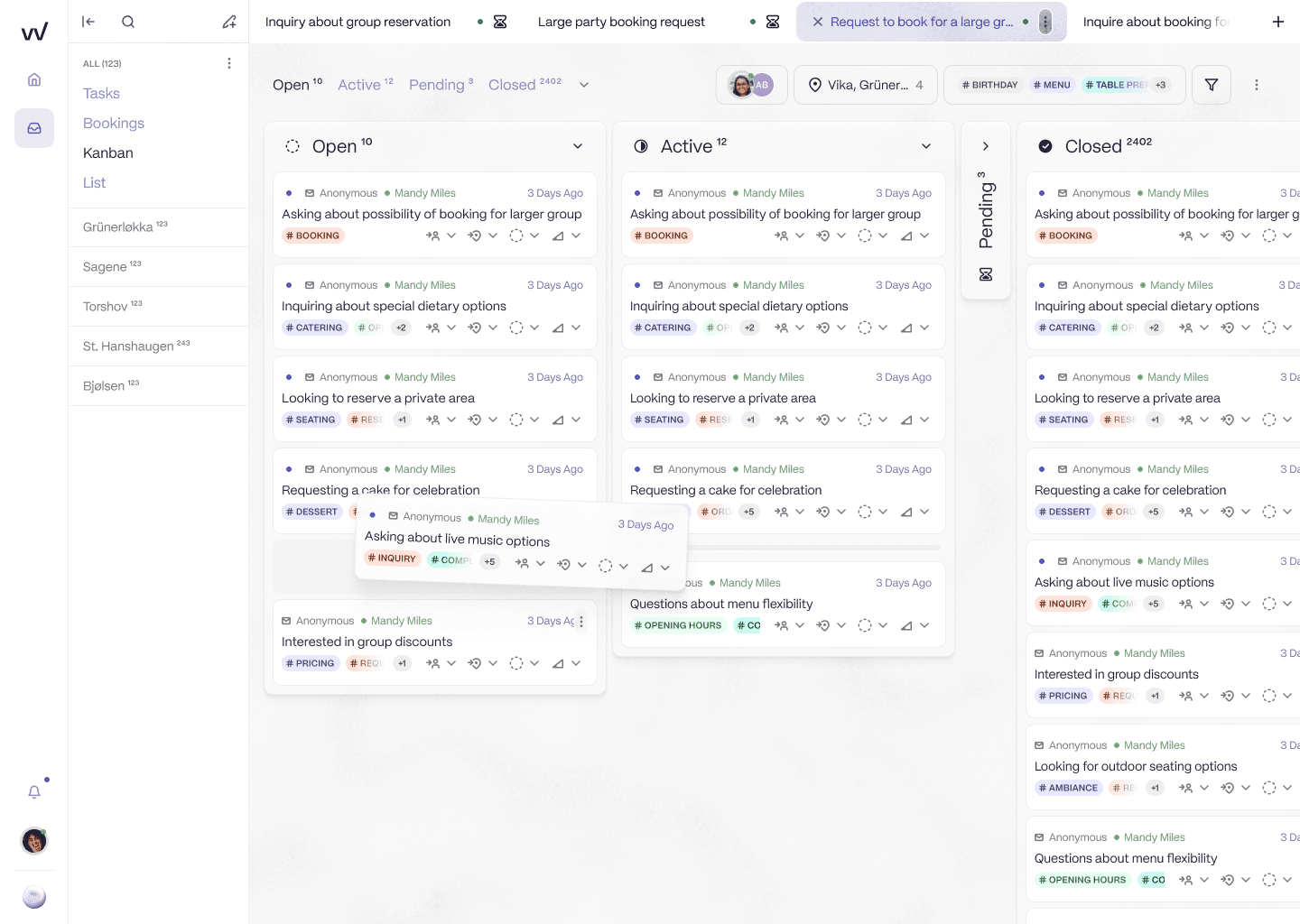
One queue per venue, so a multi-concept group stops sorting its mail before it can answer it.
The AI reads each enquiry and drafts a reply in that venue's voice, grounded in its menus, its policies and the things its regulars ask for. For a group that has invested in knowing its guests, the reply reads like it came from the venue and not from a shared mailbox.
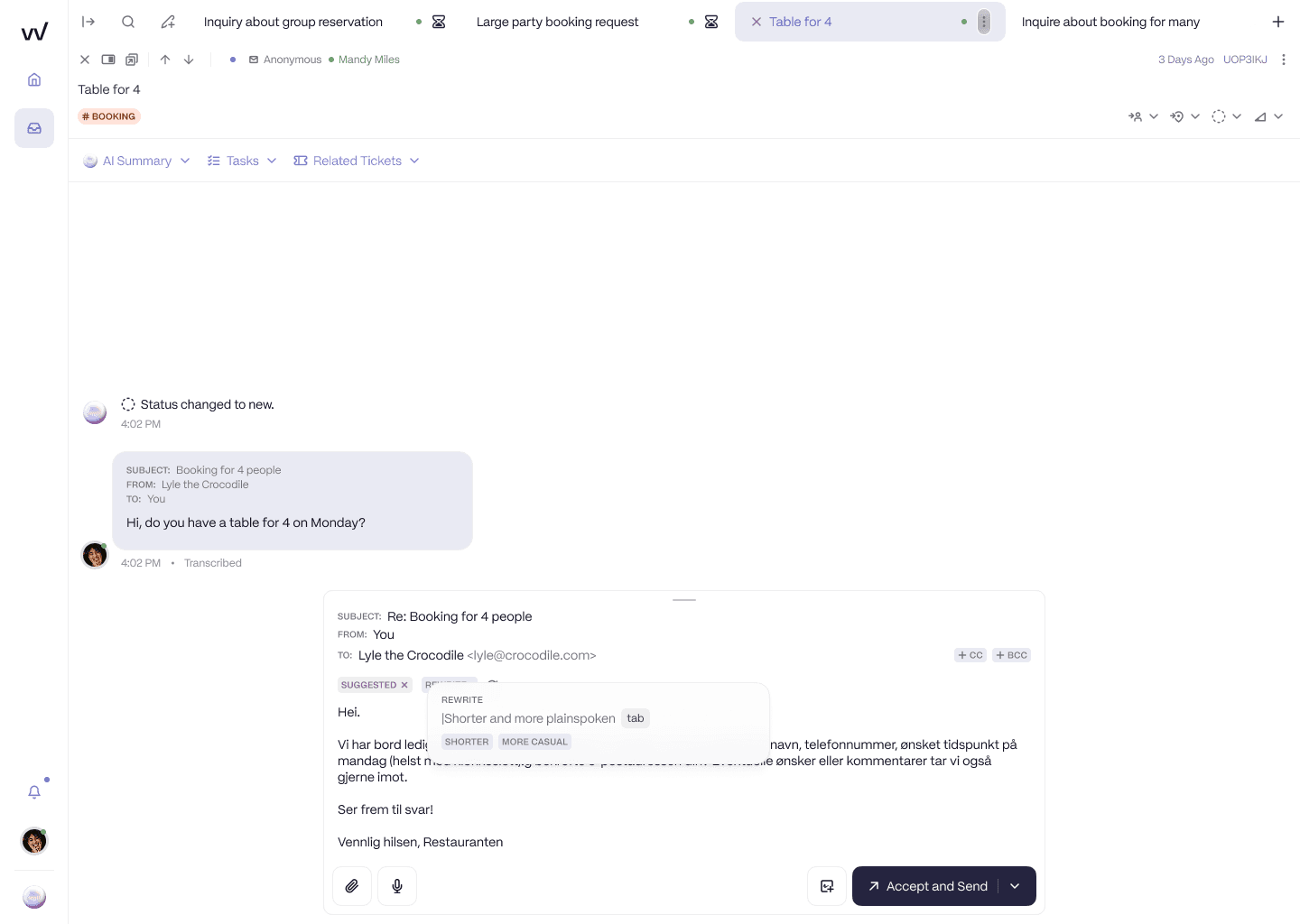
The draft arrives in the venue's own voice, ready for a person to approve or adjust.
Because it connects to the booking system, the AI does the step Gorgias cannot: it checks availability and prepares the booking inside the same thread. Routine requests are handled on arrival, and the ones worth a person's attention, the anniversary tables and the large parties, are acknowledged straight away and held in a queue someone actually works.
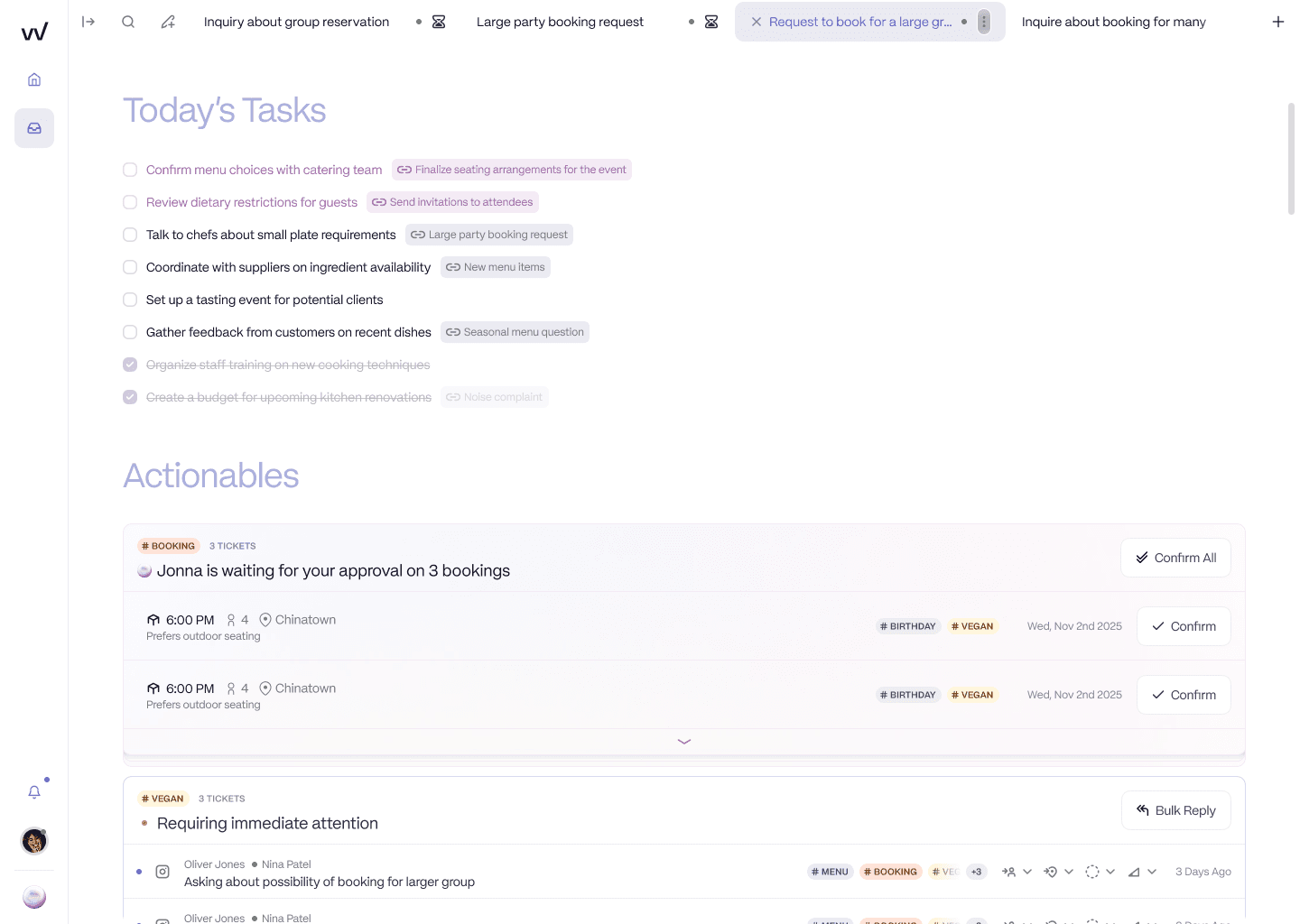
High-value bookings acknowledged and prepared, waiting for approval instead of sitting unread.
And because every enquiry is tracked against a venue, the enquiry channel finally reports like the rest of the business. Response times, volumes and conversion per site: the one view a guest-CRM platform cannot give you, because the enquiry never reached it. Gorgias reports on tickets and the revenue its agents influence, and none of those numbers is a cover.
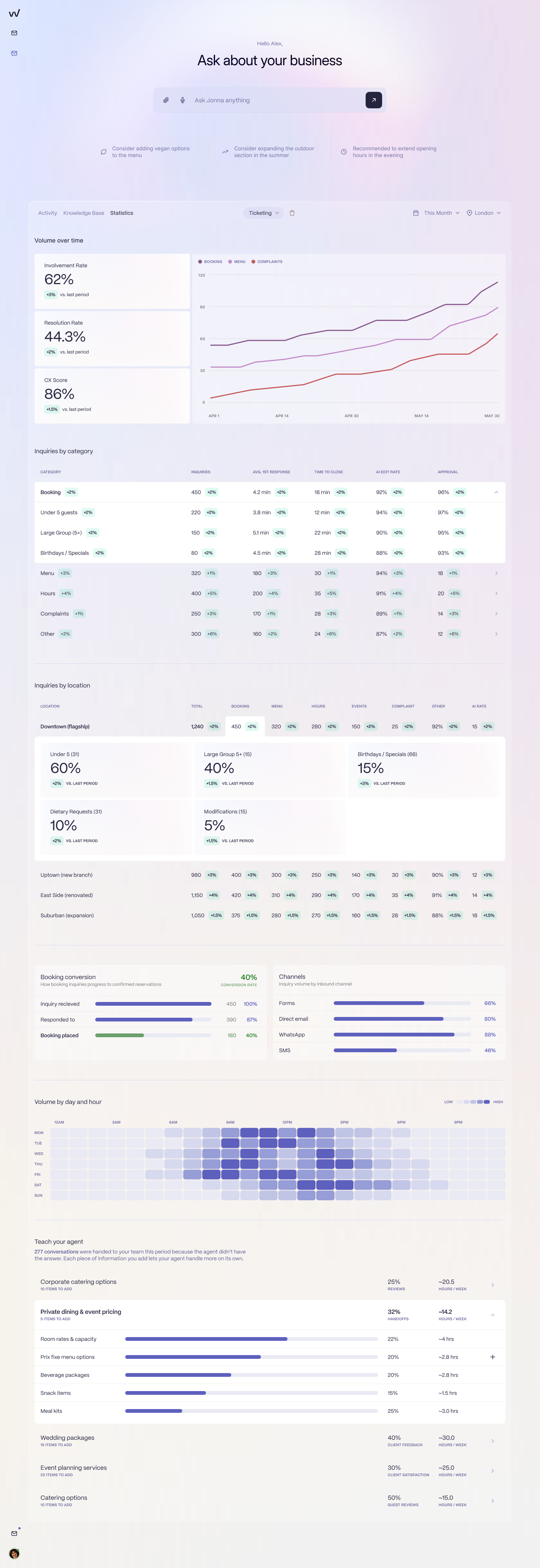
Response rate, volume and conversion by location, so the enquiry channel stops being a blind spot.
An honest note on where RevVue is today
RevVue's SevenRooms integration is in active development, and it is the most requested connection on the roadmap. That is the honest status. For now, groups run an email-only pilot that already delivers the inbox value shown above: location-aware routing, instant acknowledgement, AI-drafted replies, high-value bookings surfaced, and reporting by location. The direct booking-system connection will deepen that when it lands, but it does not gate the value you get today. The UK AI is in pilot.
This is the move the Brasilia Group made, off a horizontal helpdesk and onto an inbox built for the job. Their founder, Nikolaos Kiosses, put it plainly: "The transition from Zendesk to RevVue has been a game changer."
The wider category view is in shared inbox software for restaurants, and if you are weighing helpdesks generally, the best Zendesk alternatives for restaurant groups covers the field. To see what the AI would have said to a real enquiry your team received last week, book 20 minutes.
Frequently asked questions
Does Gorgias integrate with SevenRooms?
No. Gorgias has no native integration with SevenRooms, and no restaurant booking system appears in the Gorgias App Store. Because both tools are on Zapier, and Gorgias publishes a developer API, a bridge is buildable that copies enquiry data into a ticket. It cannot check availability, create or amend a booking, or read the guest's SevenRooms profile and spend history.
Gorgias AI Agent can cancel an order, so why can't it book a table?
Because its actions come from the systems Gorgias was built around. AI Agent performs real transactions such as order lookups, cancellations, address edits and subscription changes, because Gorgias is wired into Shopify and the e-commerce stack. A reservation diary is a different system of record, and Gorgias has no connection to one. The capability is real, the scope is e-commerce.
Is Gorgias any use to a restaurant group at all?
Yes, on the shop side. If you sell gift cards, vouchers, merchandise or meal kits online, Gorgias is genuinely strong at that, and its AI Agent will resolve much of it without a human. What it cannot do is handle booking enquiries, because it has no line into your diary. Most groups that run Gorgias for the shop still run bookings through a separate inbox.
What do restaurant groups use instead for booking enquiries?
Most run booking enquiries through a shared inbox even when a helpdesk covers customer service, because the helpdesk never solved the booking side. A purpose-built option is RevVue, which is location-aware and whose AI checks availability and prepares the booking inside the conversation. Its SevenRooms integration is in active development, with an email-only pilot available now.