No. Help Scout has no native, purpose-built integration with TheFork, and TheFork's own B2B API will not close the gap, because it is built for batch data synchronisation rather than live booking. Help Scout is a shared inbox and email-first help desk for small teams. TheFork is a booking network owned by Tripadvisor and, through TheFork Manager, the reservation software behind it. Help Scout meets these enquiries in the right channel and then stops exactly where the booking begins.
The short answer
Help Scout can receive a TheFork enquiry as a conversation. It cannot do anything with it in TheFork Manager. Checking the shift, splitting a party across tables, applying a set menu, noting a dietary need: all of that still happens by hand, in TheFork Manager, by a person.
Help Scout + TheFork | |
|---|---|
Native integration | None |
Best available workaround | A custom build on Help Scout's API and TheFork's B2B API |
What the workaround still can't do | Check live availability, create or amend a booking, apply a promotion or set menu |
TheFork deserves credit on the middle row. It is the most openly documented booking platform in this comparison, publishing a developer portal for its B2B API aimed at CRM systems and large restaurant groups. That is more than most competitors offer, and it is still the wrong shape for handling enquiries, for a reason TheFork states itself.
What actually happens to a booking enquiry
Give Help Scout its due first. Enquiries off a booking network arrive by email, and Help Scout is built for email, with assignment, saved replies, internal notes and a shared view that stops two people replying to the same guest. Against a shared Gmail account that is a genuine improvement. The problem starts where answering ends and booking begins.
Here is the real journey of one enquiry when Help Scout and TheFork do not talk to each other.
An enquiry arrives about a party of 14 for a Saturday evening, asking whether the set menu is available at that size, whether the group can sit at one long table, and whether the bill can be split. The message becomes a Help Scout conversation.
An agent opens it and reads it.
The agent opens TheFork Manager in another tab, because Help Scout cannot see the shift.
They check Saturday for 14, work out whether that is one long table or two of seven, look at what the set menu requires at that size, and check whether any active promotion excludes large parties.
They create the booking in TheFork Manager, re-keying the name, date, time, party size and the seating and billing notes from the email.
They switch back to Help Scout and write the reply with the menu, the seating plan and the billing answer.
They close the conversation.
Two days later: "It is 18 now." Eighteen changes the table plan, may change the menu terms, and may not fit the promotion. The agent repeats steps 3 to 7.
Every enquiry is handled twice, in two systems, by a person copying the same fields between screens. One operations director described the inbox behind this workflow as "a black hole, no KPIs, no response rate, nothing," because the work happened in tabs and conversations that no report could see. When you pay commission on network covers, being unable to measure what happens to network enquiries is an expensive blind spot.
The sharper cost is the enquiry you never hear about again. A guest browsing a booking network has a dozen comparable restaurants one tap away, and a party of 14 will simply book the one that comes back with a table plan. A roughly 40-venue entertainment group lost a single booking worth £40,000 because the enquiry arrived outside working hours and nobody replied in time. A three-site pizza group put it more bluntly about a 30 to 40 cover enquiry: "It just sat there. No one saw it. They went somewhere else." Help Scout did not cause those losses. Routing bookings through a system that cannot book anything is what makes the delay inevitable.
What Help Scout actually connects to
Help Scout's apps directory covers what its market needs: CRM, e-commerce, billing, chat, project tools and analytics, aimed at small businesses, SaaS companies, agencies, nonprofits and online retailers. No restaurant booking system appears in it, and TheFork is no exception.
TheFork's side is more open, and worth crediting properly. It publishes a B2B API developer portal and integrates with serious point-of-sale partners including Lightspeed, Oracle and Trivec. For a group that wants reservation data flowing into its CRM, that API is a real answer.
It is not an answer to this problem, and TheFork's own documentation explains why: the API is framed around data synchronisation without the need for real-time updates. It is a batch sync surface for moving records between systems. A booking enquiry needs the opposite, a live availability check at the moment the agent is typing and the ability to write a real booking into the shift straight away. TheFork is also not on Zapier, so the usual low-code shortcut is unavailable, which leaves a custom project against Help Scout's API and TheFork's B2B API. Help Scout AI drafts replies, summarises threads and helps agents write consistently, all from your conversations and knowledge base. It has no line into the diary and cannot take a single action in TheFork Manager.
One more gap matters for a multi-site group. Help Scout is built around mailboxes, and a mailbox is not a venue. There is no native concept of which site an enquiry belongs to, no per-venue tone, and no reporting by location.
Why this matters for booking enquiries
A support conversation and a booking enquiry look similar and behave nothing alike. A support conversation is resolved by a reply. A booking enquiry is only resolved when a table is held in the diary. That difference is the whole problem.
The shared inbox can write a polished reply. It cannot book the table. The transaction, the part that actually earns the cover, still lands on your team, one enquiry at a time. Help Scout gets you a tidy, accountable inbox and leaves the booking work exactly where it was.
What it looks like when the tool is built for booking enquiries
The gap closes when the inbox and the diary are the same surface, so a direct enquiry gets the same handling as a booking the network sends. This is what RevVue does, and it is easier to show than to describe.
Enquiries are tagged to the right venue on arrival, which matters for groups whose sites sit in different cities and sometimes different countries. Nobody works out which restaurant a message is about before answering it, because the team works from one queue, by location, rather than mailboxes standing in for venues.
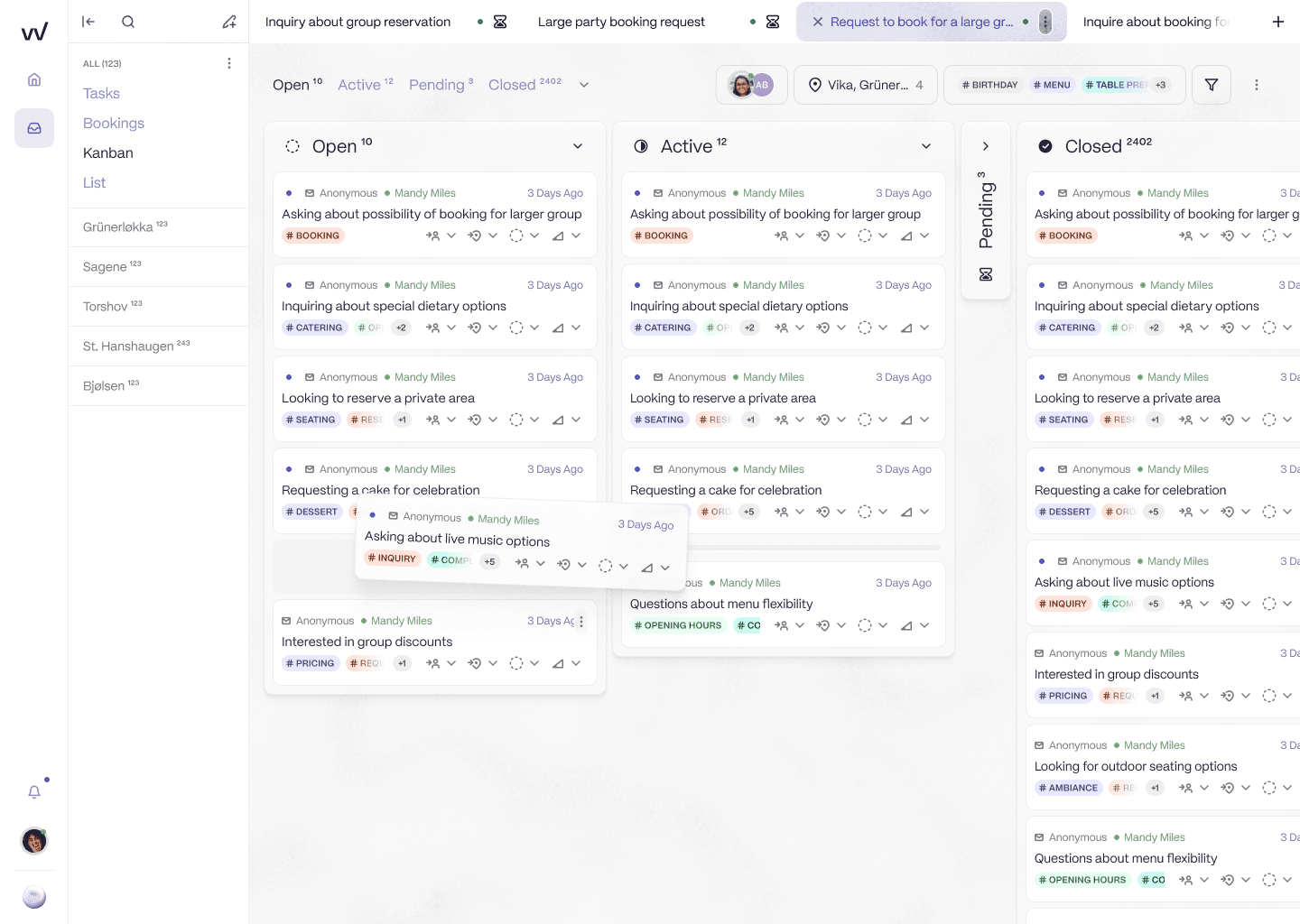
Every enquiry routed to its venue automatically, across cities and sites.
The AI drafts the reply in that venue's voice, using its menus, its policies and its own way of answering. For a group taking enquiries in more than one language, the draft is a starting point rather than a blank page.
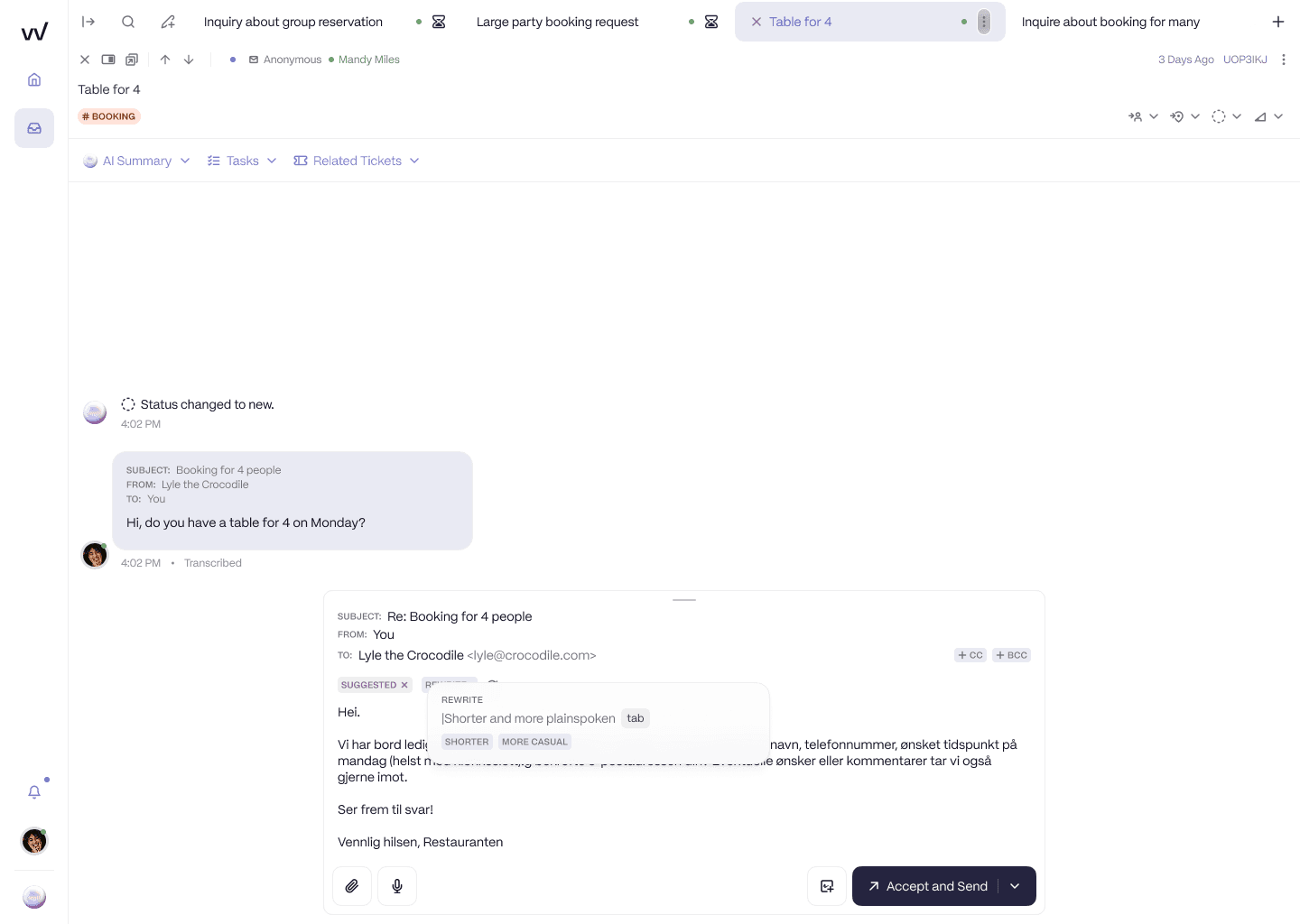
A reply drafted in the venue's voice, waiting for the team to approve it.
Because it connects to the booking system, the AI does the step Help Scout cannot: it checks availability and prepares the booking inside the same thread. The routine requests clear themselves, and the group bookings and private-hire enquiries, the ones the network does not send you, are acknowledged instantly and held for a person.
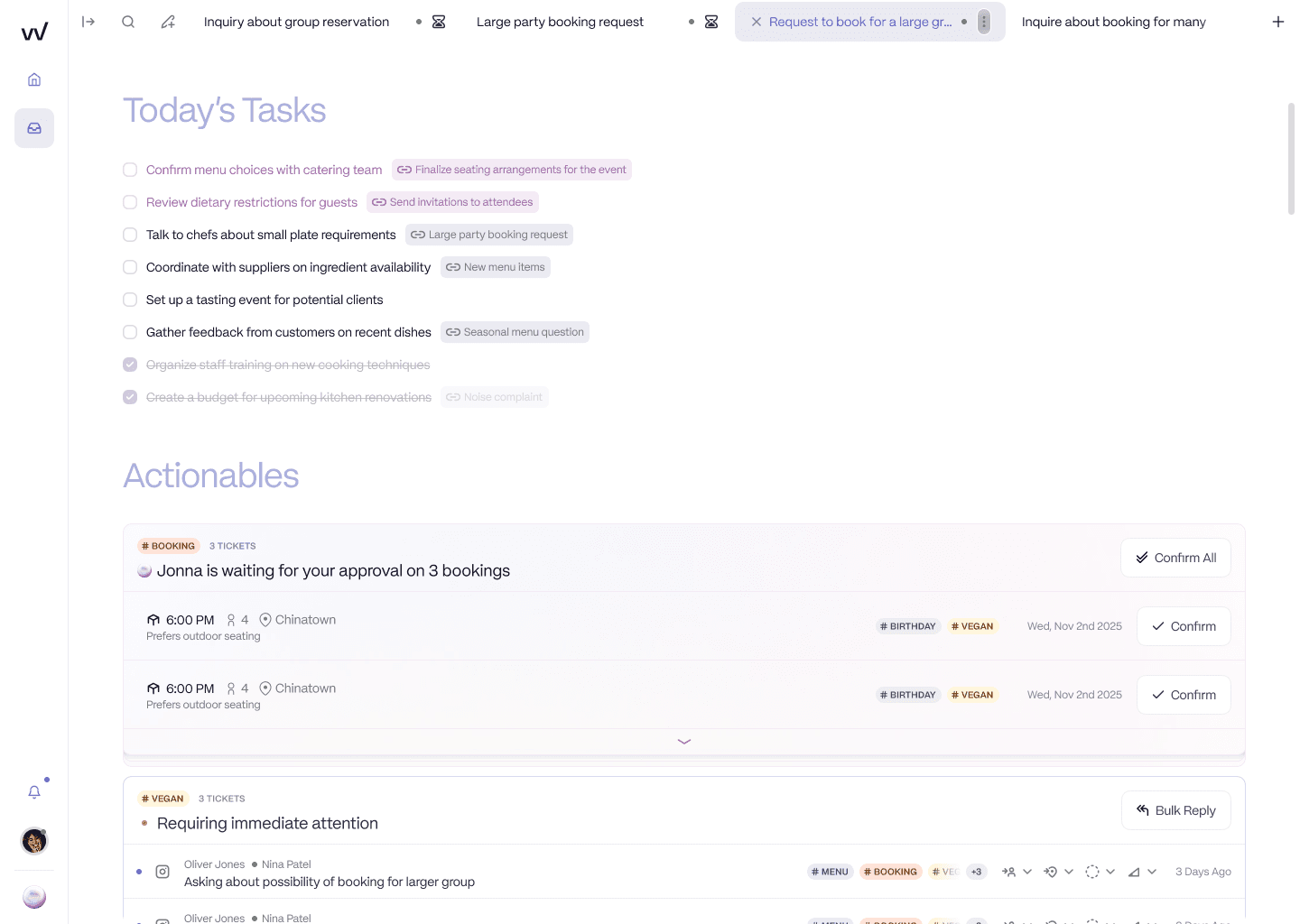
Group and private-hire enquiries acknowledged and prepared, ready for someone to close.
And because every enquiry is tracked by location, direct demand becomes as visible as network demand. Response rates and conversion by site, so you can see what your own inbox is worth next to the covers you pay commission on. Help Scout reports on conversations and happiness scores, which cannot be compared with the covers the network reports.
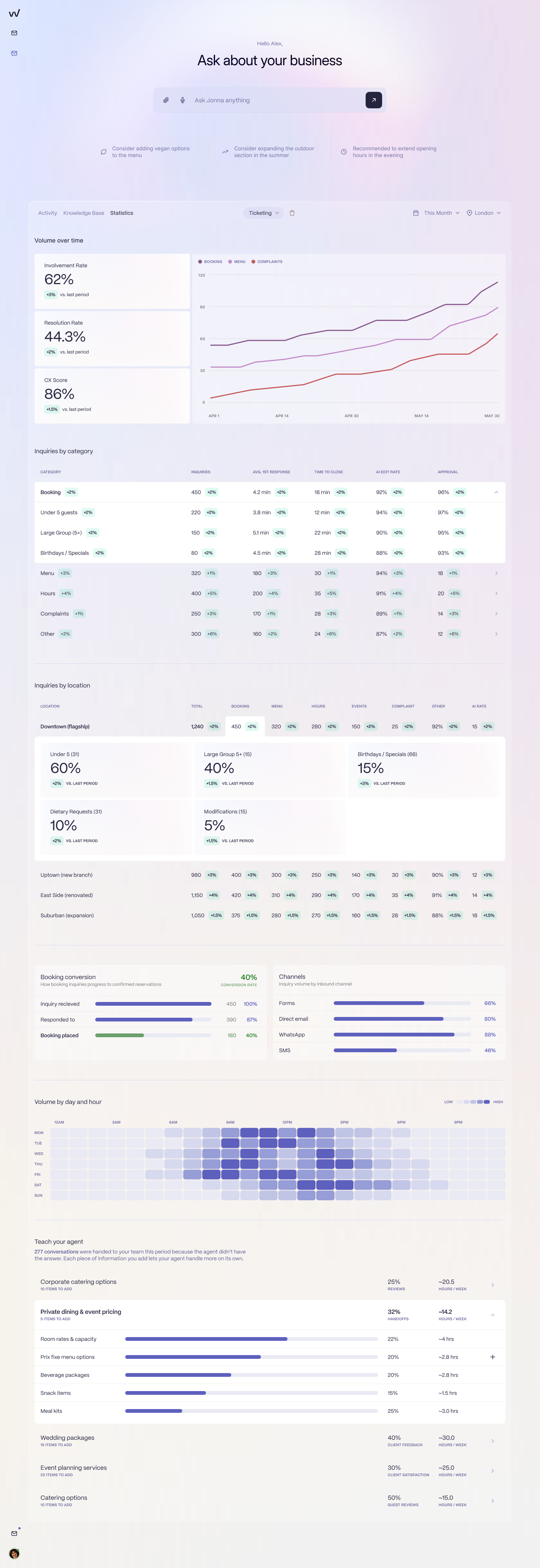
Response rate, volume and conversion by location, measured against network-sourced covers.
An honest note on where RevVue is today
RevVue's TheFork integration is on the roadmap. That is the honest status. For now, groups run an email-only pilot that already delivers the inbox value shown above: location-aware routing, instant acknowledgement, AI-drafted replies, high-value bookings surfaced, and reporting by location. The direct booking-system connection will deepen that when it lands, but it does not gate the value you get today. The UK AI is in pilot.
This is the move the Brasilia Group made, off a horizontal helpdesk and onto an inbox built for the job. Their founder, Nikolaos Kiosses, put it plainly: "The transition from Zendesk to RevVue has been a game changer."
If you are weighing the two, Help Scout alternatives for restaurants covers the comparison in full. Since most of these enquiries arrive from the network rather than your own site, automating third-party booking emails covers that specific problem in depth. To see what the AI would have said to a real enquiry your team received last week, book 20 minutes.
Frequently asked questions
Does Help Scout integrate with TheFork?
No. Help Scout has no native integration with TheFork, and TheFork is not on Zapier. Bridging the two means a custom development project against Help Scout's API and TheFork's B2B API. Even when built, it copies enquiry data into a conversation. It cannot check live availability, create a booking, or amend one in TheFork Manager.
Can TheFork's API connect it to a shared inbox?
Not usefully for booking enquiries. TheFork does publish a B2B API developer portal, which is more open than most booking systems offer, and it is a genuine answer for syncing reservation data into a CRM. But TheFork frames it around data synchronisation without the need for real-time updates. Handling an enquiry needs the opposite: a live availability check while the agent is replying, and the ability to write a booking back immediately.
Is Help Scout good for restaurant booking enquiries?
It is a real improvement on a shared Gmail account, because it adds assignment, internal notes, saved replies and response-time visibility to the email channel where most enquiries actually arrive. Two gaps remain. It cannot touch your booking system, so every enquiry is handled twice. And it is built around mailboxes rather than venues, so a multi-site group gets no native routing, per-venue tone or reporting by location.
What do restaurant groups use instead for booking enquiries?
Most run booking enquiries through a shared inbox even when they use a help desk for customer service, because the help desk never solved the booking side. A purpose-built option is RevVue, which is location-aware and whose AI checks availability and prepares the booking inside the conversation. Its TheFork integration is on the roadmap, with an email-only pilot available now.