No. Help Scout has no native, purpose-built integration with Tock. You can wire the two together loosely with Zapier, and the result still cannot check availability, move a prepaid seat or resolve a deposit inside the conversation. Help Scout is a shared inbox and email-first help desk for small teams. Tock is a reservation platform built around prepaid bookings, deposits, ticketed events and tasting menus. Help Scout is closer to how these enquiries actually arrive than most tools in this category, which makes the missing piece stand out.
The short answer
Help Scout can receive a Tock enquiry as a conversation. It cannot do anything with it in Tock. Checking the calendar, moving a prepaid booking, adjusting a deposit, adding a dietary note to a ticketed event: all of that still happens by hand, in Tock, by a person.
Help Scout + Tock | |
|---|---|
Native integration | None |
Best available workaround | A Zapier or custom-API bridge that copies enquiry text into a conversation |
What the workaround still can't do | Check availability, move or amend a prepaid booking, adjust a deposit, read booking history |
Both ends of this pairing are reachable, which makes the ceiling instructive rather than merely frustrating. Help Scout is well supported on Zapier and has its own API. Tock offers an API and webhooks and works with Zapier too. Connectivity is not the constraint.
What actually happens to a booking enquiry
Credit where it is due first. Most of these enquiries arrive by email, and Help Scout is built for email: assignment, saved replies, internal notes, and a shared view so two people do not answer the same guest. Against a shared Gmail account that is a real gain in accountability. The trouble starts where replying ends and booking begins, and on a prepaid platform that boundary comes with money attached.
Here is the real journey of one enquiry when Help Scout and Tock do not talk to each other.
An enquiry arrives about a group of ten for a tasting experience next month, asking whether the group can book as one party, whether two guests can have a non-alcoholic pairing, and how the deposit works for a group that size. The message becomes a Help Scout conversation.
An agent opens it and reads it.
The agent opens Tock in another tab, because Help Scout cannot see the calendar.
They check whether ten can be seated as one party at a single seating, whether the non-alcoholic pairing is set up as an option, and what the deposit terms are at that headcount.
They create or hold the booking in Tock, re-keying names, date, seating, pairing choices and the dietary notes from the email.
They switch back to Help Scout and write the reply, setting out the deposit and what happens if numbers change.
They close the conversation.
Two weeks later: "We are down to eight, and one has a nut allergy." The deposit total changes and the seating may too. The agent repeats steps 3 to 7.
Every enquiry is handled twice, in two systems, by a person copying the same fields between screens. Step eight is where prepaid platforms punish the double-handling, because the money has to be reconciled by hand each time the numbers move. One operations director described the inbox behind this workflow as "a black hole, no KPIs, no response rate, nothing," because the work happened in tabs and conversations that no report could see.
The sharper cost is the enquiry you never hear about again. Tasting and event enquiries arrive in the evening from people planning at home, and a reply the next afternoon often arrives after they have booked the restaurant that answered first. A roughly 40-venue entertainment group lost a single booking worth £40,000 because the enquiry arrived outside working hours and nobody replied in time. A three-site pizza group put it more bluntly about a 30 to 40 cover enquiry: "It just sat there. No one saw it. They went somewhere else." Help Scout did not cause those losses. Routing bookings through a system that cannot book anything is what makes the delay inevitable.
What Help Scout actually connects to
Help Scout's apps directory covers what its market needs: CRM, e-commerce, billing, chat, project tools and analytics, aimed at small businesses, SaaS companies, agencies, nonprofits and online retailers. No restaurant booking system appears in it, and Tock is no exception.
Tock is more open than most of its peers, which is worth stating accurately. It offers a data API and webhooks, gated to Premium and Premium Unlimited plans and provisioned on request rather than self-serve, and it works with Zapier. So a zap that opens a Help Scout conversation when a Tock booking is created or changed is genuinely buildable without engineering.
Look at what that gives you. A Tock event can create or update a Help Scout conversation. It is one-directional notification. It does not let an agent see the calendar, hold a seating, move a prepaid booking, or adjust a deposit from inside the conversation. Help Scout AI drafts replies, summarises threads and helps agents write consistently, all from your conversations and knowledge base, with no line into the calendar and no ability to take an action in Tock. So the zap makes the enquiry visible in a second place, and the actual booking work, steps 3 to 7, is unchanged.
There is also a multi-site gap. Help Scout is built around mailboxes, and a mailbox is not a venue. There is no native concept of which site an enquiry belongs to, no per-venue tone, and no reporting by location.
One piece of context before you invest in a bridge. American Express announced in February 2026 that Tock is merging into Resy, with venues unifying on Resy through summer 2026 and the consumer Tock app and exploretock.com being retired. Tock's restaurant-facing management software continues to operate as part of Resy, and API key requests already route through a Resy address.
Why this matters for booking enquiries
A support conversation and a booking enquiry look similar and behave nothing alike. A support conversation is resolved by a reply. A booking enquiry is only resolved when a seat is held in the calendar, and on Tock, usually paid for. That difference is the whole problem.
The shared inbox can write a polished reply. It cannot book the table. The transaction, the part that actually earns the cover, still lands on your team, one enquiry at a time. Help Scout gets you a tidy, accountable inbox and leaves the booking work exactly where it was.
What it looks like when the tool is built for booking enquiries
The gap closes when the enquiry and the booking are handled in one place, so a question about a prepaid seat does not turn into an admin job. This is what RevVue does, and it is easier to show than to describe.
Every enquiry is tagged to the venue it concerns, which matters for a group where each site sells a different ticketed experience. A question about one tasting menu is never answered with another restaurant's seating times, because the team works from one queue, by location, rather than mailboxes standing in for venues.
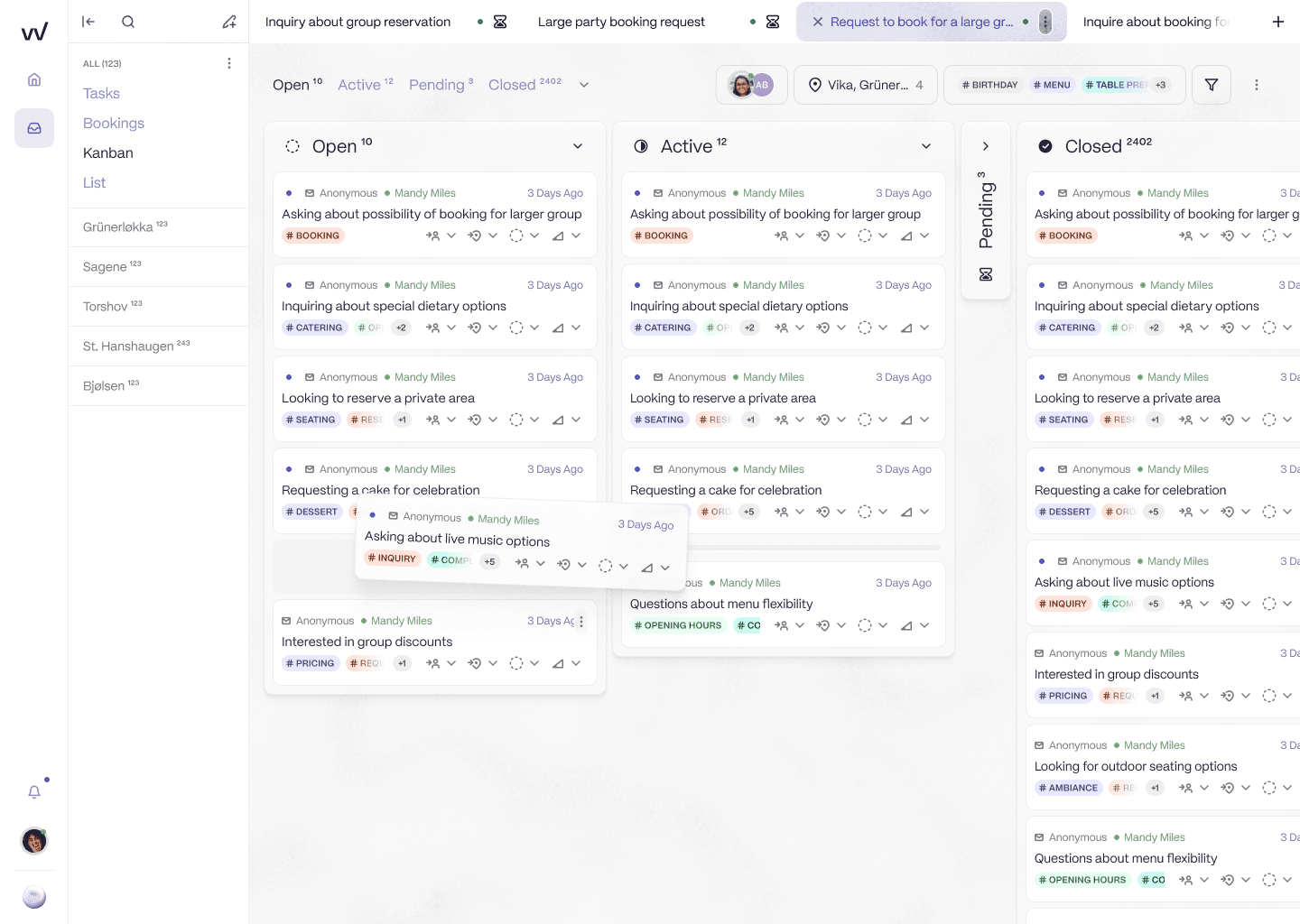
Enquiries sorted by venue, so each ticketed experience is answered with its own detail.
The AI drafts the reply in that venue's voice, grounded in its menu, its cancellation terms and its prepayment rules. Those terms are the substance of most of these enquiries, and getting them into the first reply is most of the work.
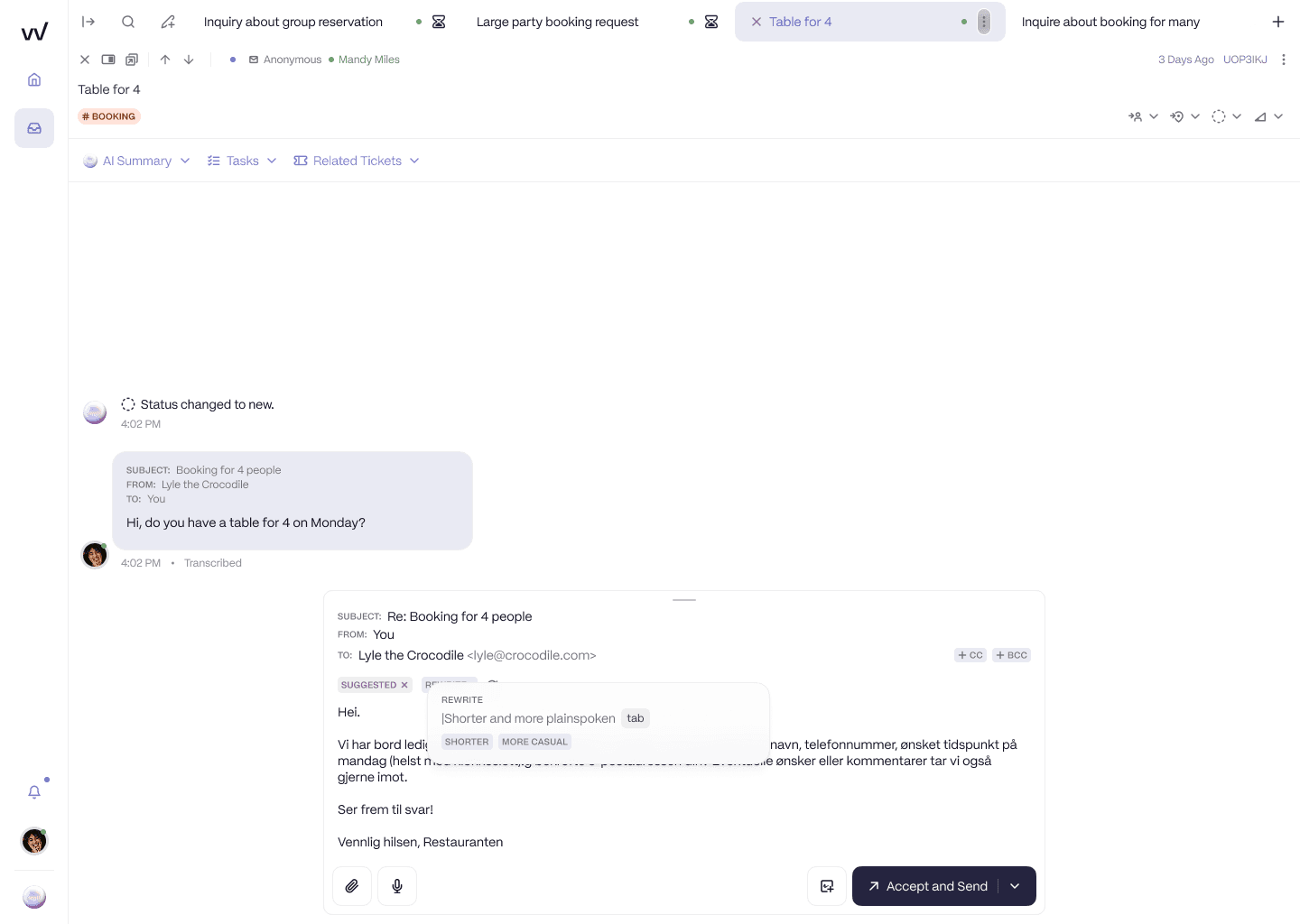
The draft arrives carrying the venue's own terms, ready for one-click approval.
Because it connects to the booking system, the AI takes the step Help Scout cannot: it checks availability and prepares the booking in the thread. Simple questions resolve on arrival, and anything touching money, a party growing by four seats or a date moving, is acknowledged instantly and queued for a person, because those are the ones with a payment attached.
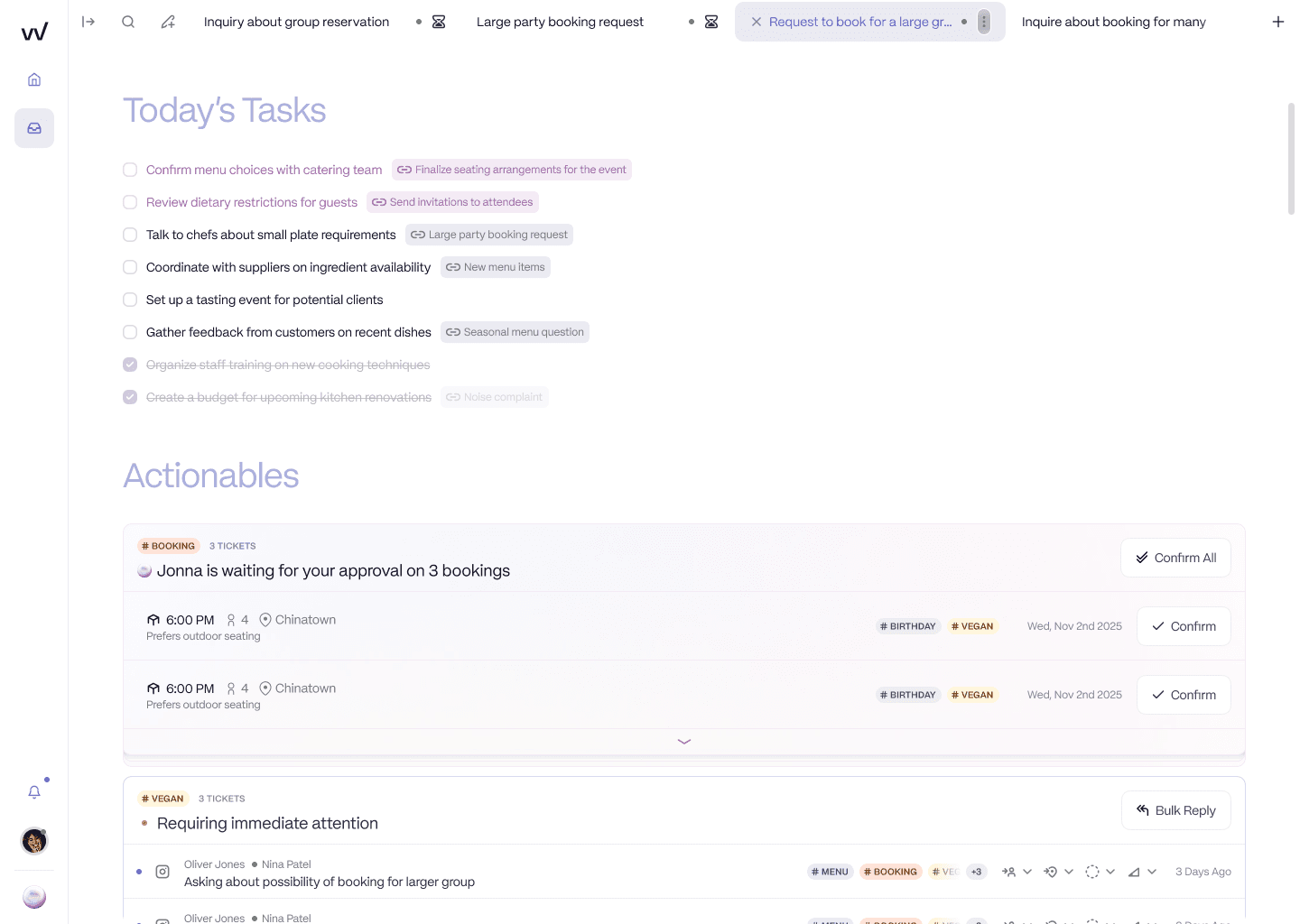
Amendments and high-value bookings held for approval, since each one carries a payment.
And because every enquiry is tracked per venue, the admin around prepaid bookings becomes measurable. How many amendments each site handles, how fast it replies, and how much of that work is repeating itself. Help Scout reports on conversations and happiness scores, which does not tell you what the amendment work cost.
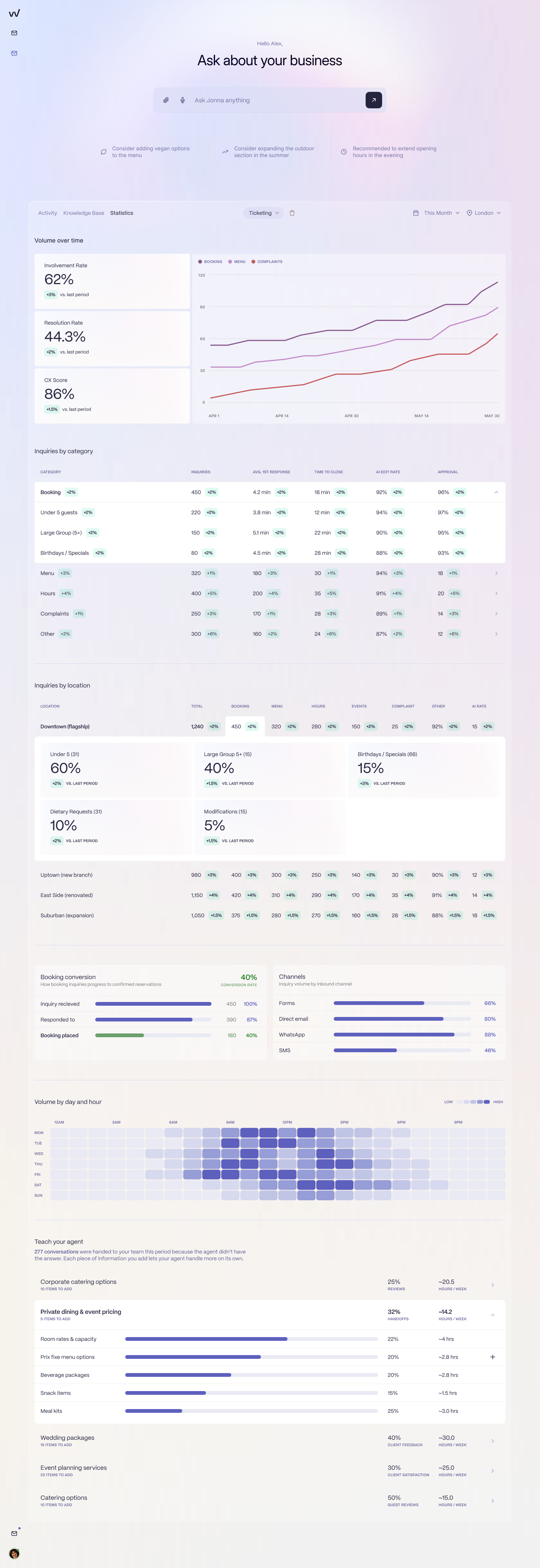
Volume, response rate and conversion by location, including the amendment traffic behind prepaid covers.
An honest note on where RevVue is today
RevVue's Tock integration is on the roadmap. That is the honest status. For now, groups run an email-only pilot that already delivers the inbox value shown above: location-aware routing, instant acknowledgement, AI-drafted replies, high-value bookings surfaced, and reporting by location. The direct booking-system connection will deepen that when it lands, but it does not gate the value you get today. The UK AI is in pilot.
This is the move the Brasilia Group made, off a horizontal helpdesk and onto an inbox built for the job. Their founder, Nikolaos Kiosses, put it plainly: "The transition from Zendesk to RevVue has been a game changer."
If you are weighing the two, Help Scout alternatives for restaurants covers the comparison in full. If you are consolidating onto Resy, the same question applies there: does Help Scout integrate with Resy. To see what the AI would have said to a real enquiry your team received last week, book 20 minutes.
Frequently asked questions
Does Help Scout integrate with Tock?
No. Help Scout has no native integration with Tock. Because Tock offers an API and works with Zapier, you can build a bridge that opens or updates a Help Scout conversation when a Tock booking changes, but it only moves information one way. It cannot check availability, move a prepaid booking, or adjust a deposit. That work still has to be done by hand in Tock.
Can I connect Tock and Help Scout with Zapier?
Yes, loosely. Both are on Zapier, so a zap can create or update a Help Scout conversation from a Tock event. That gives you notification, not capability. The agent still opens Tock in another tab to check the calendar, move the seating and reconcile the deposit. Tock's fuller data API and webhooks are limited to Premium and Premium Unlimited plans and provisioned on request.
Is Tock shutting down now that it has merged with Resy?
The consumer side is being retired, not the venue software. American Express announced in February 2026 that Tock is merging into Resy, with venues unifying on Resy through summer 2026 and the Tock app and exploretock.com being wound down. Tock's restaurant-facing management software continues to operate as part of Resy. If you are planning a custom integration, factor in that the platform underneath is consolidating.
What do restaurant groups use instead for booking enquiries?
Most run booking enquiries through a shared inbox even when they use a help desk for customer service, because the help desk never solved the booking side. A purpose-built option is RevVue, which is location-aware and whose AI checks availability and prepares the booking inside the conversation. Its Tock integration is on the roadmap, with an email-only pilot available now.