No. Hiver has no native, purpose-built integration with DesignMyNight, no venue booking system appears in Hiver's app library, and DesignMyNight is not on Zapier either, so even the low-code shortcut is missing. Hiver turns Gmail into a helpdesk, so your bookings@ address stays where it is and gains assignment, notes and SLA tracking. DesignMyNight is the UK discovery, booking and enquiry platform used by bars, pubs, late-night and experiential venues, with Collins as its venue-side software.
The short answer
Hiver can receive a DesignMyNight enquiry in your shared Gmail inbox and make it accountable. It cannot do anything with it in DesignMyNight or Collins. Checking capacity, holding an area, quoting a drinks package, taking a deposit: all of that still happens by hand, by a person.
Hiver + DesignMyNight | |
|---|---|
Native integration | None |
Best available workaround | A custom build on Hiver's API and the DesignMyNight API |
What the workaround still can't do | Check availability, hold an area, quote or attach a package, take a deposit |
That middle row is thinner than in most Hiver pairings, and the reason is on the DesignMyNight side. Hiver offers a Zapier connector and its own API. DesignMyNight is not on Zapier at all, so the no-code route does not exist and a custom build is the only option.
What actually happens to a booking enquiry
Give Hiver full credit first. If your venues run on Google Workspace and enquiries arrive at a shared Gmail address, Hiver is the lowest-friction improvement available: no migration, no new interface, and immediate assignment, internal notes, SLA rules and reporting on that mailbox. For a small bookings team juggling party threads that is a real gain.
Here is the real journey of one enquiry once you have done that.
Someone emails
bookings@about a work leavers' do for 30 on a Friday, asking whether a booth or area can be held, what drinks packages cost at that size, and whether they can bring their own playlist. The message lands in Gmail and Hiver assigns it.An agent opens it in Gmail and reads it.
The agent opens Collins in another tab, because Hiver cannot see capacity or the area plan.
They check that Friday for 30, see which area is uncommitted at that time, look up current package prices and the minimum spend, and check the music policy for that space.
They pencil the area in, re-keying the date, numbers, package and the playlist note from the email.
They switch back to Gmail and write the reply with packages and the minimum spend.
They snooze the conversation in Hiver, because a leavers' do is booked by committee.
Five days later: "It is 38 now and can we have the whole downstairs?" Thirty-eight changes the area, the minimum spend and the package maths. The agent repeats steps 3 to 7.
Every enquiry is handled twice, in two systems, by a person copying the same fields between screens. Package enquiries are worse than table enquiries here, because each round trip means re-quoting from a screen the writer cannot see. One operations director described the inbox behind this workflow as "a black hole, no KPIs, no response rate, nothing." Hiver gives you the response rate and the ownership. It cannot tell you which enquiries became bookings, because it never sees one.
The sharper cost is the enquiry you never hear about again. Someone organising a leavers' do sends the same message to five venues on a Tuesday night, and the first one back with a package and a price usually gets the deposit. A roughly 40-venue entertainment group lost a single booking worth £40,000 because the enquiry arrived outside working hours and nobody replied in time. A three-site pizza group put it more bluntly about a 30 to 40 cover enquiry: "It just sat there. No one saw it. They went somewhere else." Hiver did not cause those losses. Routing bookings through a system that cannot book anything is what makes the delay inevitable.
What Hiver actually connects to
Hiver integrates with more than 100 apps, and the named ones tell you who it sells to: Salesforce, HubSpot, QuickBooks, Okta, Jira, Slack, NetSuite, Shopify and Asana. It also offers a Zapier connector and the Hiver API for custom builds, and Harvey, its AI bot, suggests relevant templates, closes conversations and marks spam.
None of those is a venue booking system. This is worth stating carefully, because Hiver publishes a hospitality help-desk page that mentions integrating with booking engines and guest-management systems. That is general copy aimed largely at hotels, and what backs it is the 100-plus business apps, Zapier and the API rather than any named venue platform. So Hiver has not ignored hospitality. It has simply not built for the diary, and for DesignMyNight the usual fallback is unavailable too.
DesignMyNight and Collins connect outward through their own APIs to point-of-sale, payment and marketing systems rather than exposing a general automation connector, and neither is on Zapier. So bridging to Hiver means a custom development project against Hiver's API and the DesignMyNight API. For a bar or late-night group that is a hard budget line, and what it delivers is modest: enquiry text landing in a Gmail conversation, one direction, treated as a message. Harvey helps with the writing rather than the booking. It can surface the right package template and cannot tell you whether the downstairs area is free.
There is one more gap for a multi-site group. Hiver's structure is Gmail's structure: mailboxes, labels and rules. A label is not a venue. There is no native concept of which site an enquiry belongs to, no per-venue tone, and no reporting by location, which matters most for a group whose sites have genuinely different personalities.
Why this matters for booking enquiries
A support conversation and a booking enquiry look similar and behave nothing alike. A support conversation is resolved by a reply. A party enquiry is only resolved when the space is held and the deposit is taken. That difference is the whole problem.
Hiver makes the email accountable. It cannot book the party in. The transaction, the part that actually earns the revenue, still lands on your team, one enquiry at a time. Hiver is best understood as the most graceful way to keep the old workflow rather than a way out of it.
What it looks like when the tool is built for booking enquiries
The gap closes when the enquiry and the booking sit in one place, so a package question can be answered and held in the same reply. This is what RevVue does, and it is easier to show than to describe.
Enquiries are routed to the right bar or venue automatically, which matters when a group runs several late-night sites with different licences, layouts and last entry times. Nobody quotes the wrong venue's closing time, because the team works from one queue, by location, rather than labels standing in for venues.
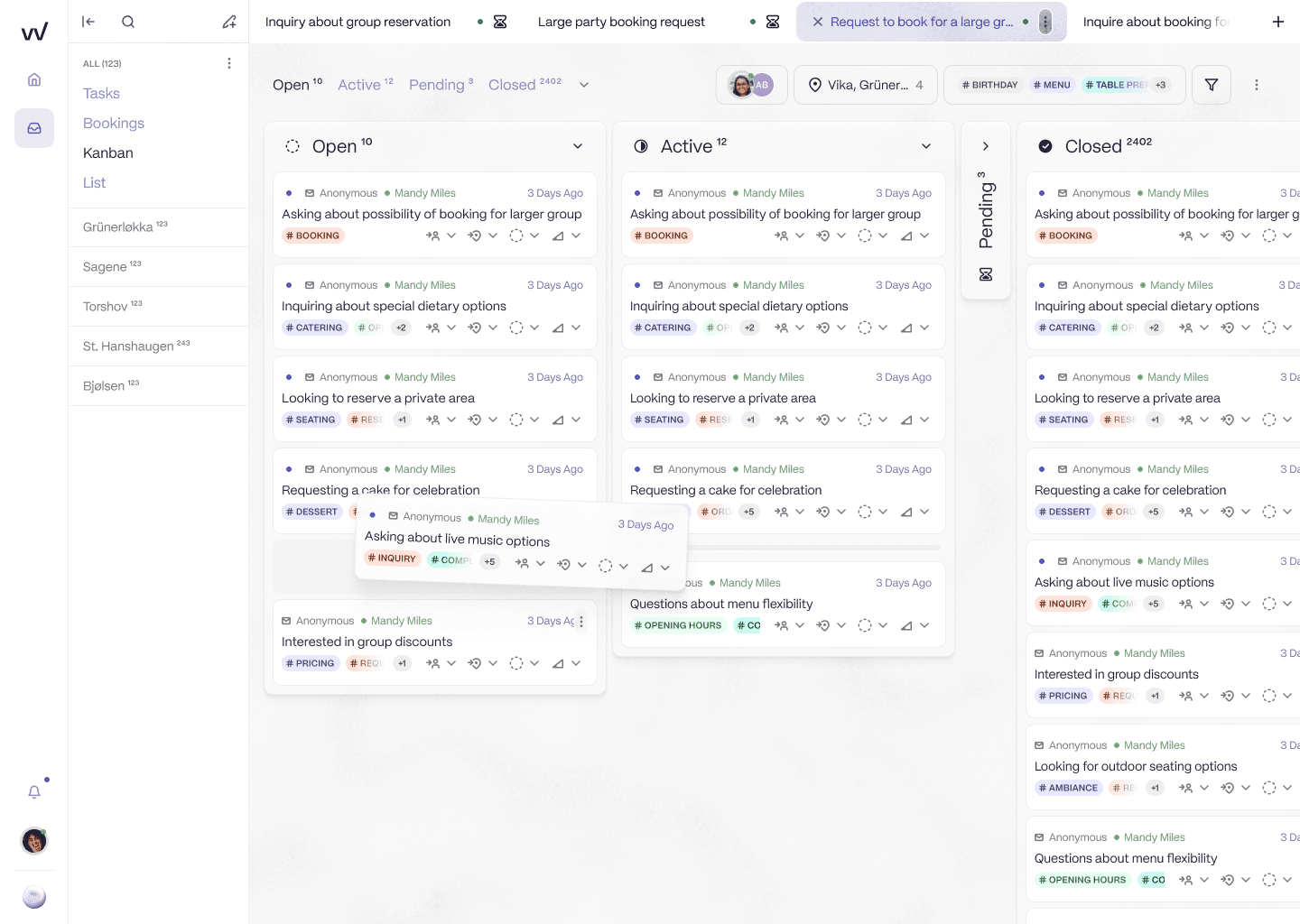
Each site gets its own queue, so the answer always matches the venue that was asked about.
The AI drafts the reply in that venue's voice, grounded in its packages, its minimum spends and what the space can actually hold. Package enquiries are long and repetitive, and the draft arrives with those details already in it.
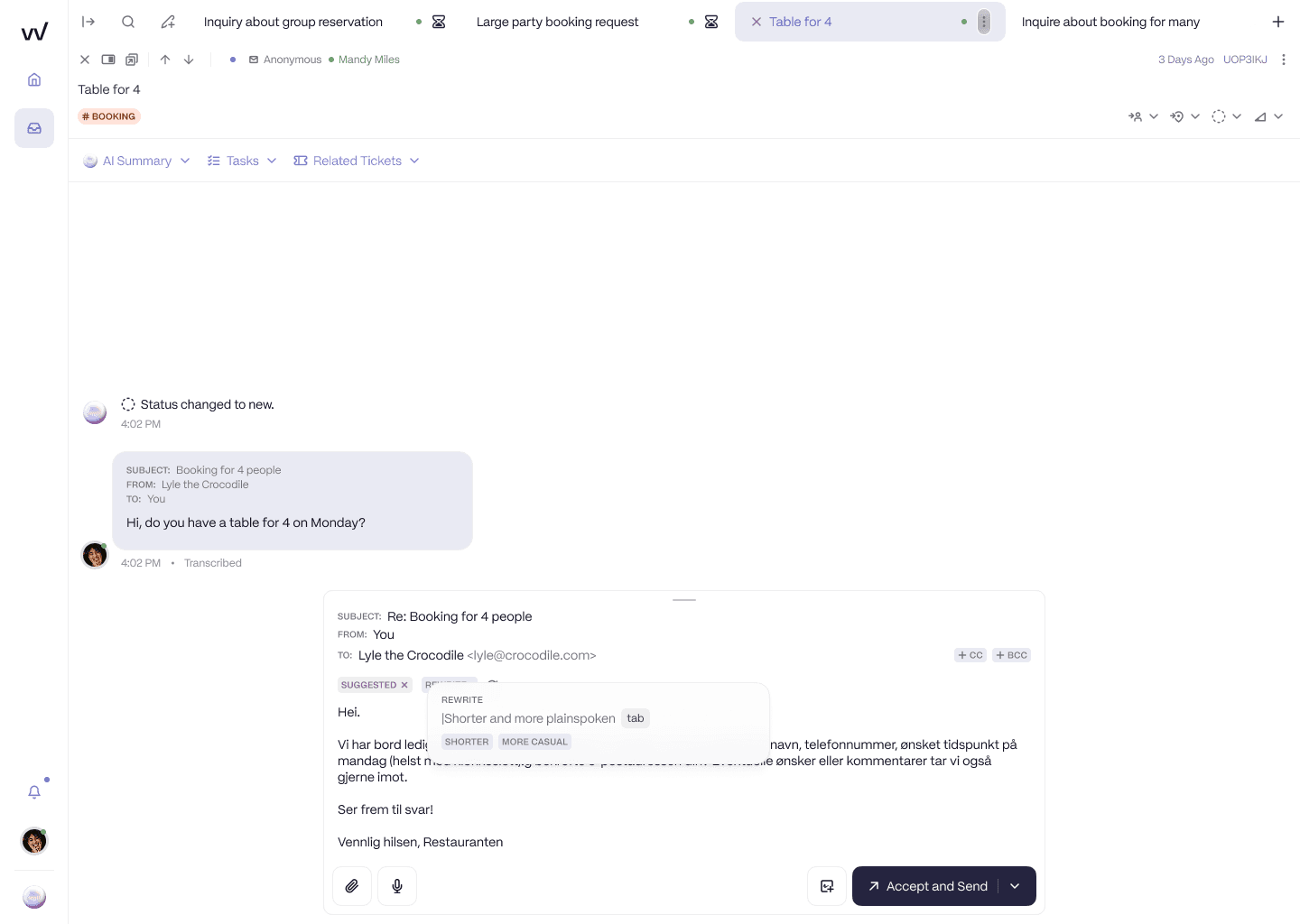
The package answer drafted in the venue's voice, waiting for one-click approval.
Because it connects to the booking system, the AI does the step Hiver cannot: it checks what is free and prepares the booking inside the conversation. Straightforward requests are handled as they arrive, and the ones carrying a deposit or a whole-space hire are acknowledged instantly and held for a person to work properly.
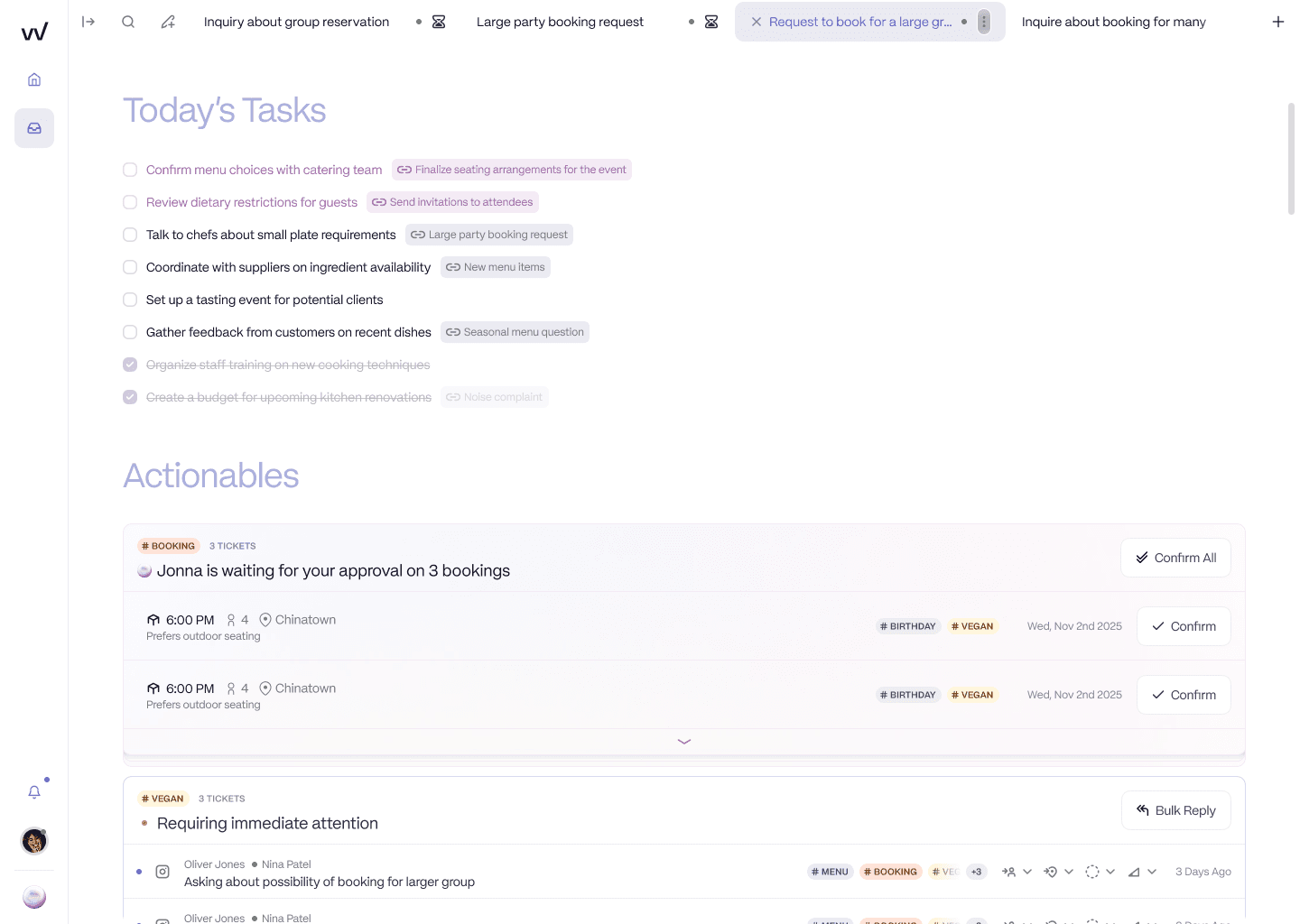
Deposit-carrying and large-party enquiries, acknowledged and prepared for someone to finish.
And because everything is tracked per site, you get the numbers a booking widget never produced: how fast each venue replies, how many enquiries convert, and which site is quietly losing its Friday nights. Hiver reports on mailbox SLAs and response times, which is a different question from how many Saturday bookings you won.
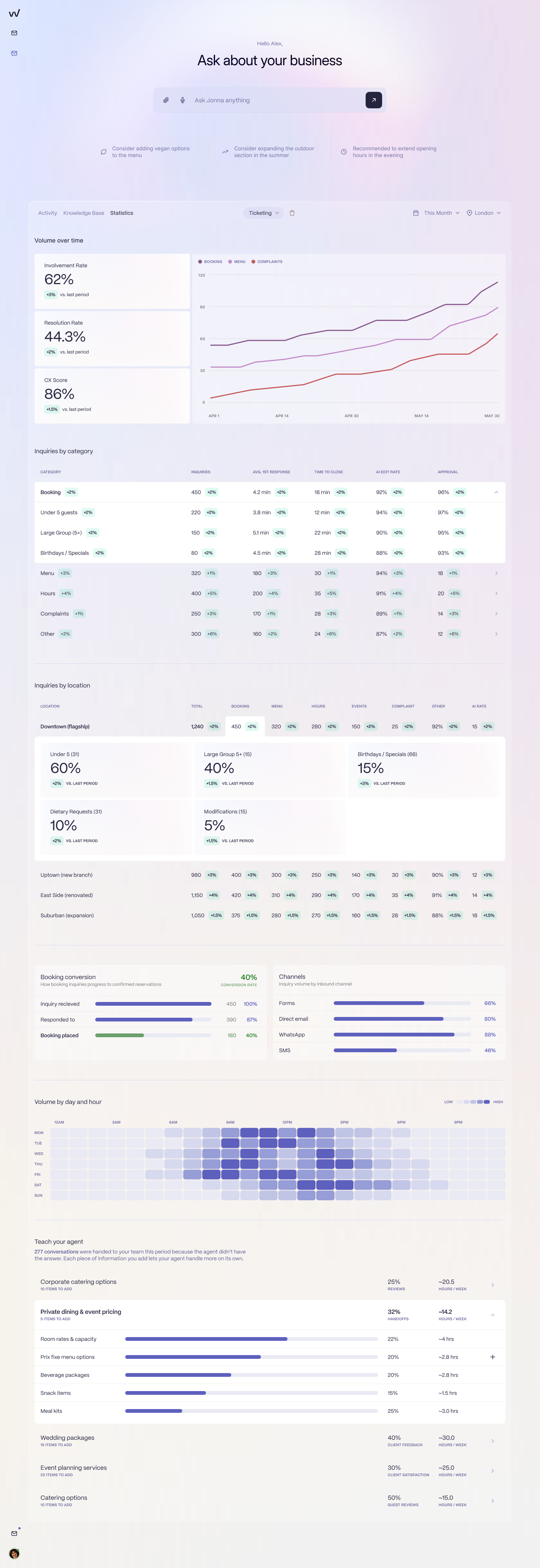
Response rate, volume and conversion per site, including the enquiries that never converted.
An honest note on where RevVue is today
RevVue's DesignMyNight integration is in active development. That is the honest status. For now, venues run an email-only pilot that already delivers the inbox value shown above: location-aware routing, instant acknowledgement, AI-drafted replies, high-value bookings surfaced, and reporting by location. The direct booking-system connection will deepen that when it lands, but it does not gate the value you get today. The UK AI is in pilot.
This is the move the Brasilia Group made, off a horizontal helpdesk and onto an inbox built for the job. Their founder, Nikolaos Kiosses, put it plainly: "The transition from Zendesk to RevVue has been a game changer."
If your enquiries currently live in a shared Gmail account, replacing a shared Gmail inbox for a restaurant group is the most relevant read next. Because party and private-hire enquiries are where the money is for a late-night venue, how to triage high-value group bookings is worth reading too. To see what the AI would have said to a real enquiry your team received last week, book 20 minutes.
Frequently asked questions
Does Hiver integrate with DesignMyNight?
No. Hiver has no native integration with DesignMyNight, and no venue booking system appears in Hiver's app library. DesignMyNight is not on Zapier either, so there is no low-code bridge. Connecting them means a custom development project against Hiver's API and the DesignMyNight API, and even then it only copies enquiry text into a Gmail conversation. It cannot check availability, hold an area, or take a deposit.
Can I connect Hiver and DesignMyNight with Zapier?
No. Hiver has a Zapier connector, but DesignMyNight is not on Zapier, so there is no zap to build. DesignMyNight and Collins connect outward through their own APIs to point-of-sale, payment and marketing systems rather than exposing a general automation connector, which leaves custom development as the only route.
Hiver's website mentions booking engines. Does that include venue diaries?
Not in any named sense. Hiver publishes a hospitality help-desk page that refers to booking engines and guest-management systems, which is general copy aimed largely at hotels, and it is backed by Hiver's 100-plus business apps, its Zapier connector and its API rather than by any named venue booking platform. Connecting DesignMyNight means a custom build, and that still cannot check availability or hold an area.
What do bars and late-night venues use instead for party enquiries?
Most stay on a shared inbox and accept the double-handling, because no general-purpose tool solved the booking side. A purpose-built option is RevVue, which is location-aware and whose AI checks availability and prepares the booking inside the conversation, with high-value party enquiries surfaced for a person to nurture. Its DesignMyNight integration is in active development, with an email-only pilot available now.