No. Hiver has no native, purpose-built integration with OpenTable, and no restaurant booking system appears in Hiver's app library. Hiver turns Gmail into a helpdesk, so your bookings@ address stays where it is and gains assignment, notes and SLA tracking. OpenTable is the front-of-house diary and the consumer reservation network that fills covers. Hiver is the gentlest upgrade in this comparison, and it is still a mailbox.
The short answer
Hiver can receive an OpenTable enquiry in your shared Gmail inbox and make it accountable. It cannot do anything with it in OpenTable. Checking the diary, holding tables, splitting a party across sittings, adding a note: all of that still happens by hand, in OpenTable, by a person.
Hiver + OpenTable | |
|---|---|
Native integration | None |
Best available workaround | A Zapier or custom-API bridge that copies enquiry data into the conversation |
What the workaround still can't do | Check availability, create or amend a reservation, seat a party, read the guest's dining history |
One point of precision, because Hiver's own marketing invites confusion. Hiver publishes a hospitality help-desk page that mentions integrating with booking engines and guest-management systems. That is general copy aimed largely at hotels, and what backs it is Hiver's 100-plus business apps, its Zapier connector and its API. No restaurant booking system is named in the app library. So the accurate statement is not that Hiver ignores hospitality. It is that connecting OpenTable to Hiver means a zap or a custom build, and neither lets Hiver check availability or create a reservation.
What actually happens to a booking enquiry
Give Hiver full credit first. If your group is on Google Workspace and enquiries already arrive at a shared Gmail address, Hiver is the lowest-friction improvement available: no migration, no new interface, and immediate assignment, internal notes, SLA rules and reporting on that mailbox. Against an unmanaged shared inbox that is a real gain.
Here is the real journey of one enquiry once you have done that.
A guest emails
bookings@about Mother's Day. They want a table for ten, ask whether the group can sit together or would have to split across two sittings, and mention one guest uses a wheelchair. The message lands in Gmail and Hiver assigns it.An agent opens it in Gmail and reads it.
The agent opens OpenTable in another tab, because Hiver cannot see the diary.
They check the Mother's Day service for ten, work out whether that is one long table or two sittings, look at what the kitchen can take at each turn on the busiest lunch of the year, and check step-free access and table height.
They create the reservation in OpenTable, re-keying the name, date, time, party size and the access notes from the email.
They switch back to Gmail and write the reply.
They close the conversation in Hiver.
The guest replies: "Grandparents are joining, so 12." Twelve on Mother's Day is a different question again. The agent repeats steps 3 to 7.
Every enquiry is handled twice, in two systems, by a person copying the same fields between screens. On a peak date like Mother's Day the volume of these threads is the whole problem, and Hiver improves exactly half of it: you can see who owns each email and how long it has been sitting. One operations director described the inbox behind this workflow as "a black hole, no KPIs, no response rate, nothing." Hiver gives you the response rate. It cannot give you covers, because it never sees one.
The sharper cost is the enquiry you never hear about again. A guest who found you through the OpenTable network has a page of alternatives in the same postcode, and Mother's Day enquiries are placed early and decided fast. A roughly 40-venue entertainment group lost a single booking worth £40,000 because the enquiry arrived outside working hours and nobody replied in time. A three-site pizza group put it more bluntly about a 30 to 40 cover enquiry: "It just sat there. No one saw it. They went somewhere else." Hiver did not cause those losses. Routing bookings through a system that cannot book anything is what makes the delay inevitable.
What Hiver actually connects to
Hiver integrates with more than 100 apps, and the named ones tell you who it sells to: Salesforce, HubSpot, QuickBooks, Okta, Jira, Slack, NetSuite, Shopify and Asana. It also offers a Zapier connector and the Hiver API for custom builds, and Harvey, its AI bot, suggests relevant templates, closes conversations and marks spam.
None of those is a restaurant booking system, which matters more than the raw integration count, because a diary is not a CRM. In practice a restaurant group has two routes: a zap, or a custom build on the Hiver API.
The zap is available in this pairing, because OpenTable is on Zapier too, with deeper API access partner-gated. Build it and look at what you have: an enquiry or an OpenTable event can create or update a conversation in your Gmail inbox, with a label and an owner attached. That is notification and workflow, moving one direction. It does not let the agent see the diary, hold a table, create the reservation, or read what the guest ordered last time. Harvey helps with the writing rather than the booking. It can surface the right Mother's Day template and cannot tell you whether the long table is free.
There is one more gap worth naming for a multi-site group. Hiver's structure is Gmail's structure: mailboxes, labels and rules. A label is not a venue. There is no native concept of which site an enquiry belongs to, no per-venue tone, and no reporting by location, so a group running six restaurants ends up either with six shared addresses or one address where nobody can see which site is falling behind.
Why this matters for booking enquiries
A support conversation and a booking enquiry look similar and behave nothing alike. A support conversation is resolved by a reply. A booking enquiry is only resolved when a table is held in the diary. That difference is the whole problem.
Hiver makes the email accountable. It cannot book the table. The transaction, the part that actually earns the cover, still lands on your team, one enquiry at a time. Hiver is best understood as the most graceful way to keep the old workflow rather than a way out of it.
What it looks like when the tool is built for booking enquiries
The gap closes when the inbox and the diary are one surface, so an enquiry that arrives by email is worth the same as one that arrives through the network. This is what RevVue does, and it is easier to show than to describe.
Every enquiry is tagged to the venue it is for the moment it lands. A group with sites in several cities stops relying on whoever recognises the address in the signature, and the team works from one queue, by location, rather than labels standing in for venues.
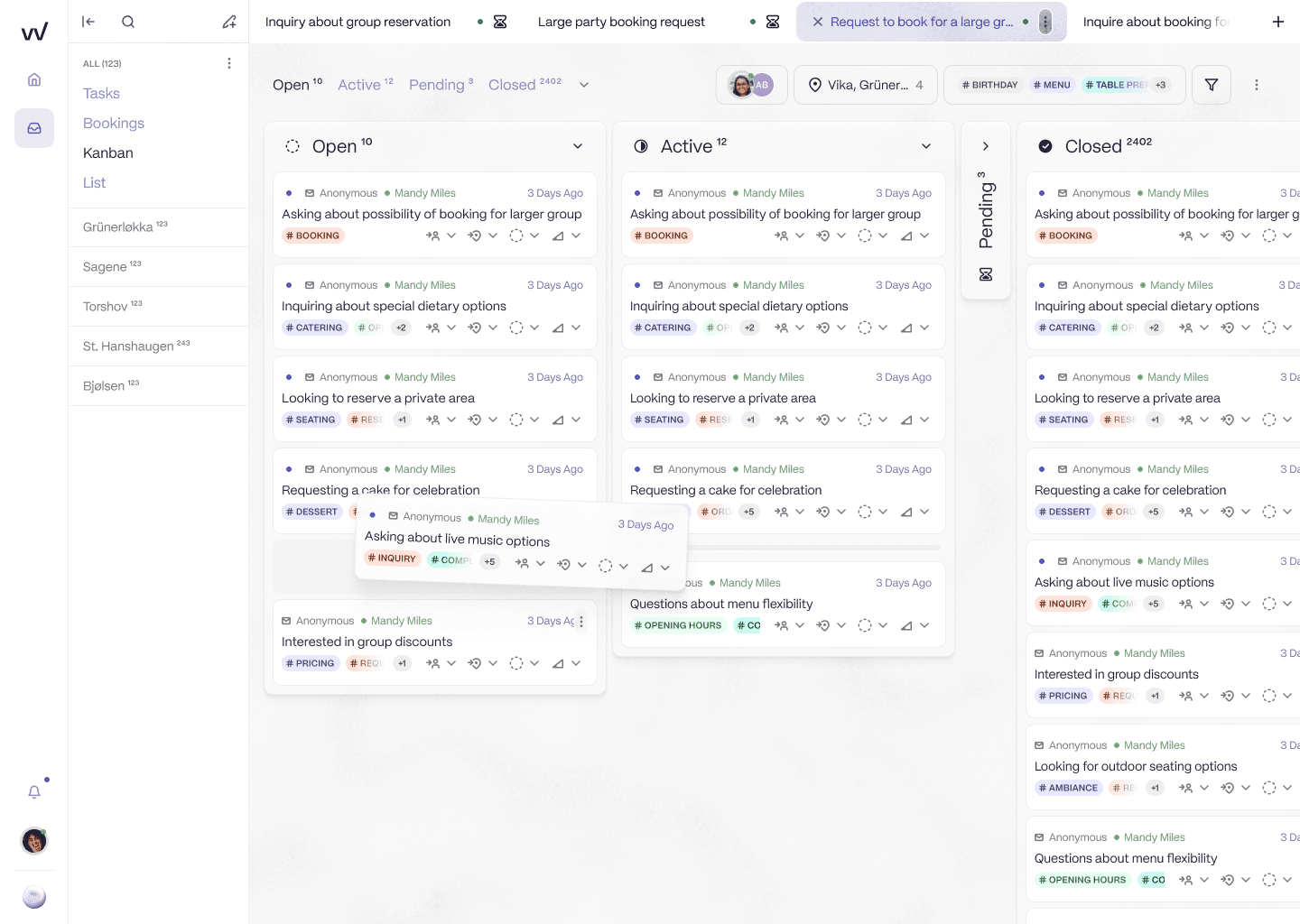
Enquiries arrive already sorted by venue, so nothing waits to be forwarded.
The AI drafts the reply in that venue's voice, using its menus, its policies and its own answers to the questions guests keep asking. The team reviews and sends instead of retyping the same explanation about set menus for the fourth time that week.
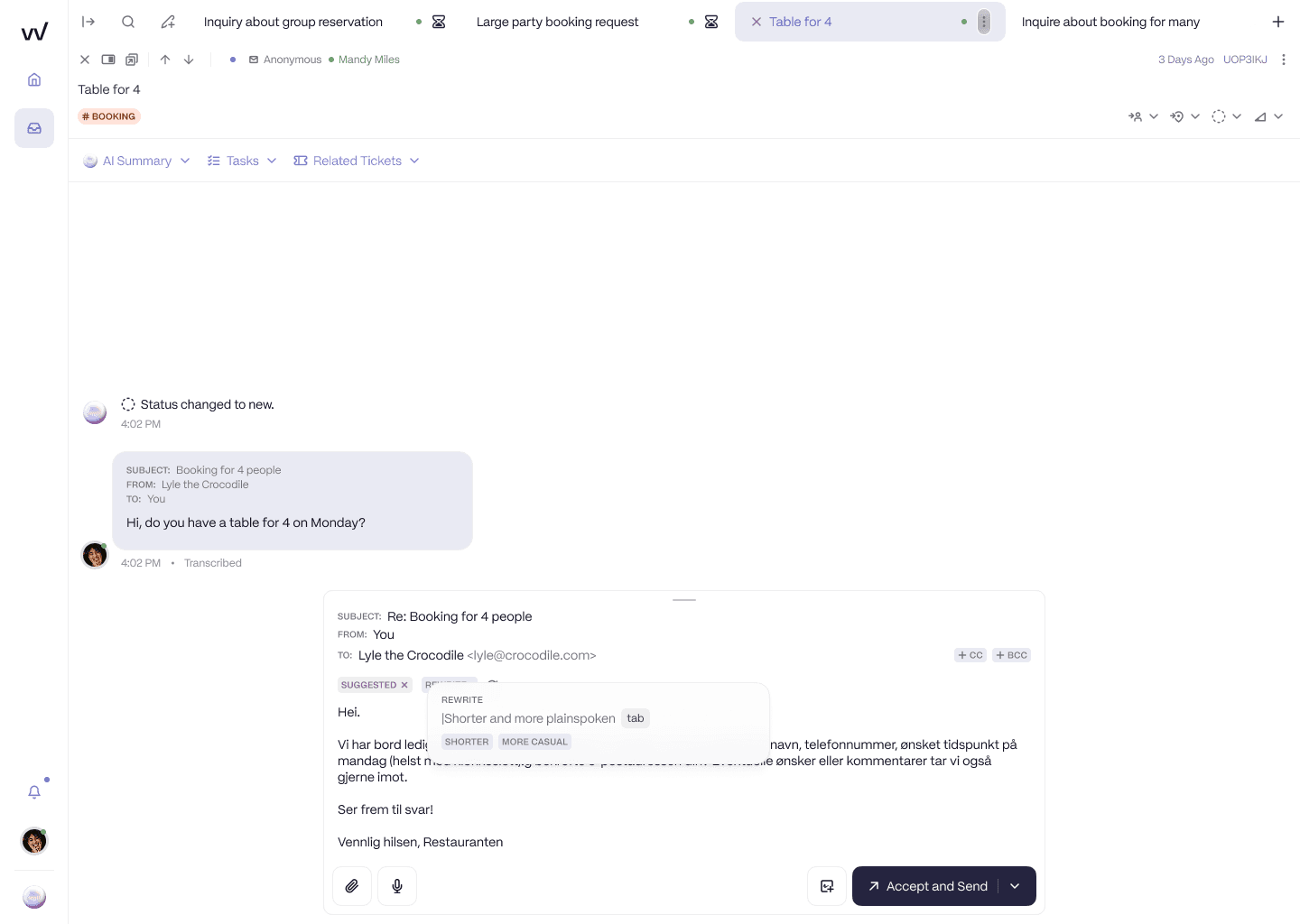
A drafted reply the team approves in one click, instead of writing the same answer again.
Because it connects to the booking system, the AI takes the step Hiver cannot: it checks availability and prepares the booking in the same thread. The everyday requests resolve on arrival, and the large parties and private-hire enquiries are acknowledged immediately and queued for a person, so the slowest reply is no longer the biggest booking.
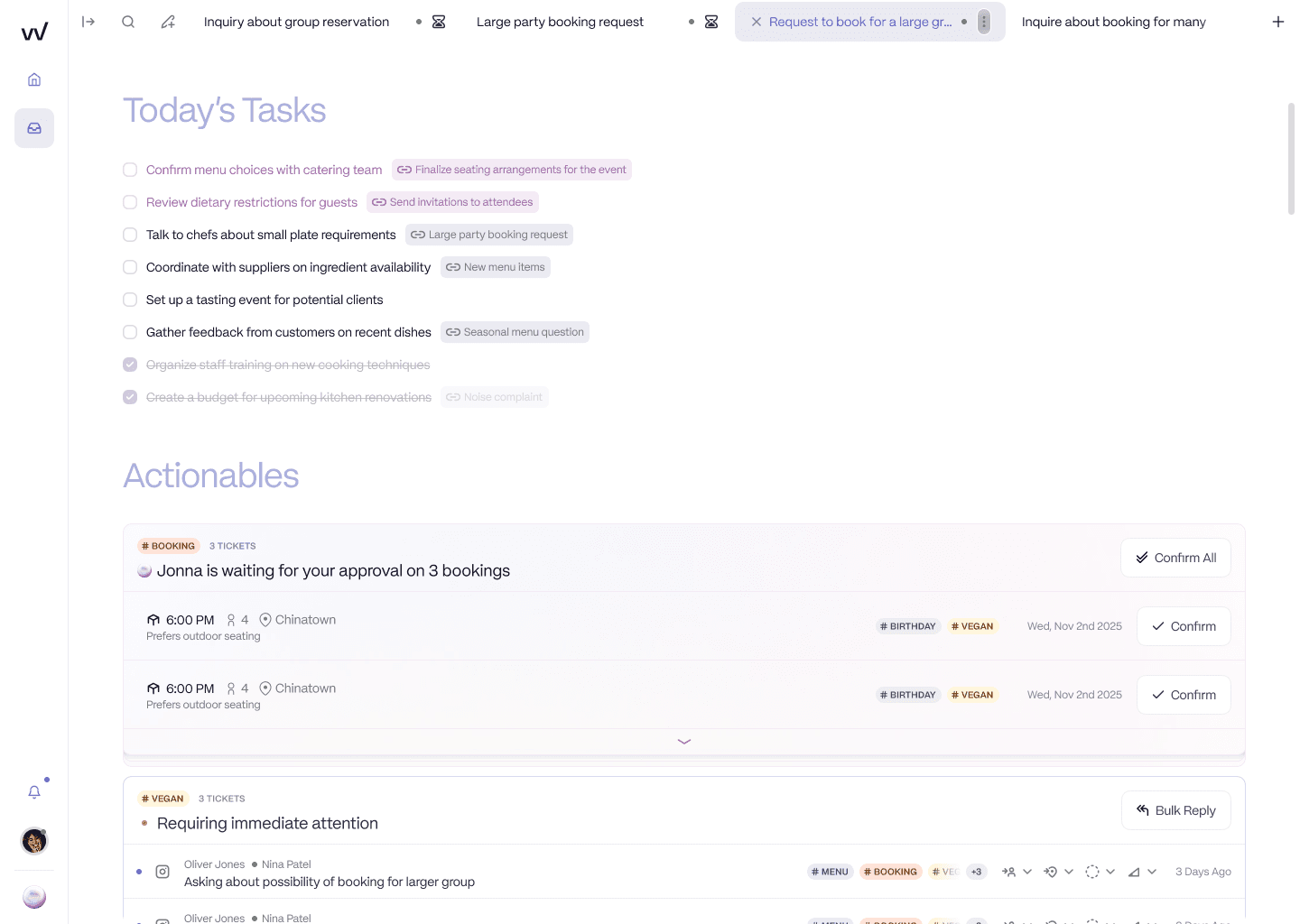
The bookings worth a person's time, acknowledged instantly and prepared for approval.
And because every enquiry is tied to a location, email covers become countable. You can see response times and conversion by site next to the covers the network sends you, and compare the two honestly for the first time. Hiver reports on mailbox SLAs and response times, which tells you nothing about how many tables those conversations produced.
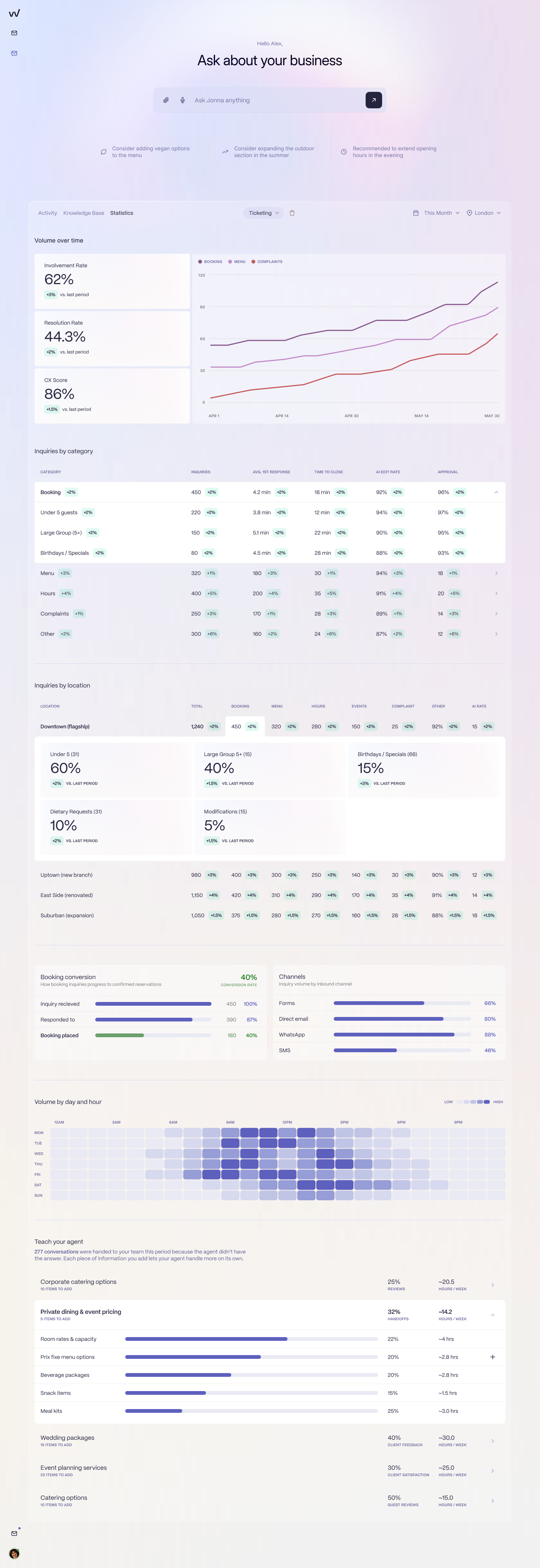
Volume, response rate and conversion by location, sitting alongside the covers the network delivers.
An honest note on where RevVue is today
RevVue's OpenTable integration is in active development. That is the honest status. For now, groups run an email-only pilot that already delivers the inbox value shown above: location-aware routing, instant acknowledgement, AI-drafted replies, high-value bookings surfaced, and reporting by location. The direct booking-system connection will deepen that when it lands, but it does not gate the value you get today. The UK AI is in pilot.
This is the move the Brasilia Group made, off a horizontal helpdesk and onto an inbox built for the job. Their founder, Nikolaos Kiosses, put it plainly: "The transition from Zendesk to RevVue has been a game changer."
If your enquiries currently live in a shared Gmail account, replacing a shared Gmail inbox for a restaurant group is the most relevant read next. Since a good share of these enquiries arrive from the booking network rather than your own site, automating third-party booking emails covers that specific problem. To see what the AI would have said to a real enquiry your team received last week, book 20 minutes.
Frequently asked questions
Does Hiver integrate with OpenTable?
No. Hiver has no native integration with OpenTable, and no restaurant booking system appears in Hiver's app library. Because both tools are on Zapier you can build a bridge that copies enquiry or booking data into a Gmail conversation, but it only moves information one way. It cannot check availability, create or amend a reservation, seat a party, or read the guest's dining history. OpenTable's deeper API access is partner-gated.
Hiver's website mentions booking engines. Does that include restaurant diaries?
Not in any named sense. Hiver publishes a hospitality help-desk page that refers to booking engines and guest-management systems, which is general copy aimed largely at hotels, and it is backed by Hiver's 100-plus business apps, its Zapier connector and its API rather than by any named restaurant booking system. Connecting OpenTable means a zap or a custom build, and neither lets Hiver check availability or create a reservation.
Is Hiver a good choice for restaurant booking enquiries?
It is the easiest improvement to adopt if you are already on Google Workspace, because your bookings@ address stays in Gmail and gains assignment, internal notes, SLA rules and response reporting with no migration. Two gaps remain. It cannot touch your booking system, so every enquiry is handled twice. And its structure is mailboxes and labels rather than venues, so a multi-site group gets no native routing, per-venue tone or reporting by location.
What do restaurant groups use instead for booking enquiries?
Most stay on a shared inbox and accept the double-handling, because no general-purpose tool solved the booking side. A purpose-built option is RevVue, which is location-aware and whose AI checks availability and prepares the booking inside the conversation. Its OpenTable integration is in active development, with an email-only pilot available now.