No. Intercom has no native, purpose-built integration with Resy, and Resy provides no public API and no Zapier app to build one with. Intercom is a customer-messaging platform built around web chat and its AI agent, Fin. Resy is a reservation, waitlist and guest-CRM platform owned by American Express, used by restaurants where the diary is the scarce resource. Fin can hold a fluent conversation about your restaurant. It cannot touch your book.
The short answer
Intercom can receive a Resy enquiry as a conversation. It cannot do anything with it in Resy. Checking the book, cancelling a reservation, waiving a fee, seeing what the guest spent last visit: all of that still happens by hand, in Resy, by a person.
Intercom + Resy | |
|---|---|
Native integration | None |
Best available workaround | A custom build, and only if Resy grants you partner API access |
What the workaround still can't do | Check availability, cancel or amend a reservation, action a fee, read the guest's Resy history |
The middle row is worse here than almost anywhere else in this comparison, and that is a fact about Resy rather than about Intercom. Resy is not on Zapier. It publishes no OpenAPI specification and runs no self-serve developer signup. Access goes to approved partners in defined categories (point of sale, CRM, loyalty, marketing, discovery) under a direct agreement. The only surface open to everyone is the embeddable "Book with Resy" widget, which is a booking button for your website, not a way for a messaging platform to read your diary.
What actually happens to a booking enquiry
There is a second mismatch worth naming before the workflow, because it shapes everything. Intercom is chat-first, and it is excellent at chat. Booking enquiries in the UK and Europe arrive overwhelmingly by email: from your website contact form, from a booking network, from a corporate PA who wants a written record. A tool whose strongest surface is a chat widget is meeting your enquiries where they mostly are not.
Here is the real journey of one enquiry when Intercom and Resy do not talk to each other.
A guest messages in the chat widget on Saturday afternoon to say they cannot make tonight's table for four and asks whether they will be charged the no-show fee. The message becomes an Intercom conversation.
An agent picks it up and reads it.
The agent opens Resy in another tab, because Intercom cannot see the book.
They find the reservation, check the cancellation window and fee terms, and look at whether the table can realistically be resold at this notice.
They cancel the booking in Resy, decide on the fee, and release the table so it can be rebooked.
They switch back to Intercom and write the reply, explaining the fee decision.
They close the conversation.
The guest replies: "Could we rebook for next Friday instead, same four?" The agent repeats steps 3 to 7, now checking availability rather than cancelling.
Every enquiry is handled twice, in two systems, by a person copying the same fields between screens. One operations director described the inbox behind this workflow as "a black hole, no KPIs, no response rate, nothing," because the work happened in tabs and conversations that no report could see.
The sharper cost is the enquiry you never hear about again. Chat sets an expectation of an instant answer, which is a promise a restaurant team cannot keep during service, and the enquiries that arrive by email out of hours get no answer at all until morning. A roughly 40-venue entertainment group lost a single booking worth £40,000 because the enquiry arrived outside working hours and nobody replied in time. A three-site pizza group put it more bluntly about a 30 to 40 cover enquiry: "It just sat there. No one saw it. They went somewhere else." Intercom did not cause those losses. Routing bookings through a system that cannot book anything is what makes the delay inevitable.
What Intercom actually connects to
The Intercom App Store is substantial: CRMs, analytics, developer tools, billing platforms, marketing automation. It reflects Intercom's core market, which is software and SaaS companies running support and engagement at scale. No restaurant booking system appears in it, and Resy is no exception.
The usual fallback is unavailable here. Resy is absent from Zapier, so there is no low-code bridge to attempt. That leaves a custom development project against Intercom's API and Resy's partner API, which first requires Resy to grant partner access for a use case that does not match its published partner categories. For most operators the project ends at that conversation.
Fin deserves a fair hearing, because it is genuinely one of the strongest AI agents on the market. Fin can answer questions from your help content and past conversations, resolve routine queries end to end, and hand off cleanly when it cannot. What it does not have is a line into a reservation system. Fin can tell a guest your cancellation policy. It cannot see whether the table can be resold, cancel the booking, waive the fee, or check Friday. Give it actions against your own systems and those actions are whatever you have built, which brings you back to the partner-access problem above.
There is also a fit issue that shows up across a multi-site group. Intercom is built around one product and one brand voice. A group running six venues with different menus, policies and tones has to bend a single-product model to cover them, and there is no native concept of which venue an enquiry belongs to.
One planning note: Resy is currently absorbing Tock's venues under American Express, roughly doubling its library to more than 25,000 restaurants. If you run both, you are consolidating onto Resy.
Why this matters for booking enquiries
A support conversation and a booking enquiry look similar and behave nothing alike. A support conversation is resolved by a reply. A booking enquiry is only resolved when a table is held in the book. That difference is the whole problem.
The messaging platform can write a polished reply. It cannot book the table. The transaction, the part that actually earns the cover, still lands on your team, one enquiry at a time. This is why most groups that run Intercom for customer messaging still run their booking enquiries through a shared Gmail or Outlook inbox. The platform never solved the booking side, so the old inbox stayed, and with it the double-handling and the black box.
What it looks like when the tool is built for booking enquiries
The gap closes when the inbox and the diary are the same surface, so the enquiry is answered and booked in one place instead of two. This is what RevVue does, and it is easier to show than to describe.
Enquiries are tagged to the right venue as they arrive, so a group with several restaurants stops triaging by hand. That matters more when demand is high, because the enquiries that arrive by email are usually the ones the online book already turned away. The team works from one queue, by location, rather than a chat inbox that closes the conversation and moves on.
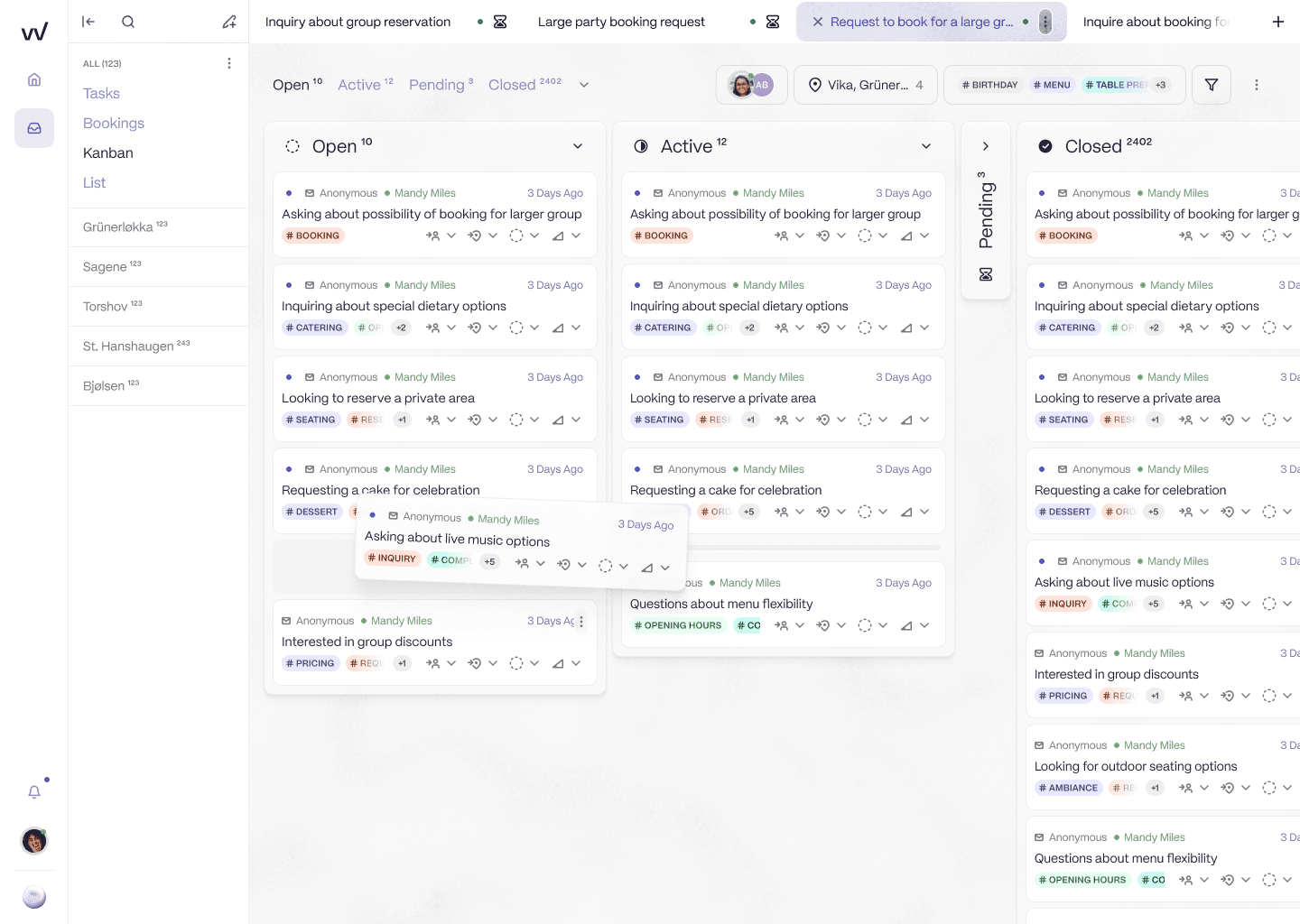
One queue, sorted by venue, for the enquiries that never fitted into the online book.
The AI drafts the reply in that venue's voice, using its menus, its policies and the answers it gives most often. Guests who write after missing a slot want a real answer about alternatives, and the draft already contains them.
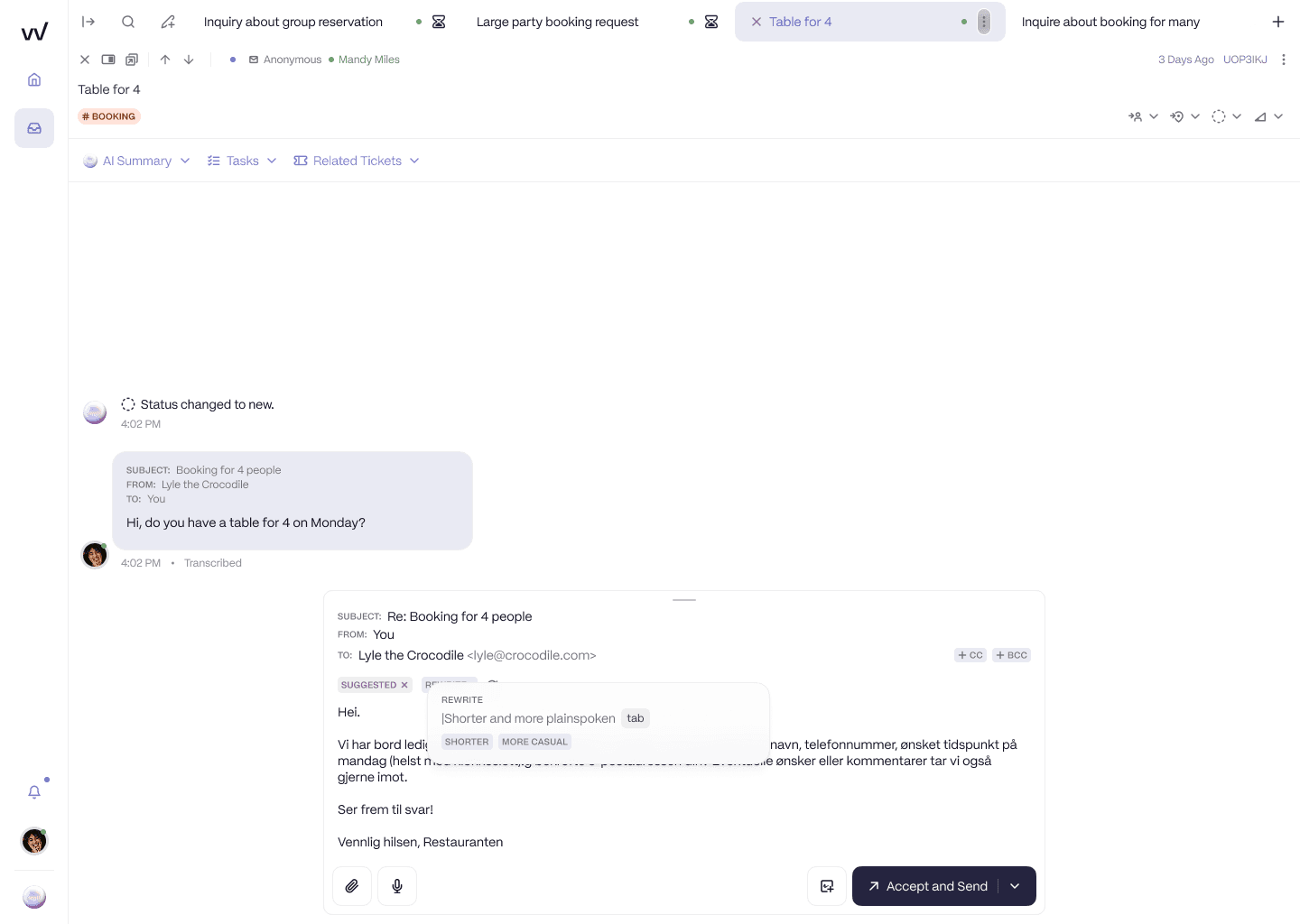
A drafted reply in the venue's voice, ready for the team to approve or adjust.
Because it connects to the booking system, the AI does the step Intercom cannot: it checks availability and prepares the booking inside the conversation. Everyday requests are handled on arrival, and the high-value ones, the celebration tables and the large parties, are acknowledged instantly and held in a queue the team works.
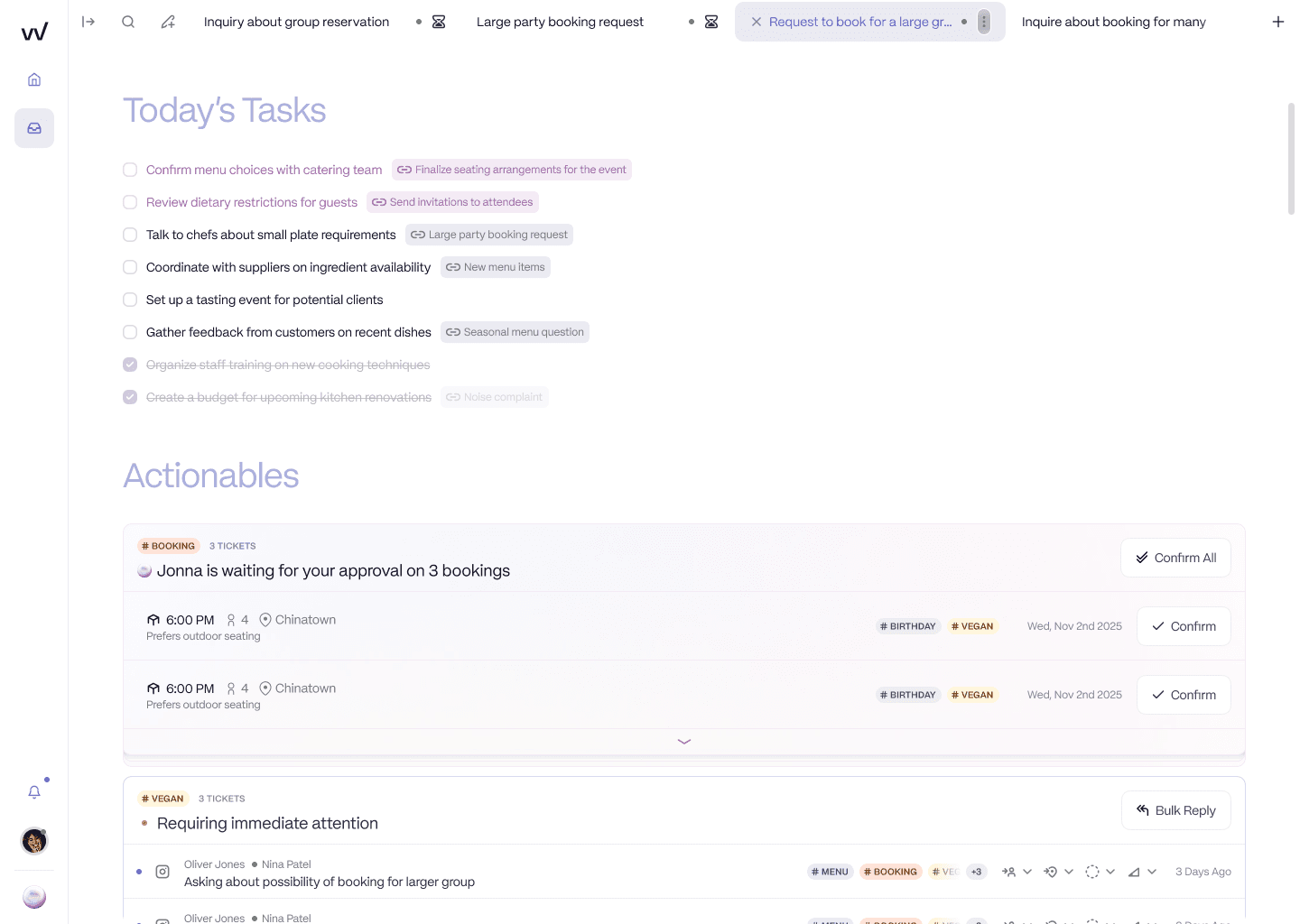
High-value enquiries acknowledged and prepared, waiting for a person rather than for attention.
And because every enquiry is tracked by venue, you can finally see the demand that never made it into the book. Response rates, volumes and conversion by site: the part a reservations platform cannot show you. Intercom reports on conversations and resolution rates, which never connects a reply to a seated table.
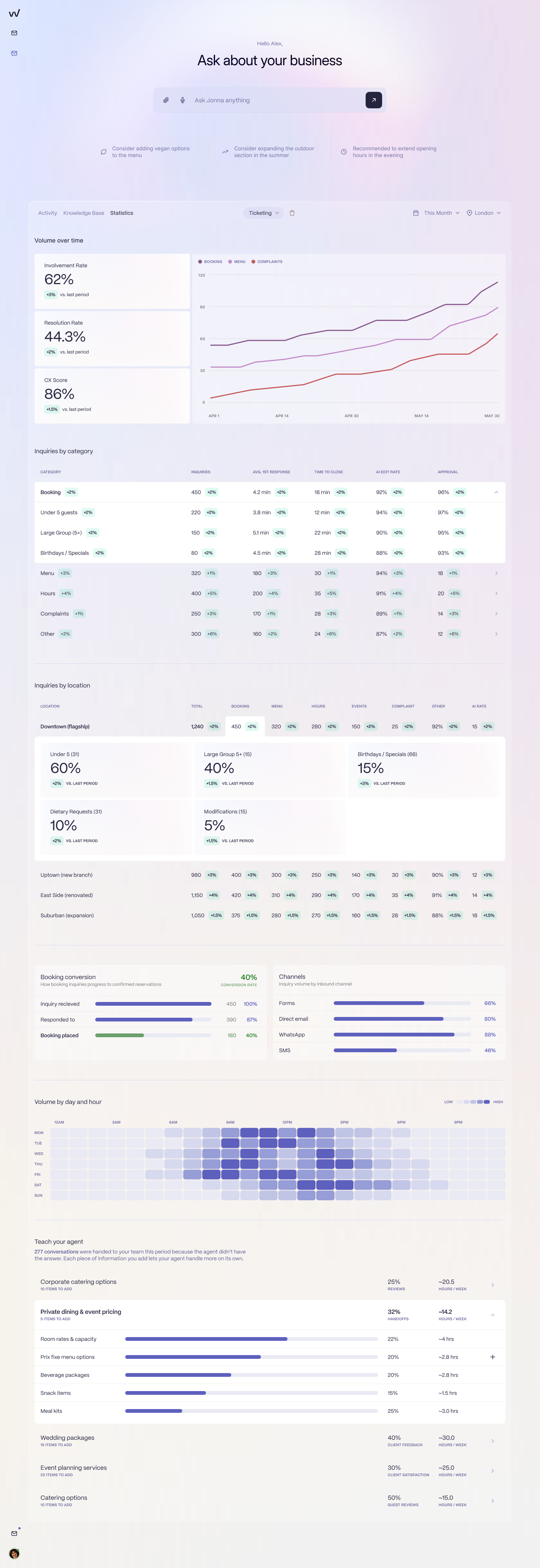
Enquiry volume, response rate and conversion by location, including the demand the book never recorded.
An honest note on where RevVue is today
RevVue's Resy integration is on the roadmap. That is the honest status. For now, groups run an email-only pilot that already delivers the inbox value shown above: location-aware routing, instant acknowledgement, AI-drafted replies, high-value bookings surfaced, and reporting by location. The direct booking-system connection will deepen that when it lands, but it does not gate the value you get today. The UK AI is in pilot.
This is the move the Brasilia Group made, off a horizontal helpdesk and onto an inbox built for the job. Their founder, Nikolaos Kiosses, put it plainly: "The transition from Zendesk to RevVue has been a game changer."
If you are weighing the two, the fuller comparison is in RevVue vs Intercom, and the wider options are covered in Intercom alternatives for restaurant groups. If most of your enquiries arrive from booking networks rather than your own site, automating third-party booking emails covers that specific problem. To see what the AI would have said to a real enquiry your team received last week, book 20 minutes.
Frequently asked questions
Does Intercom integrate with Resy?
No. Intercom has no native integration with Resy, and there is no self-serve route to build one. Resy publishes no public API and is not on Zapier, so a bridge requires partner API access granted directly by Resy plus custom development. Even then it only copies enquiry text into a conversation. It cannot check availability, cancel or create a reservation, or read the guest's Resy history.
Can Fin book a table in Resy?
No. Fin is a strong conversational AI agent, and it can answer questions from your help content, resolve routine queries and hand off cleanly. It has no connection to a reservation system. Fin can quote your cancellation policy, but it cannot see the book, cancel a reservation, waive a fee, or check availability for another date. Any actions Fin takes are limited to systems you have already connected, and Resy cannot be connected without partner access.
Is Intercom a good fit for restaurant booking enquiries?
It is a mismatch in two ways. Intercom is strongest at web chat, while most UK and European booking enquiries arrive by email from contact forms, booking networks and corporate bookers. And Intercom is built around a single product and brand voice, so a group running several venues with different menus, policies and tones has no native way to route or answer by location.
What do restaurant groups use instead for booking enquiries?
Most run booking enquiries through a shared Gmail or Outlook inbox even when they use Intercom for customer messaging, because the platform never solved the booking side. A purpose-built option is RevVue, which is location-aware and whose AI checks availability and prepares the booking inside the conversation. Its Resy integration is on the roadmap, with an email-only pilot available now.