No. Re:amaze has no native, purpose-built integration with Collins, and no venue booking system appears anywhere in its integration list. Re:amaze is a multi-channel helpdesk for small and mid-sized e-commerce businesses, owned by GoDaddy. Collins is the venue-side management software from DesignMyNight that bars, event spaces and competitive-socialising venues use to run private hire, large parties, pre-orders and deposits. The enquiries Collins exists to handle are the longest and most valuable threads a venue gets, and Re:amaze cannot touch any of them.
The short answer
Re:amaze can gather a function enquiry from email, chat, WhatsApp or a DM and give it an owner and a status. It cannot act on it inside Collins. Checking which space is free, holding the mezzanine, building the pre-order, applying the minimum spend and raising the deposit all still happen by hand, in Collins, by a person.
Re:amaze + Collins | |
|---|---|
Native integration | None |
Best available workaround | A custom build on Re:amaze's API and the Collins API |
What the workaround still can't do | Check space availability, hold a room, build a pre-order or raise a deposit inside the conversation |
Be precise about the workaround, because it is weaker here than in several other pairings. Collins is not on Zapier. Re:amaze is. With nothing to connect to on the Collins side, there is no low-code bridge: any integration is a development project against two APIs, paid for and maintained by you, and it still would not let anyone hold a room from the reply window.
What actually happens to a booking enquiry
Give Re:amaze the credit first. A venue group selling private hire fields enquiries on every channel there is, and the person asking about a 60-person leaving do is as likely to open Instagram as to find the events address. Pulling those into one queue with assignment and response tracking, cheaply, is a genuine improvement over a shared mailbox nobody owns.
Here is one enquiry, all the way through.
An email arrives asking to hold the mezzanine for a 60-person leaving do in November, with a pre-order menu and an invoice rather than a card. Re:amaze queues and assigns it.
An agent opens it and reads it.
The agent opens Collins in another tab, because Re:amaze cannot see the function diary.
They check whether the mezzanine is free on the dates offered, what its capacity is standing versus seated, what minimum spend applies to a November Thursday, and whether the kitchen will take a pre-order at that size.
They provisionally hold the space in Collins, re-keying the company name, contact, date, headcount and the note about invoicing.
They switch back to Re:amaze and write the reply with options and a quote.
They set a reminder to chase, because a function enquiry is never resolved in one message.
The reply comes back a week later: "Can we do the Thursday instead, and 75 people?" Seventy-five may not fit on the mezzanine. The agent repeats steps 3 to 7.
That last step is the real cost for a venue like this. A private-hire enquiry is not one exchange, it is six or eight over a fortnight, and every single one of them is a full round trip between two systems. Re:amaze made sure nothing was lost. It has no view of whether the event was won, because the money lives in Collins and the conversation lives in Re:amaze. One operations director described the inbox behind this workflow as "a black hole, no KPIs, no response rate, nothing."
The sharper cost is the event that goes elsewhere. A 60-person leaving do is worth thousands and the organiser is briefing three venues at once, and the slowest to reply loses without ever knowing it was in the running. A roughly 40-venue entertainment group lost a single booking worth £40,000 because the enquiry arrived outside working hours and nobody replied in time. A three-site pizza group put it more bluntly about a 30 to 40 cover enquiry: "It just sat there. No one saw it. They went somewhere else."
What Re:amaze actually connects to
Re:amaze's integration list is a clear statement of its market: Shopify, BigCommerce, Magento, WooCommerce, WordPress, Stripe, Google Workspace, Slack, Jira, Aircall, JustCall, RingCentral and Pipedrive, plus Zapier. More than 5,000 e-commerce brands across more than 100 countries use it, and it rates highly on the Shopify and BigCommerce app stores.
No venue booking system appears in that list, and it would be unfair to call that a failing. Re:amaze is built and priced for e-commerce businesses. An events-led venue group is not the customer it was designed around, so the absence of a Collins integration is the product working as intended for a different market.
The workaround is thinner here than the Zapier-enabled pairings. Collins publishes no Zapier connector, so the low-code route is closed. A custom build against Re:amaze's API and the Collins API is possible in principle, and it is a genuine project: scoping, development, and maintenance every time either side changes. What it buys you is enquiry data copied into a conversation, one direction. It does not put the function diary in front of the person writing the reply, and it does not let them hold the mezzanine, price the minimum spend or raise the deposit without switching systems.
Re:amaze's AI drafts responses, summarises threads and powers chatbots, with much of that suite carrying a beta label. It is a real feature set, less mature than the AI in the more expensive platforms, and grounded in conversation history and help-centre content. On a function enquiry it can help with the wording. It cannot tell you what the room holds or what November costs.
There is one more gap that matters for a group. Re:amaze can manage multiple businesses in one place, which sounds close to multi-venue support. It separates brands rather than the availability behind them, and its reporting counts conversations rather than events, so a group with four sites still cannot see which venue is slowest on private-hire enquiries or which is converting them.
Why this matters for booking enquiries
A support conversation and a booking enquiry look alike and behave nothing alike. A support conversation ends when the answer is good. A function enquiry ends when a room is held, a menu is agreed and a deposit is paid. Almost none of that can be done from an inbox that cannot see the diary.
Re:amaze routes the enquiry to a person quickly, across whichever channel it came in on. That is worth something, and it is not the hard part. The hard part is a multi-week negotiation about space, capacity and money, conducted in one system and recorded in another, where the only thing tracking it is somebody's memory and a calendar reminder.
What it looks like when the tool is built for booking enquiries
The gap closes when the enquiry and the function diary are the same surface, so a private-hire question does not become a week of forwarded email. This is what RevVue does, and it is easier to show than to describe.
Every enquiry is tagged to the venue it concerns, which matters for a group whose sites each hold several private rooms. The team stops opening messages just to work out which building is being asked about, and works from one queue, by location, rather than one multi-channel queue that still treats every site the same.
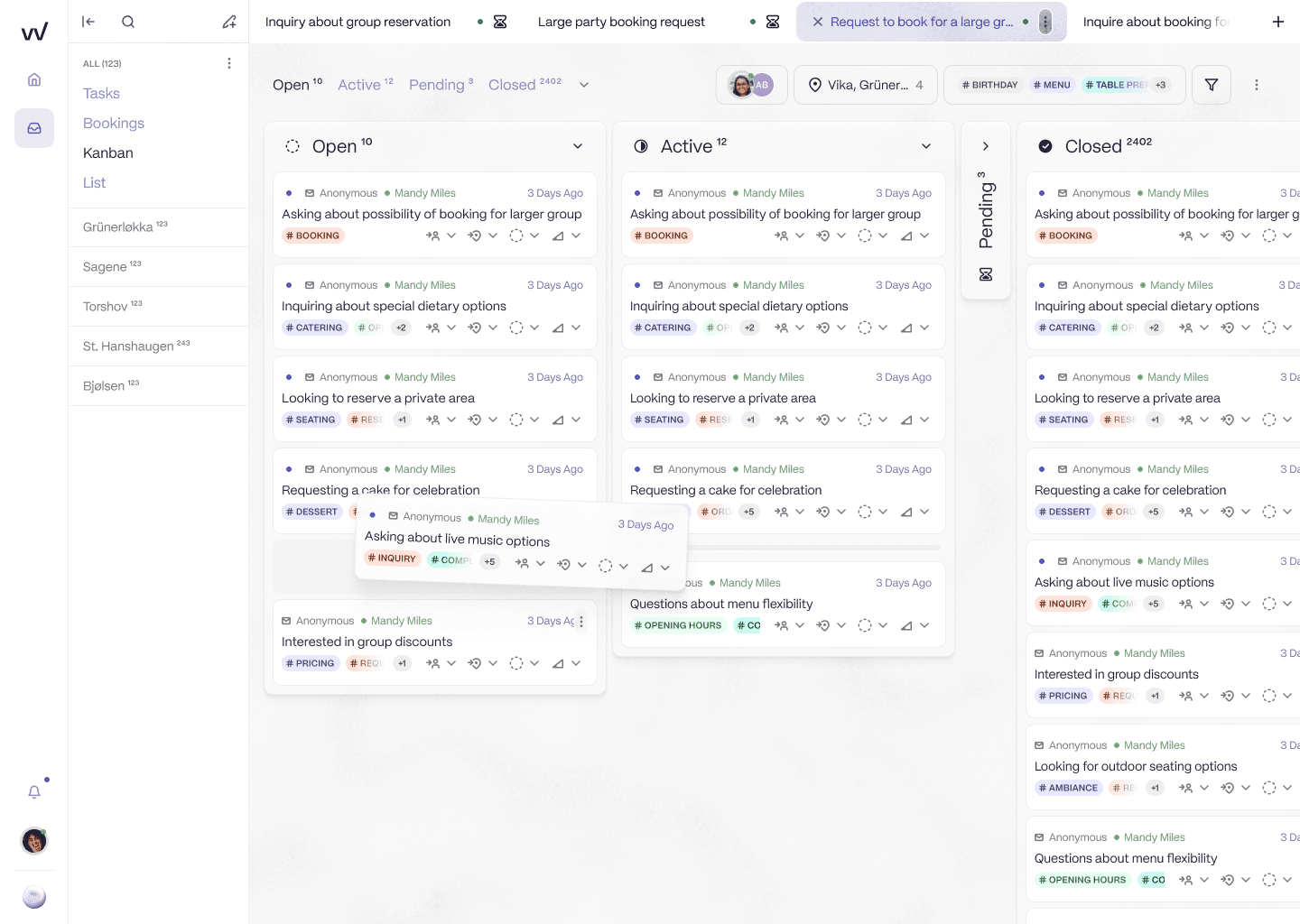
One queue per venue, so an enquiry about a private room reaches the people who run it.
The AI drafts the reply in the venue's voice, using its own capacities, its minimum spends and what each room can seat. Event enquiries are the longest threads a venue handles, and starting from a drafted answer removes most of the typing.
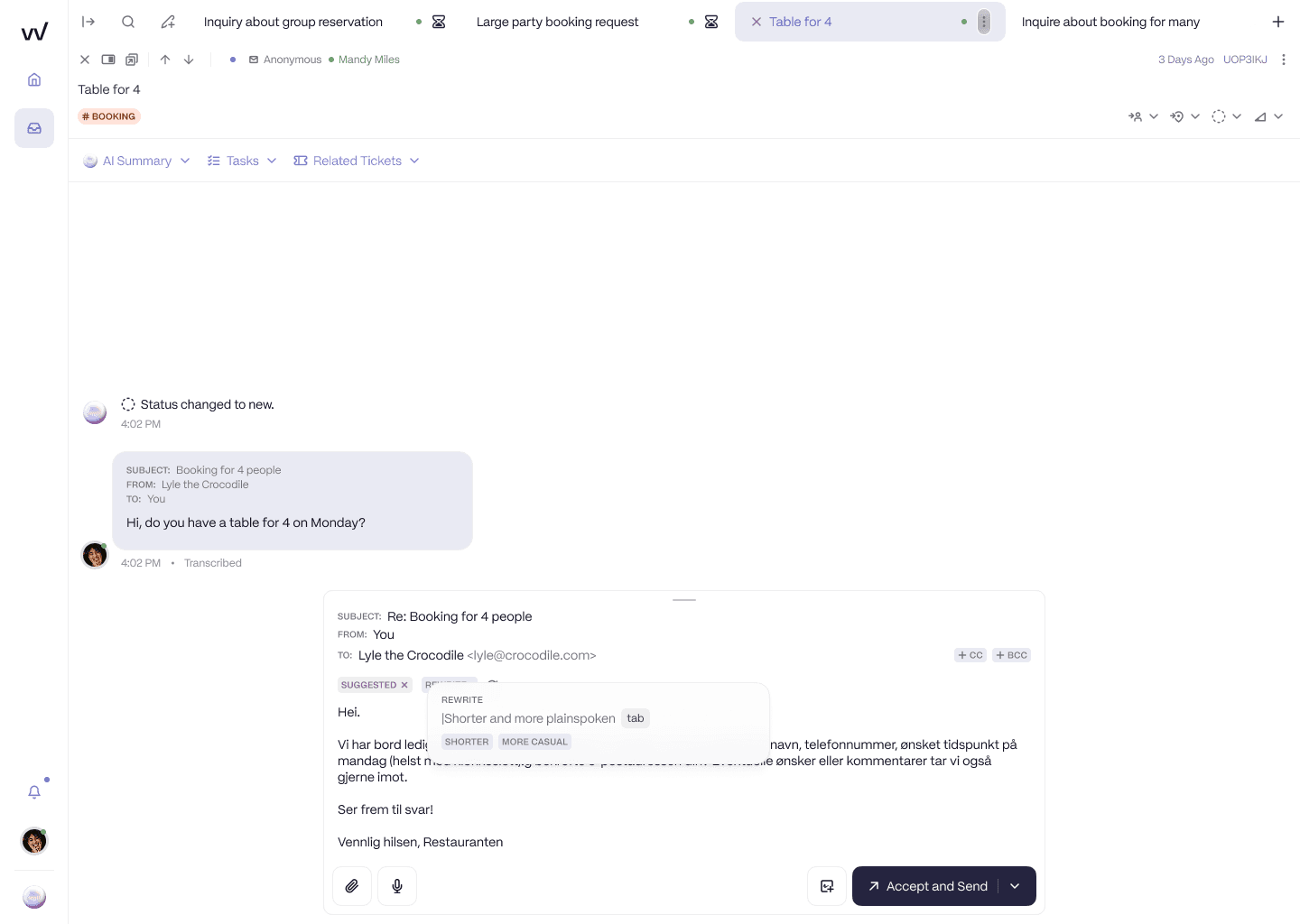
A drafted reply carrying the venue's own capacities and terms, ready to approve.
Because it connects to the booking system, the AI takes the step Re:amaze cannot: it checks the space against the date and prepares the booking in the thread. Simple date questions are answered on arrival, and the enquiries worth thousands are acknowledged within moments and held in a queue a person works through.
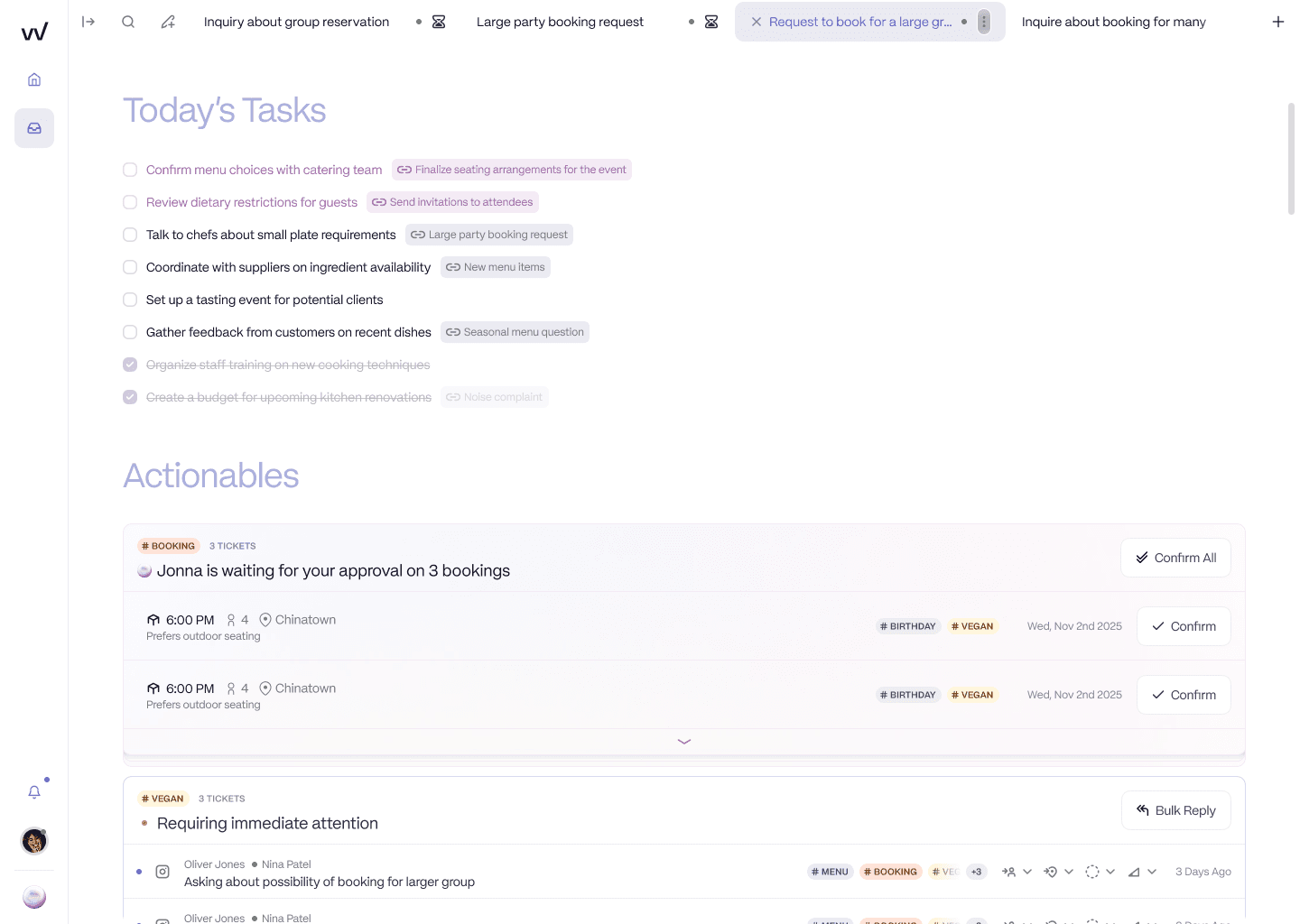
The large-event enquiries held, prepared and visible, instead of buried in a shared inbox.
And because every enquiry belongs to a venue, private hire finally has a funnel. Enquiry volume, reply speed and conversion by site: the reporting a function diary cannot produce, because it only ever sees the events that were confirmed. Re:amaze reports on conversations, response times and volume per channel, none of which tells you how much function revenue the inbox lost.
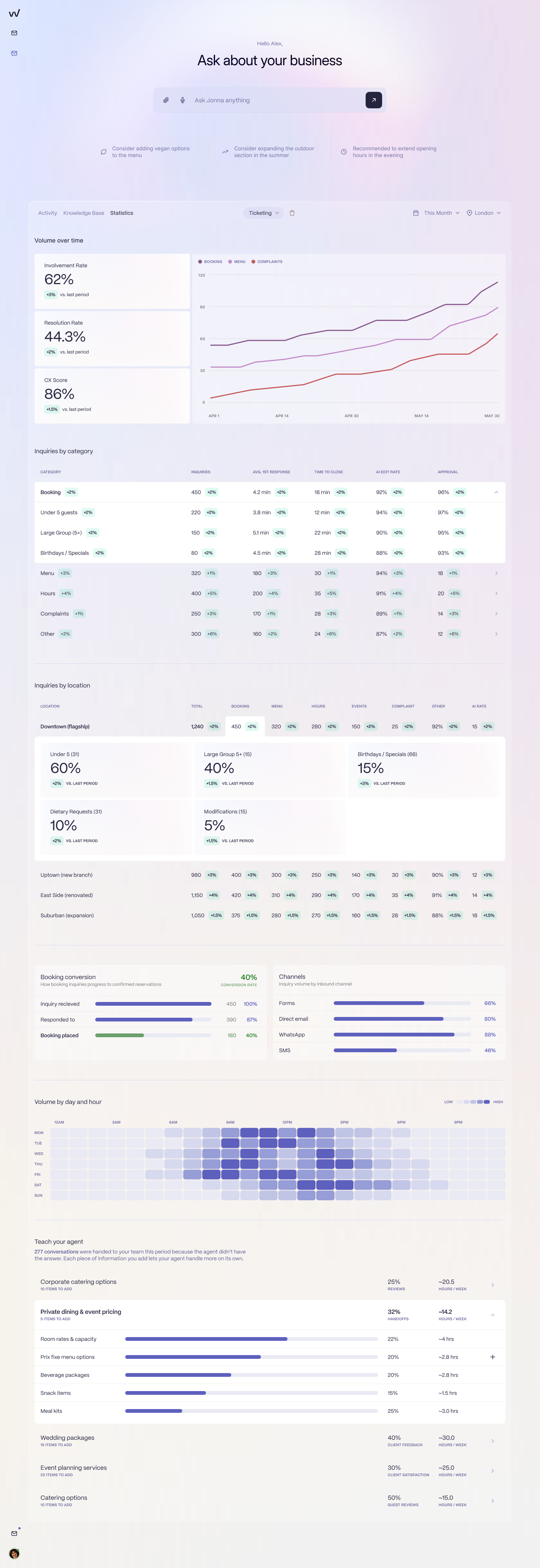
Enquiries, response times and conversion by location, including the ones that never got booked.
An honest note on where RevVue is today
RevVue's Collins integration is on the roadmap and not live. That is the honest status. Venues run an email-only pilot now, which already delivers the inbox value shown above: location-aware routing, instant acknowledgement, AI-drafted replies, high-value enquiries surfaced and held for a person, and reporting by location. The direct booking-system connection deepens it when it lands. The UK AI is in pilot.
This is the move the Brasilia Group made, off a horizontal helpdesk and onto an inbox built for the job. Their founder, Nikolaos Kiosses, put it plainly: "The transition from Zendesk to RevVue has been a game changer."
Because private-hire threads are the highest-value work a venue group handles, triaging high-value group bookings is the most relevant read next, and shared inbox software for restaurants is the wider category view. To see what the AI would have said to a real enquiry your team received last week, book 20 minutes.
Frequently asked questions
Does Re:amaze integrate with Collins?
No. Re:amaze has no native integration with Collins, and no venue booking system appears in its integration list. Collins is not on Zapier either, so there is no low-code bridge available. Connecting them means a custom build against Re:amaze's API and the Collins API, and even then the result is enquiry data copied into a conversation rather than the ability to hold a space or raise a deposit.
Can Re:amaze handle private-hire and function enquiries?
It can hold the conversation, assign an owner and track how long a reply took, across every channel the enquiry might arrive on. It cannot do the commercial work. Checking which space is free on a date, capacity seated versus standing, minimum spend, pre-orders and deposits all live in Collins, so every message in a multi-week negotiation means switching systems and re-keying details.
Is Re:amaze a good choice for an events-led venue group?
It is a reasonable, affordable answer to scattered channels, and it is stronger if the group also sells vouchers or merchandise online, because the Shopify side is where Re:amaze is best. It is a poor answer to function enquiries. It is built and priced for e-commerce businesses, it has no line into Collins, and it has no concept of which venue an enquiry belongs to.
What do venue groups use instead for private-hire enquiries?
Most keep a shared inbox beside Collins and accept that every enquiry is handled twice. A purpose-built option is RevVue, which is location-aware and whose AI checks availability and prepares the booking inside the conversation, with high-value enquiries acknowledged instantly and queued for a person. Its Collins integration is on the roadmap, with an email-only pilot available now.