No. Re:amaze has no native, purpose-built integration with ROLLER, and no venue booking system appears anywhere in its integration list. Re:amaze is a multi-channel helpdesk for small and mid-sized e-commerce businesses, owned by GoDaddy. ROLLER is the ticketing, bookings and point-of-sale platform behind trampoline parks, competitive-socialising venues, family entertainment centres and attractions. ROLLER has the most open API in this whole comparison, and it still does not close the gap.
The short answer
Re:amaze can gather a ROLLER-bound enquiry from chat, email, SMS or a DM and give it an owner and a response time. It cannot act on it inside ROLLER. Checking session capacity, holding lanes, adding a food package and applying a group rate all still happen by hand, in ROLLER, by a person.
Re:amaze + ROLLER | |
|---|---|
Native integration | None |
Best available workaround | A custom build on ROLLER's open API |
What the workaround still can't do | Check session capacity, hold a slot, apply a package or price a group inside the conversation |
ROLLER is worth crediting properly. It publishes a genuinely open, self-serve API and a partner directory of roughly ten integrations covering Mailchimp, Klaviyo, NetSuite, Xero, Microsoft Power BI, Google Tag Manager 360, Brevo and Yellow Dog Inventory. No helpdesk appears among them, and ROLLER is not on Zapier. Because the API is open, a custom build is more feasible here than for any other system in the matrix. That sharpens the point instead of softening it: even a well-built bridge leaves the actual booking work inside the conversation undone.
What actually happens to a booking enquiry
Give Re:amaze the credit first, because leisure venues have the channel problem badly. Parents book birthday parties on whatever is open on their phone, which means Instagram DMs, WhatsApp, the website chat widget and the group mailbox, often late at night. Re:amaze pulls all of that into one queue with assignment and response tracking, at a price a small operator can carry.
Here is one enquiry, all the way through.
A chat enquiry arrives about a school group of 30 across two sessions, asking for a packed-lunch add-on and an accessible lane. Re:amaze queues and assigns it.
An agent opens the conversation and reads it.
The agent opens ROLLER in another tab, because Re:amaze cannot see capacity.
They check whether two consecutive sessions have 15 spaces each on the date, whether the accessible lane is free in both, what the school group rate is, and whether the kitchen can do 30 packed lunches that morning.
They build the booking in ROLLER, re-keying the school name, contact, headcount split across sessions, the add-on and the accessibility note.
They switch back to Re:amaze and reply in the chat with a quote.
They set a reminder to chase the deposit, because school bookings are rarely confirmed on the first message.
The school replies a week later: "It is 42 now and we need three sessions." That changes capacity, the rate band and the lunch order. The agent repeats steps 3 to 7.
Every enquiry is handled twice, in two systems, by a person moving between screens. For a leisure venue the specific damage is that capacity is perishable in a way a restaurant table is not. A session that runs half full at 10am on a Tuesday cannot be recovered, and the enquiry that would have filled it was sitting in a chat queue while somebody worked out the group rate. Re:amaze made sure the chat was answered. It has no view of whether the session filled. One operations director described the inbox behind this workflow as "a black hole, no KPIs, no response rate, nothing."
The sharper cost is the group that books elsewhere. A 30-child school trip is worth several hundred pounds and the organiser is emailing three venues in one sitting. A roughly 40-venue entertainment group lost a single booking worth £40,000 because the enquiry arrived outside working hours and nobody replied in time. A three-site pizza group put it more bluntly about a 30 to 40 cover enquiry: "It just sat there. No one saw it. They went somewhere else."
What Re:amaze actually connects to
Re:amaze's integration list is a clear statement of who it was built for: Shopify, BigCommerce, Magento, WooCommerce, WordPress, Stripe, Google Workspace, Slack, Jira, Aircall, JustCall, RingCentral and Pipedrive, plus Zapier. More than 5,000 e-commerce brands across more than 100 countries use it.
No venue or attraction booking system is in that list. Re:amaze is built and priced for e-commerce businesses, and a trampoline park is not the customer it was designed around.
The workaround is genuinely more achievable in this pairing than in any other, and it is worth being precise about why that does not rescue it. ROLLER's API is open and self-serve, and Re:amaze has a documented API and a Zapier connector, so a developer has real material to work with on both sides. What they can build is data movement: an enquiry creating a conversation, a booking updating a record, a webhook firing a notification. What they cannot build, without becoming ROLLER, is the thing the agent needs in the moment, which is live session capacity in the reply window plus the ability to hold two consecutive slots and an accessible lane while the conversation is still open. The bridge moves information about bookings. It does not make bookings.
Re:amaze's AI drafts replies, summarises conversations and powers chatbots, and much of that suite has carried a beta label. It is a real and improving feature set, less mature than the AI in more expensive platforms, and grounded in past conversations and help-centre content. It can draft a friendly answer about party packages. It cannot tell you whether Saturday's 11am session has 30 spaces.
One more gap matters for a multi-site operator. Re:amaze can manage multiple businesses in one place, which sounds like the answer to running five parks. It separates brands rather than the capacity behind them, and it reports on conversations rather than admissions, so there is no view of which site is losing group bookings to a slow reply.
Why this matters for booking enquiries
A support conversation and a booking enquiry look alike and behave nothing alike. A support conversation is resolved by a reply. A booking enquiry is resolved only when capacity is held. For a venue selling timed sessions, the answer also expires: what was free when the message arrived may not be free when someone finally reads it.
Re:amaze makes sure the enquiry reaches a person on whatever channel it came in on. It cannot hold the lane. The commercial work stays in ROLLER, done by hand, while the clock runs on a perishable session.
What it looks like when the tool is built for booking enquiries
The gap closes when the enquiry and the booking live in one place, so a party enquiry is answered and held in a single reply. This is what RevVue does, and it is easier to show than to describe.
Every enquiry is tagged to the venue it is for, which matters for an operator running several attractions with different capacities and session times. A question about one site is never answered with another site's slots, because the team works from one queue, by location, rather than one multi-channel queue that still treats every site the same.
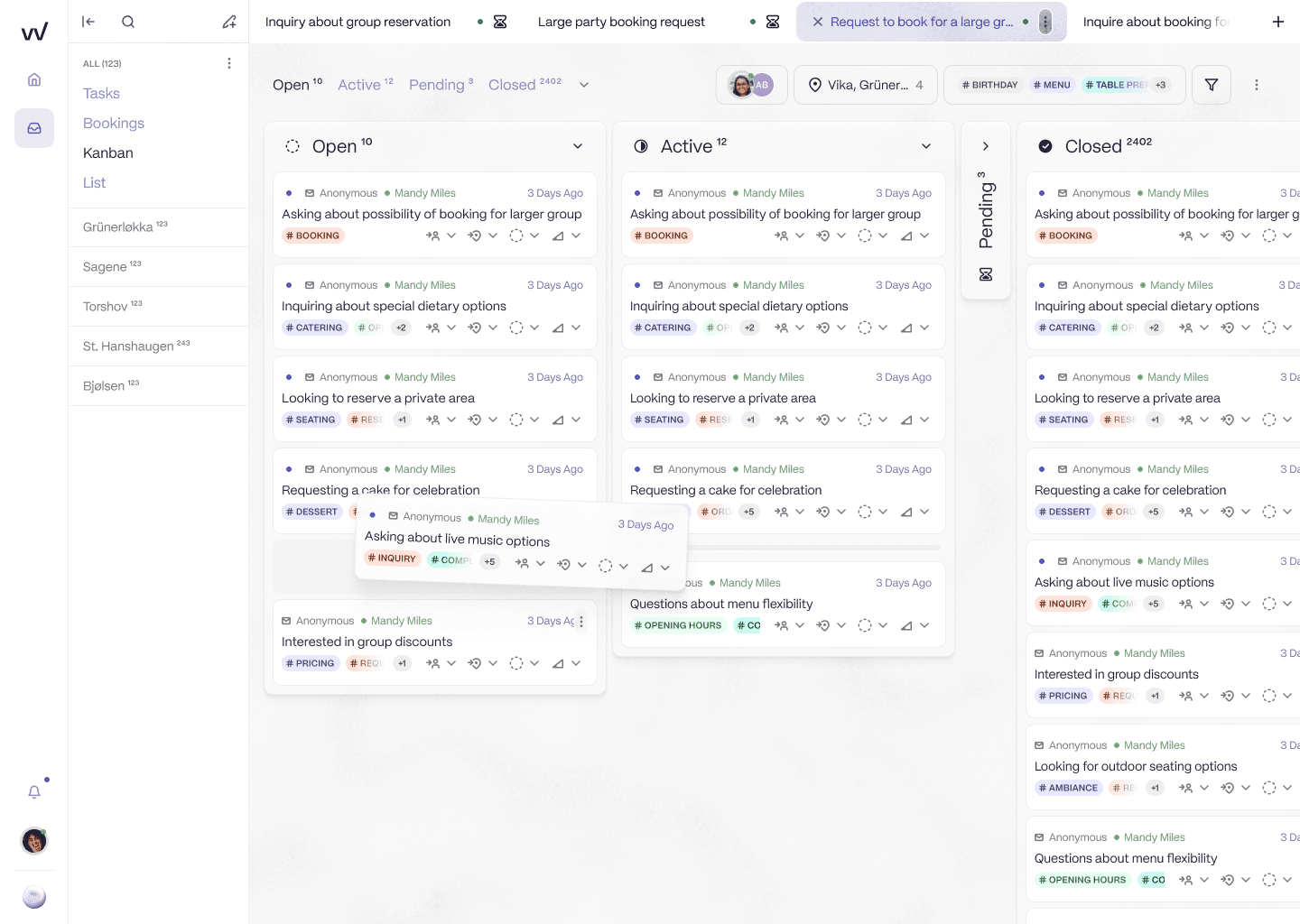
One queue per venue, so session times and capacities never get crossed.
The AI drafts the reply in that venue's voice, grounded in its packages, its group rates and what each session can take. Party and group enquiries repeat constantly, and the draft arrives with the specifics already filled in.
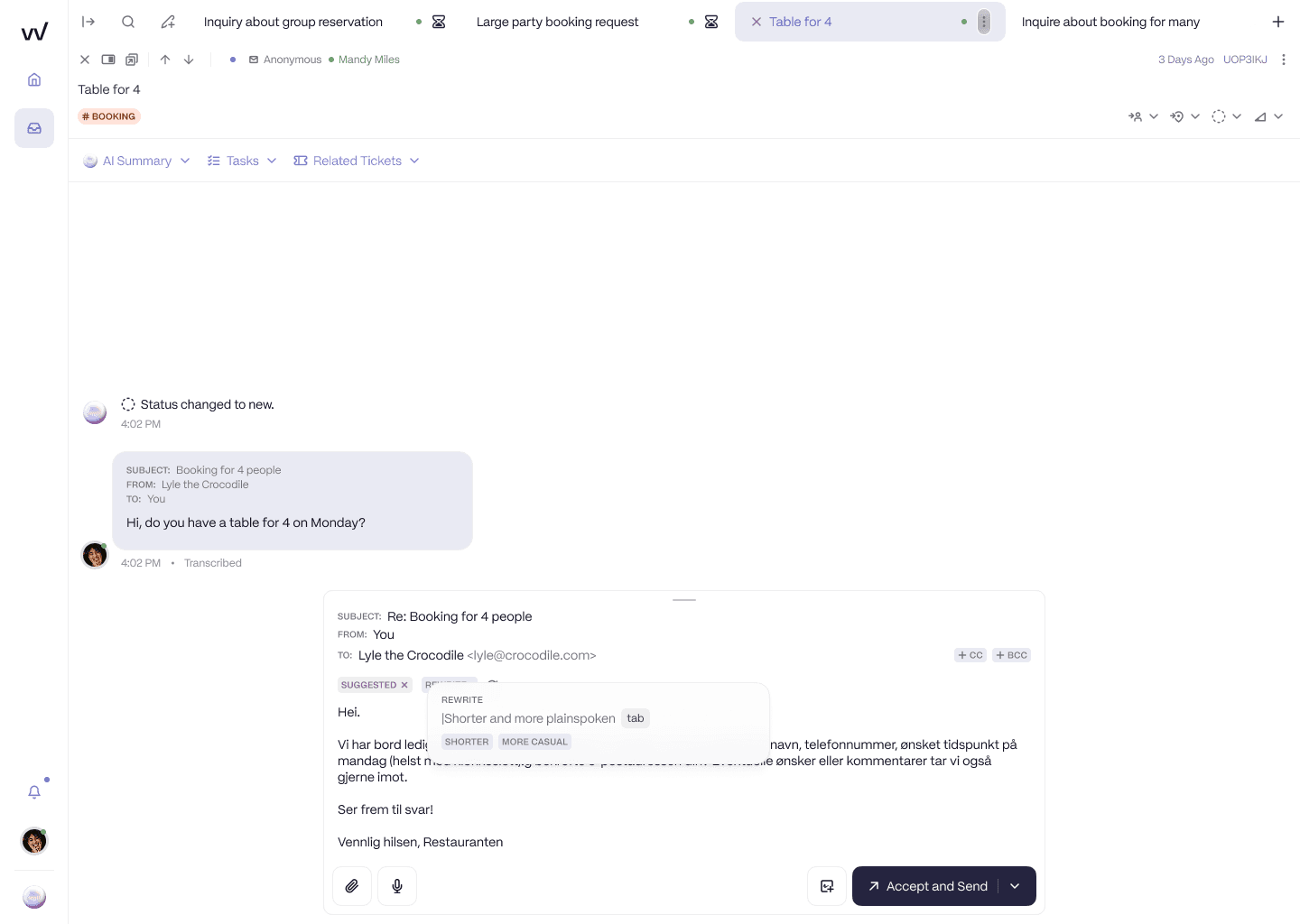
The package reply drafted in the venue's voice, ready to approve and send.
Because it connects to the booking system, the AI takes the step Re:amaze cannot: it checks capacity and prepares the booking in the conversation. Small requests are handled as they land, and the group bookings, the school trips and the birthday parties that fill a session, are acknowledged instantly and held for a person to finish.
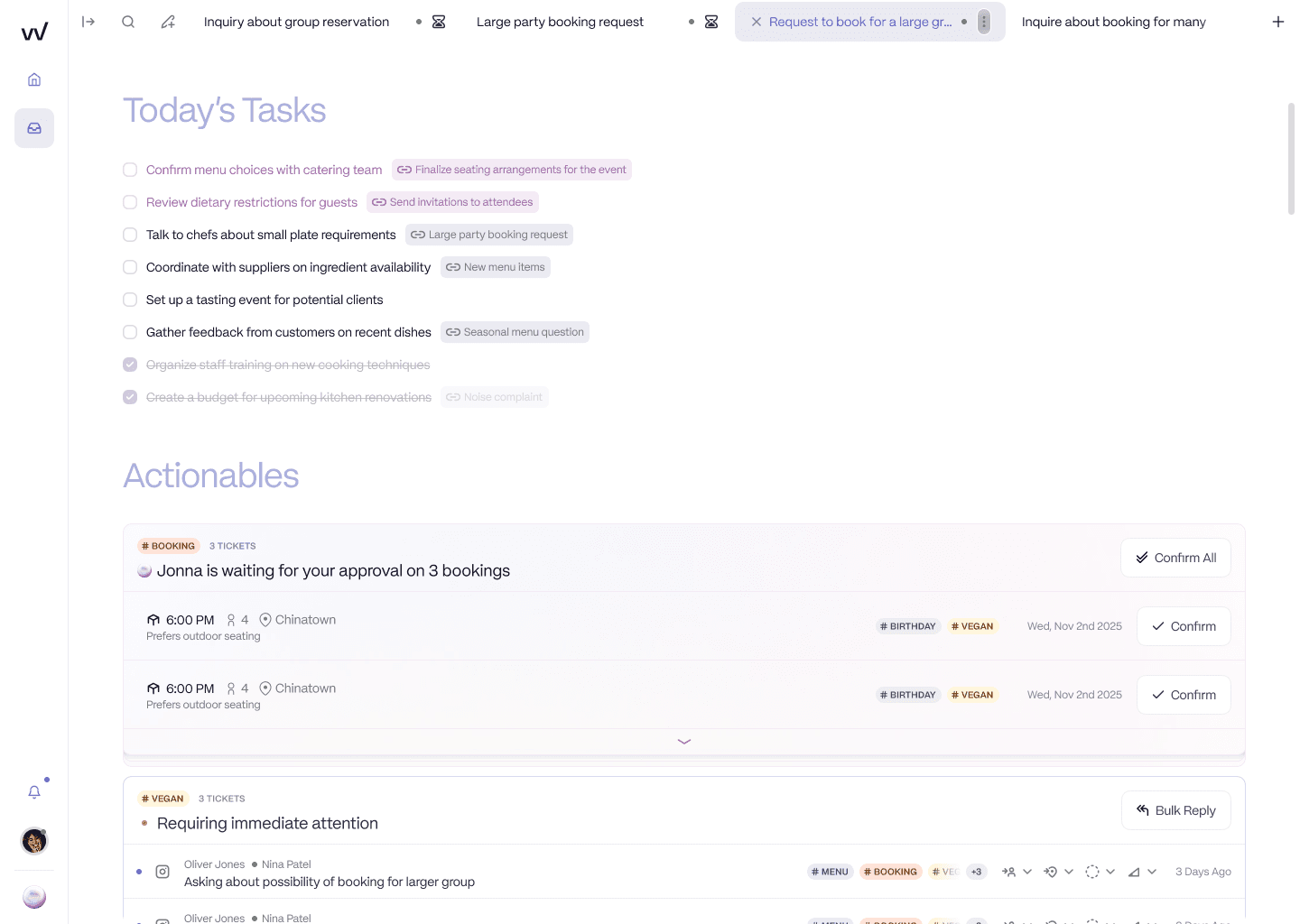
Group bookings acknowledged and prepared, waiting for a person instead of waiting to be noticed.
And because every enquiry is tracked per site, group demand becomes a number. Enquiry volume, reply speed and conversion by location, so you can see which attraction is losing parties to a slow inbox. Re:amaze reports on conversations, response times and volume per channel, which says nothing about how many sessions filled.
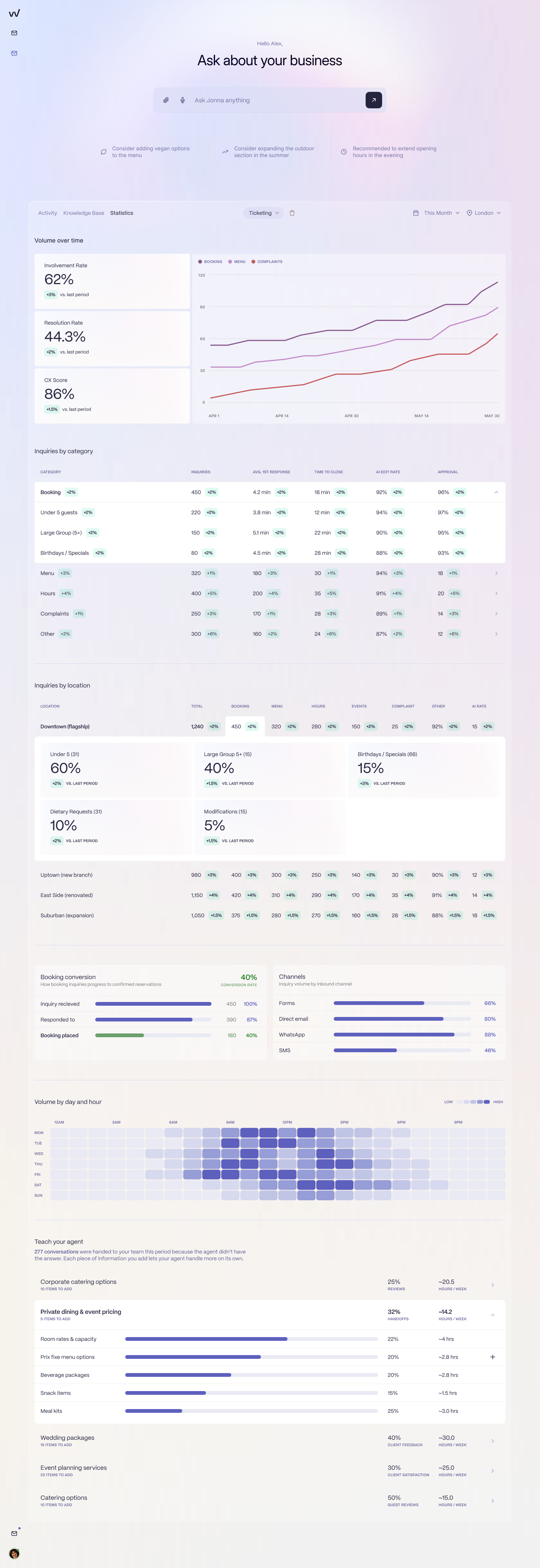
Volume, response rate and conversion by location, showing which site is losing group bookings.
An honest note on where RevVue is today
RevVue's ROLLER integration is on the roadmap and not live. That is the honest status. Venues run an email-only pilot now, which already delivers the inbox value shown above: location-aware routing, instant acknowledgement, AI-drafted replies, high-value enquiries surfaced and held for a person, and reporting by location. The UK AI is in pilot.
This is the move the Brasilia Group made, off a horizontal helpdesk and onto an inbox built for the job. Their founder, Nikolaos Kiosses, put it plainly: "The transition from Zendesk to RevVue has been a game changer."
Because group and party bookings are where the revenue is for a leisure operator, triaging high-value group bookings is the most relevant read next, and shared inbox software for restaurants is the wider category view. To see what the AI would have said to a real enquiry your team received last week, book 20 minutes.
Frequently asked questions
Does Re:amaze integrate with ROLLER?
No. Re:amaze has no native integration with ROLLER, and no venue booking system appears in its integration list. ROLLER is not on Zapier, so the route is a custom build on its open API. That build can move booking data into a conversation, and it still cannot check session capacity, hold a slot, apply a package or price a group inside the reply window.
ROLLER has an open API. Does that make an integration easy?
Easier than for any other system in this comparison, and still not sufficient. ROLLER publishes a genuinely open, self-serve API, so a developer has real material to work with. What a bridge produces is data movement between two systems. What an agent needs is live capacity in front of them while they type, plus the ability to hold two consecutive sessions and an accessible lane before the conversation ends. Moving information about bookings is not the same as making them.
Is Re:amaze a good choice for a leisure or attractions operator?
It is a fair, affordable answer to scattered channels, and leisure venues have that problem acutely, with parents messaging by DM and chat at all hours. It is a poor answer to booking enquiries. It is built and priced for e-commerce businesses, it has no line into ROLLER, and it has no concept of which site an enquiry belongs to.
What do leisure venues use instead for booking enquiries?
Most run a shared inbox next to ROLLER and accept that every enquiry is handled twice, which is expensive when sessions are perishable. A purpose-built option is RevVue, which is location-aware and whose AI checks availability and prepares the booking inside the conversation, with group enquiries acknowledged instantly and held for a person. Its ROLLER integration is on the roadmap, with an email-only pilot available now.