No. Re:amaze has no native, purpose-built integration with SevenRooms, and no restaurant booking system appears anywhere in its integration list. Re:amaze is a multi-channel helpdesk for small and mid-sized e-commerce businesses, owned by GoDaddy, and its strength is pulling email, live chat, SMS, WhatsApp, Instagram and Facebook into one queue. SevenRooms is a reservations, guest-CRM and events platform built around deep guest profiles and spend history. Re:amaze can gather every channel your guests use to ask for a table. It cannot book one.
The short answer
Re:amaze will collect a SevenRooms enquiry from whichever channel it arrived on and put it in a single queue with an owner and a status. It cannot do anything with that enquiry inside SevenRooms. Checking the diary, reading the guest's spend history, holding the table, adding the occasion note: all of that still happens by hand, in SevenRooms, by a person.
Re:amaze + SevenRooms | |
|---|---|
Native integration | None |
Best available workaround | A Zapier or custom-API bridge that copies enquiry data into a conversation |
What the workaround still can't do | Check availability, create or amend a booking, read the guest's SevenRooms profile and spend history |
The distinction worth holding onto is between channels and systems. Re:amaze is unusually good at the first problem. A restaurant group genuinely does receive booking requests by Instagram DM, by WhatsApp, through a chat widget and by email, and having those land in four different places is a real operational mess that Re:amaze genuinely fixes. What it does not fix is that the answer to every one of those messages lives in a different piece of software.
What actually happens to a booking enquiry
Give Re:amaze the credit it has earned first. For a small group whose enquiries are scattered across four apps and two phones, consolidating them into one queue with assignment and response tracking is a real improvement, and it costs less than most of the alternatives. If your team is currently losing messages because nobody is sure who watches the Instagram account at the weekend, this solves that.
Here is what happens to one enquiry after you have done it.
A regular sends an Instagram DM asking to book the counter for four for their partner's birthday, and mentions the wine pairing they had last time. Re:amaze pulls it into the shared queue and assigns it.
An agent opens the conversation and reads it.
The agent opens SevenRooms in another tab, because Re:amaze cannot see the diary or the guest record.
They search for the guest, find the profile, read the visit history to work out which pairing "last time" refers to, and check whether the counter has four seats together on that date.
They create the booking in SevenRooms, re-keying the name, date, time, party size, the counter preference and a note about the wine.
They switch back to Re:amaze and write the reply.
They close the conversation.
The guest replies on the same DM thread: "Can we make it six?" Six will not fit at the counter. The agent repeats steps 3 to 7, and now has to offer a table instead.
Every enquiry is handled twice, in two systems, by a person copying the same fields between screens. Step four is where a SevenRooms customer loses most, because the guest history that justifies the platform's price sits in a tab the person writing the reply cannot see. Re:amaze made sure the message was not missed. It has no view of whether a table resulted. One operations director described the inbox behind this workflow as "a black hole, no KPIs, no response rate, nothing." Consolidating channels narrows the hole. It does not close it.
The sharper cost is the enquiry that never comes back. A regular asking for a birthday at the counter expects to be recognised, and a party planning weeks ahead will ask three places. A roughly 40-venue entertainment group lost a single booking worth £40,000 because the enquiry arrived outside working hours and nobody replied in time. A three-site pizza group put it more bluntly about a 30 to 40 cover enquiry: "It just sat there. No one saw it. They went somewhere else." Re:amaze did not cause that. Routing bookings through a system that cannot book anything is what makes the delay structural.
What Re:amaze actually connects to
Re:amaze's integration list tells you exactly who it was built for: Shopify, BigCommerce, Magento, WooCommerce, WordPress, Stripe, Google Workspace, Slack, Jira, Aircall, JustCall, RingCentral and Pipedrive, plus Zapier. It serves more than 5,000 e-commerce brands across more than 100 countries and is rated highly on the Shopify and BigCommerce app stores.
Not one restaurant booking system appears in that list. That is not an oversight. Re:amaze is built and priced for e-commerce businesses, and a restaurant group is not the customer it was designed around. The absence of a diary integration is the product working as intended for a different market.
Because both Re:amaze and SevenRooms are on Zapier, a bridge is possible in this pairing. Re:amaze's Zapier connector authenticates with the API credentials in its settings and exposes triggers for new conversations and messages, plus actions to create contacts and add messages. Build the zap and look honestly at what you have: an enquiry or a SevenRooms event can create or update a conversation, tagged and assigned. That is routing and notification, moving one direction. It does not let the agent see the diary, pull the guest's spend history, hold the counter, or write a booking from the reply window.
Re:amaze's AI covers response drafting, conversation summarising and chatbots, and much of it has carried a beta label. Treat it for what it is: a real and improving feature set, less mature than the AI in the pricier platforms, and grounded in conversation history and help-centre content like all of them. It can suggest how to word a reply about the counter. It cannot tell you whether the counter is free.
There is one more gap that matters for a multi-site group. Re:amaze does support managing multiple businesses in one place, which sounds like the answer to running six venues. In practice it separates brands, not the availability behind them, and the AI and reporting still work on conversations rather than covers. You get one queue across many channels and no concept of which venue's diary an enquiry needs to be answered from.
Why this matters for booking enquiries
A support conversation and a booking enquiry look alike and behave nothing alike. A support conversation is resolved by a reply. A booking enquiry is only resolved when a table is held in the diary. That difference is the whole problem.
Re:amaze gets the message to the right person on whichever channel it arrived. It cannot book the table. The transaction, the part that actually earns the cover, still lands on your team, one enquiry at a time, in a second system. Consolidating five channels into one queue makes the work visible. It does not make it smaller.
What it looks like when the tool is built for booking enquiries
The gap closes when the enquiry and the guest record sit on the same screen, so whoever replies can already see who is writing. This is what RevVue does, and it is easier to show than to describe.
Enquiries are sorted by venue as they arrive, which matters most for a group running distinct concepts under one company. A request for the chef's counter is never answered with the brasserie's availability, and the team works from one queue, by location, rather than one multi-channel queue that still treats every site the same.
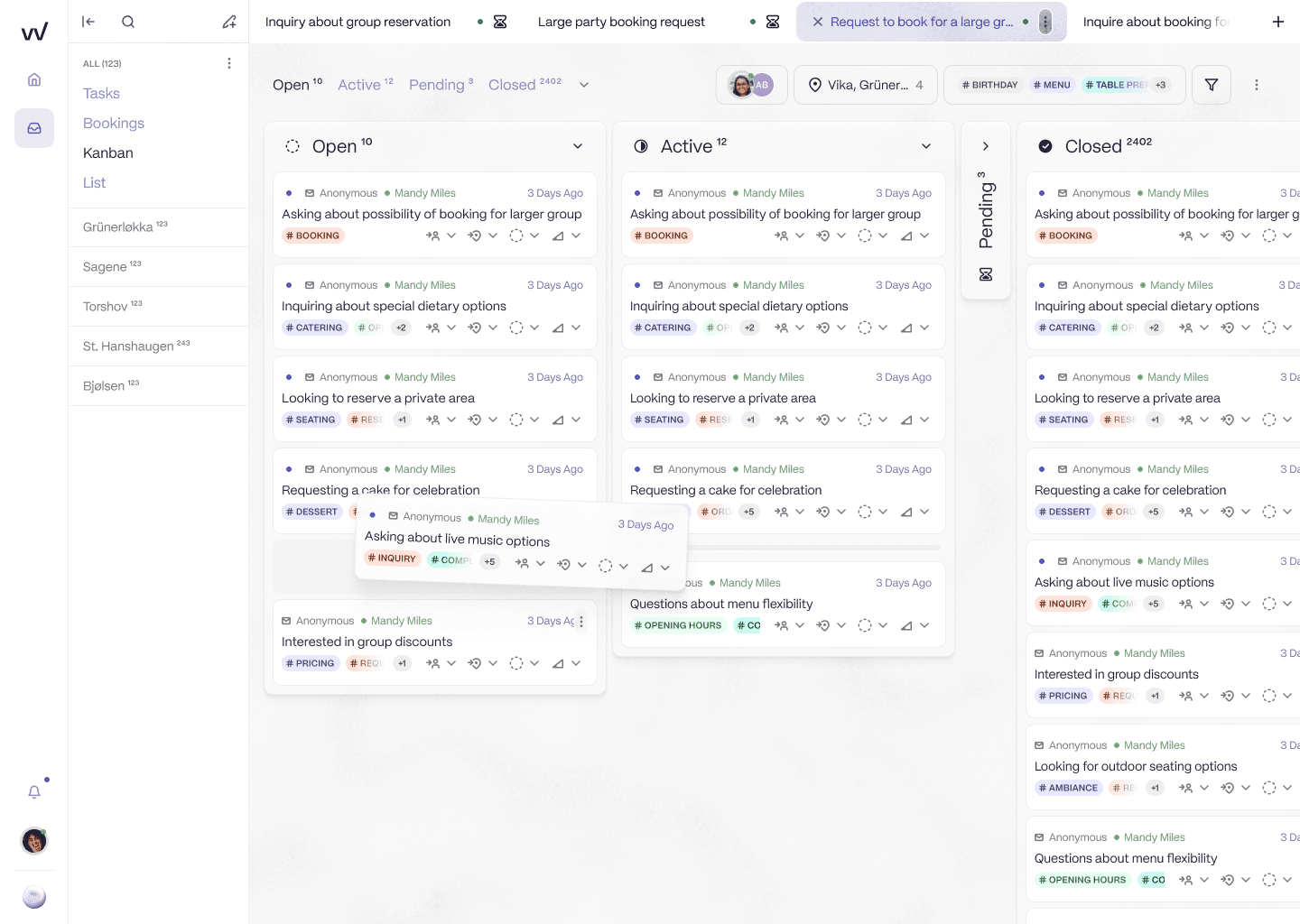
One queue per venue, so a multi-concept group stops sorting its mail before it can answer it.
The AI reads each enquiry and drafts a reply in that venue's voice, grounded in its menus, its policies and the things its regulars ask for. For a group that has invested in knowing its guests, the reply reads like it came from the venue and not from a shared mailbox.
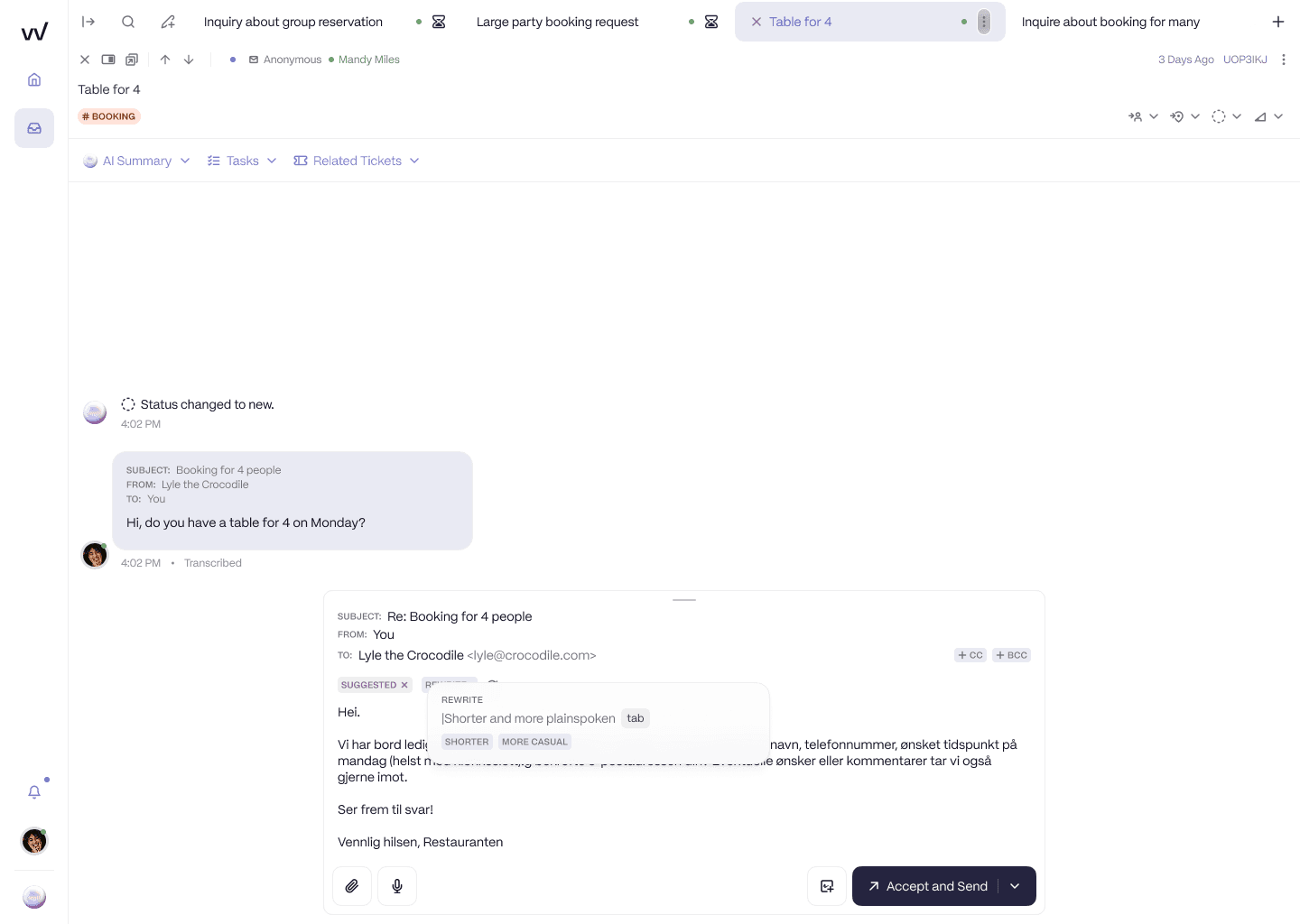
The draft arrives in the venue's own voice, ready for a person to approve or adjust.
Because it connects to the booking system, the AI does the step Re:amaze cannot: it checks availability and prepares the booking inside the same thread. Routine requests are handled on arrival, and the ones worth a person's attention, the anniversary tables and the large parties, are acknowledged straight away and held in a queue someone actually works.
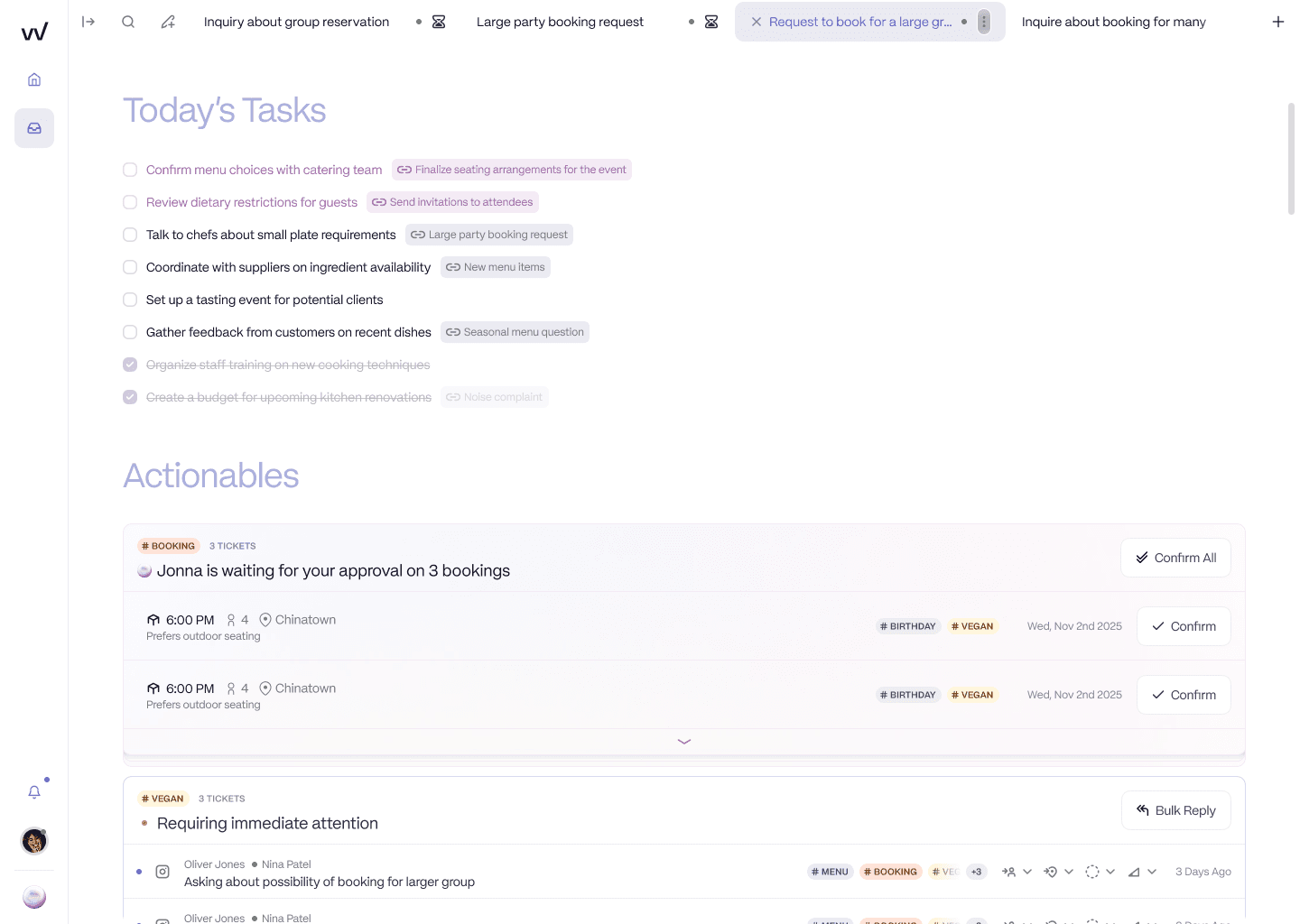
High-value bookings acknowledged and prepared, waiting for approval instead of sitting unread.
And because every enquiry is tracked against a venue, the enquiry channel finally reports like the rest of the business. Response times, volumes and conversion per site: the one view a guest-CRM platform cannot give you, because the enquiry never reached it. Re:amaze reports on conversations, response times and volume per channel, and none of those numbers is a cover.
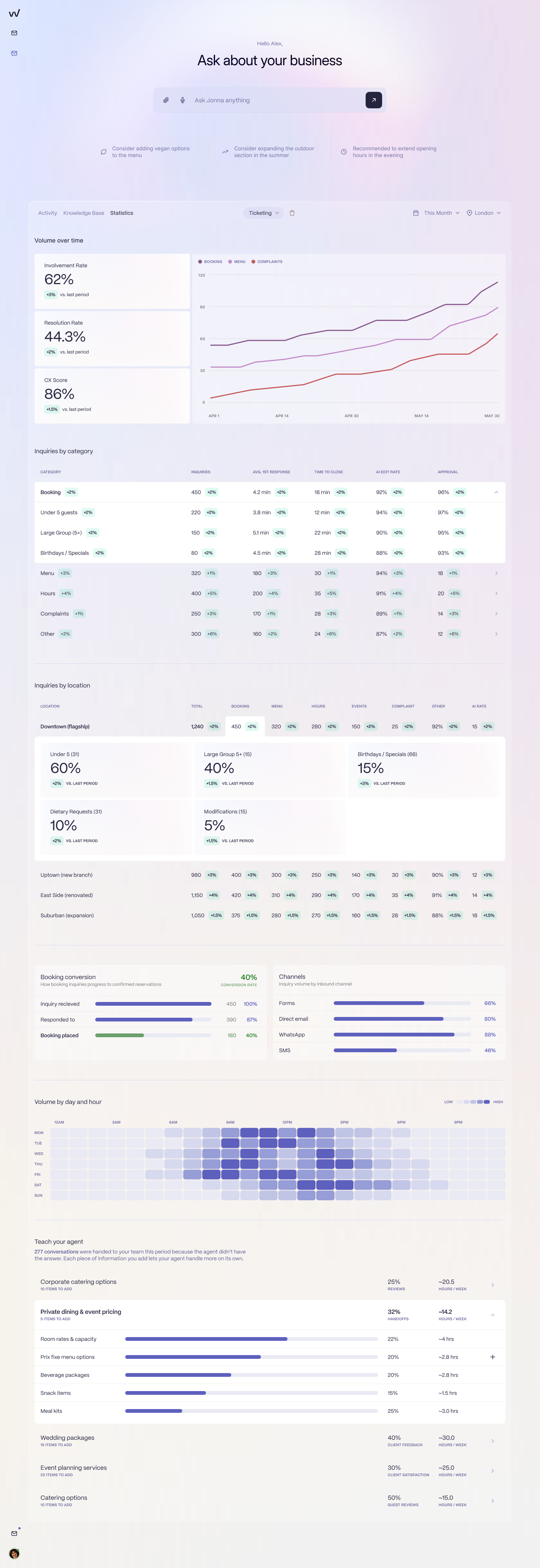
Response rate, volume and conversion by location, so the enquiry channel stops being a blind spot.
An honest note on where RevVue is today
RevVue's SevenRooms integration is in active development, and it is the most requested connection on the roadmap. That is the honest status. For now, groups run an email-only pilot that already delivers the inbox value shown above: location-aware routing, instant acknowledgement, AI-drafted replies, high-value bookings surfaced, and reporting by location. The direct booking-system connection will deepen that when it lands, and it does not gate the value available today. The UK AI is in pilot.
This is the move the Brasilia Group made, off a horizontal helpdesk and onto an inbox built for the job. Their founder, Nikolaos Kiosses, put it plainly: "The transition from Zendesk to RevVue has been a game changer."
If you are weighing up the wider category, shared inbox software for restaurants is the broader view, and because so many of these messages land outside service hours, handling booking enquiries 24/7 is the most relevant read next. To see what the AI would have said to a real enquiry your team received last week, book 20 minutes.
Frequently asked questions
Does Re:amaze integrate with SevenRooms?
No. Re:amaze has no native integration with SevenRooms, and no restaurant booking system appears in its integration list. Because both tools are on Zapier you can build a bridge that copies enquiry or booking data into a conversation, but it only moves information one way. It cannot check availability, create or amend a booking, or read the guest's SevenRooms profile and spend history.
Re:amaze handles Instagram and WhatsApp. Does that help with booking enquiries?
It helps with half the problem, and it is the half most tools ignore. Booking requests genuinely arrive by DM and WhatsApp as well as by email, and pulling them into one queue with an owner and a response time is a real gain over four separate apps. The other half is untouched. Every one of those channels still ends with a person opening SevenRooms in another tab to check the diary and key the booking in by hand.
Is Re:amaze a good choice for a restaurant group?
It is a reasonable, affordable choice if your problem is scattered channels and your group also runs an online shop for vouchers, gift cards or merchandise, because the Shopify side is where Re:amaze is strongest. It is a poor fit if your problem is booking enquiries. It is built and priced for e-commerce businesses, it has no line into any diary, and it has no concept of which venue an enquiry belongs to.
What do restaurant groups use instead for booking enquiries?
Most keep a shared inbox and accept the double-handling, because no general-purpose helpdesk solved the booking side. A purpose-built option is RevVue, which is location-aware and whose AI checks availability and prepares the booking inside the conversation. Its SevenRooms integration is in active development, with an email-only pilot available now.