No. Zendesk has no native, purpose-built integration with Resy, and Resy is the hardest booking system in this category to bridge, because it has no public developer portal and no self-serve API. Zendesk is a customer-service helpdesk. Resy is a reservation, waitlist and guest-CRM platform owned by American Express, built for in-demand restaurants where the diary is the scarce resource. They were built for different jobs, and the gap between them is where booking enquiries sit unanswered.
The short answer
Zendesk can receive a Resy enquiry as a ticket. It cannot do anything with it in Resy. Checking the book, moving a party, adding the birthday note, releasing a table: all of that still happens by hand, in Resy, by a person.
Zendesk + Resy | |
|---|---|
Native integration | None |
Best available workaround | A custom build, and only if Resy grants you partner API access |
What the workaround still can't do | Check availability, create or amend a reservation, read the guest's Resy history |
Worth being precise about the middle row, because it is what makes Resy different from the rest of the matrix. With SevenRooms or OpenTable you can at least reach for Zapier and build something crude. Resy is not on Zapier. It publishes no OpenAPI specification and runs no self-serve developer signup. Integration access is granted to approved partners in defined categories (point of sale, CRM, loyalty, marketing, discovery) under a direct agreement. The only surface open to everyone is the embeddable "Book with Resy" widget, which is a booking button for your website, not a way for a helpdesk to read your diary.
What actually happens to a booking enquiry
The restaurants that run Resy are often the ones under the most booking pressure: counter formats, chef-led rooms, sites where a Thursday sells out in minutes. That pressure is exactly why the manual workflow hurts. Here is the real journey of one enquiry when Zendesk and Resy do not talk to each other.
A regular emails to ask whether their table for six on Friday can move to 8.30pm, and mentions it is a birthday. The message becomes a Zendesk ticket.
An agent opens the ticket and reads it.
The agent opens Resy in another tab, because Zendesk cannot see the book.
They find the existing reservation, check whether 8.30pm can take six, and look at what moving it does to the turn behind it.
They amend the booking in Resy, re-keying the new time and adding the birthday note to the guest's profile by hand.
They switch back to Zendesk and write the reply.
They mark the ticket solved.
The guest replies: "Could we make it seven, and is the counter or a table better for a birthday?" The agent repeats steps 3 to 7.
Every enquiry is handled twice, in two systems, by a person copying the same fields between screens. One operations director described the inbox behind this workflow as "a black hole, no KPIs, no response rate, nothing," because the work happened in tabs and tickets that no report could see. The reservations team knows it is busy. Nobody can show how busy, how fast, or how much it converted.
The sharper cost is the enquiry you never hear about again. A booking enquiry has a short shelf life, and a restaurant with a full book has the least slack to answer quickly. A roughly 40-venue entertainment group lost a single booking worth £40,000 because the enquiry arrived outside working hours and nobody replied in time. A three-site pizza group put it more bluntly about a 30 to 40 cover enquiry: "It just sat there. No one saw it. They went somewhere else." Zendesk did not cause those losses. Routing bookings through a system that cannot book anything is what makes the delay inevitable.
What Zendesk actually connects to
Zendesk has a large marketplace: CRMs, e-commerce platforms, telephony, analytics, workforce tools. What it does not have is a connection to restaurant booking systems, because those are not the tools its core market runs. Zendesk sells into software, retail and financial services. Search the Zendesk Marketplace and you will find Salesforce and Shopify, not Resy.
Normally the fallback is an automation bridge, and for some booking systems that at least exists. Here it does not. Resy is absent from Zapier, so there is no low-code path at all. The remaining option is a custom development project against Zendesk's API and Resy's partner API, which means first persuading Resy to grant partner access for a use case that does not match its published partner categories. For most operators that is where the conversation ends, and it ends before a line of code is written.
Even if you cleared that hurdle, what you would have built is a pipe that copies enquiry text into a ticket. It moves information in one direction and treats a reservation request as a support case. Zendesk AI, the platform's answer bot and agent copilot, can suggest a reply from your knowledge base and past tickets, but it has no line into the book and cannot take a single action inside Resy. So the "integration" is a copy of the enquiry sitting in a second system, and the actual booking work, steps 3 to 7 above, is unchanged.
One more thing worth noting for planning purposes. Resy is currently absorbing Tock's venues under American Express, roughly doubling its library to more than 25,000 restaurants. If you run both today, you are consolidating onto Resy, and the integration question consolidates with it.
Why this matters for booking enquiries
A support ticket and a booking enquiry look similar and behave nothing alike. A support ticket is resolved by a reply. A booking enquiry is only resolved when a table is held in the book. That difference is the whole problem.
The helpdesk can write a polished reply. It cannot book the table. The transaction, the part that actually earns the cover, still lands on your team, one enquiry at a time. This is why most groups that run Zendesk for customer service (vouchers, refunds, complaints that need finance) still run their booking enquiries through a shared Gmail or Outlook inbox. The helpdesk never solved the booking side, so the old inbox stayed, and with it the double-handling and the black box.
What it looks like when the tool is built for booking enquiries
The gap closes when the inbox and the diary are the same surface, so the enquiry is answered and booked in one place instead of two. This is what RevVue does, and it is easier to show than to describe.
Enquiries are tagged to the right venue as they arrive, so a group with several restaurants stops triaging by hand. That matters more when demand is high, because the enquiries that arrive by email are usually the ones the online book already turned away. The team works from one queue, by location, rather than a ticket queue that treats every site the same.
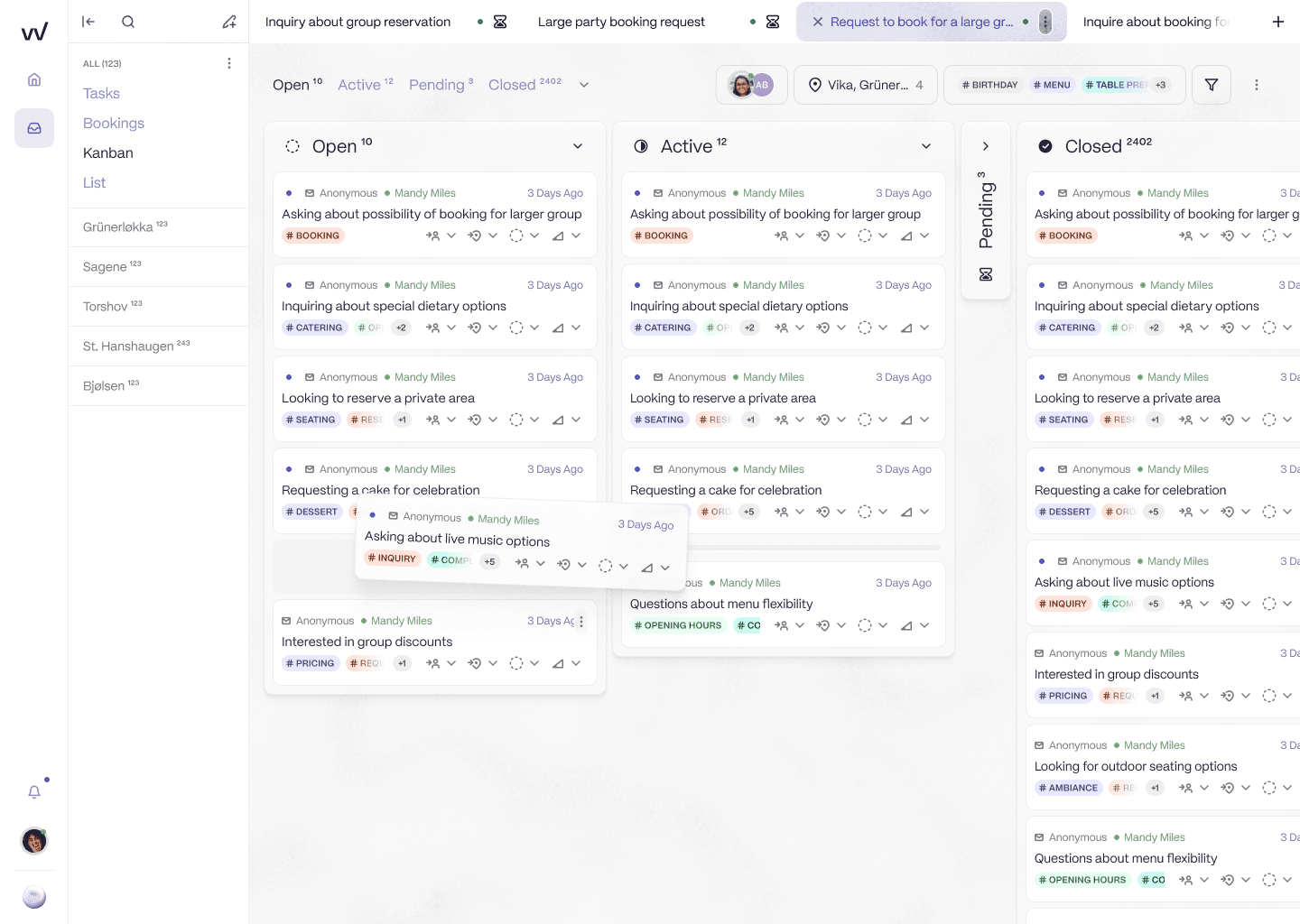
One queue, sorted by venue, for the enquiries that never fitted into the online book.
The AI drafts the reply in that venue's voice, using its menus, its policies and the answers it gives most often. Guests who write after missing a slot want a real answer about alternatives, and the draft already contains them.
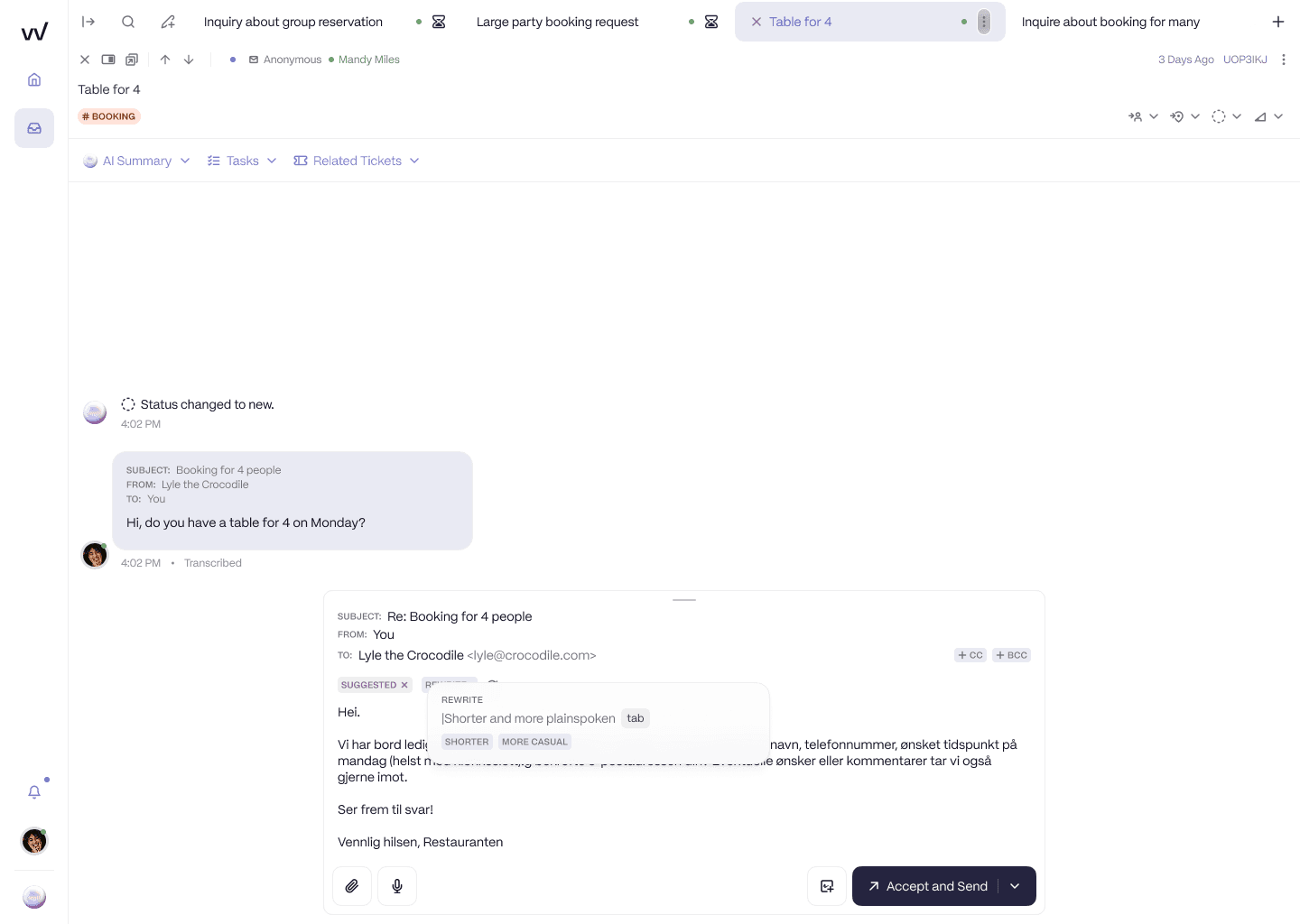
A drafted reply in the venue's voice, ready for the team to approve or adjust.
Because it connects to the booking system, the AI does the step Zendesk cannot: it checks availability and prepares the booking inside the conversation. Everyday requests are handled on arrival, and the high-value ones, the celebration tables and the large parties, are acknowledged instantly and held in a queue the team works.
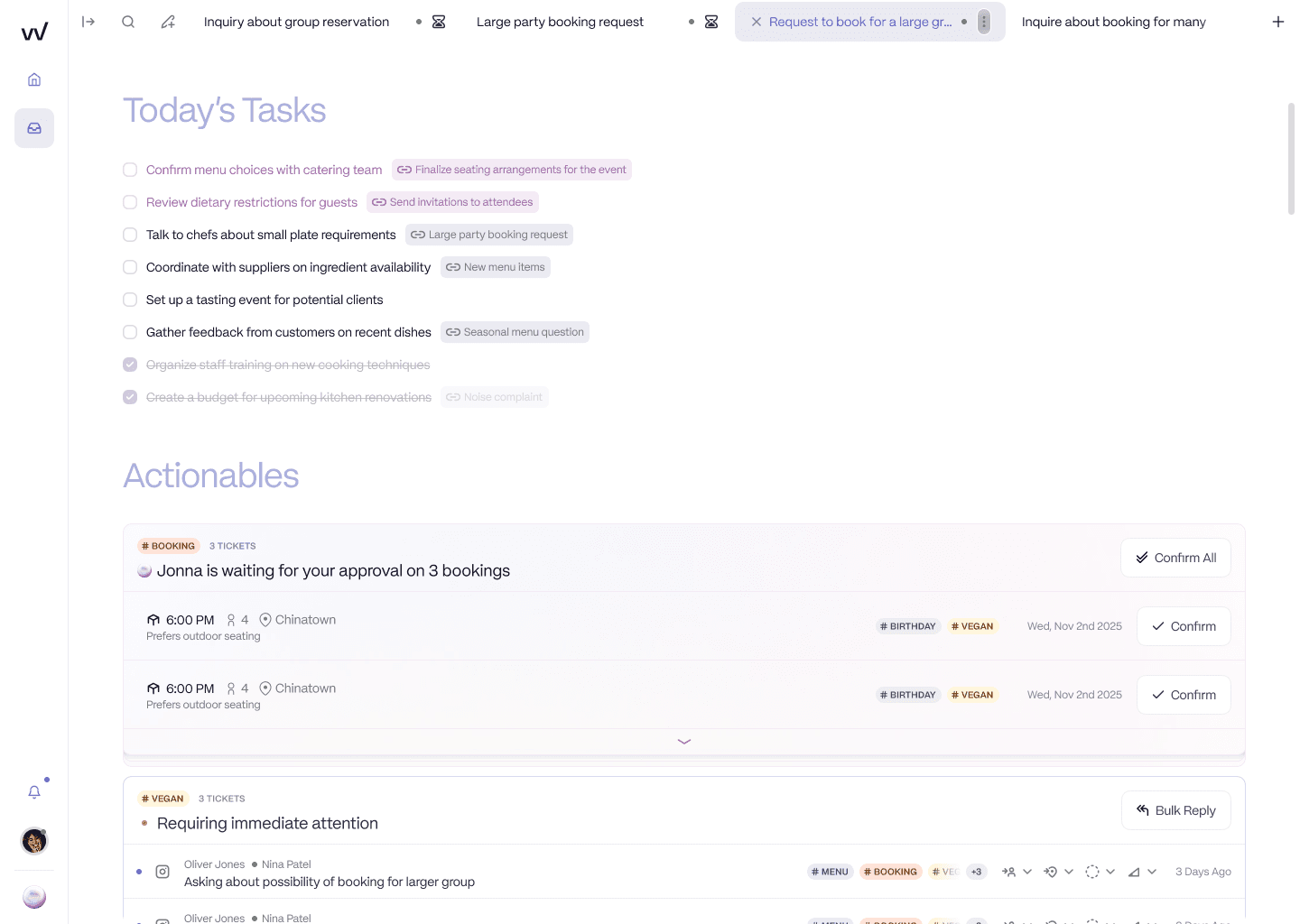
High-value enquiries acknowledged and prepared, waiting for a person rather than for attention.
And because every enquiry is tracked by venue, you can finally see the demand that never made it into the book. Response rates, volumes and conversion by site: the part a reservations platform cannot show you. Zendesk reports on tickets and satisfaction scores, which never connects a reply to a seated table.
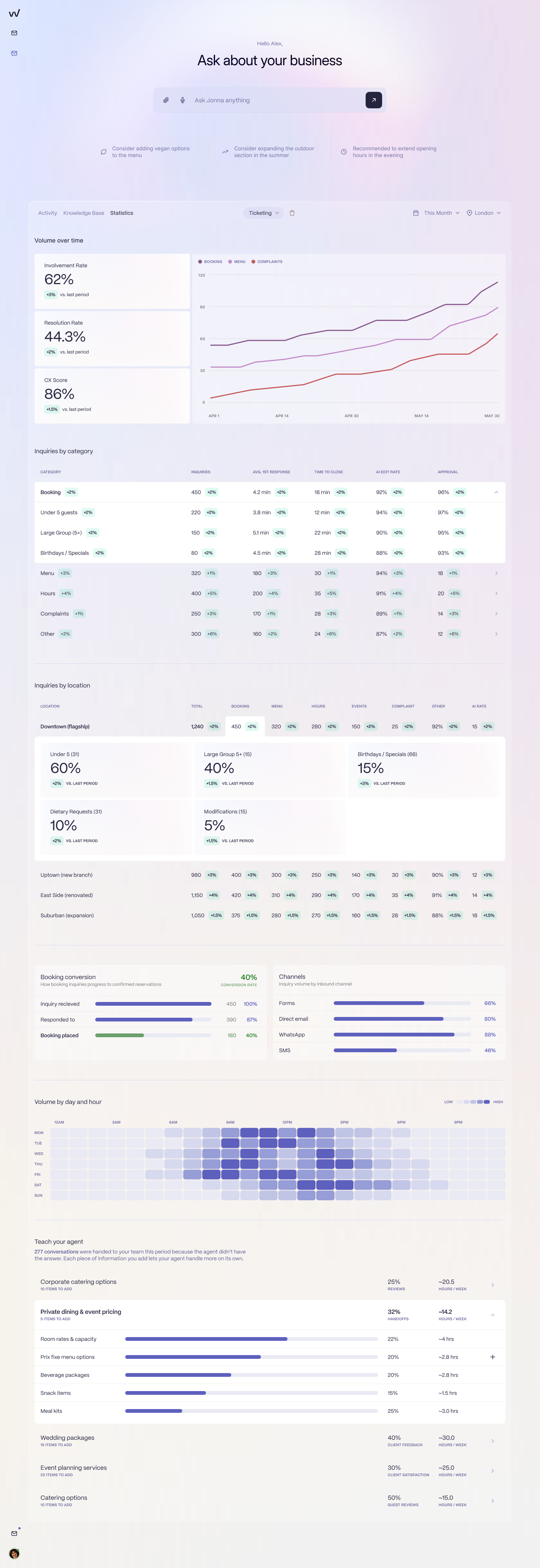
Enquiry volume, response rate and conversion by location, including the demand the book never recorded.
An honest note on where RevVue is today
RevVue's Resy integration is on the roadmap. That is the honest status. For now, groups run an email-only pilot that already delivers the inbox value shown above: location-aware routing, instant acknowledgement, AI-drafted replies, high-value bookings surfaced, and reporting by location. The direct booking-system connection will deepen that when it lands, but it does not gate the value you get today. The UK AI is in pilot.
This is the move the Brasilia Group made, off a horizontal helpdesk and onto an inbox built for the job. Their founder, Nikolaos Kiosses, put it plainly: "The transition from Zendesk to RevVue has been a game changer."
If you are weighing the two, the fuller comparison is in RevVue vs Zendesk, and whether the helpdesk fits a multi-site operator at all is covered in is Zendesk right for restaurant groups. If most of your enquiries arrive from booking networks rather than your own site, automating third-party booking emails covers that specific problem. To see what the AI would have said to a real enquiry your team received last week, book 20 minutes.
Frequently asked questions
Does Zendesk integrate with Resy?
No. Zendesk has no native integration with Resy, and there is no self-serve route to build one. Resy publishes no public API and is not available on Zapier, so bridging the two requires partner API access granted directly by Resy plus a custom development project. Even then it only copies enquiry text into a ticket. It cannot check availability, create a reservation, or amend one in Resy.
Is there a Resy app in the Zendesk Marketplace?
No. The Zendesk Marketplace is built around the tools its core market uses, which are CRMs, e-commerce platforms, telephony and analytics. No restaurant booking system appears in it, and Resy is no exception. Resy's own integration partners are point-of-sale, CRM, loyalty, marketing and discovery platforms, and no customer-service helpdesk is among them.
Does Resy have a public API or a Zapier integration?
No to both. Resy does not run a self-serve developer portal and publishes no OpenAPI specification, and it is not listed on Zapier. Access is limited to approved partners under a direct agreement. The only publicly available surface is the embeddable "Book with Resy" widget, which lets guests book from your website but gives a helpdesk no way to read or write to your diary.
What do restaurant groups use instead for booking enquiries?
Most run booking enquiries through a shared Gmail or Outlook inbox even when they use Zendesk for customer service, because the helpdesk never solved the booking side. A purpose-built option is RevVue, which is location-aware and whose AI checks availability and prepares the booking inside the conversation. Its Resy integration is on the roadmap, with an email-only pilot available now.