No. Zendesk has no native, purpose-built integration with TheFork, and TheFork's own B2B API will not close the gap either, because it is built for batch data synchronisation rather than live booking. Zendesk is a customer-service helpdesk. TheFork is a booking network and, through TheFork Manager, the reservation and table-management software behind it, used across the UK and Europe to fill covers. They were built for different jobs, and enquiries that arrive off the network land in the space between them.
The short answer
Zendesk can receive a TheFork enquiry as a ticket. It cannot do anything with it in TheFork Manager. Checking the shift, holding a table, applying the set menu, noting the allergy: all of that still happens by hand, in TheFork Manager, by a person.
Zendesk + TheFork | |
|---|---|
Native integration | None |
Best available workaround | A custom build on Zendesk's API and TheFork's B2B API |
What the workaround still can't do | Check live availability, create or amend a booking, apply a promotion or set menu |
The middle row deserves a caveat that works in TheFork's favour. Of the major booking systems, TheFork is the most openly documented: it publishes a developer portal for its B2B API, aimed at CRM platforms and large restaurant groups. That is more than most of its competitors offer. It is still the wrong shape for this job, for a reason TheFork states itself.
What actually happens to a booking enquiry
Groups that lean on TheFork are usually using it to fill covers, which means a healthy share of enquiries come from people who found you on the network rather than your own website. Here is the real journey of one enquiry when Zendesk and TheFork do not talk to each other.
An enquiry arrives from a guest who found the restaurant on TheFork, asking about a table for ten next Saturday, whether the set menu is available for a group that size, and requesting a quiet corner. It is written in French. The message becomes a Zendesk ticket.
An agent opens the ticket and reads it, translating as they go.
The agent opens TheFork Manager in another tab, because Zendesk cannot see the shift.
They check availability for ten on Saturday, look at which tables can seat that party away from the pass, and check whether the set menu and any active promotion apply to a group booking.
They create the booking in TheFork Manager, re-keying the guest's name, date, time, party size and the seating note from the email.
They switch back to Zendesk and write the reply, in French if someone on shift can, in English if not.
They mark the ticket solved.
The guest replies: "Can we make it 12, and two are vegetarian." The agent repeats steps 3 to 7.
Every enquiry is handled twice, in two systems, by a person copying the same fields between screens. One operations director described the inbox behind this workflow as "a black hole, no KPIs, no response rate, nothing," because the work happened in tabs and tickets that no report could see. For a group paying to be on a network that sends enquiries, not being able to measure what happens to those enquiries is a particularly uncomfortable blind spot.
The sharper cost is the enquiry you never hear about again. A guest browsing a booking network has a dozen alternatives one tap away, so a slow reply is not a delay, it is a lost cover. A roughly 40-venue entertainment group lost a single booking worth £40,000 because the enquiry arrived outside working hours and nobody replied in time. A three-site pizza group put it more bluntly about a 30 to 40 cover enquiry: "It just sat there. No one saw it. They went somewhere else." Zendesk did not cause those losses. Routing bookings through a system that cannot book anything is what makes the delay inevitable.
What Zendesk actually connects to
Zendesk has a large marketplace: CRMs, e-commerce platforms, telephony, analytics, workforce tools. What it does not have is a connection to restaurant booking systems, because those are not the tools its core market runs. Zendesk sells into software, retail and financial services. Search the Zendesk Marketplace and you will find Salesforce and Shopify, not TheFork.
TheFork's side of the equation is more open, and that is worth crediting properly. It publishes a B2B API developer portal, and it integrates with serious partners on the point-of-sale side, including Lightspeed, Oracle and Trivec. If you are a large group wanting your reservation data in your CRM, that API is a real answer.
It is not an answer to this problem, and TheFork's own documentation says why: the API is framed around data synchronisation without the need for real-time updates. It is a sync surface, designed to move records between systems in batches. A booking enquiry needs the opposite. It needs a live availability check at the moment the agent is typing, and the ability to write a real booking back into the shift before the guest loses patience. A batch sync cannot do that no matter how well it is built, and TheFork is not on Zapier, so there is no low-code shortcut either. Zendesk AI, the platform's answer bot and agent copilot, can suggest a reply from your knowledge base and past tickets, but it has no line into the diary and cannot take a single action inside TheFork Manager. So the realistic bridge is a custom development project that ends up copying enquiry data into a ticket, and the actual booking work, steps 3 to 7 above, is unchanged.
Why this matters for booking enquiries
A support ticket and a booking enquiry look similar and behave nothing alike. A support ticket is resolved by a reply. A booking enquiry is only resolved when a table is held in the diary. That difference is the whole problem.
The helpdesk can write a polished reply. It cannot book the table. The transaction, the part that actually earns the cover, still lands on your team, one enquiry at a time. This is why most groups that run Zendesk for customer service (vouchers, refunds, complaints that need finance) still run their booking enquiries through a shared Gmail or Outlook inbox. The helpdesk never solved the booking side, so the old inbox stayed, and with it the double-handling and the black box.
What it looks like when the tool is built for booking enquiries
The gap closes when the inbox and the diary are the same surface, so a direct enquiry gets the same handling as a booking the network sends. This is what RevVue does, and it is easier to show than to describe.
Enquiries are tagged to the right venue on arrival, which matters for groups whose sites sit in different cities and sometimes different countries. Nobody works out which restaurant a message is about before answering it, because the team works from one queue, by location, rather than a ticket queue that treats every site the same.
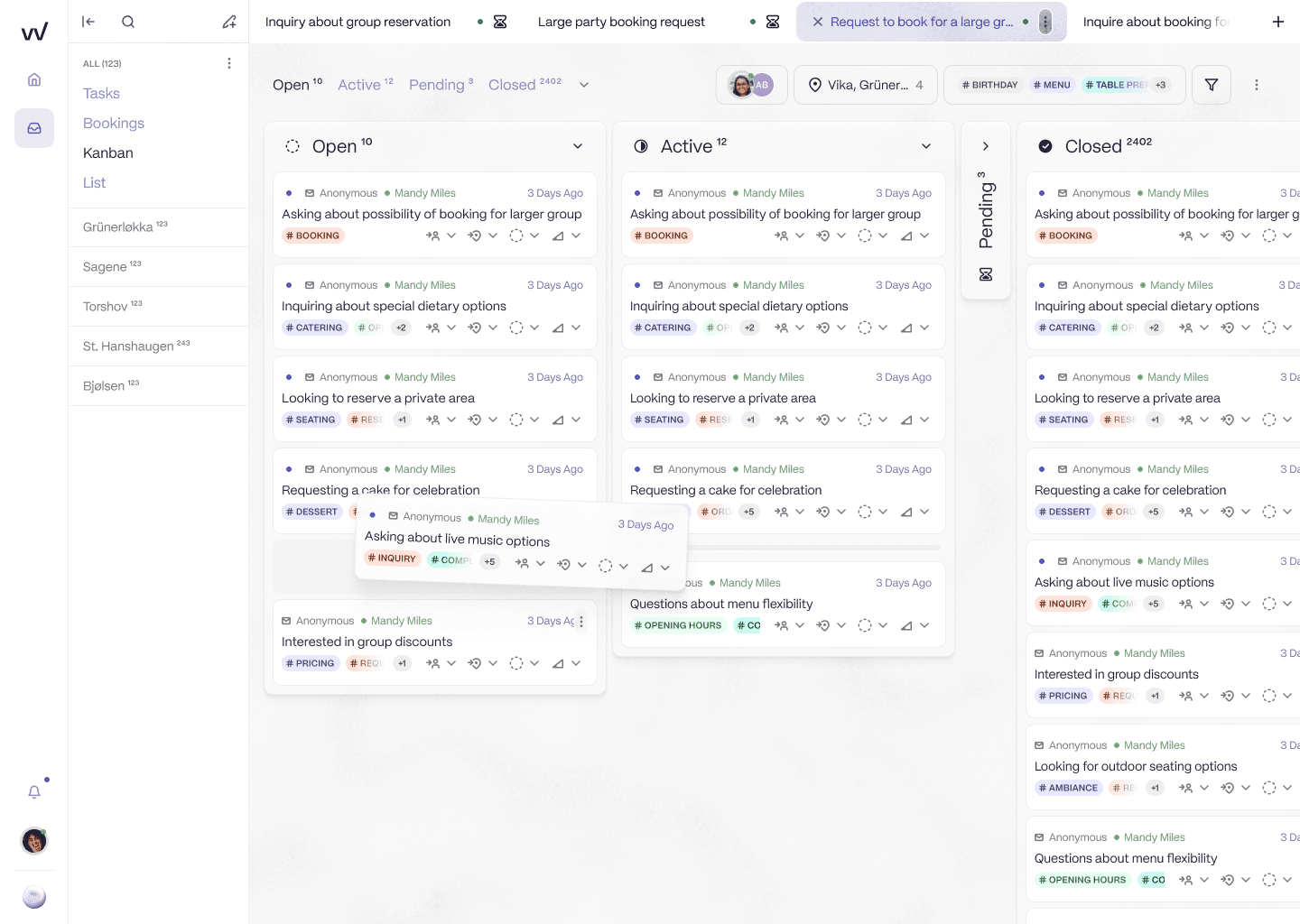
Every enquiry routed to its venue automatically, across cities and sites.
The AI drafts the reply in that venue's voice, using its menus, its policies and its own way of answering. For a group taking enquiries in more than one language, the draft is a starting point rather than a blank page.
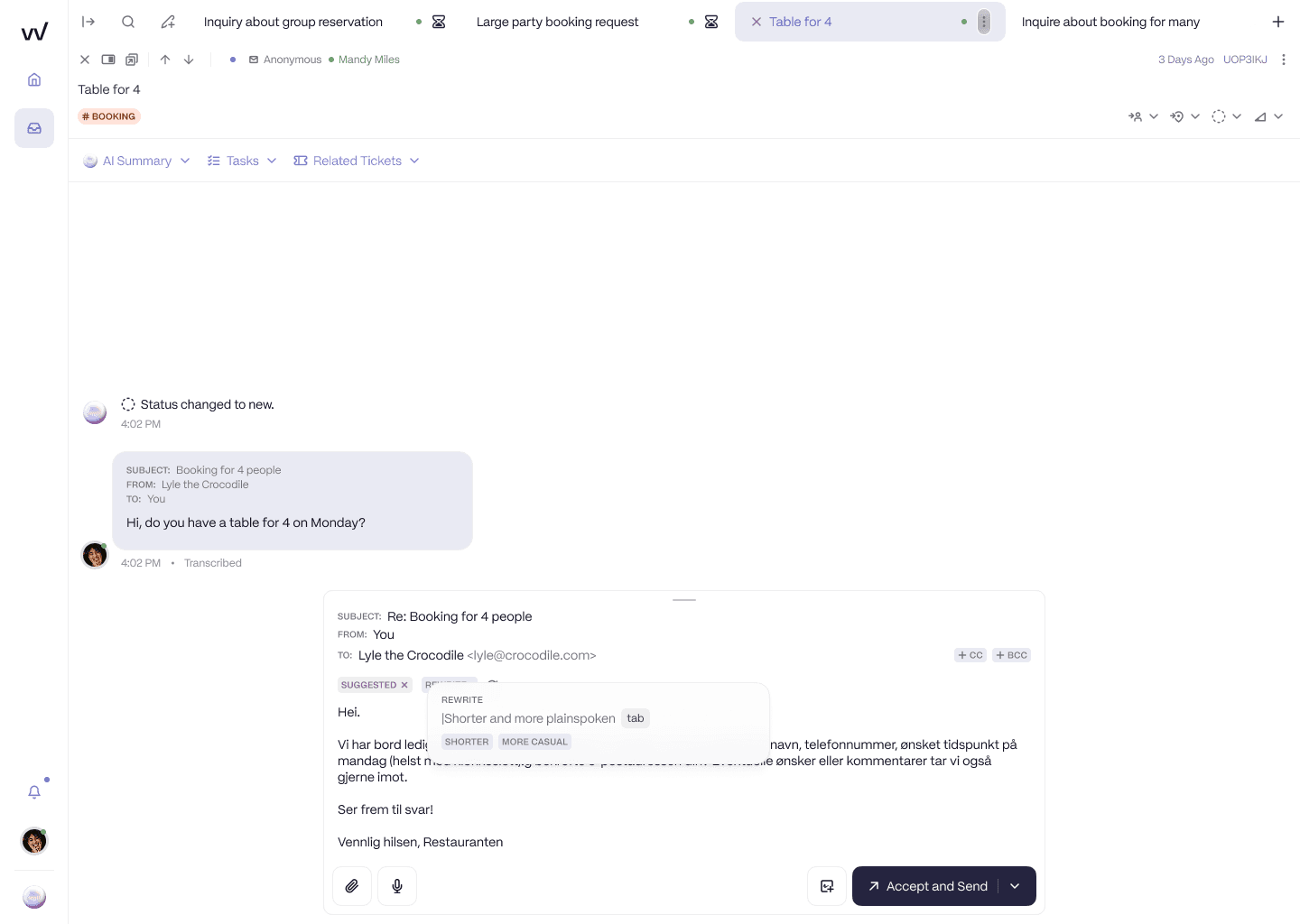
A reply drafted in the venue's voice, waiting for the team to approve it.
Because it connects to the booking system, the AI does the step Zendesk cannot: it checks availability and prepares the booking inside the same thread. The routine requests clear themselves, and the group bookings and private-hire enquiries, the ones the network does not send you, are acknowledged instantly and held for a person.
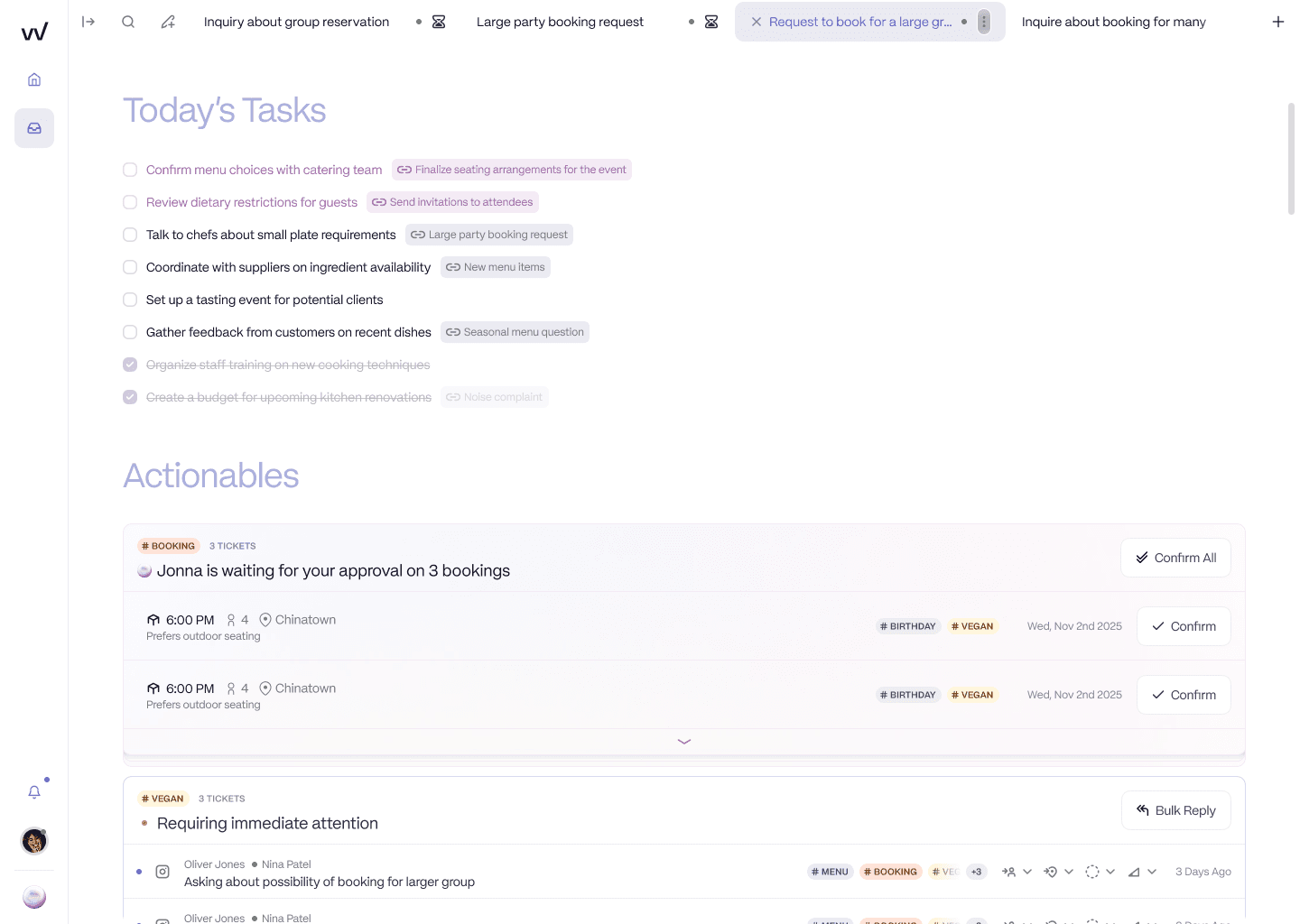
Group and private-hire enquiries acknowledged and prepared, ready for someone to close.
And because every enquiry is tracked by location, direct demand becomes as visible as network demand. Response rates and conversion by site, so you can see what your own inbox is worth next to the covers you pay commission on. Zendesk reports on tickets and satisfaction scores, which cannot be compared with the covers the network reports.
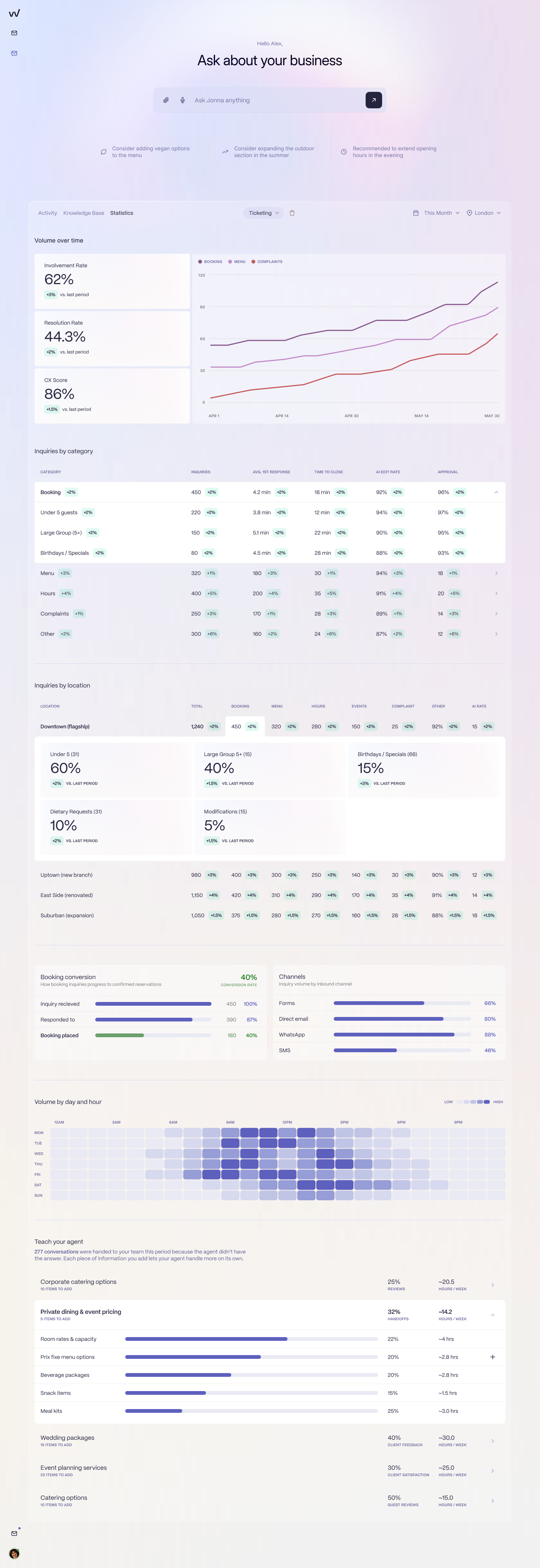
Response rate, volume and conversion by location, measured against network-sourced covers.
An honest note on where RevVue is today
RevVue's TheFork integration is on the roadmap. That is the honest status. For now, groups run an email-only pilot that already delivers the inbox value shown above: location-aware routing, instant acknowledgement, AI-drafted replies, high-value bookings surfaced, and reporting by location. The direct booking-system connection will deepen that when it lands, but it does not gate the value you get today. The UK AI is in pilot.
This is the move the Brasilia Group made, off a horizontal helpdesk and onto an inbox built for the job. Their founder, Nikolaos Kiosses, put it plainly: "The transition from Zendesk to RevVue has been a game changer."
If you are weighing the two, the fuller comparison is in RevVue vs Zendesk, and whether the helpdesk fits a multi-site operator at all is covered in is Zendesk right for restaurant groups. Since most of these enquiries arrive from the network rather than your own site, automating third-party booking emails covers that specific problem in depth. To see what the AI would have said to a real enquiry your team received last week, book 20 minutes.
Frequently asked questions
Does Zendesk integrate with TheFork?
No. Zendesk has no native integration with TheFork, and TheFork is not available on Zapier. Bridging the two means a custom development project against Zendesk's API and TheFork's B2B API. Even when it is built, it copies enquiry data into a ticket. It cannot check live availability, create a booking, or amend one in TheFork Manager.
Can TheFork's API connect it to a helpdesk?
Not usefully for booking enquiries. TheFork does publish a B2B API developer portal, which is more open than most booking systems offer, and it is a genuine answer for syncing reservation data into a CRM. But TheFork frames it around data synchronisation without the need for real-time updates. Handling an enquiry needs the opposite: a live availability check while the agent is replying, and the ability to write a booking back immediately. A batch sync surface cannot do that.
Why doesn't Zendesk work with restaurant booking systems?
Because Zendesk was built for customer-service tickets, not reservations. Its market is software, retail and financial services, so its integrations are CRMs and e-commerce tools, not TheFork or OpenTable. Handling a booking enquiry needs the tool to read and write to the diary, which a support helpdesk is not designed to do.
What do restaurant groups use instead for booking enquiries?
Most run booking enquiries through a shared Gmail or Outlook inbox even when they use Zendesk for customer service, because the helpdesk never solved the booking side. A purpose-built option is RevVue, which is location-aware and whose AI checks availability and prepares the booking inside the conversation. Its TheFork integration is on the roadmap, with an email-only pilot available now.