Front is the strongest shared inbox on the market, and of all the horizontal tools it is closest to how booking enquiries actually work. It is genuinely good at ownership, internal discussion and response-time discipline on a shared address. It also builds real vertical integrations, with whole app-store categories for logistics, maritime and travel. That is exactly what makes its position here worth understanding: Front went vertical for freight, not for hospitality, so a restaurant group gets the general-purpose product.
What Front is genuinely good at
This is a serious product and the credit should be specific.
Ownership on a shared address is solved. Assignment, internal comments beside the message rather than in a separate thread, and clear rules about who owns what. For a bookings@ address that three people dip into, this eliminates the two failure modes: nobody answers, or two people answer differently.
Response-time discipline is real. SLAs, reminders and analytics on how quickly the team replies. For a business where speed decides whether you win a booking, having that measured at all puts you ahead of most operators.
Collaboration is better than in any ticketing tool. A manager can be looped into a large-party enquiry, comment privately, and hand it back, without the guest ever seeing a forwarded email chain.
Front AI is capable. Copilot drafts and answers using past conversations, help content and connected systems. Autopilot resolves across channels, and Smart QA, Smart CSAT and Topics analyse what the team is dealing with.
And it does go vertical. This matters. Front's app store has categories for Logistics and Maritime and for Travel, containing integrations built for those industries' systems of record. Front is demonstrably willing to build deep, industry-specific connections.
Where it breaks for a restaurant group
The vertical it built is not yours. Front proved it will wire into an industry's core systems when the market justifies it. Hospitality has not had that treatment, so there is no restaurant booking system in the app store and no diary-aware behaviour anywhere in the product. This is a more useful framing than "shared inboxes cannot do this," because Front shows they can. It just has not been done for restaurants.
Tags stand in for venues. Front's model is inboxes, tags and rules. A group with eight sites either runs eight inboxes or one inbox with a tag per venue. Neither gives you per-venue tone in replies or a clean per-site view of response time and conversion, because a tag is a label rather than a place with capacity and a manager.
Front AI cannot see the diary. Copilot is grounded in conversations, help content and connected systems, and no booking system is among those connected systems. So it drafts a good reply to a 30-cover Christmas enquiry and cannot tell you whether you can seat 30 that night.
One practical caveat worth knowing. Front's Zapier integration can only access shared inboxes, because the Zapier OAuth token is scoped that way. Individual inboxes need an API token plus Webhooks by Zapier. If you were planning to bridge Front to a booking system with a zap, that constrains the design before you start.
The test: what happens to a booking enquiry
Here is one enquiry at a group running Front well.
A company emails in September about a Christmas party for 60 on a Thursday in mid-December, asking about a private area, a pre-order and an invoice.
Front routes it to the events inbox, applies the venue tag and assigns an owner. This part works properly.
The owner opens it and reads it.
They open the booking system in another tab, because Front cannot see the diary, and check whether the area is free on that Thursday and what it holds seated versus standing.
They check the December minimum spend and whether the kitchen will take a 60-cover pre-order.
They loop in the general manager with an internal comment, which Front handles well.
They reply with options, then hold the space in the booking system by hand.
The company replies: "Can we do 75?" Seventy-five may not fit. Steps 4 to 7 run again, and a private-hire negotiation runs six or eight messages.
Steps two and six are Front at its best, and they are genuinely valuable. Steps four, five and seven are the entire commercial substance of the enquiry, and Front is not present for any of it. One operations director described the inbox behind this workflow as "a black hole, no KPIs, no response rate, nothing." Front fixes the response-rate part of that sentence and cannot touch the covers part.
A roughly 40-venue entertainment group lost a single booking worth £40,000 because the enquiry arrived outside working hours and nobody replied in time. A three-site pizza group put it more bluntly about a 30 to 40 cover enquiry: "It just sat there. No one saw it. They went somewhere else."
Who Front actually suits
Buy Front if your problem is genuinely about ownership and collaboration on shared addresses, and you have several teams sharing several inboxes: a head-office operation handling supplier email, PR, recruitment and general enquiries alongside bookings. Front is excellent at that, and no cheaper tool matches its collaboration model.
Do not buy Front if the job is booking enquiry throughput across venues. You will pay for a strong collaboration layer and still key every booking in by hand, with tags approximating the venue structure the product does not model.
The nuance worth stating is that Front is the closest a horizontal tool gets. If a booking-enquiry product did not exist, Front would be the sensible compromise. That is a real endorsement, and it is also the whole argument: the compromise is only necessary if nothing is built for the job.
For the specifics on your stack, does Front integrate with SevenRooms and does Front integrate with Collins answer that directly.
What a booking-enquiry inbox does differently
The gap closes when the inbox and the diary are the same surface, so the enquiry is answered and booked in one place. This is what RevVue does, and it is easier to show than to describe.
Every enquiry is tagged to the venue it concerns automatically, and the venue is a real entity rather than a label. The team works from one queue by location instead of tags standing in for venues.
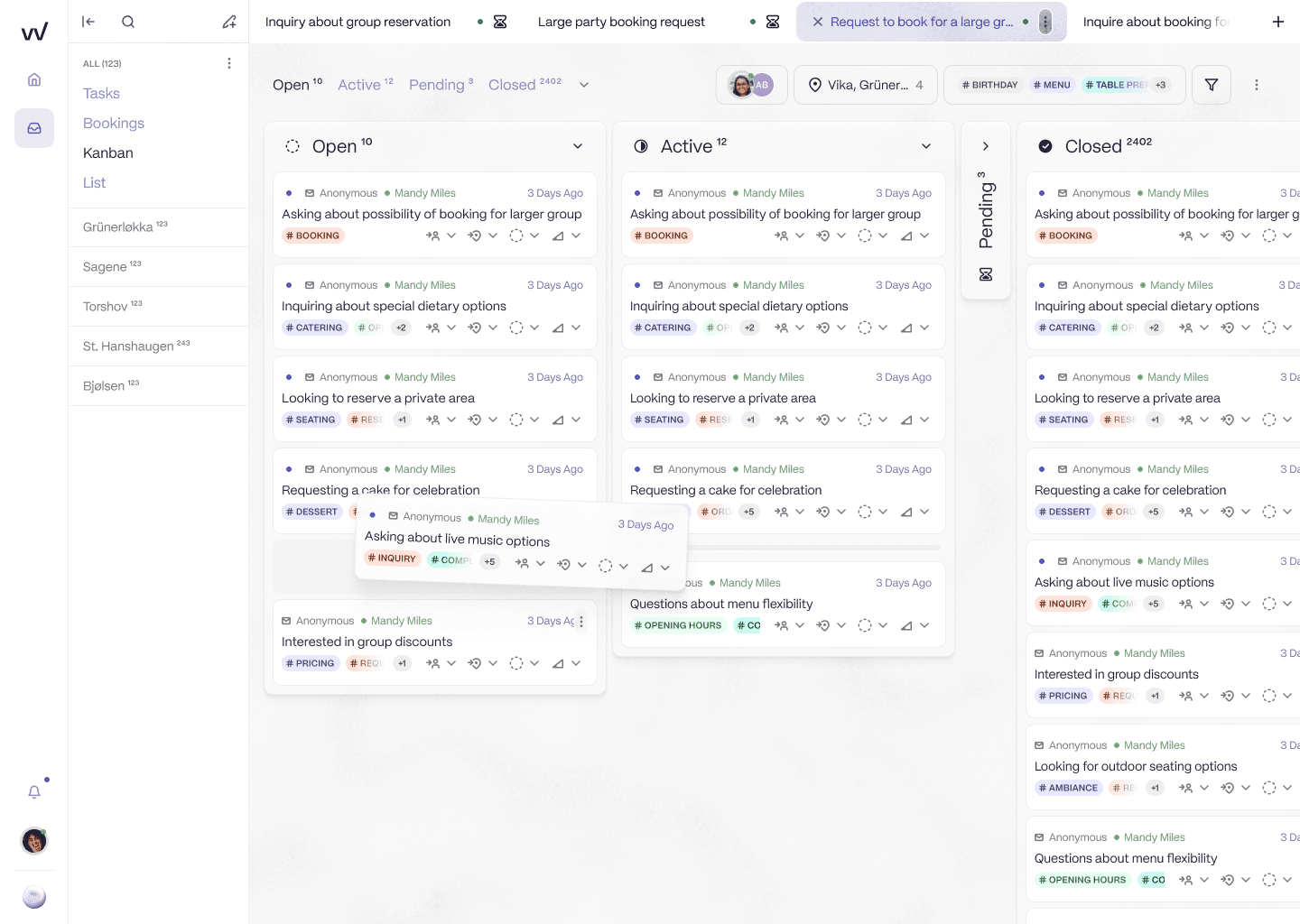
One queue per venue, so a group stops using tags to stand in for sites.
The AI drafts the reply in that venue's voice, grounded in its own capacities, minimum spends and what each room can seat. That is a step beyond drafting from past conversations, because a December private-hire answer depends on this venue's rooms.
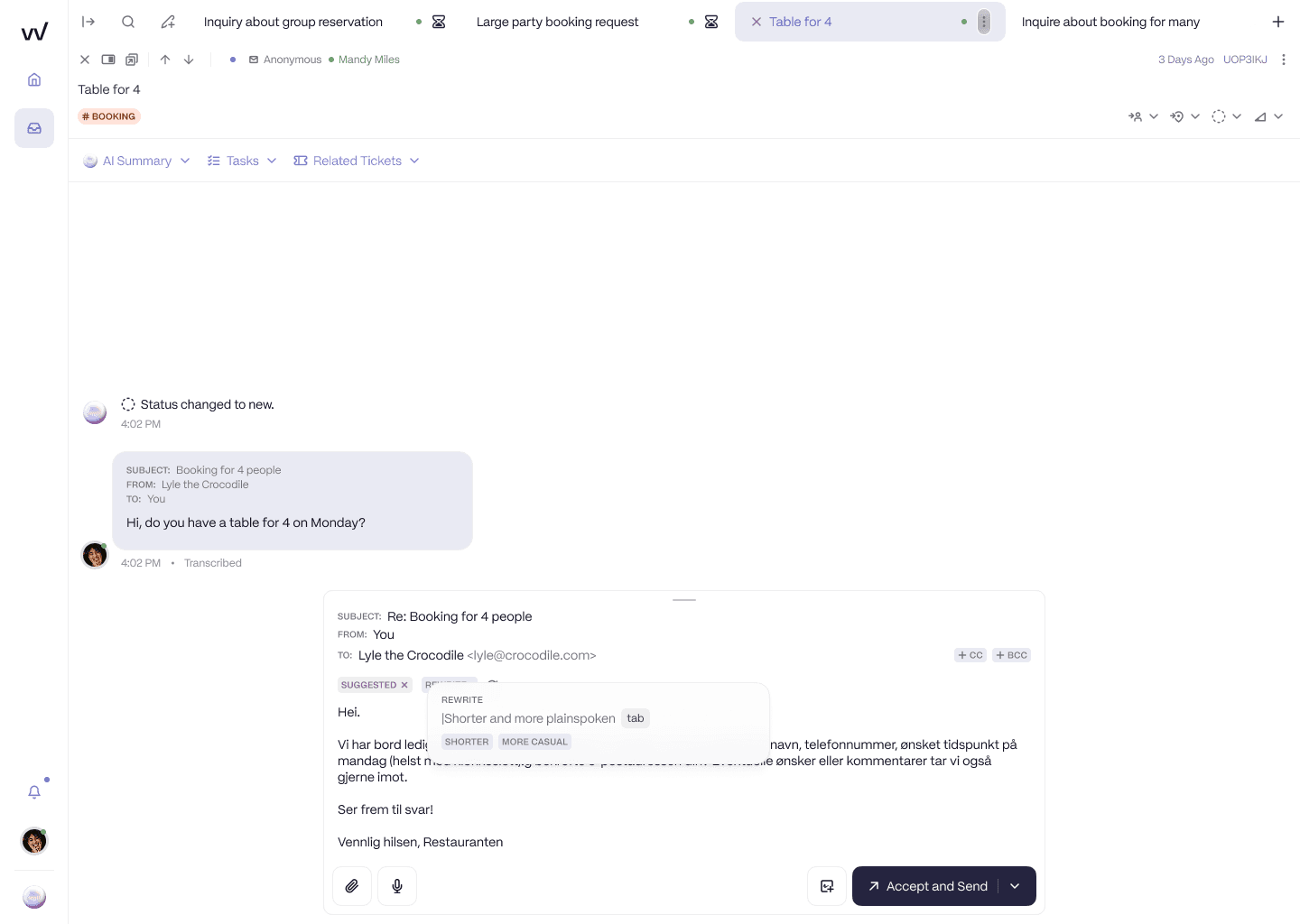
A drafted reply carrying the venue's own capacities and terms, ready to approve.
Because it connects to the booking system, the AI does the step Copilot cannot: it checks the space against the date and prepares the booking in the thread. Simple date questions are answered on arrival, and the enquiries worth thousands are acknowledged within moments and held in a queue a person works through.
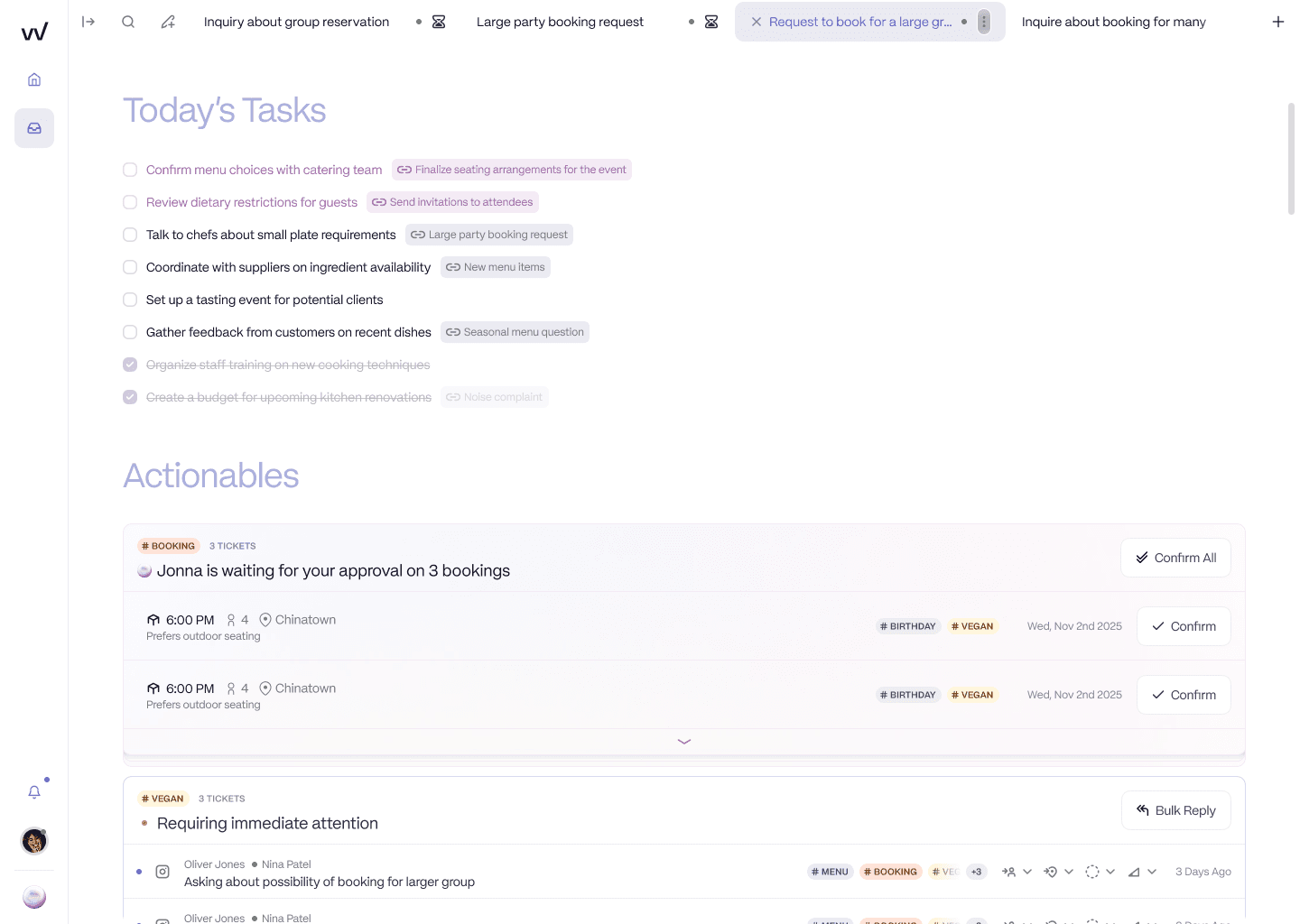
The large-event enquiries held, prepared and visible, instead of buried in a shared inbox.
And because every enquiry belongs to a venue, private hire finally has a funnel. Front reports on conversations and response times, which is the right measure for a shared inbox and not a measure of revenue.
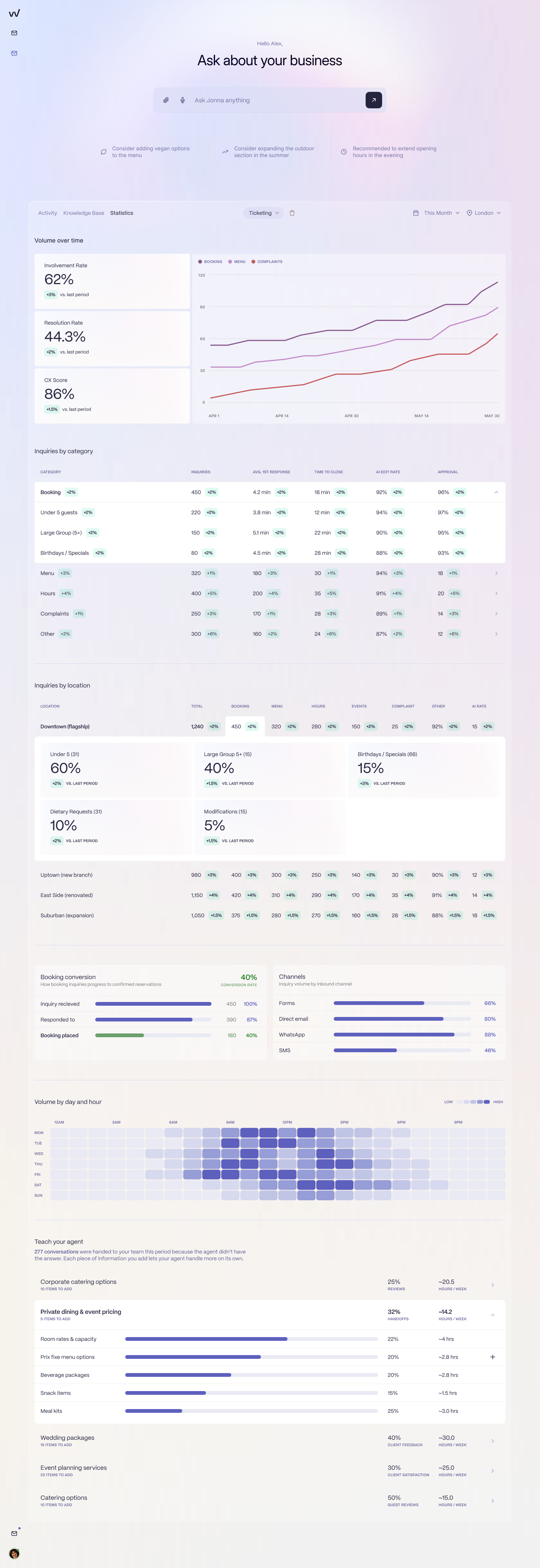
Enquiries, response times and conversion by location, including the ones that never got booked.
An honest note on where RevVue is today
Being straight about status: RevVue's SevenRooms, OpenTable and DesignMyNight integrations are in active development, and the other booking systems are on the roadmap with an email-only pilot available now. That pilot already delivers what is shown above: location-aware routing, instant acknowledgement, AI-drafted replies in each venue's tone, high-value enquiries surfaced and held, and reporting by location. The UK AI is in pilot.
This is the move the Brasilia Group made, off a horizontal helpdesk and onto an inbox built for the job. Their founder, Nikolaos Kiosses, put it plainly: "The transition from Zendesk to RevVue has been a game changer."
If you are comparing the category more broadly, shared inbox software for restaurants is the wider view, and triaging high-value group bookings covers the private-hire workflow specifically. To see what the AI would have said to a real enquiry your team received last week, book 20 minutes.
Frequently asked questions
Is Front good for restaurants?
It is the best of the horizontal shared inboxes for a restaurant group, and it still is not built for booking enquiries. Ownership, internal comments, SLAs and response-time reporting on a shared bookings@ address are all genuinely strong. What is missing is any connection to a diary and any concept of a venue, so bookings are keyed in by hand and tags have to stand in for sites.
Front builds vertical integrations. Why not for restaurants?
Front does go deep for specific industries, with app-store categories for logistics, maritime and travel built around those sectors' systems of record. Hospitality has not had that treatment, so no restaurant booking system appears in the app store. That is worth knowing precisely because it shows the limitation is a market choice rather than a technical one.
Can I connect Front to a booking system with Zapier?
Partly, and with a caveat. Front has an official Zapier app, but the integration can only access shared inboxes, because the Zapier OAuth token is scoped that way. Individual inboxes need an API token plus Webhooks by Zapier. Even once built, a zap moves enquiry data into a conversation and cannot check availability or create a booking.
What works better for a multi-venue group?
Something where the venue is a real entity rather than a tag, and where the inbox reaches the diary. RevVue routes each enquiry to its site, drafts replies in that venue's tone, checks availability and prepares the booking inside the conversation, and reports response rate and conversion by location. Its SevenRooms, OpenTable and DesignMyNight integrations are in development, with an email-only pilot available now.