Help Scout gets one important thing right that most helpdesks get wrong: it is email-first, and booking enquiries arrive by email. It is simple, affordable and pleasant to use, and for a small group replacing an unmanaged shared mailbox it is a genuine step up. Where it stops is the same place every horizontal tool stops. It has no line into your diary, and its structure is mailboxes rather than venues, so a group running six sites is approximating something the product does not model.
What Help Scout is genuinely good at
Give it real credit, because it deserves more than most in this category.
The channel is right. Help Scout was built around email conversations rather than chat widgets or ticket queues. A booking enquiry from a group organiser is a long, asynchronous email, and Help Scout treats it as a conversation with a person rather than a ticket with a reference number. Guests get replies that look like email, not like a support system.
It is simple and cheap. There is no six-week implementation. A small team can be running properly within a day, with assignment, saved replies, internal notes and collision detection so two people do not answer the same enquiry. For a two- or three-site group, that solves the immediate ownership problem.
The AI helps with the writing. Help Scout AI drafts, summarises and assists on replies, which takes real time out of answering the same set-menu question repeatedly.
Nothing is bloated. Compared with the enterprise platforms, Help Scout does not ask you to configure a workflow engine before you can answer an email. For an operator without an IT function, that matters.
Where it breaks for a restaurant group
Two structural limits, and one of them gets worse the more venues you run.
Mailboxes stand in for venues. Help Scout's organising unit is the mailbox. A group with six restaurants ends up with either six mailboxes, which fragments reporting and means someone must decide where each message belongs, or one mailbox with tags, which means no per-venue tone and no clean answer to "which site is slowest." Neither is venue-awareness. The product has no idea that a restaurant exists as a thing with its own capacity, menu and manager.
There is no connection to the diary. This is the decisive one. Help Scout can route the enquiry, assign it, remind you about it and help draft the reply. It cannot check whether Friday at 7.30 has a table for 12, cannot hold it, and cannot create the booking. Every enquiry is therefore handled twice: once in Help Scout to answer, once in the booking system to book.
The consequence is that Help Scout makes your email accountable without making your bookings faster. That is a real improvement on chaos and a small one against the actual cost.
The test: what happens to a booking enquiry
Here is one enquiry at a group running Help Scout well.
An email arrives at the group address on a Saturday night: a party of 12 for a Friday in three weeks, one coeliac, asking whether the back room can be held.
Help Scout puts it in the mailbox and assigns it by whatever rule you set.
On Monday an agent opens it.
They work out which venue it is about, because the guest did not say and the mailbox is shared.
They open the booking system in another tab and check whether 12 can be seated on that Friday and whether the back room is free.
They check the menu and what the kitchen does about a coeliac cover at that size.
They reply, then create the booking in the diary by hand, re-keying every field.
The guest replies: "Can we make it 16?" Sixteen may not fit the back room. Steps 5 to 7 run again.
Step four is the tax a group pays that a single restaurant does not, and it recurs on every message. Step seven is the double-handling. One operations director described the inbox behind this workflow as "a black hole, no KPIs, no response rate, nothing." Help Scout fixes the ownership half of that quote and none of the reporting half that matters commercially, because it never sees a cover.
A roughly 40-venue entertainment group lost a single booking worth £40,000 because the enquiry arrived outside working hours and nobody replied in time. A three-site pizza group put it more bluntly about a 30 to 40 cover enquiry: "It just sat there. No one saw it. They went somewhere else."
Who Help Scout actually suits
Buy Help Scout if you are a single site or a two-site group whose enquiries currently sit in an unowned shared mailbox, and your main problem is that messages get missed or answered twice. It is cheap, it is quick to adopt, and it will fix that specific problem this week. It is also a sensible choice for a group's general customer-care address, separate from bookings, handling feedback, lost property and voucher queries.
Do not buy Help Scout if your problem is booking enquiry volume across several venues. You will end up with either a mailbox per site or a tag scheme, plus every booking still keyed in by hand, and no reporting that connects enquiries to covers.
The honest comparison is that Help Scout is the best of the horizontal tools at the thing that comes before the booking, and identical to all of them at the booking itself.
For the specifics on your stack, does Help Scout integrate with SevenRooms and does Help Scout integrate with ResDiary answer that directly.
What a booking-enquiry inbox does differently
The gap closes when the inbox and the diary are one surface, so availability is checked while the reply is being written. This is what RevVue does, and it is easier to show than to describe.
Enquiries arrive already sorted by venue, so nobody spends the first 30 seconds of every message working out which restaurant it is about. The team works from one queue by location instead of mailboxes standing in for sites.
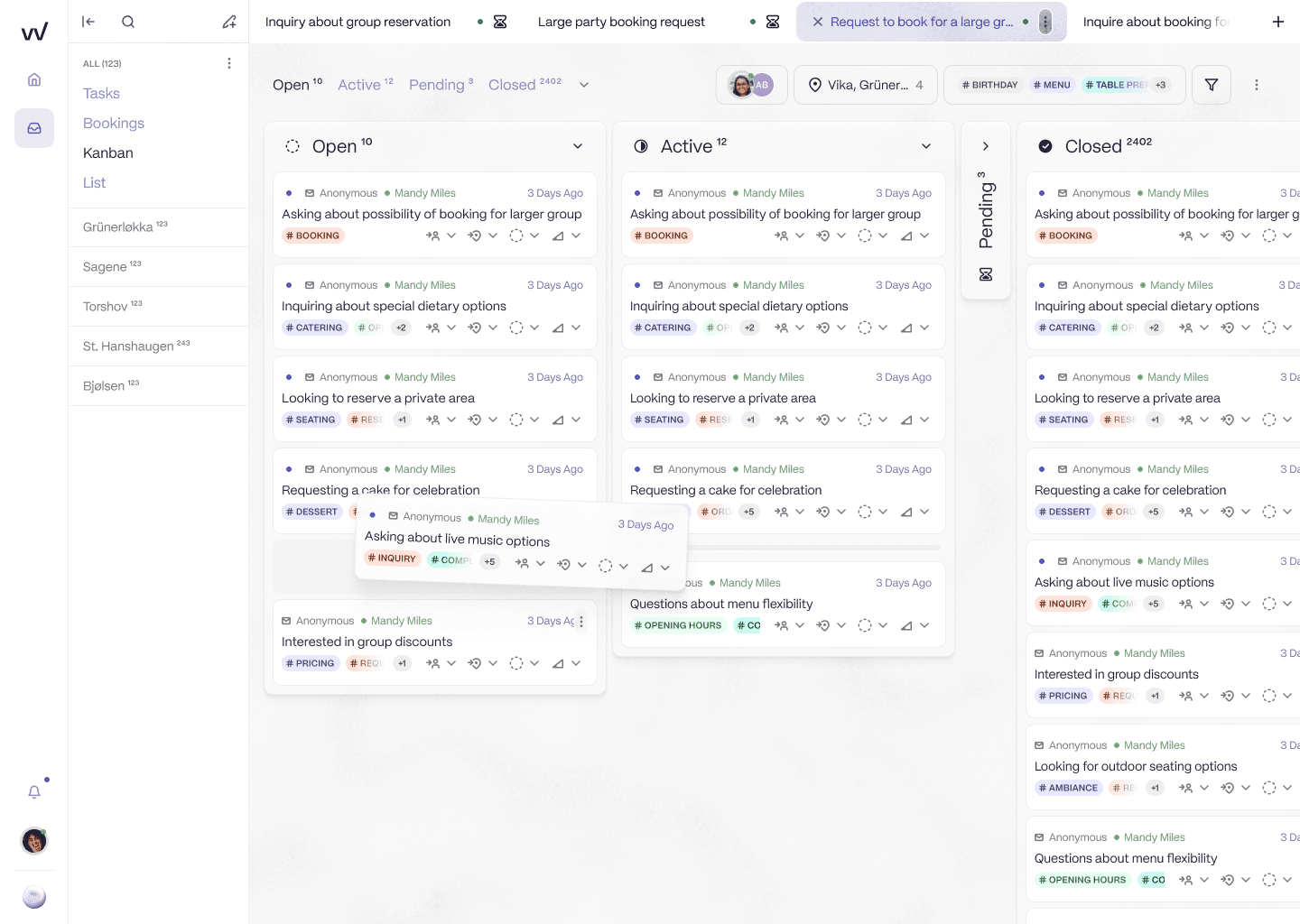
Every enquiry tagged to its venue on arrival, so a group stops using mailboxes to stand in for sites.
The AI drafts the reply in that venue's voice, grounded in its menus, its policies and its service times, which is a step beyond a saved reply written once for the whole group.
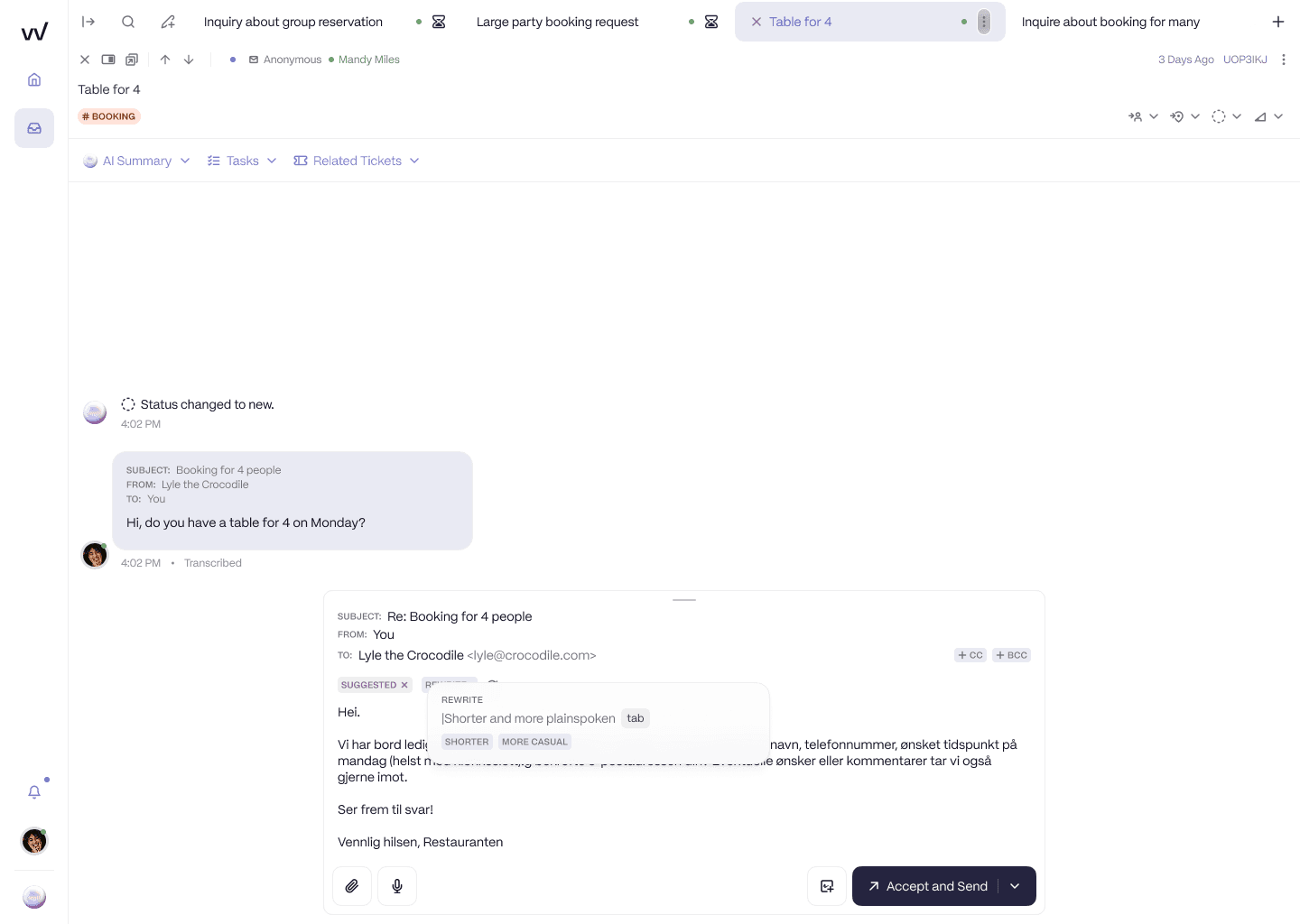
The reply drafted in the venue's voice, with the team reviewing instead of re-keying.
Because it connects to the booking system, the AI does the step a shared inbox cannot: it checks what the diary will take and prepares the booking in the same thread. Routine requests clear on arrival, including on a Saturday night, and the large parties are acknowledged instantly and held for a person to place deliberately.
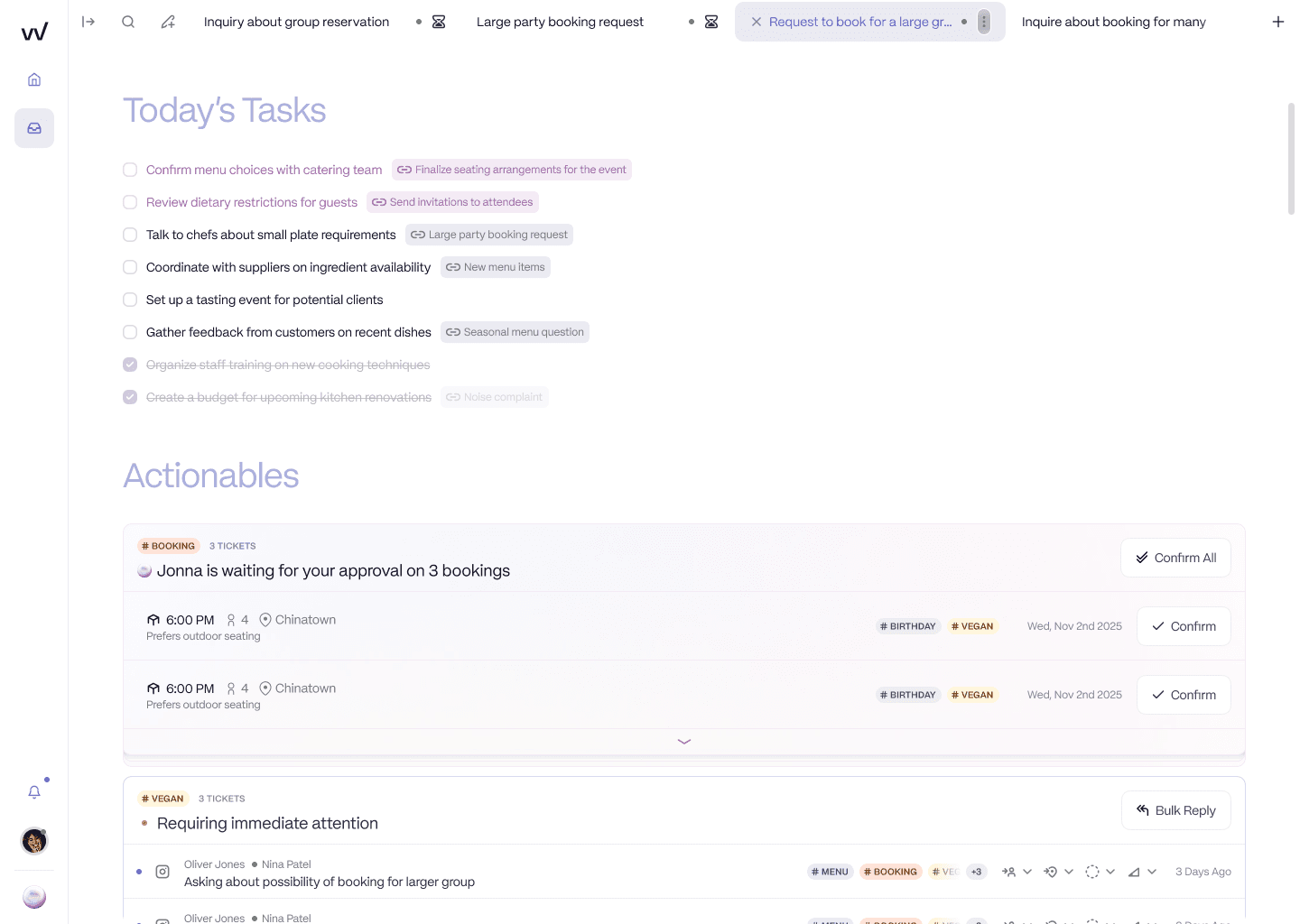
Large parties acknowledged and prepared, waiting for someone to decide where they fit.
And because every enquiry is tracked by location, the black box becomes a dashboard. Help Scout reports on conversations and happiness scores, which measures the support job well and says nothing about covers.
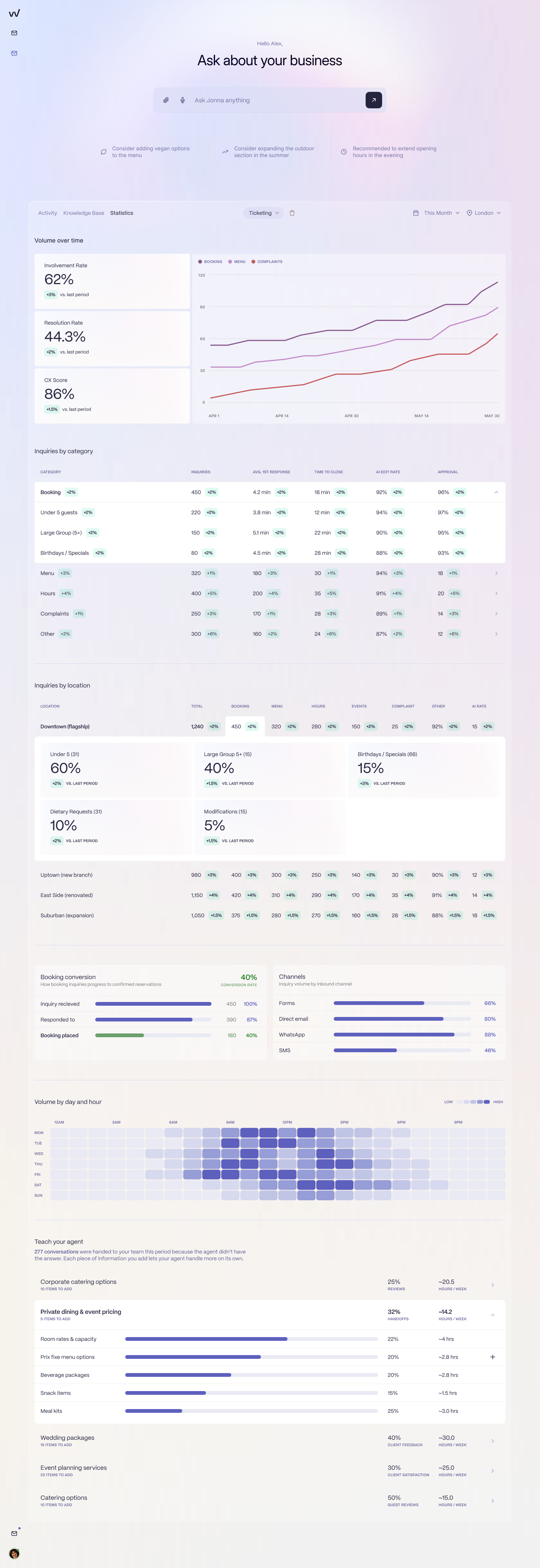
Response rate, volume and conversion by location, rather than conversations closed.
An honest note on where RevVue is today
Being straight about status: RevVue's SevenRooms, OpenTable and DesignMyNight integrations are in active development, and the other booking systems are on the roadmap with an email-only pilot available now. That pilot already delivers what is shown above: location-aware routing, instant acknowledgement, AI-drafted replies in each venue's tone, high-value enquiries surfaced, and reporting by location. The UK AI is in pilot.
This is the move the Brasilia Group made, off a horizontal helpdesk and onto an inbox built for the job. Their founder, Nikolaos Kiosses, put it plainly: "The transition from Zendesk to RevVue has been a game changer."
If you are comparing the category more broadly, shared inbox software for restaurants is the wider view. To see what the AI would have said to a real enquiry your team received last week, book 20 minutes.
Frequently asked questions
Is Help Scout good for restaurants?
For customer service and for a single site's shared mailbox, yes. It is email-first, which suits how booking enquiries actually arrive, and it is simple and affordable with assignment, notes and collision detection. For booking enquiries across a group it falls short, because its organising unit is the mailbox rather than the venue and it has no connection to a diary, so every booking is still done by hand.
Can Help Scout connect to my booking system?
Not natively. No restaurant booking system appears in the Help Scout apps directory, so the options are a Zapier zap where the booking system supports one, or a custom API build. Either way, what you get is enquiry data copied into a conversation. It still cannot check availability, hold a table or create a booking from the reply window.
How does Help Scout handle multiple venues?
By approximation. You either create a mailbox per venue, which fragments reporting and forces someone to route messages, or use one mailbox with tags, which gives you no per-venue tone and no clean answer to which site is slowest to reply. Help Scout has no concept of a venue as an entity with its own capacity, menu and manager.
What works better for a multi-site group?
Something that treats the venue as a first-class concept and connects to the diary. RevVue tags each enquiry to its site automatically, drafts replies in that venue's tone, checks availability and prepares the booking inside the conversation, and reports response rate and conversion by location. Its SevenRooms, OpenTable and DesignMyNight integrations are in development, with an email-only pilot available now.