OpenTable automates a great deal of guest email. Confirmations go out by email and text, deposits and card details are requested automatically, reservation changes and special requests trigger notifications, reminders arrive by SMS, and behaviour-triggered campaigns handle birthdays, anniversaries and guests who have not visited in a while. What it does not automate is the message from somebody who has not booked yet, and that message is usually the most valuable one in your inbox.
What OpenTable automates today
Credit where it is due. OpenTable's automation is mature, and on the Pro plan it is properly configurable rather than fixed.
Automated message | What triggers it |
|---|---|
Booking confirmation, email and text | The reservation being made |
Card details and deposit request | Booking a covered slot or policy-protected shift |
Change and special-request notification | An amendment to an existing reservation |
SMS reminder | A configurable window before arrival |
Feedback survey | The visit completing |
Behaviour campaigns | Birthdays, anniversaries and win-back sends triggered on guest history |
Premium Communications, on the Pro plan, lets you rewrite the wording of confirmation, reminder and waitlist messages and change when transactional reminders send. Emails carry your logo, colours and profile image, so the guest sees your brand rather than OpenTable's.
For a group that has configured this properly, a large share of routine guest communication runs without anyone touching it, and no-shows fall. If your reminders are still on defaults, the highest-return job this week is inside OpenTable, not outside it.
What OpenTable does not automate
Look at what every message in that table has in common. Each one is triggered by a reservation that already exists. The record comes first, the automation follows.
Booking enquiries invert that. They come from someone with no reservation, asking a question whose answer depends on live availability, the menu, the room and often the kitchen. There is no record, so nothing can trigger, so nothing is automated. That leaves the following manual, permanently:
A party of 14 for a work lunch that the online widget will not accept.
Questions about set menus, corkage, accessibility or a quiet table.
Private hire and semi-private area requests.
Amendments sent by replying to a confirmation email, which land in a mailbox rather than in OpenTable.
Enquiries arriving by WhatsApp, Instagram or the group's own contact form, which never touch OpenTable.
There is an added wrinkle for groups. OpenTable fills covers through its consumer network, and those arrive fully automated. The enquiries that arrive direct, by email, carry no commission and are worth more per cover. They are also the ones that sit unanswered, because they are the only ones that need a person.
What actually happens to an enquiry OpenTable cannot answer
Here is one enquiry at a group running OpenTable well, with every automation configured.
A message arrives at the group's reservations address on a Friday evening: 14 people for a work lunch in a fortnight, one bill, and a question about whether the private area is available.
It sits over the weekend. OpenTable never sees it, because it is not a reservation.
On Monday someone opens the mailbox and reads it.
They open OpenTable in another tab, choose the right venue, and check whether 14 can be seated at that time and what the private area costs.
They check whether one bill is a problem for that site and what the deposit policy is at that size.
They write the reply by hand with the options.
If it is accepted, they create the booking in OpenTable, re-keying the name, company, date, time, party size and the billing note.
The reply comes back: "It is 17 now and can we start at 12.30?" Seventeen at 12.30 is a different table plan. Steps 4 to 7 run again.
Automation only restarts at step seven, when a reservation finally exists. Everything before that is a person and a keyboard, roughly 60 hours after the enquiry arrived. One operations director described the mailbox behind this workflow as "a black hole, no KPIs, no response rate, nothing." OpenTable reports precisely on covers served. It has nothing to say about enquiries never answered.
A roughly 40-venue entertainment group lost a single booking worth £40,000 because the enquiry arrived outside working hours and nobody replied in time. A three-site pizza group put it more bluntly about a 30 to 40 cover enquiry: "It just sat there. No one saw it. They went somewhere else."
Why the gap exists
The dividing line is transactional versus conversational email, and it follows from how the software is built.
Transactional automation needs a record, an event and a template. The reservation exists, the clock hits the reminder window, the message sends. OpenTable is designed around that loop and executes it well at enormous scale.
An enquiry supplies none of the three. There is no record, because creating one is what the guest is asking for. There is no event, because a stranger emailing on a Friday night is not a state change in the diary. And no template covers it, because the answer depends on this venue's availability, this room's capacity and this kitchen's willingness.
Answering it automatically needs a system that can read unstructured text, work out which of your venues it concerns, check availability and draft a reply in that venue's voice. That is a different product from a reservation platform, which is why no reservation platform has built it.
What automating the enquiry side looks like
The gap closes when the inbox and the diary are one surface, so an enquiry arriving by email is worth the same as a cover the network sends. This is what RevVue does, and it is easier to show than to describe.
Every enquiry is tagged to the venue it is for the moment it lands. A group with sites in several cities stops relying on whoever recognises the address in the signature, and nothing waits to be forwarded to the right manager.
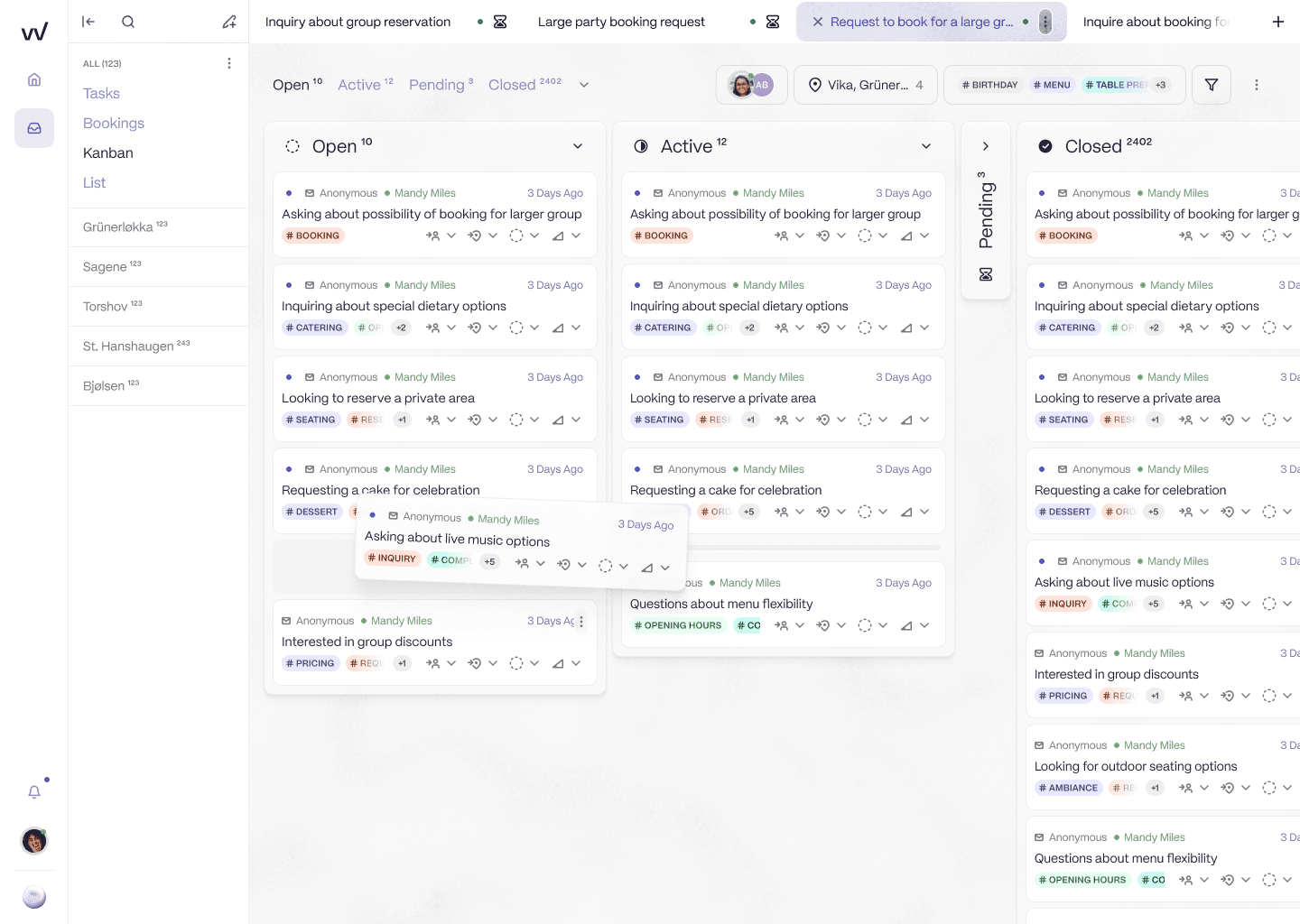
Enquiries arrive already sorted by venue, so nothing waits to be forwarded.
The AI drafts the reply in that venue's voice, using its menus, its policies and its own answers to the questions guests keep asking. The team reviews and sends instead of retyping the same explanation about set menus for the fourth time that week.
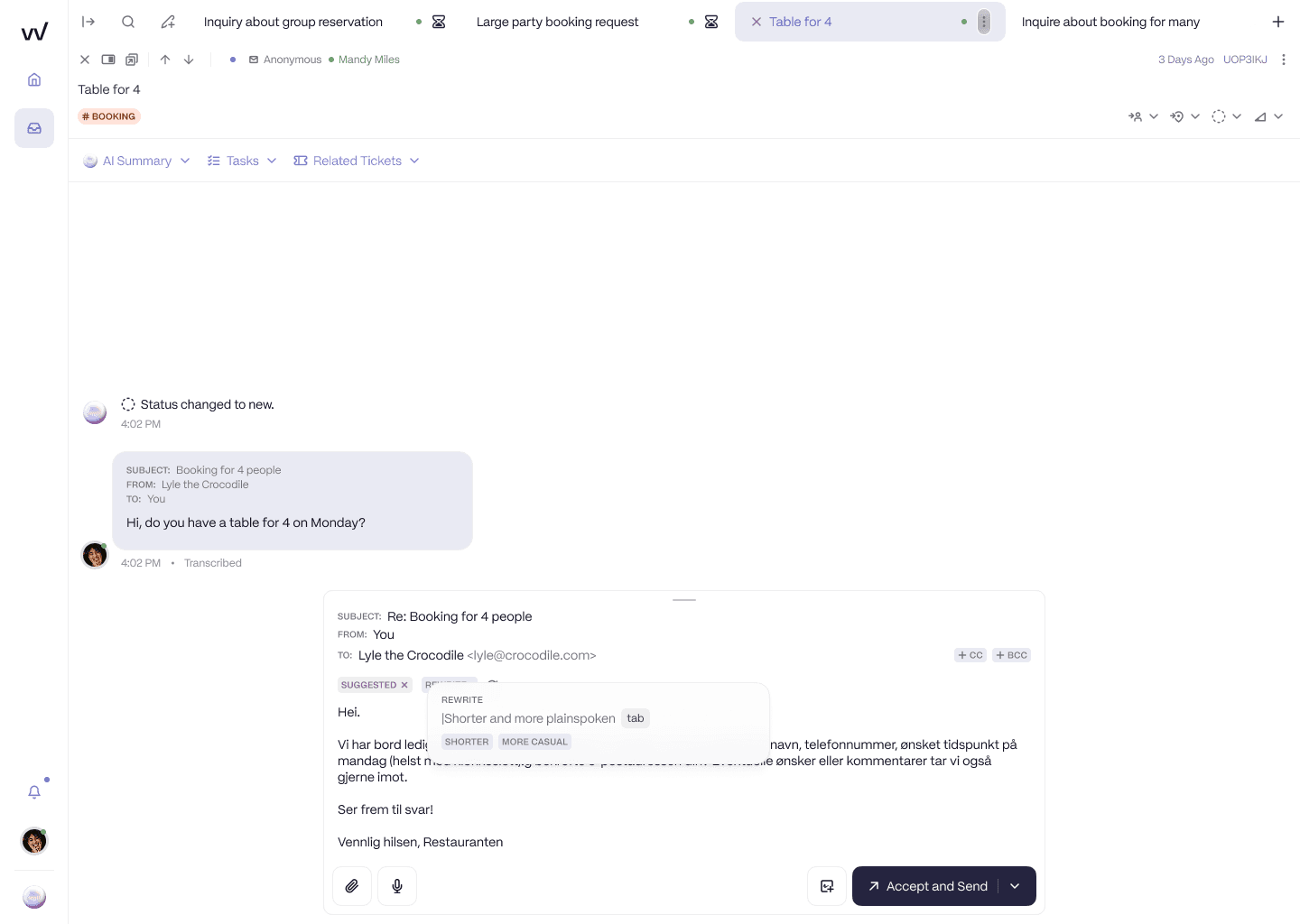
A drafted reply the team approves in one click, instead of writing the same answer again.
Because it connects to the booking system, the AI takes the step the mailbox cannot: it checks availability and prepares the booking in the same thread. Everyday requests resolve on arrival, including on a Friday night, and the large parties and private-hire enquiries are acknowledged immediately and queued for a person, so the slowest reply is no longer the biggest booking.
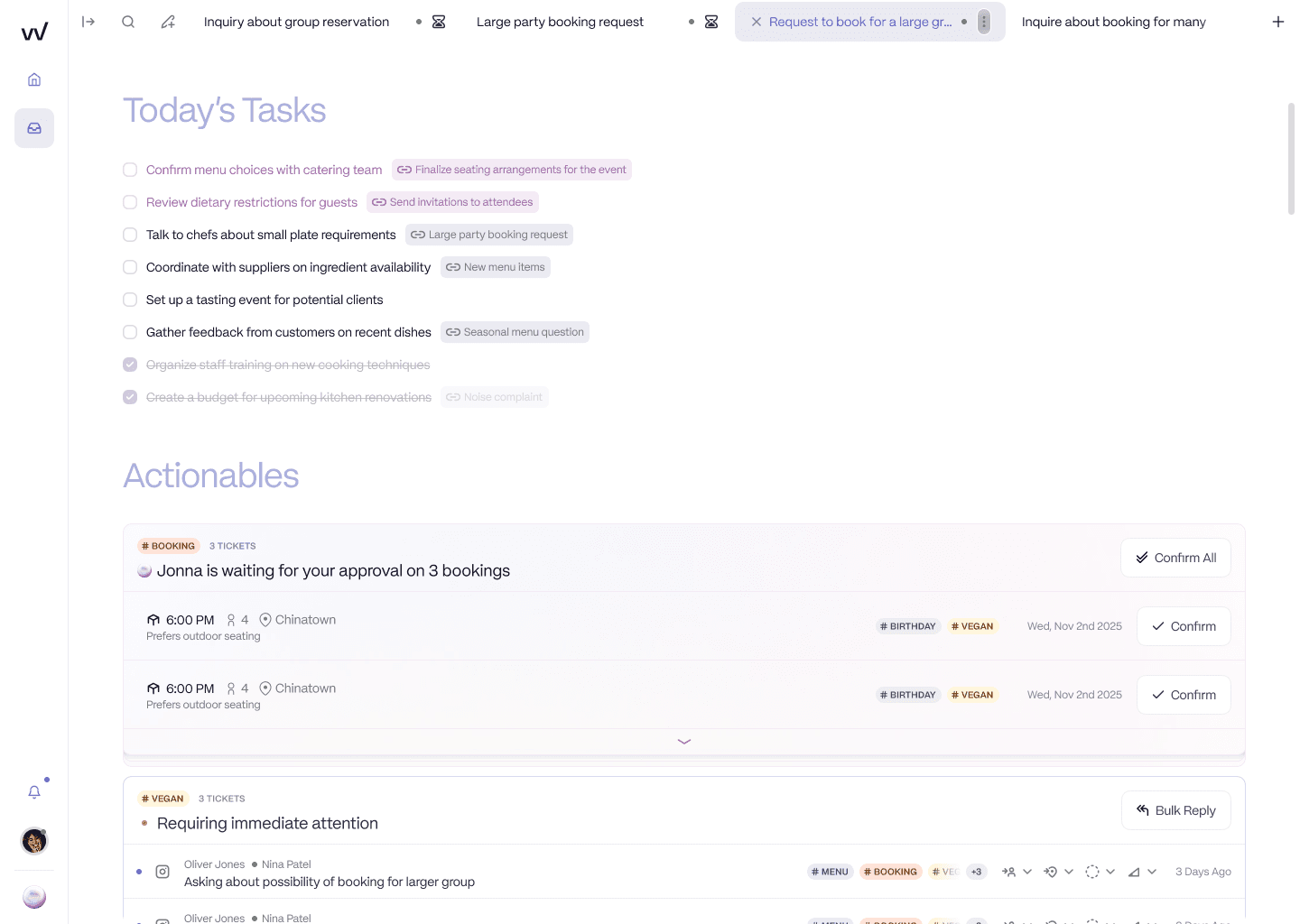
The bookings worth a person's time, acknowledged instantly and prepared for approval.
And because every enquiry is tied to a location, email covers become countable. You can finally put response times and conversion by site next to the covers the network sends you, and compare the commission-free channel against the commissioned one honestly.
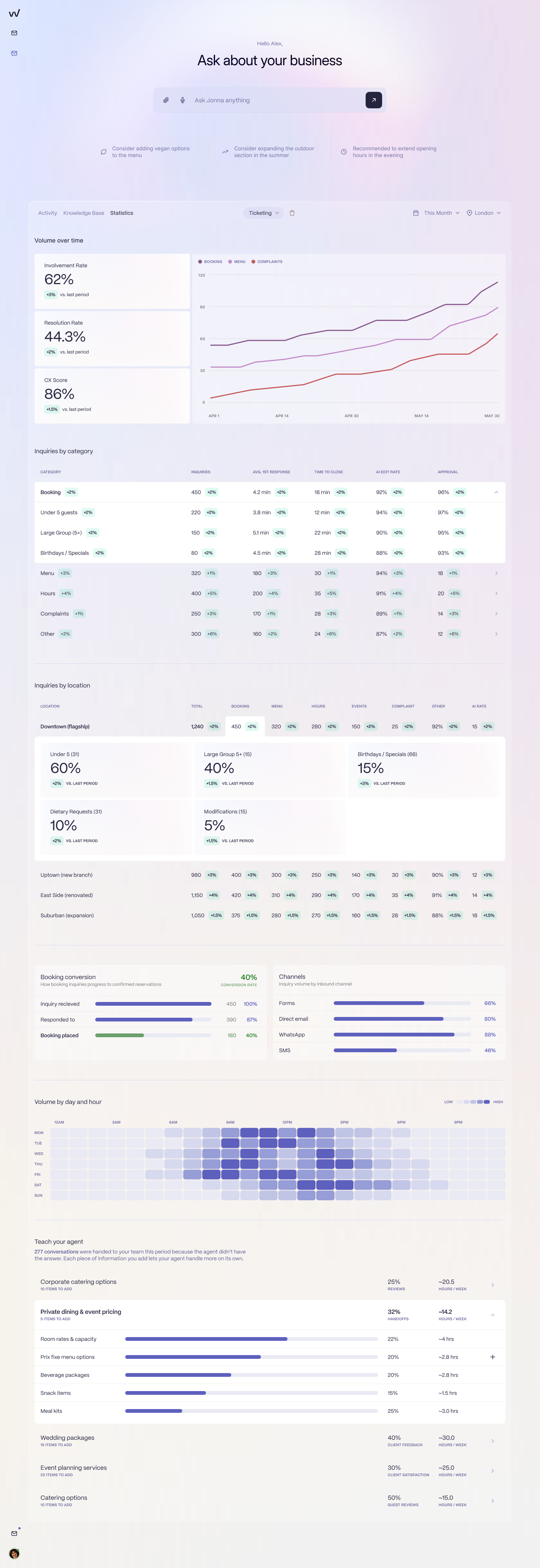
Volume, response rate and conversion by location, sitting alongside the covers the network delivers.
An honest note on where RevVue is today
RevVue's OpenTable integration is in active development. That is the honest status. For now, groups run an email-only pilot that already delivers everything shown above: location-aware routing, instant acknowledgement, AI-drafted replies in the venue's tone, high-value enquiries surfaced, and reporting by location. The direct connection deepens it when it lands, and it does not gate the value available today. The UK AI is in pilot.
This is the move the Brasilia Group made, off a horizontal helpdesk and onto an inbox built for the job. Their founder, Nikolaos Kiosses, put it plainly: "The transition from Zendesk to RevVue has been a game changer."
Because a large share of these messages arrive from the network and third-party sites, automating third-party booking emails is the most relevant read next, and if you are weighing a helpdesk for this, does Zendesk integrate with OpenTable answers that directly. To see what the AI would have said to a real enquiry your team received last week, book 20 minutes.
Frequently asked questions
What email does OpenTable automate?
OpenTable automates booking confirmations by email and text, requests for card details and deposits, notifications when a reservation changes or carries a special request, SMS reminders before arrival, and feedback surveys afterwards. It also runs behaviour-triggered campaigns for birthdays, anniversaries and guests who have not visited recently. On the Pro plan, Premium Communications lets you rewrite the wording and change the timing of confirmation, reminder and waitlist messages.
Can OpenTable answer inbound booking enquiries automatically?
No. Every OpenTable automation fires from a reservation that already exists. An enquiry comes from someone with no booking, so there is no record to trigger from, and no template fits because the answer depends on live availability, the menu and the room. Large parties, private hire, dietary questions and amendments are all still answered by a person.
Why does the enquiry inbox matter more for a group?
Because of margin. Covers arriving through the OpenTable network are automated and carry commission. Covers arriving from a direct email enquiry carry none, so they are worth more, and they are the only ones that need a human before they can be booked. That makes the direct enquiries both the most valuable messages you get and the slowest ones to be answered.
How do you automate the enquiry side?
You need something that reads an unstructured message, works out which venue it concerns, checks availability and drafts a reply in that venue's voice for a person to approve. That is RevVue. Its OpenTable integration is in active development, and an email-only pilot is available now covering routing by location, instant acknowledgement, AI-drafted replies and reporting on enquiries you could not previously see.