SevenRooms automates guest email thoroughly. Booking confirmations, 24-hour reminders carrying confirm and cancel buttons, same-day reminders two hours out, post-dining feedback surveys and a library of 13 pre-built marketing emails all fire without anyone touching them. What none of that covers is the message from somebody who has not booked yet: the party of 20 asking about a Friday, the dietary question, the amendment. That conversation is still typed by hand, and on most sites it is the slowest thing the team does.
What SevenRooms automates today
Give SevenRooms proper credit, because its automation is genuinely deep and most operators do not use half of it. Everything below runs on triggers, without a person writing a message.
Automated message | What triggers it |
|---|---|
Booking confirmation | The reservation being made, online or by a team member |
24-hour reminder | Time before the booking, carrying confirm and cancel actions |
Same-day reminder | Roughly two hours before arrival |
Post-dining feedback survey | The visit completing |
Marketing sequences | 13 pre-built automations, from welcome series to win-back, triggered on guest behaviour, visit frequency and dining history |
There is a native WhatsApp add-on in EMEA and APAC that carries the same confirmations, reminders and broadcasts on a channel guests actually read.
Two things make this better than most reservation platforms. The messages are grounded in the guest record, so a regular's confirmation can look different from a first-timer's. And the marketing automations are behavioural rather than a scheduled blast, which is why win-back campaigns out of SevenRooms tend to work.
If your no-show rate is high or your database is going stale, the answer is usually that this automation is switched off or half-configured, not that you need another tool.
What SevenRooms does not automate
Every message in that table has one thing in common: it is triggered by a booking that already exists. The automation begins the moment there is a reservation record to hang it on.
Booking enquiries are the opposite. They arrive from someone with no reservation, asking a question whose answer depends on availability, the menu, the space and sometimes the kitchen. There is no record, so there is no trigger, so there is no automation. In practice that means the following are all still manual:
A request for a table for 20 on a Friday that the online widget will not take.
Any question about set menus, dietary requirements, corkage or accessibility.
Private hire and event enquiries, which run over a dozen messages.
Amendments arriving by reply to a confirmation email, which land in a mailbox rather than in SevenRooms.
Enquiries that come by Instagram DM, WhatsApp or the group's contact form and never touch SevenRooms at all.
These are also the highest-value messages you receive. The automated confirmation protects a booking already won. The inbound enquiry is a booking not yet won, and it is the one waiting on a human.
What actually happens to an enquiry SevenRooms cannot answer
Here is the real journey of one enquiry at a group running SevenRooms well, with every automation switched on.
An enquiry arrives at the group's
bookings@address on a Sunday evening: a party of 20 for a Friday in three weeks, one vegan, one coeliac, and a question about whether the back room can be held.It sits. Nobody is on the group inbox on a Sunday, and SevenRooms never sees the message because it is not a booking.
On Monday a manager opens the mailbox and reads it.
They open SevenRooms in another tab, pick the right venue, and check whether 20 can be seated on that Friday and whether the back room is free.
They check the menu and the kitchen's position on the two dietary requirements, which may mean asking the head chef.
They write the reply by hand, quoting availability, the set menu options and the deposit terms.
If the guest accepts, they create the booking in SevenRooms, re-keying the name, date, time, party size, the room and both dietary notes.
The guest replies: "Can we make it 24, and add a cake?" Twenty-four may not fit the back room. Steps 4 to 7 run again.
Only at step seven does any automation restart, because only then does a booking record exist. Everything before it is a person and a keyboard, roughly 36 hours after the enquiry arrived. One operations director described the mailbox behind that workflow as "a black hole, no KPIs, no response rate, nothing." SevenRooms can tell you the covers you served. It cannot tell you the enquiries you never answered.
The cost is not theoretical. A roughly 40-venue entertainment group lost a single booking worth £40,000 because the enquiry arrived outside working hours and nobody replied in time. A three-site pizza group put it more bluntly about a 30 to 40 cover enquiry: "It just sat there. No one saw it. They went somewhere else."
Why the gap exists
The split is between transactional and conversational email, and it is a design decision rather than an oversight.
Transactional automation needs three things: a record, an event and a template. A booking exists, the clock reaches 24 hours out, the reminder sends. SevenRooms is built around exactly that, and it does it well.
A booking enquiry has none of the three. There is no record, because that is what the guest is asking you to create. There is no event to trigger from, because a stranger emailing on a Sunday is not a state change in your diary. And there is no template that works, because the answer depends on live availability, this venue's menu, this room's capacity and what the kitchen will agree to.
That is why the enquiry side stayed manual everywhere while the confirmation side got automated everywhere. Answering it needs something that can read an unstructured message, work out which venue it concerns, check the diary, and draft a reply in that venue's voice. That is a different kind of system from a reservation platform, which is why reservation platforms did not build it.
What automating the enquiry side looks like
The gap closes when the inbox and the guest record sit on the same screen, so the person replying can already see who is writing and what is free. This is what RevVue does, and it is easier to show than to describe.
Enquiries are sorted by venue as they arrive, which matters for a group running distinct concepts under one company. A request for the chef's counter is never answered with the brasserie's availability, and the team works from one queue by location instead of a single mailbox everybody dips into.
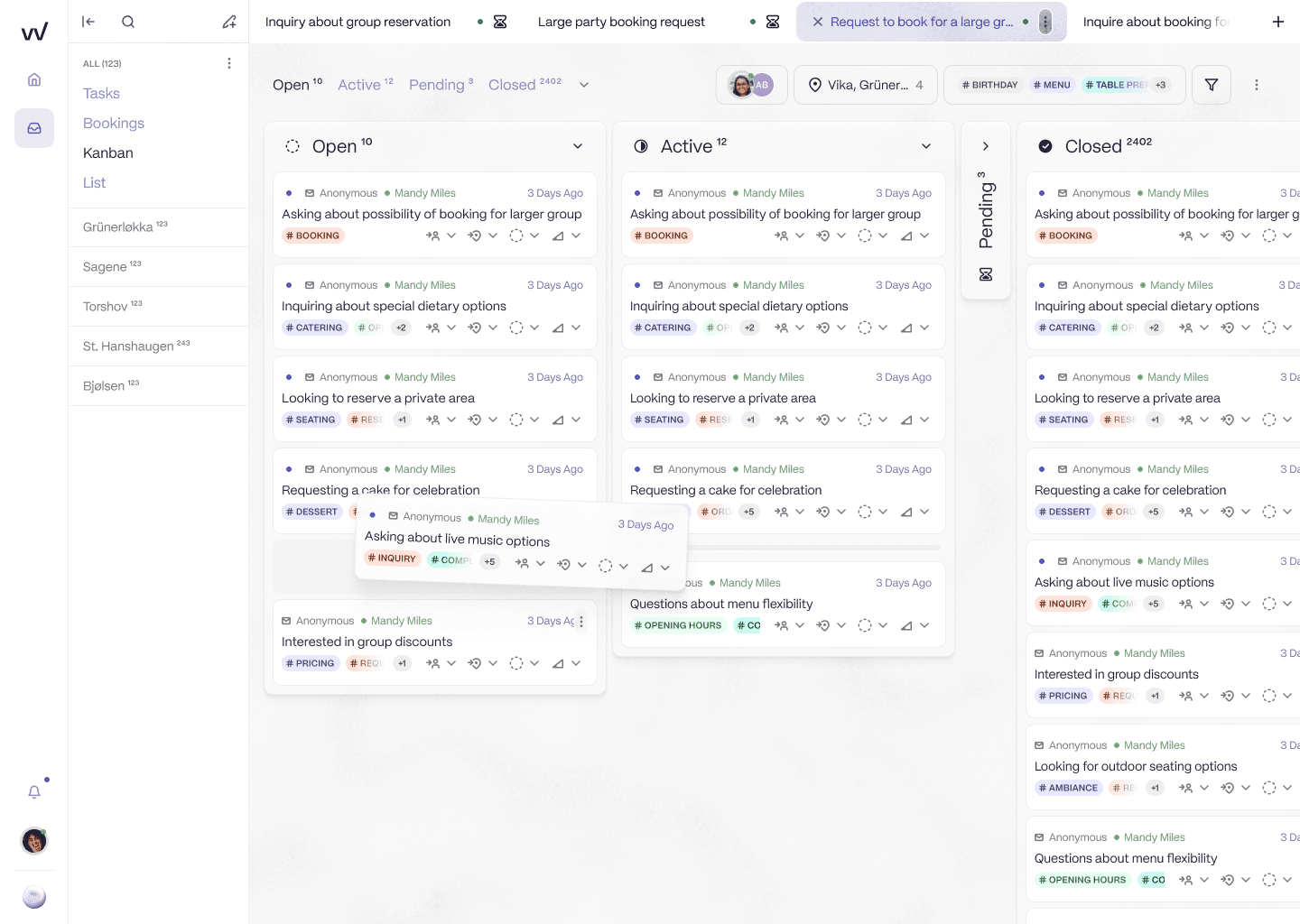
One queue per venue, so a multi-concept group stops sorting its mail before it can answer it.
The AI reads each enquiry and drafts a reply in that venue's voice, grounded in its menus, its policies and the things its regulars ask for. This is the piece a reservation platform's templates cannot reach, because the answer to a 20-cover dietary question is not a merge field.
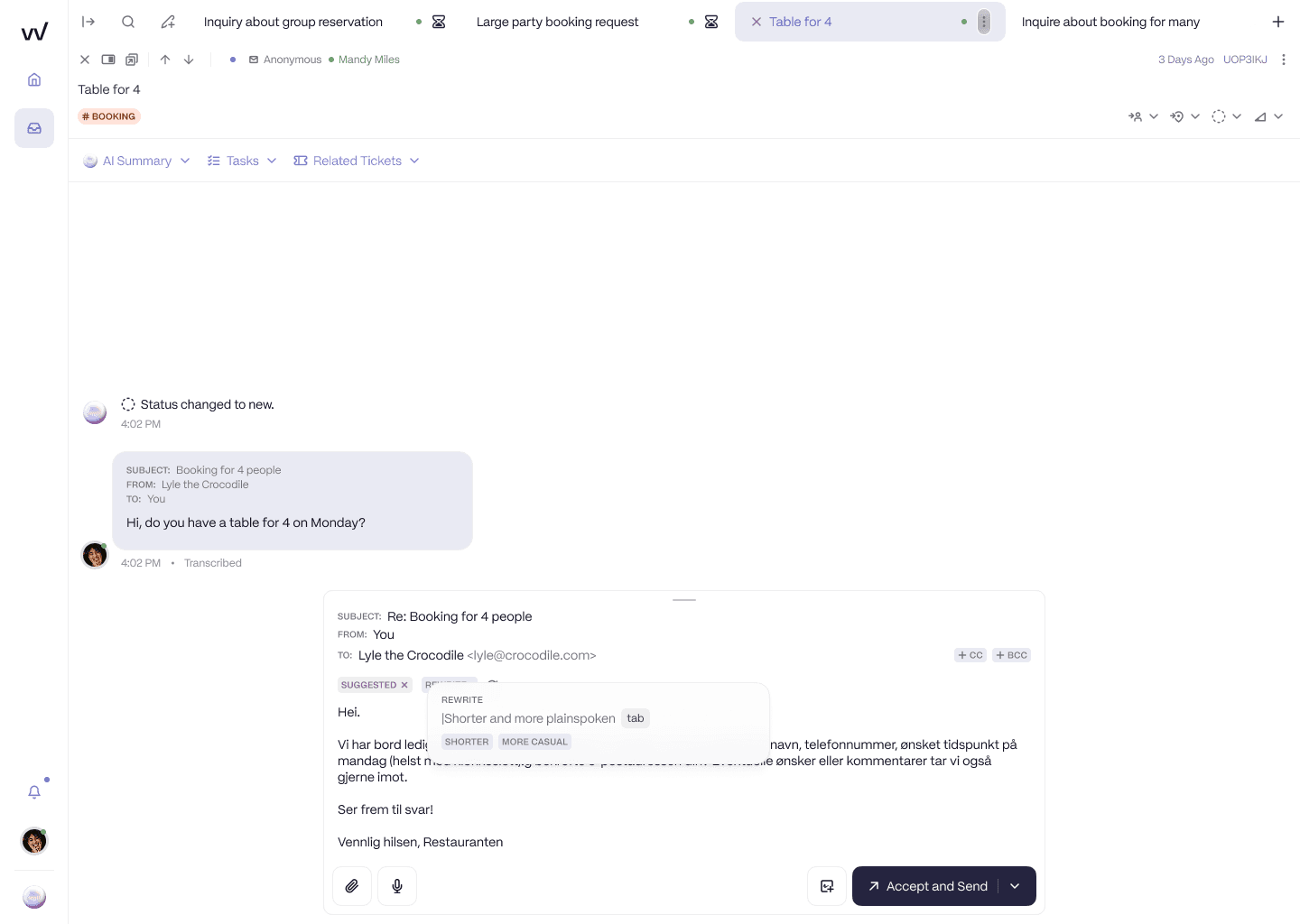
The draft arrives in the venue's own voice, ready for a person to approve or adjust.
Because it connects to the booking system, the AI does the step the mailbox cannot: it checks availability and prepares the booking inside the same thread. Routine requests are handled on arrival, including at 9pm on a Sunday, and the ones worth a person's attention are acknowledged straight away and held in a queue someone actually works.
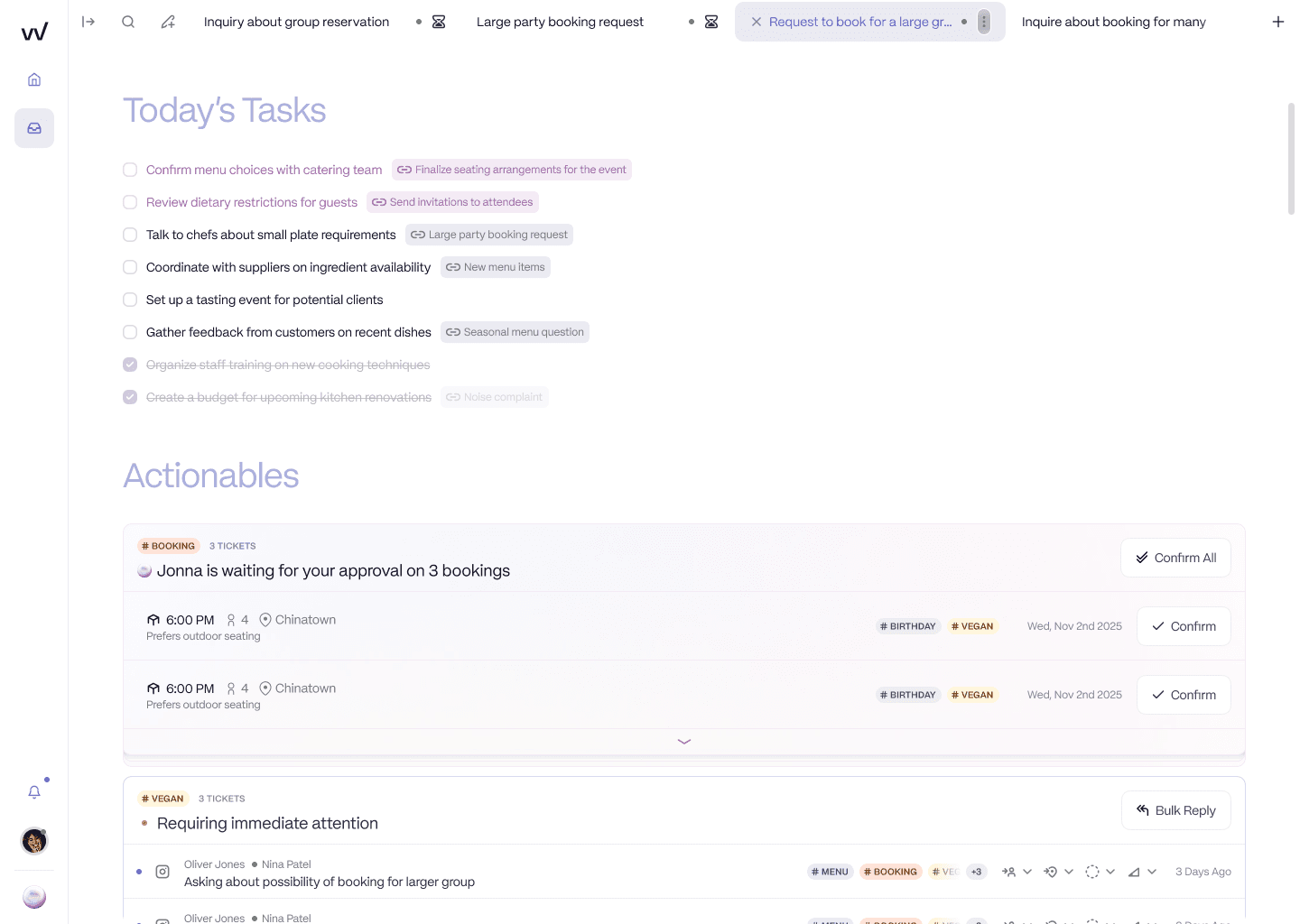
High-value bookings acknowledged and prepared, waiting for approval instead of sitting unread until Monday.
And because every enquiry is tracked against a venue, the enquiry channel finally reports like the rest of the business. SevenRooms reports beautifully on the bookings you took. This is the reporting for the ones you did not.
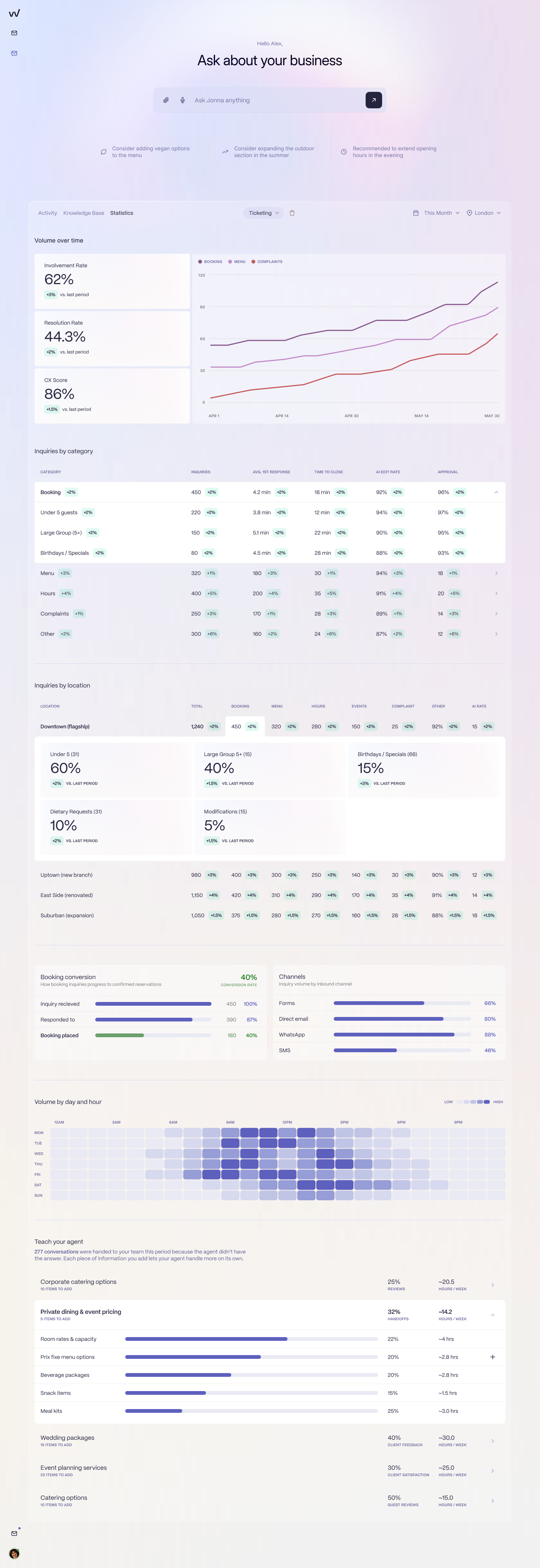
Response rate, volume and conversion by location, so the enquiry channel stops being a blind spot.
An honest note on where RevVue is today
RevVue's SevenRooms integration is in active development, and it is the most requested connection on the roadmap. That is the honest status. For now, groups run an email-only pilot that already delivers everything shown above: location-aware routing, instant acknowledgement, AI-drafted replies in the venue's tone, high-value enquiries surfaced, and reporting by location. The direct connection deepens it when it lands, and it does not gate the value available today. The UK AI is in pilot.
This is the move the Brasilia Group made, off a horizontal helpdesk and onto an inbox built for the job. Their founder, Nikolaos Kiosses, put it plainly: "The transition from Zendesk to RevVue has been a game changer."
If you are also weighing up a helpdesk for this, does Zendesk integrate with SevenRooms answers that directly, and shared inbox software for restaurants is the wider category view. To see what the AI would have said to a real enquiry your team received last week, book 20 minutes.
Frequently asked questions
What email does SevenRooms automate?
SevenRooms automates booking confirmations, 24-hour reminders carrying confirm and cancel actions, same-day reminders around two hours before arrival, and post-dining feedback surveys. It also ships 13 pre-built marketing automations, from welcome series to win-back, triggered on guest behaviour, visit frequency and dining history. In EMEA and APAC a WhatsApp add-on carries the same messages on that channel.
Can SevenRooms answer inbound booking enquiries automatically?
No. Every SevenRooms automation is triggered by a booking that already exists. An enquiry comes from someone with no reservation, so there is no record to trigger from and no template that fits, because the answer depends on live availability, the menu and the space. Enquiries for large parties, dietary questions, private hire and amendments are all still answered by a person.
Why do enquiries not reach SevenRooms at all?
Because they arrive as messages rather than bookings. A guest emails the group address, replies to a confirmation, sends an Instagram DM or fills in a website contact form, and none of those creates a reservation record. The message lands in a mailbox that SevenRooms has no view of, which is why response times on enquiries are usually invisible in your reporting.
How do you automate the enquiry side?
You need something that reads an unstructured message, works out which venue it concerns, checks the diary and drafts a reply in that venue's voice for a person to approve. That is RevVue. Its SevenRooms integration is in active development, and an email-only pilot is available now that already covers routing by location, instant acknowledgement, AI-drafted replies and reporting on the enquiries you never used to see.