TheFork Manager automates guest messaging well and with unusually good timing control. A confirmation email goes out on booking, an SMS reminder follows 24 to 48 hours ahead, and automated reconfirmation requests can be sent by email, text or both at a moment you choose, such as two hours before service. What none of it covers is the direct enquiry: the guest who emails your venue instead of booking through the network. Those are your commission-free covers, and they are the only ones that need a person before they can be booked.
What TheFork automates today
Give it credit. On the venue side, TheFork Manager's guest communication is more configurable than most.
Automated message | What it does |
|---|---|
Booking confirmation | Automatic email when the reservation is made |
SMS reminder | Typically 24 to 48 hours before the booking |
Reconfirmation request | By email, SMS or both, at a time you choose, with wording you customise |
Two-way SMS | The guest can respond, and you can message about modifications and cancellations |
Modification and cancellation notices | Sent as the booking changes |
CRM | Tracks guest preferences to support more personal service |
The reconfirmation feature is the standout. Being able to ask for reconfirmation two hours before service, in your own words, on the channel the guest actually reads, is a sharper no-show tool than a fixed reminder a day out. Combined with the network's reach, it is a strong package for filling and protecting covers.
What TheFork does not automate
Everything above is triggered by a reservation that already exists, and most of those reservations arrived through the network.
Direct enquiries are different in kind. They come from someone who found you another way and wrote to ask a question, and none of the automation applies:
A party of ten wanting the set menu and a quiet table.
Questions about parking, highchairs, accessibility or dietary requirements.
Private hire and group bookings, which the network does not send you.
Amendments emailed to the venue rather than made through the booking.
Messages in another language, which a European network makes routine.
The commercial shape of this is what makes it matter. Covers arriving through TheFork network carry commission. Covers arriving from a direct email do not, so they are worth more per head. They are also the only ones requiring a human before they can be confirmed, which means your highest-margin demand is your slowest-served demand.
There is an operational wrinkle too. A guest who booked through the network and then emails the venue directly starts a second thread that is not linked to the booking, so the person reading it has to find the reservation in TheFork Manager before they can do anything useful.
What actually happens to an enquiry TheFork cannot answer
Here is a realistic journey at a venue running TheFork Manager.
A guest books through the network, then emails the venue directly in French to add a highchair and ask about parking.
It sits in the venue mailbox. TheFork Manager never sees it, because it is not a change made in the system.
Next morning someone reads it, possibly running it through a translation first.
They open TheFork Manager, find the reservation that came in through the network, and confirm the table can take a highchair.
They check what the venue tells guests about parking that night, which may mean asking a manager.
They add the note to the booking, re-keying the request.
They reply, in French.
The guest replies: "We are now ten, not six, and we would like the set menu." Ten is a different table and may fall outside the network allocation entirely. Steps 4 to 7 run again.
Nothing in this chain is automated, and the language step adds a delay that is invisible in any report. One operations director described the mailbox behind this workflow as "a black hole, no KPIs, no response rate, nothing." TheFork Manager reports on covers seated and commission paid. It has nothing to say about the party of ten that emailed and never heard back in time.
A roughly 40-venue entertainment group lost a single booking worth £40,000 because the enquiry arrived outside working hours and nobody replied in time. A three-site pizza group put it more bluntly about a 30 to 40 cover enquiry: "It just sat there. No one saw it. They went somewhere else."
Why the gap exists
The split is transactional versus conversational, and TheFork's own developer documentation shows why it holds.
Transactional automation needs a record, an event and a template. A booking exists, the clock reaches two hours before service, the reconfirmation sends. TheFork Manager does that well and lets you tune it.
An enquiry supplies none of the three. There is no record for a new request, no observable event when an email lands in your mailbox, and no template that answers a question about a highchair, parking and a set menu in a second language.
TheFork's B2B API makes the boundary explicit. It is the best documented booking API in this category, aimed at CRM platforms and large groups, and TheFork frames it as data synchronisation "without the need for real-time updates." That is a batch sync surface for moving booking data between systems. It is not a live availability-and-booking interface for a conversation, which is precisely what answering an enquiry requires.
So the gap is not an oversight. The platform is built to fill and protect covers it knows about, and a direct enquiry is a cover it does not know about yet.
What automating the enquiry side looks like
The gap closes when the inbox and the diary are the same surface, so a direct enquiry gets the same handling as a booking the network sends. This is what RevVue does, and it is easier to show than to describe.
Enquiries are tagged to the right venue on arrival, which matters for groups whose sites sit in different cities and sometimes different countries. Nobody works out which restaurant a message is about before answering it.
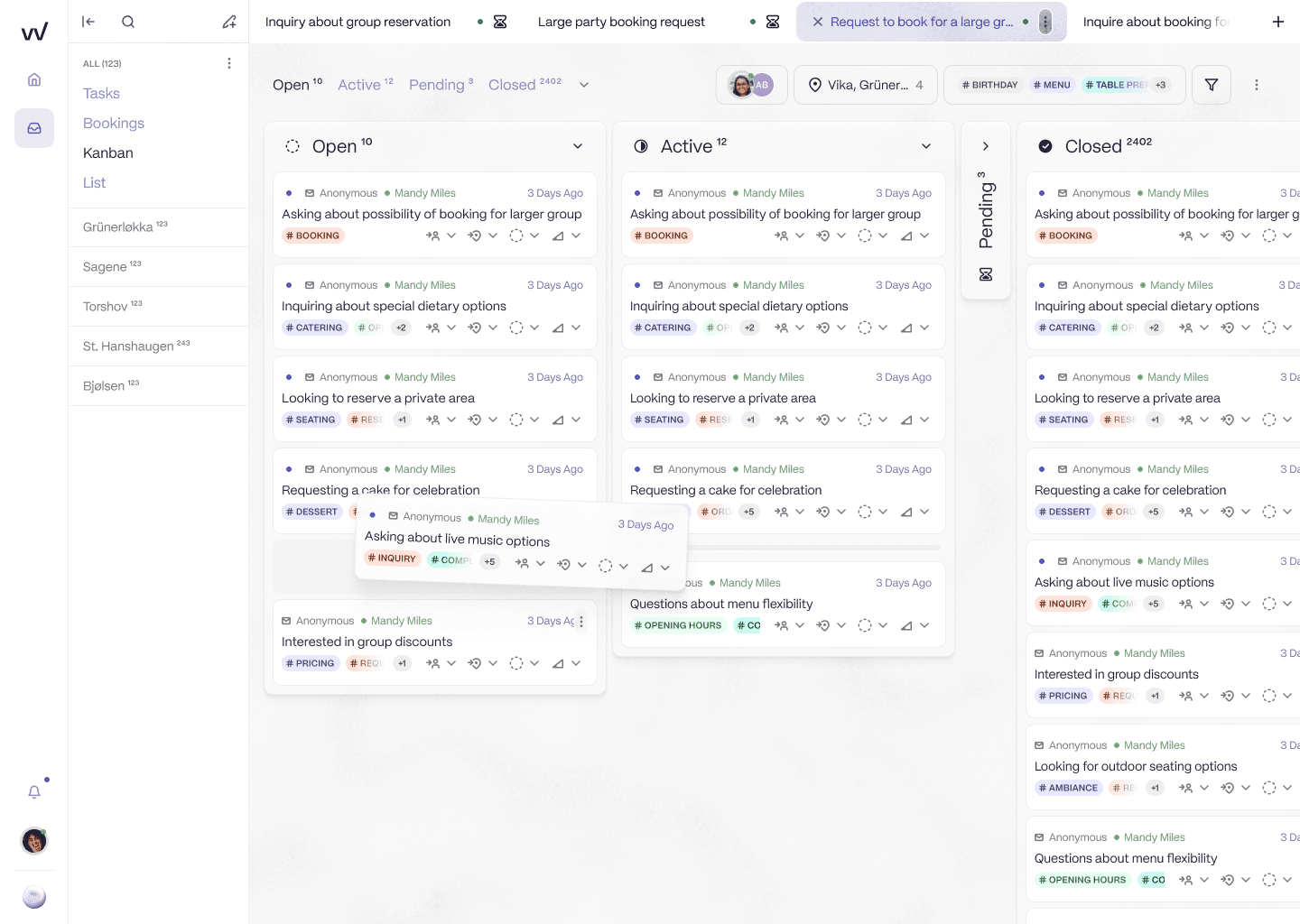
Every enquiry routed to its venue automatically, across cities and sites.
The AI drafts the reply in that venue's voice, using its menus, its policies and its own way of answering. For a group taking enquiries in more than one language, the draft is a starting point rather than a blank page.
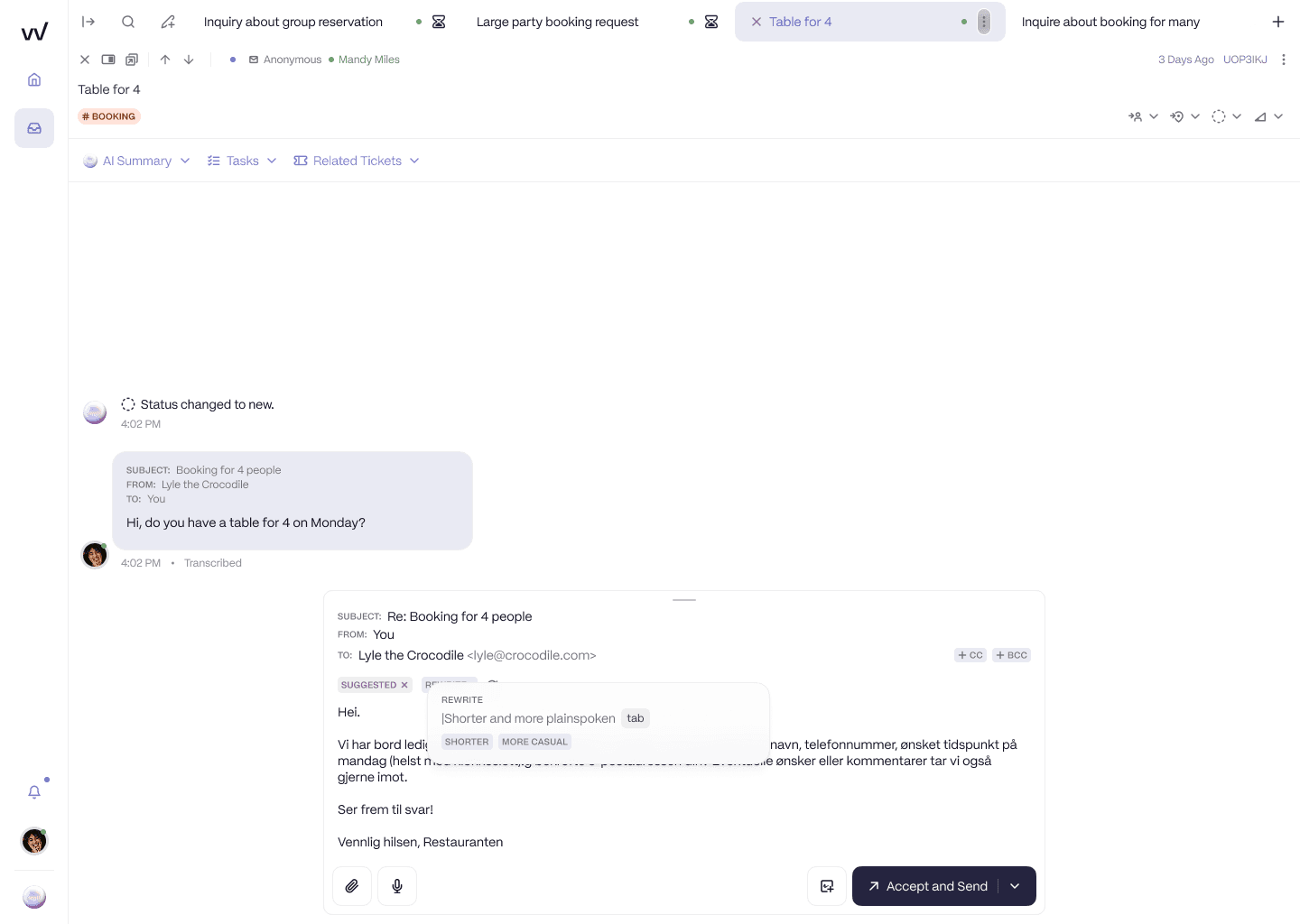
A reply drafted in the venue's voice, waiting for the team to approve it.
Because it connects to the booking system, the AI does the step the mailbox cannot: it checks availability and prepares the booking inside the same thread. Routine requests clear themselves, and the group bookings and private-hire enquiries, the ones the network does not send you, are acknowledged instantly and held for a person.
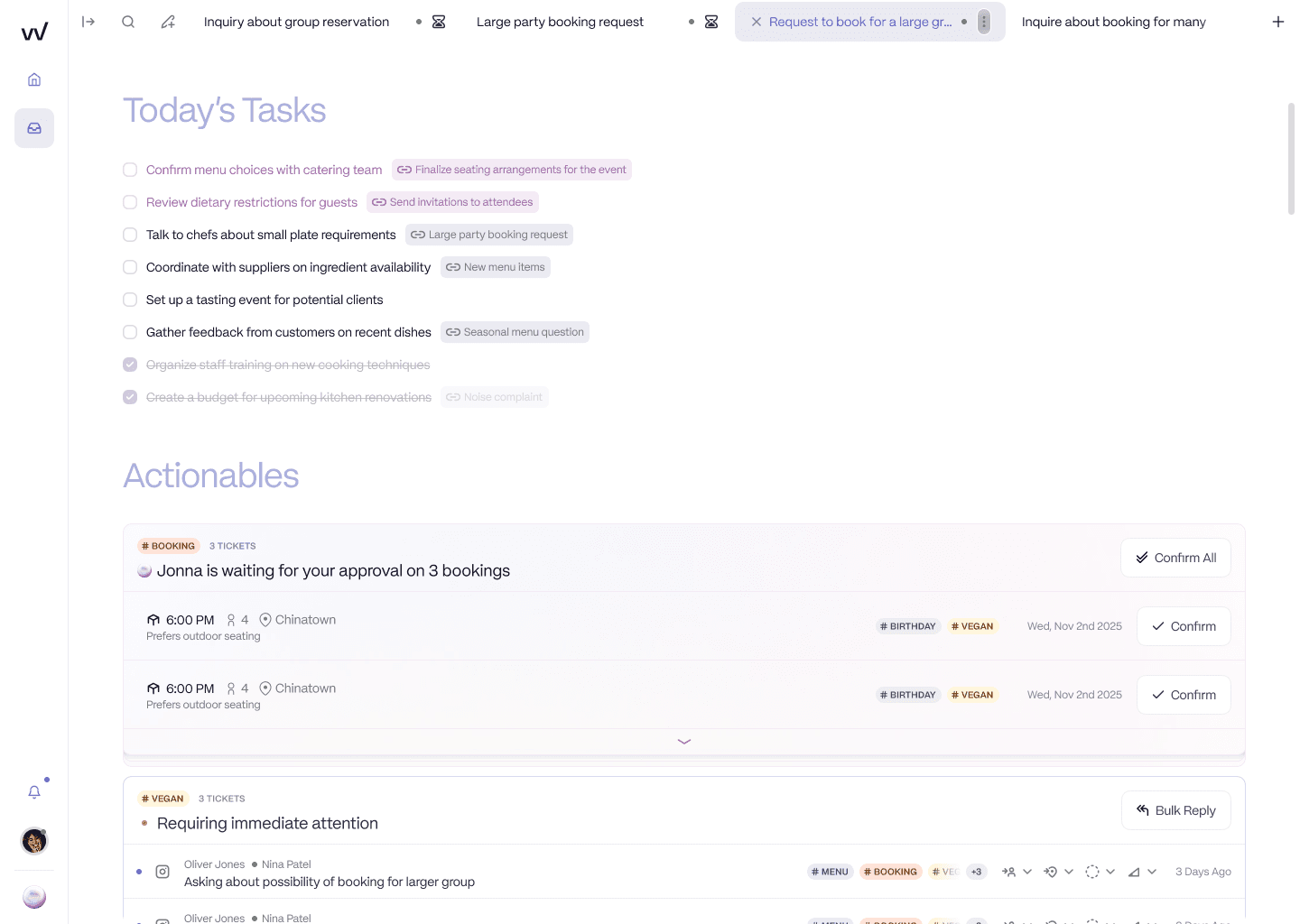
Group and private-hire enquiries acknowledged and prepared, ready for someone to close.
And because every enquiry is tracked by location, direct demand becomes as visible as network demand: response rates and conversion by site, so you can see what your own inbox is worth next to the covers you pay commission on.
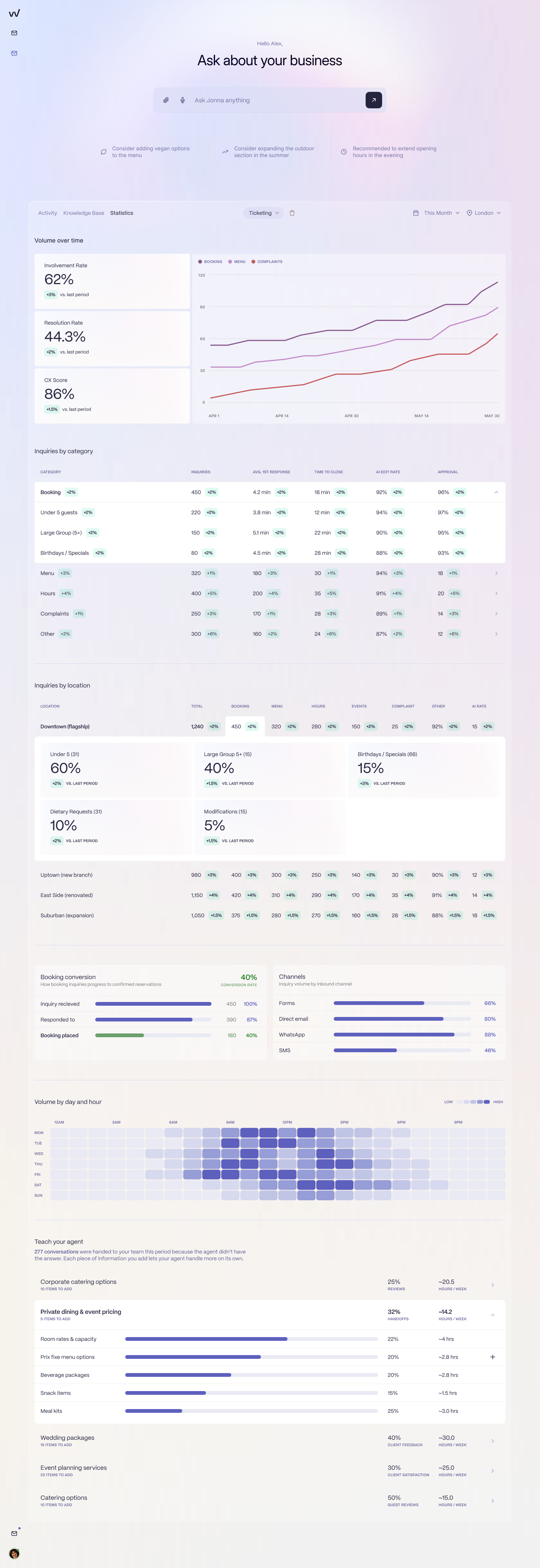
Response rate, volume and conversion by location, measured against network-sourced covers.
An honest note on where RevVue is today
RevVue's TheFork integration is on the roadmap and not live. That is the honest status. Restaurants run an email-only pilot now, which already delivers the rest: routing by location, instant acknowledgement out of hours, AI-drafted replies in each venue's tone, group enquiries held for a person, and reporting by location. The direct connection deepens it when it lands. The UK AI is in pilot.
Before adding anything, check your reconfirmation settings in TheFork Manager. If you are not using timed reconfirmation, that is a cheaper no-show win than any new tool.
This is the move the Brasilia Group made, off a horizontal helpdesk and onto an inbox built for the job. Their founder, Nikolaos Kiosses, put it plainly: "The transition from Zendesk to RevVue has been a game changer."
Since a good share of these enquiries arrive from the booking network and third-party sites, automating third-party booking emails is the most relevant read next, and if you are weighing a helpdesk for this, does Zendesk integrate with TheFork answers that directly. To see what the AI would have said to a real enquiry your team received last week, book 20 minutes.
Frequently asked questions
What email does TheFork automate?
TheFork Manager sends an automatic confirmation email when a booking is made, an SMS reminder typically 24 to 48 hours before the reservation, and automated reconfirmation requests by email, text or both at a time you choose, such as two hours before service, with wording you customise. It also runs two-way SMS and sends messages about modifications and cancellations, while its CRM tracks guest preferences.
Can TheFork answer direct booking enquiries automatically?
No. Every automation fires from a reservation that already exists, and most of those came through the network. A direct enquiry is a message from someone asking a question, so there is no record to trigger from and no template that fits, because the answer depends on live availability, the menu and the room. Group bookings, private hire and dietary questions are all still answered by a person.
Why do direct enquiries matter more than network bookings?
Margin. Covers arriving through TheFork network carry commission, while covers arriving from a direct email do not, so they are worth more per head. They are also the only ones needing a human before they can be confirmed, which makes your highest-margin demand the slowest to be served and the easiest to lose.
Does TheFork's API solve this?
No, and its documentation explains why. TheFork publishes a well documented B2B API aimed at CRM platforms and large groups, and frames it as data synchronisation without the need for real-time updates. That is a batch sync surface for moving booking data between systems, not a live availability-and-booking interface, which is exactly what answering an enquiry inside a conversation requires.