Tock automates the messages around a prepaid booking carefully, which is what a prepaid model requires. Confirmation texts and emails go out on booking, the confirmation message itself is yours to write, reminders send on a lead time you set or on the day, and the reminder SMS asks the guest to reply "1" to confirm they are coming. What it cannot do is answer the message asking to change a booking, and on a tasting-menu site amendments are most of the inbound volume, each one carrying money.
What Tock automates today
Credit where it is due. Tock's automation exists to protect prepaid covers, and it does that job well.
Automated message | What it does |
|---|---|
Booking confirmation, text and email | Sent on booking, carrying a confirmation message you write yourself |
Prepayment and deposit collection | Takes a deposit or the full meal including tax and gratuity at the point of booking |
Reminder email or text | Configurable to send a set number of days ahead, or same day |
Reconfirmation prompt | The reminder SMS asks the guest to reply "1" to confirm |
Notify and waitlist | Captures and manages demand for full services |
The customisable confirmation message is more useful than it first appears. Guests see it immediately after booking online and again in the confirmation email, so it is where a tasting-menu restaurant puts arrival timing, the cancellation policy, dietary deadlines and anything else that prevents a support conversation later.
Taken together with prepayment, this is the strongest no-show defence in the category. If your no-shows are high on Tock, the automation is probably not switched on properly.
What Tock does not automate
Every message above hangs off a booking that already exists and has been paid for. That is the design.
Inbound enquiries have no such record, and on a Tock site they cluster into two groups that the automation does not reach.
The first is the ordinary enquiry: a party the online offering will not take, a question about the vegetarian menu, an accessibility request, a private event.
The second is the one that matters more here, and it is unusual to this platform: the amendment on a prepaid booking. Guests write to ask to move a date, swap two covers to the vegetarian menu, drop one of six, or ask what happens to their deposit. Each of those:
Arrives as an email reply or a message, not as a change in Tock.
Needs someone to look at both availability and the payment already taken.
Has a money consequence, whether a further charge, a partial refund or a seat that goes unpaid.
Often comes back a second time when the first answer changes the plan.
So the automation protects the booking and leaves the entire economics of changing it to a person working between two screens.
What actually happens to an enquiry Tock cannot answer
Here is one enquiry at a restaurant running Tock well.
An email arrives on a Sunday about a prepaid tasting-menu booking for six, asking to swap two seats to the vegetarian menu and move the date by a week.
It sits. Tock never sees it, because it is not a change made in Tock.
On Monday someone opens the mailbox and reads it.
They open Tock in another tab, find the reservation, and check whether the new date has six seats at that sitting.
They check whether the vegetarian menu is priced differently and work out what the move does to the amount already paid.
They amend the booking, adjust the menu selections, and either take a further payment or process a partial refund.
They reply by hand, explaining the money.
The guest replies: "One of the six can't make it now." That is a cancellation inside a prepaid booking with its own refund rule. Steps 4 to 7 run again.
Nothing here is automatable by a reservation platform, because none of it starts inside the reservation platform. And a mistake at step six is not an inconvenience, it is a wrong refund or an unpaid seat. One operations director described the mailbox behind this workflow as "a black hole, no KPIs, no response rate, nothing." Tock can tell you what you took. It cannot tell you what the amendment traffic cost you in hours.
A roughly 40-venue entertainment group lost a single booking worth £40,000 because the enquiry arrived outside working hours and nobody replied in time. A three-site pizza group put it more bluntly about a 30 to 40 cover enquiry: "It just sat there. No one saw it. They went somewhere else." At a tasting-menu restaurant, a six-cover booking is a significant sum and the guest deciding between two restaurants takes the one that answers the awkward question first.
Why the gap exists
The dividing line is transactional versus conversational, and prepayment makes it starker.
Transactional automation needs a record, an event and a template. Tock has an unusually rich record, because it holds the booking and the payment, and its automation around that record is strong.
An enquiry supplies none of the three. There is no record when a stranger asks about a private event. And in the amendment case there is a record, but the trigger is wrong: the event is an email arriving in a mailbox, which is not something the reservation platform can observe. Tock changes state when someone edits the booking inside Tock. It has no way to know that a guest has asked for that edit in writing.
There is a second reason. Answering a prepaid amendment is not just a diary lookup, it is a small commercial decision: what to charge, what to refund, whether to waive. Templates cannot make that call, and a platform that automated it wrongly would be worse than one that does not try.
Closing the gap needs a layer that watches the mailbox rather than the diary, reads the request, works out which booking it refers to, checks the diary and the payment, and prepares the change for a person to approve.
What automating the enquiry side looks like
The gap closes when the enquiry and the booking are handled in one place, so a question about a prepaid seat does not turn into an admin job. This is what RevVue does, and it is easier to show than to describe.
Every enquiry is tagged to the venue it concerns, which matters for a group where each site sells a different ticketed experience. A question about one tasting menu is never answered with another restaurant's seating times.
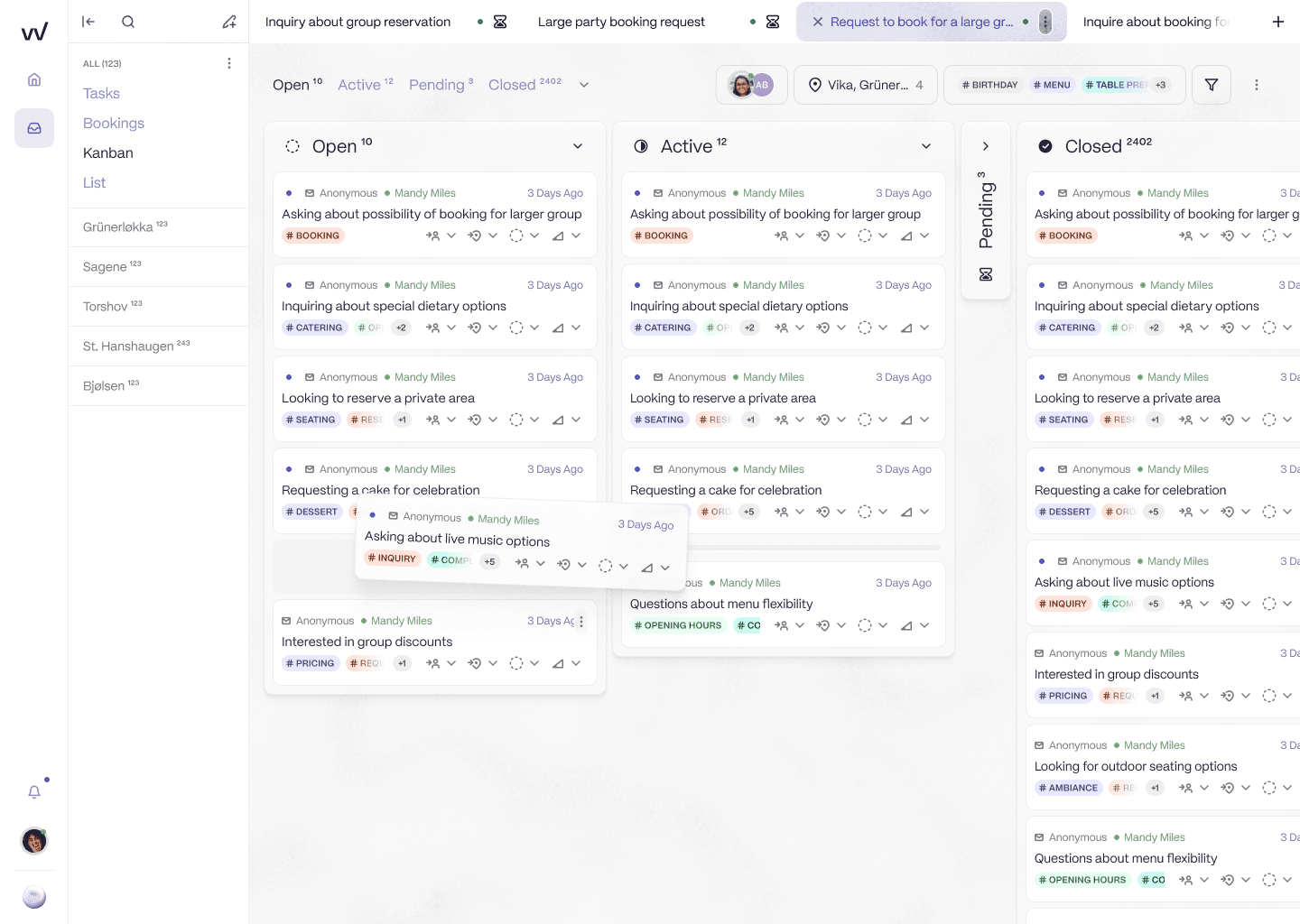
Enquiries sorted by venue, so each ticketed experience is answered with its own detail.
The AI drafts the reply in that venue's voice, grounded in its menu, its cancellation terms and its prepayment rules. Those terms are the substance of most of these messages, and getting them into the first reply is most of the work.
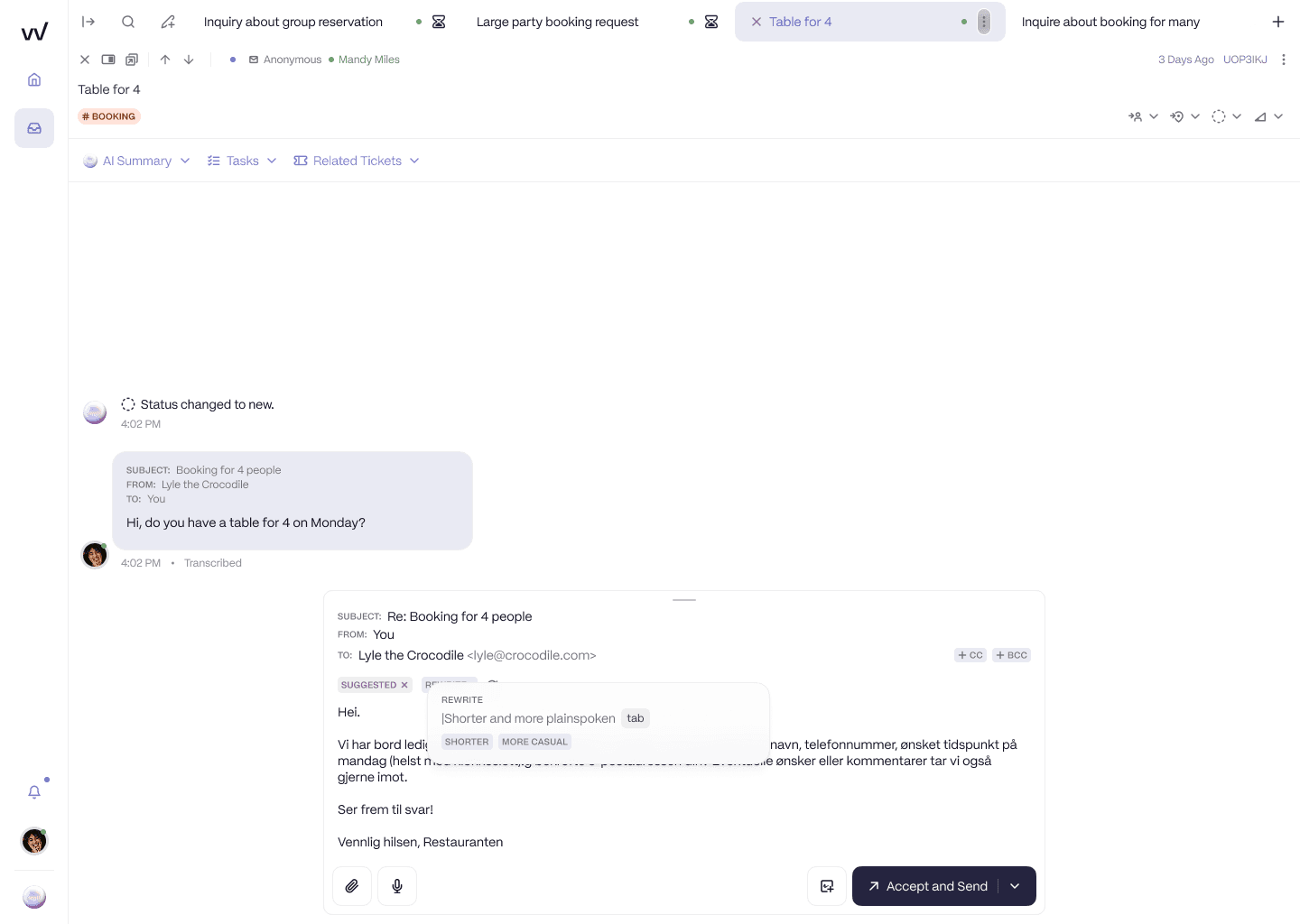
The draft arrives carrying the venue's own terms, ready for one-click approval.
Because it connects to the booking system, the AI takes the step the mailbox cannot: it checks availability and prepares the change in the thread. Simple questions resolve on arrival, including on a Sunday, and anything touching money, a party growing by four seats or a date moving, is acknowledged instantly and queued for a person, because those are the ones with a payment attached.
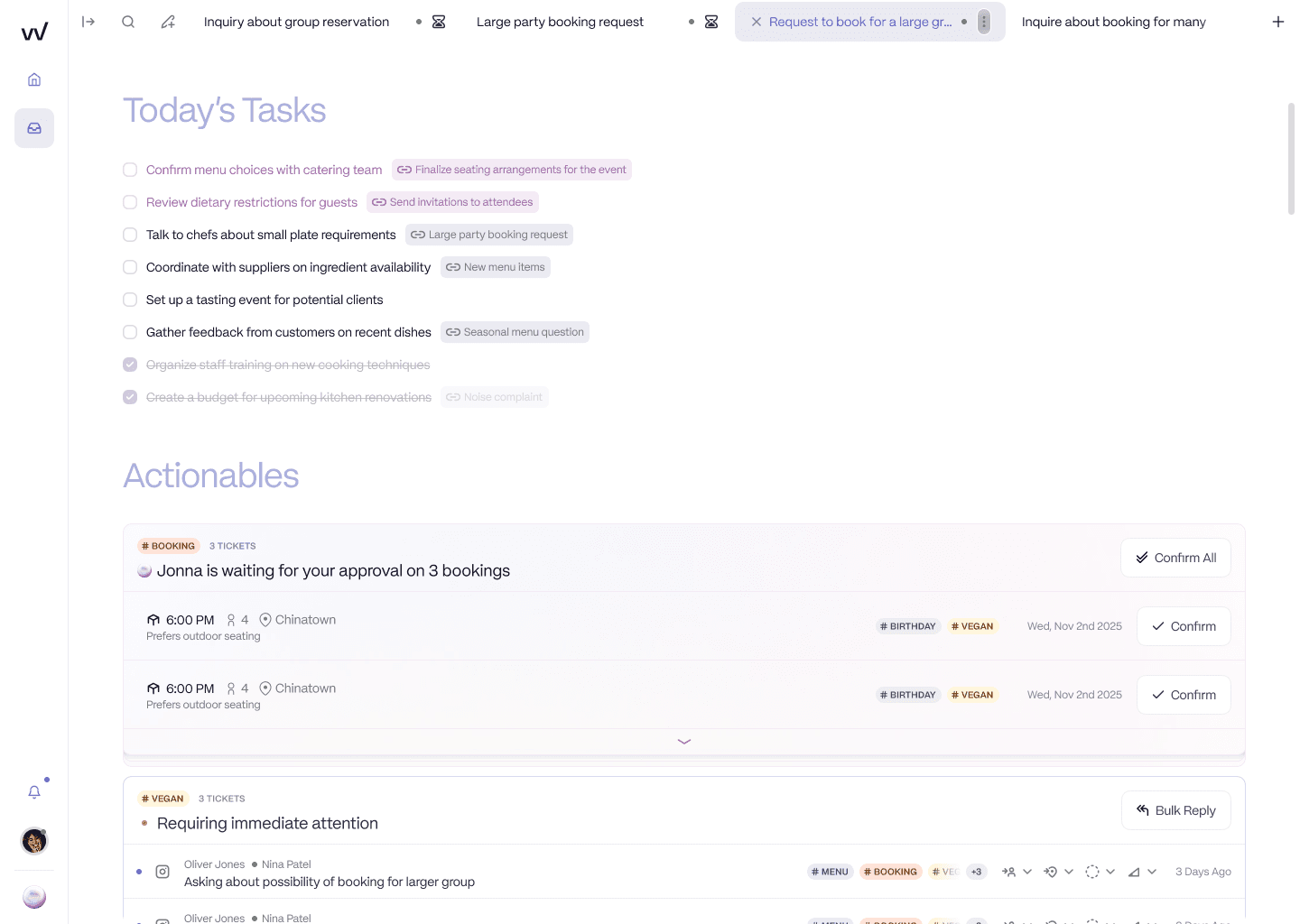
Amendments and high-value bookings held for approval, since each one carries a payment.
And because every enquiry is tracked per venue, the admin around prepaid bookings finally becomes measurable: how many amendments each site handles, how fast it replies, and how much of that work is repeating itself.
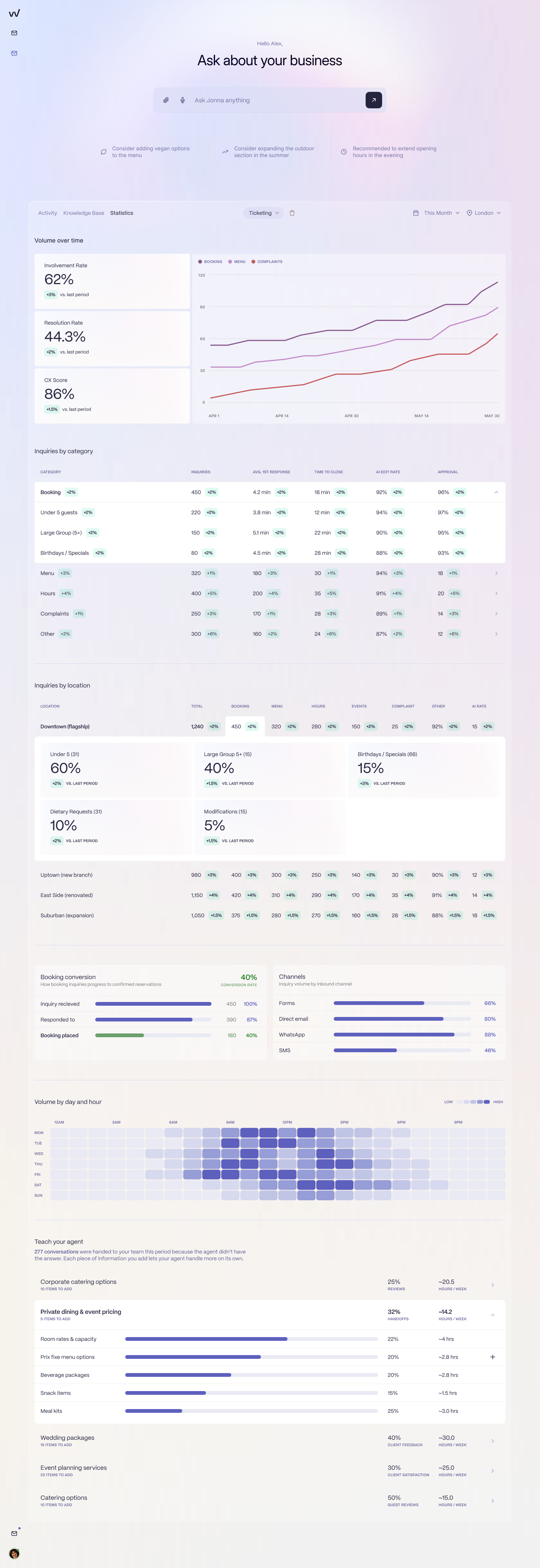
Volume, response rate and conversion by location, including the amendment traffic behind prepaid covers.
An honest note on where RevVue is today
RevVue's Tock integration is on the roadmap and not live. That is the honest status, and there is live context worth factoring in: American Express announced in February 2026 that Tock is merging into Resy, with venues unified on Resy through summer 2026. The consumer Tock app and exploretock.com are being retired, while Tock's restaurant-facing software continues as part of Resy, and API key requests already route to a resy.com address.
Restaurants run an email-only pilot now, which covers the enquiry and amendment traffic described above: routing by location, instant acknowledgement out of hours, AI-drafted replies carrying your terms, amendments held for a person, and reporting by location. The UK AI is in pilot.
This is the move the Brasilia Group made, off a horizontal helpdesk and onto an inbox built for the job. Their founder, Nikolaos Kiosses, put it plainly: "The transition from Zendesk to RevVue has been a game changer."
If your amendments and enquiries arrive at all hours, handling booking enquiries 24/7 is the most relevant read next, and if you are weighing a helpdesk for this, does Zendesk integrate with Tock answers that directly. To see what the AI would have said to a real enquiry your team received last week, book 20 minutes.
Frequently asked questions
What email does Tock automate?
Tock sends automated confirmation texts and emails when a booking is made, carrying a confirmation message you write yourself, and it collects prepayments or deposits at the same time. Reminder emails and texts can be configured to send a set number of days before the reservation or on the day, and the reminder SMS asks guests to reply "1" to confirm they are coming. Notify and waitlist features handle demand for full services.
Can Tock handle a request to change a prepaid booking?
Not automatically. Tock changes state when someone edits the booking inside Tock, and it has no way to observe that a guest has asked for that change by email. So the request lands in a mailbox, and a person has to check availability on the new date, work out the price difference, take a further payment or process a partial refund, then reply. On a tasting-menu site those amendments are most of the inbound volume.
Why does the enquiry gap cost more on a prepaid system?
Because every change carries money. On a standard diary a mistake means a wrong table. On Tock it means an incorrect refund, an unpaid seat or a menu billed at the wrong price. The person answering is making a small commercial decision from a mailbox, without the booking or the payment in front of them, which is where errors and delays come from.
Does the Resy merger change this?
The venue-facing software continues as part of Resy, so the day-to-day automation described here still applies. American Express announced in February 2026 that Tock merges into Resy with venues unified through summer 2026, and the consumer app and exploretock.com are being retired. It is a live transition rather than a finished one, which mainly matters if you are considering commissioning a bespoke integration around Tock.