Zendesk vs Freshdesk for restaurant groups in 2026
Zendesk and Freshdesk are both customer-service helpdesks used by multi-location restaurant groups, mostly for tickets like voucher redemptions, refunds, and post-visit complaints. Zendesk is the heavier enterprise option (£55 to £115 per agent per month) with deeper integrations and feature depth. Freshdesk is the lighter mid-market option (£15 to £69 per agent per month) with simpler implementation and Freddy AI for basic triage. Neither integrates with restaurant booking systems, so most groups using either tool still run their booking-enquiry inbox through shared Outlook on the side.
Before you choose between Zendesk and Freshdesk
Restaurant groups have two distinct inbound flows. The right helpdesk depends on which one you are buying for, and the answer is rarely "the same tool for both."
Customer-service tickets are structured and post-visit. A voucher does not redeem. A guest's card was charged twice. A complaint needs finance to look at it. A staff member behaved badly. These tickets need an audit trail, an SLA, often a workflow that touches more than one team. Zendesk and Freshdesk both handle this work well.
Booking enquiries are different. "Table for 30 on Saturday." "Do you have a vegetarian menu." "Can I move my booking from 7pm to 8pm." High volume, conversational, useful only if it connects to the booking system. Neither Zendesk nor Freshdesk does that, which is why even 60+ venue groups who adopt either tool for customer service typically still run their booking-enquiry inbox through shared Outlook.
When an Ops Director says "we already use Zendesk" or "we already use Freshdesk," the right next question is what for. The Zendesk-vs-Freshdesk choice is a customer-service ticketing choice. It is not a booking-enquiry choice. Those are still in Outlook regardless of which helpdesk you pick.
With that framing in place, here is each tool at a glance.
Zendesk at a glance
Zendesk is the market-leading customer-service helpdesk. Used by tech companies, e-commerce, financial services, and a growing share of larger restaurant groups for ticketing. Pricing starts at £55 per agent per month and runs to £115 at the enterprise tier. Effective minimum for a group with custom configuration: £10,000 to £30,000 per year.
Strengths for restaurant groups:
Brand recognition. When an Ops Director thinks "helpdesk," Zendesk is the first name.
Enterprise feature depth: complex SLA management, enterprise SSO, deep API, marketplace of 1,000+ integrations.
Omnichannel coverage. Voice, chat, email, social, all fully built out.
Established IT trust. Large IT teams have already vetted Zendesk for security and compliance.
Weaknesses for restaurant groups:
No booking system integration. Does not talk to SevenRooms, OpenTable, Collins, or Roller.
No native location-awareness. Routing by site, reporting by site, SLAs by site: all require custom fields, custom triggers, and often a Zendesk consultant.
Per-agent pricing punishes lean reservations teams. Site managers cost extra seats.
Generic AI. Intelligent Triage is trained on support tickets, not hospitality.
Configuration cost. The headline price understates the real total cost. Most groups spend 30 to 50 per cent of year-one licence cost on configuration.
Best for: Restaurant groups with strong IT capacity, complex multi-team workflows, or those already on Zendesk for adjacent businesses (hotel chains, corporate parents). Not for: Small central teams without IT support, or groups whose primary pain is booking enquiries.
A UK leisure venue group running multi-site trampoline parks is currently on Zendesk and actively reviewing options. Their stated job: reduce Zendesk cost while maintaining ticketing capability. They are not unhappy with Zendesk as a ticketing system. They are unhappy with what it costs them to use one for a workload that requires something different.
If you are in this position already, our roundup of best Zendesk alternatives for restaurant groups covers the full shortlist.
Freshdesk is the mid-market alternative most restaurant groups consider next.
Freshdesk at a glance
Freshdesk is positioned as easier to implement and less expensive than Zendesk. Pricing starts at £15 per agent per month and runs to £69 at the higher tiers, with a limited free tier. Growing in UK mid-market hospitality, including 60-location groups running Freshdesk Omnichannel.
Strengths for restaurant groups:
Lower price than Zendesk. £15 to £69 per agent per month.
Simpler implementation. Less overwhelming for small teams.
Decent AI triage. Freddy AI handles ticket categorisation, suggested replies, and sentiment detection.
Known quantity in UK hospitality. Multiple groups have adopted it without forcing a major IT engagement.
Weaknesses for restaurant groups:
The contact form blocker. Freddy AI processes direct emails only. For most restaurant groups the contact form is the primary inbound channel, so the AI cannot touch the channel that matters most.
No location-level reporting. Reports break down by category, not by site. The question "which brasseries had the most steak complaints last month" is not answerable in Freshdesk.
Manual PII redaction. Sharing complaint summaries with leadership requires manually reviewing every email body to redact guest names and contact numbers. At 725 emails per week (real volume at one customer), this is a compliance burden in disguise.
Same architectural gaps as Zendesk. No booking system integration. No location-native data model.
Best for: Restaurant groups with small central teams, tight budgets, and a customer-service ticketing workload that is genuinely email-based. Not for: Groups whose primary inbound channel is the contact form, or groups whose leadership routinely asks site-level reporting questions.
A 60-location UK restaurant group on Freshdesk Omnichannel hit the contact form blocker first. Their Guest Excellence Lead described it: "We hit a bit of a barrier with Freshdesk. Their email bot doesn't work with the contact form. It only works with direct email, and obviously we use the contact form." The same lead described the reporting gap: "I can say we've had a lot of complaints about steaks, but they say: which brasseries? How many complaints out of how much? And I'm like, I can't get that detail."
Side by side, here is how the two tools compare on the dimensions that decide most evaluations.
Zendesk vs Freshdesk: head-to-head
Dimension | Zendesk | Freshdesk |
|---|---|---|
Starting price | £55/agent/month | £15/agent/month |
Top-tier price | £115/agent/month | £69/agent/month |
AI | Intelligent Triage (generic) | Freddy AI (generic; does not handle contact forms) |
Booking system integration | None | None |
Location-awareness | Custom fields + triggers, consultant often required | Custom fields + manual tagging |
Omnichannel | Voice, chat, email, social (full) | Email primary, chat/social via Omnichannel add-on |
Implementation | Weeks to months | Weeks |
Marketplace | 1,000+ integrations | Smaller but growing |
Best workload | Enterprise customer service with complex workflows | SMB-to-mid-market customer service |
Three things this comparison surfaces that are not obvious from a feature list.
The price gap is real but smaller than it looks. For a 3-person reservations team, Zendesk is roughly £165 to £345 per month while Freshdesk is roughly £45 to £207. The annual delta is £1,400 to £3,300. For most restaurant groups, the configuration cost on Zendesk closes that gap quickly, often in year one.
Both ship the same architectural gap. Neither integrates with the booking system. The AI on either platform can write a reply but cannot check availability or create a booking. For booking enquiries specifically, the choice between Zendesk and Freshdesk does not matter because the same gap exists in both.
Implementation time is the underrated dimension. Zendesk implementations stretch into months when a group wants location-aware routing and reporting. Freshdesk implementations are weeks. For a Head of Reservations who needs to show progress in 90 days, that matters more than the feature comparison.
Each tool has scenarios where it pulls clearly ahead.
Where Zendesk pulls ahead
Complex multi-team workflows. Groups where customer service, finance, ops, and IT all touch the same ticket. Zendesk's automations, triggers, and SLA management are deeper than Freshdesk's. If your refund process needs to route to a finance approver, then back to the customer-service team, then escalate to a regional manager on day three, Zendesk handles that workflow without breaking.
Adjacent businesses already on Zendesk. Restaurant groups under corporate parents that already run Zendesk for the parent company, or hotel chains where the restaurant is a sub-brand inside a larger property management group. Adding the restaurant to an existing Zendesk instance is faster than spinning up a separate Freshdesk.
Strong IT teams who value enterprise infrastructure. Enterprise SSO, audit trails, deep API access, the 1,000+ integration marketplace. If your CTO is going to be involved in the evaluation and wants vendor-managed support infrastructure, Zendesk is the safer choice.
Most multi-location restaurant groups under 50 sites do not need Zendesk's depth. Some do. The honest test: if your CTO would describe your current support stack as "complex," Zendesk earns its premium. If they would describe it as "a shared inbox plus a couple of forms," Freshdesk gets you there for less.
Where Freshdesk pulls ahead
Small central teams on tight budgets. A 3-person reservations team at a 15-site group looking at the difference between £45 per month and £165 per month at lower tiers. That £1,400 to £3,300 per year matters when you are also looking at other tooling spend. Freshdesk gets you most of the ticketing capability for a fraction of the cost.
Self-implementation without a dedicated IT team. Freshdesk's simpler interface and lighter configuration mean a Head of Reservations can stand it up without a consultant engagement. Restaurant groups under 25 sites often do not have a dedicated IT function, and Freshdesk is friendlier for those teams.
Email-first customer service without omnichannel needs. If your customer-service workload is dominated by email tickets, you do not need Zendesk's voice and social channels. Freshdesk does email well and lets you add chat or social later via Omnichannel if the business changes.
Freshdesk's AI ceiling is lower than Zendesk's, the enterprise feature depth is shallower, and the integrations marketplace is smaller. For groups who will outgrow Freshdesk in 18 months, paying the Zendesk premium up front can be cheaper than migrating later. For groups who will not, the Freshdesk savings are real.
Both tools work for customer-service tickets. Neither answers the harder question.
The question neither tool answers
A booking enquiry is not a support ticket. It is a transaction against the booking system. "Table for 30 on Saturday" only matters if you can check the availability, create the booking, and update guest records. Zendesk and Freshdesk can write the reply. Neither can do the booking. Without the booking system integration, an AI reply to a booking enquiry is just a polite email. The actual work falls back to your reservations team, who still have to open the booking system and do it by hand.
For a restaurant group, the booking-enquiry workload is the larger inbound flow. Group bookings, dietary requests, amendments, special occasions: these arrive at higher volume than customer-service tickets and carry higher revenue per message. A £4,000 venue hire enquiry that sits in a queue for 24 hours because your tool can write a reply but not book the table is the most expensive feature gap in the comparison.
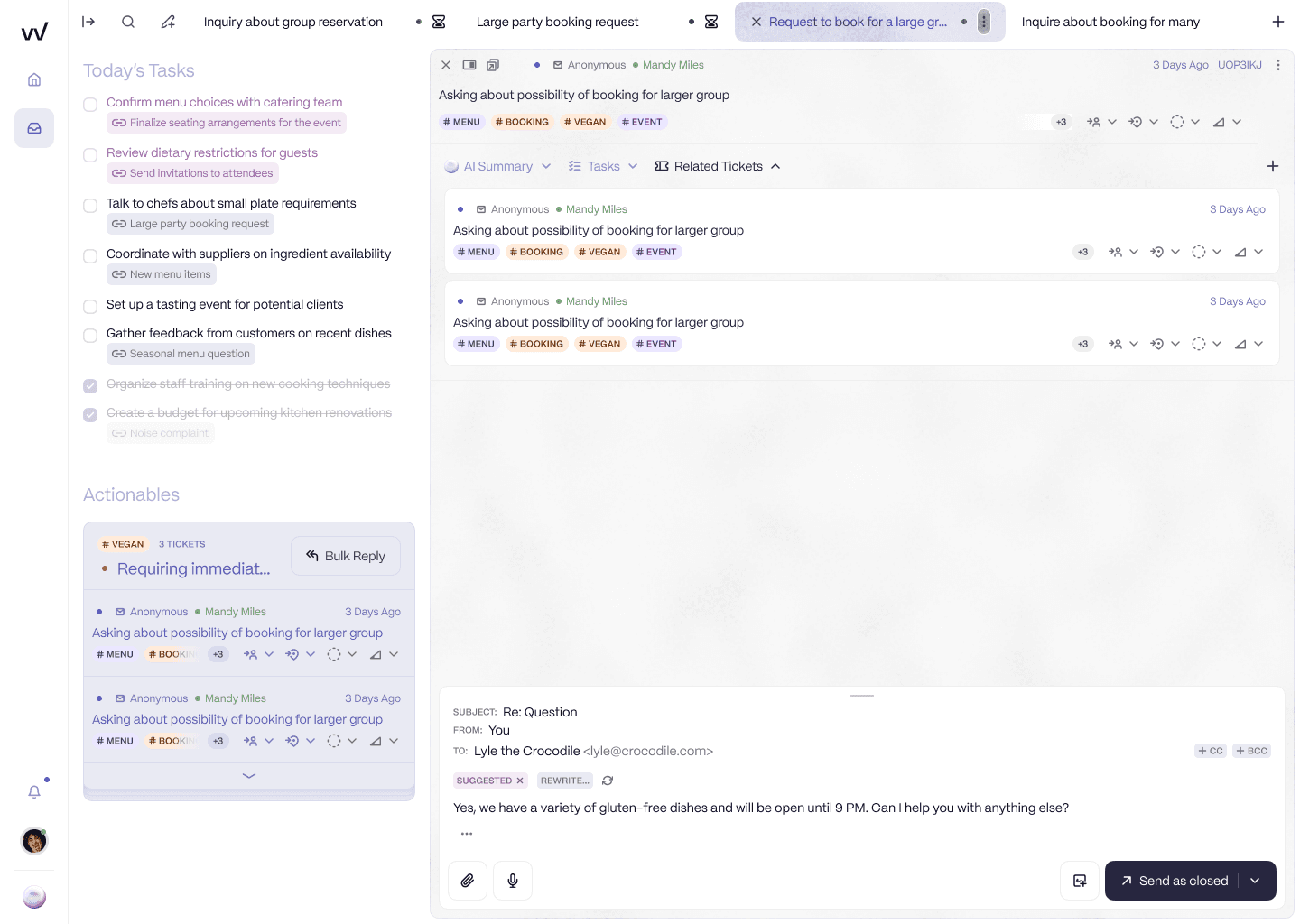
RevVue is the option built for booking enquiries specifically. Location is the foundational data model, so every message is tagged to a site automatically. The AI talks to the booking system inside the conversation thread (checks availability, creates bookings, handles amendments). Each venue gets its own knowledge base and brand tone, learned from historical email replies. Pricing is per location (£75 per month), not per agent. The two tools can coexist: Zendesk or Freshdesk for customer-service tickets, RevVue for booking enquiries.
The Brasilia Group, a UK restaurant group, migrated from Zendesk to RevVue. Their founder, Nikolaos Kiosses, described the outcome as: "The transition from Zendesk to RevVue has been a game changer." The driver was specific. Zendesk could not break down reporting by site, route messages by location without manual configuration, integrate with their booking system, or apply AI that understood hospitality context. Our side-by-side RevVue vs Zendesk comparison goes deeper into the architectural argument and what migration looks like.
If you have already decided to move off Zendesk and want the broader shortlist, see best Zendesk alternatives for restaurant groups.
Picking between Zendesk and Freshdesk is the wrong first question for most restaurant groups. Here is a checklist that asks the right ones.
How to decide: five questions to answer before you commit
Is this purchase for customer-service tickets, booking enquiries, or both? If tickets only, you are in the right comparison. If booking enquiries are part of the workload, neither tool fully solves it.
What is your central team size and IT capacity? Under 10 people without dedicated IT: Freshdesk. Larger teams with IT support or complex workflows: Zendesk.
What is your annual budget for inbound communication tooling? Under £5,000 per year: Freshdesk fits. Over £10,000 per year: Zendesk is realistic. The configuration cost on either tool is often 30 to 50 per cent of the licence cost in year one.
Do you need omnichannel (voice, chat, social) or is email enough? Email-only: Freshdesk does it well. Omnichannel from day one: Zendesk is more complete.
Are you willing to run two tools (one for tickets, one for booking enquiries) or are you looking for one solution? If two tools is acceptable, pick Zendesk or Freshdesk for tickets and RevVue (or shared Outlook) for booking enquiries. If you want one tool for both, neither Zendesk nor Freshdesk will do it on its own.
Most multi-location restaurant groups under 30 sites end up with Freshdesk for tickets and either RevVue or shared Outlook for booking enquiries. Larger or enterprise-adjacent groups end up with Zendesk for tickets and RevVue (or Outlook) for booking enquiries. The single-tool answer almost never holds up under real workload.
Here are three groups working through this decision now.
What happens after you choose
The Brasilia Group migrated from Zendesk to RevVue. The drivers were specific: no site-level reporting on Zendesk, no location routing without manual configuration, no booking system integration, generic AI. Their customer-service ticketing volume did not justify running two tools, so the move was both directions at once.
A UK leisure venue group running multi-site trampoline parks is on Zendesk and actively reviewing alternatives. Stated goal: reduce Zendesk cost while maintaining ticketing capability. They are looking for an AI layer that justifies the spend by deflecting routine tickets, or an alternative built around their leisure-specific product complexity (age limits, weight limits, session types, party packages). Typical "we bought the enterprise tool, now we are questioning whether it earns its price" arc.
A 60-location UK restaurant group on Freshdesk Omnichannel is open to switching despite Freshdesk's lower price. They moved from Zendesk to Freshdesk for cost and hit the same structural problems anyway: contact form blocker, no location reporting, manual PII redaction. The cheaper Zendesk alternative did not solve the underlying mismatch.
Pick the tool that fits your actual ticketing workload. Structure your evaluation around the booking-enquiry question separately. Budget for the possibility that you will need two tools. If you want to talk to a peer group who has lived this decision, book a demo and we will put you in front of a customer who has made the migration.
Frequently asked questions
Which is better for restaurant groups, Zendesk or Freshdesk?
It depends on which workload you are solving for. For customer-service tickets (vouchers, refunds, complaints) Zendesk is the heavier enterprise option with deeper integrations, and Freshdesk is the cheaper, simpler option for small teams. Neither integrates with restaurant booking systems, so for the booking-enquiry workload most multi-location groups still run a shared Outlook on the side regardless of which they pick.
How much do Zendesk and Freshdesk cost for a restaurant group?
Zendesk runs £55 to £115 per agent per month, with an effective minimum spend of £10,000 to £30,000 per year once configuration is included. Freshdesk runs £15 to £69 per agent per month, with a limited free tier. For a 3-person reservations team the annual delta is £1,400 to £3,300, before configuration.
Does Zendesk or Freshdesk integrate with SevenRooms or OpenTable?
No. Neither tool integrates with SevenRooms, OpenTable, Collins, or Roller. The AI on both platforms can write a reply but cannot check availability or create a booking. This is why most restaurant groups with either tool for customer service still run booking enquiries through shared Outlook.
Is Freshdesk's AI better than Zendesk's for hospitality?
Both AIs are trained on generic support tickets, not hospitality. Freshdesk's Freddy AI is decent for categorisation but does not process website contact form submissions, which is the primary inbound channel for most restaurant groups. Zendesk's Intelligent Triage has broader coverage but the same generic-data limitation. Neither understands the difference between a dietary question and a £4,000 venue hire enquiry.
Can a restaurant group use Zendesk or Freshdesk for booking enquiries?
Technically yes, emails arrive and tickets are created. Practically no, because neither integrates with the booking system. The AI can write a reply but cannot check availability, create the booking, or update guest records. Even 60+ venue groups with Zendesk or Freshdesk for customer service typically run their booking-enquiry inbox through shared Outlook on the side.
What is the best alternative to Zendesk and Freshdesk for restaurant groups?
For booking enquiries specifically, RevVue is the hospitality-native option. It integrates with major booking systems, treats location as a foundational data model, and prices per location (£75 per month) rather than per agent. The Brasilia Group migrated from Zendesk to RevVue. RevVue does not displace Zendesk or Freshdesk for customer-service ticketing: the two tools can coexist.