Freshdesk is a horizontal customer-support platform that many multi-location restaurant groups adopt as a step up from shared Gmail. It works well enough for generic support, but three limitations push hospitality teams into active shopping. Its AI does not process website contact form submissions, the primary inbound channel for most groups. Its reporting is per-category rather than per-location, so "which sites had the most complaints?" is not a question it can answer. And it does not redact personal data from ticket bodies, so sharing any report means reviewing every email by hand. These are architectural limitations, not settings. The right alternative depends on which job you are actually buying for: customer-service ticketing at scale, or the booking-enquiry inbox.
Why hospitality teams outgrow Freshdesk
Start with what Freshdesk gets right, because the reader on it has real reasons to stay. It is a genuine step up from a shared mailbox: proper ticketing, and email, live chat, and phone linked in one place. The guest-experience lead at a 60-site brasserie group described exactly what makes it sticky: "I love how it's all together, the phones, the tickets, the live chat. So if someone's on live chat I can see whether they've already submitted a ticket via the website. I love how that's all linked. We can catch out scammers and fakers quite well." That is worth something, and switching has a real cost. This article is for the reader who has crossed from tolerating the gaps to actively looking.
There are three gaps, and they are the same three every time.
The first is the contact form. Freshdesk's AI bot processes direct emails but not submissions from a website contact form, and for most restaurant groups the contact form is the main way enquiries arrive. The same lead put it plainly: "We hit a bit of a barrier with Freshdesk. Their email bot doesn't work with the contact form. It only works with direct email and obviously we use the contact form. So that development piece isn't done yet, which is rubbish." The AI is switched on, the canned responses are written, and the automation still does not happen, because the channel does not plug into the bot.
The second is location reporting. Freshdesk tags tickets by category but does not aggregate the content by site. So when leadership asks the obvious question, the tool goes quiet: "I can say we've had a lot of complaints about steaks, but they say, which brasseries? How many complaints out of how much? And I'm like, I can't get that detail." The workaround is to export a category report, paste it into a separate AI tool to summarise, and map it to locations by hand, every week.
The third is personal data. Freshdesk does not redact guest names and numbers from ticket bodies, so any report shared internally has to be cleaned first. At this group that meant going through 725 emails by hand to delete contact details before a single complaint summary could be sent upward. That is a compliance burden wearing the costume of a process problem.
None of these is a failure of the team. They are the shape of a horizontal tool meeting a hospitality operation.
What to look for in a Freshdesk alternative
Before naming options, fix the axes you are judging them on. For a multi-location restaurant group, five questions separate a real fit from another workaround:
Does it integrate with your booking system? SevenRooms, OpenTable, Collins. This is the one integration that decides whether an enquiry can be resolved or only replied to.
Does its AI handle your contact form, not just direct email?
Does reporting break down by location natively, without a manual export?
Does it redact personal data before export, so a report can be shared without a manual review step?
What do migration and trialling look like? How long to move historical tickets, and is there a pilot that does not require full commitment upfront?
Hold every option below against these five.
The alternatives, and who each one is for
No single tool wins on all five. Here is who each one is actually for.
RevVue: built for restaurant groups
Best for: the booking-enquiry inbox, location-level reporting, and an AI that works across channels.
RevVue is built around location as the foundational data model, not a custom field bolted on. Every message is tagged to the site it came from automatically, which means location-level reporting is available out of the box. The "which brasseries, how many out of how much" question that Freshdesk cannot answer is a standard report here, with no export-and-summarise loop. Its AI is trained on hospitality context rather than generic support tickets, and it works across channels including the web and contact form, though it is worth being upfront that the AI agent is in UK pilot, not full general release here yet.
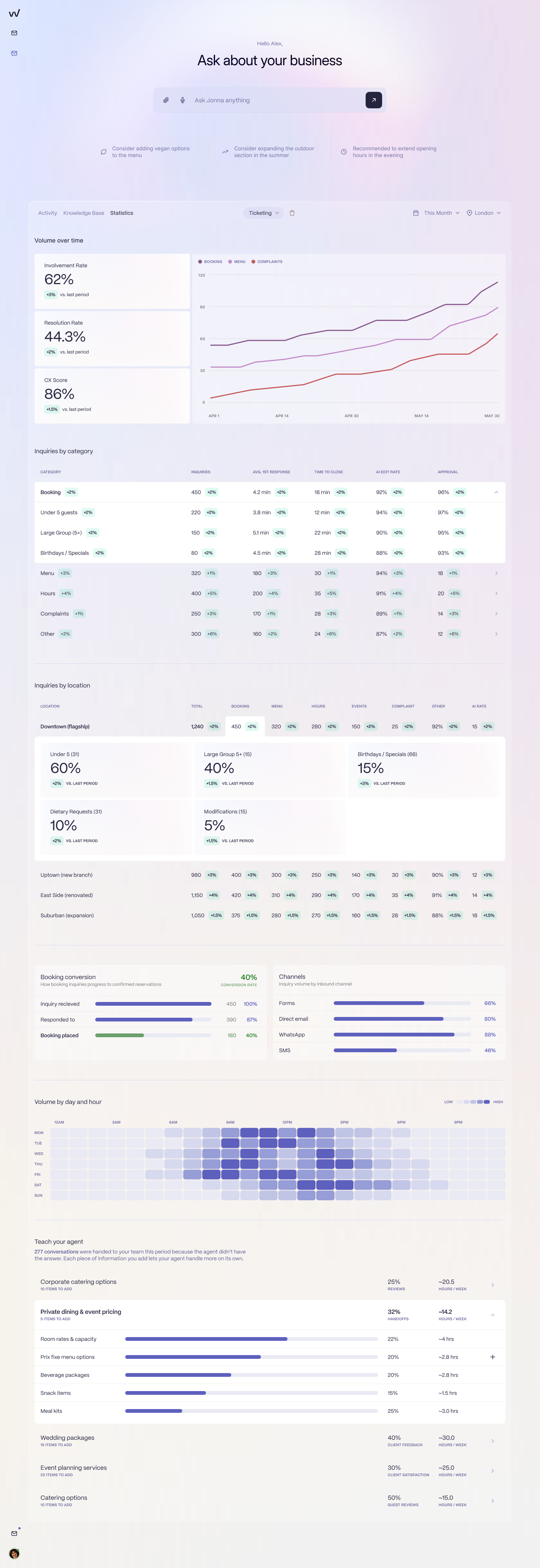
Location-level reporting out of the box: enquiry and complaint volume by site, the answer Freshdesk sends you to a spreadsheet for.
The difference that matters most is the booking system. RevVue's AI connects to the booking system inside the conversation: it can check availability and create the booking, not just draft a reply. No horizontal helpdesk does this. Each venue gets its own knowledge base and brand tone, so a 30-concept group sounds right at every site. Pricing is per location at £75 rather than per agent, which fits a group that grows by adding venues. A London restaurant group that moved off a generic helpdesk did so for exactly these reasons: reporting by site, routing by location, and an inbox that talks to the booking system.
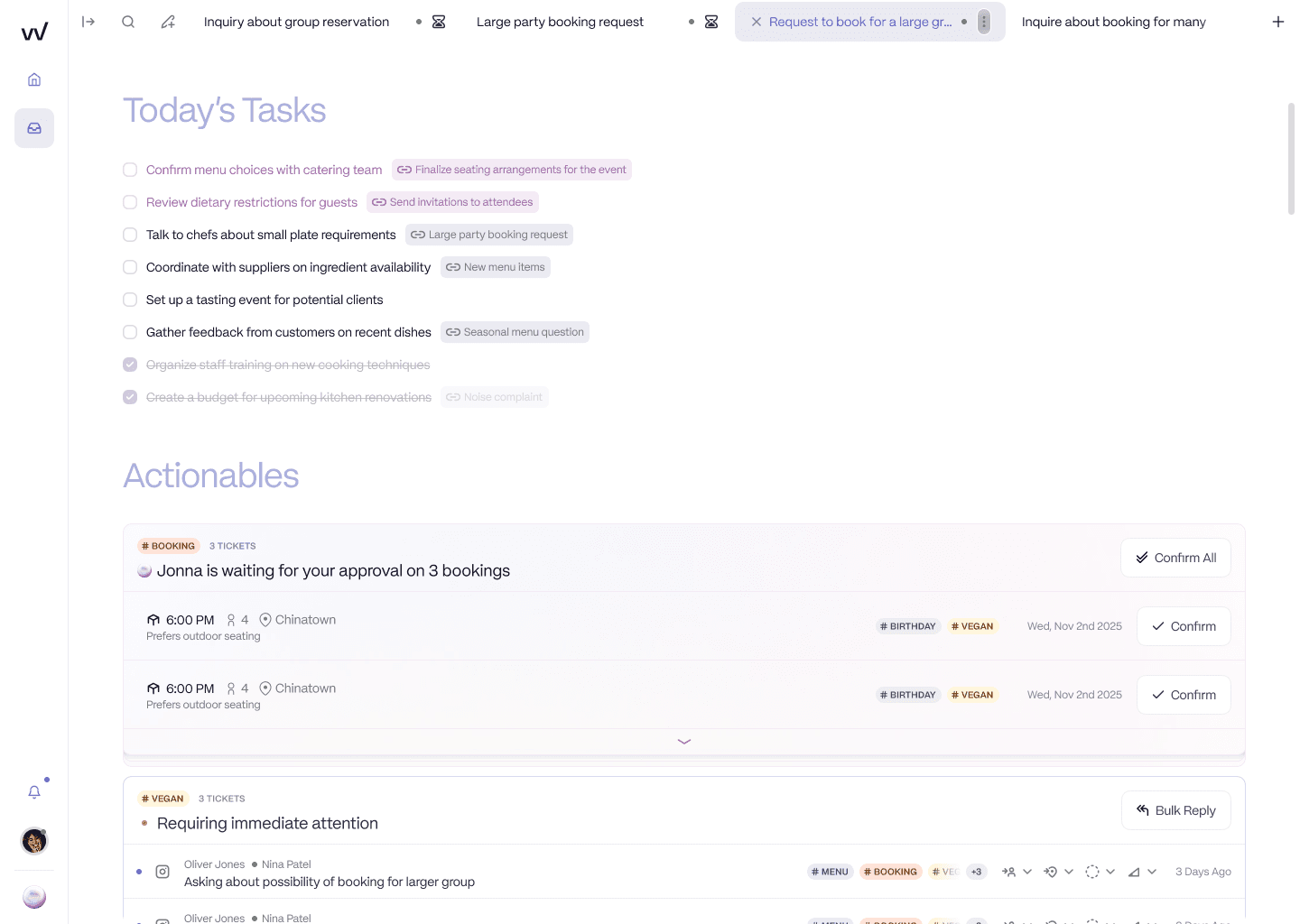
The AI prepares and holds bookings for one-click approval inside the thread, the booking action a horizontal helpdesk cannot take.
The honest catch: RevVue is not a like-for-like replacement for enterprise customer-service ticketing. If your dominant need is structured CS escalation at scale, read on.
Zendesk: the enterprise step-up
Best for: groups whose dominant pain is heavy customer-service ticketing, not booking enquiries.
If you are leaving Freshdesk because you have outgrown it on the support side, Zendesk is the established step up. It has enterprise depth Freshdesk does not: SSO, role-based permissions, complex SLA management, and a marketplace of more than 1,000 integrations, all vetted by enterprise procurement many times over.
The catch is that it is more expensive, at £55 to £115 per agent per month, and it shares Freshdesk's core limitations for a restaurant group. It has no concept of a location, so routing and reporting by site still need custom fields and a consultant, and it does not integrate with your booking system either. You are buying more power, not a different data model. For the detail, see Zendesk vs Freshdesk for restaurant groups and the Zendesk alternatives roundup.
Intercom: AI-first and web-chat-led
Best for: digital-first, tech-savvy groups that live in web chat.
Intercom has one of the strongest AI agents on the market in Fin, and if your guests mostly reach you through a chat widget on a modern website, it is worth a look.
The catch for a restaurant group is threefold. It is premium per-seat pricing, starting around £74 per seat per month. It was built web-chat-first rather than email-first, so it cuts against a central team that has run on email for twenty years. And it has no per-venue knowledge base or branding, so a group running several concepts cannot give each venue its own voice. It also shares the booking-integration gap: Fin can write a strong reply, but it cannot book the table.
Help Scout: the lighter, simpler help desk
Best for: a small central team that wants less overhead than Freshdesk, not more.
Not every group leaving Freshdesk wants something bigger. Help Scout is a clean, email-first, shared-inbox help desk that is simpler to run than a full omnichannel suite, and for a small team handling a manageable volume it can be a calmer home than Freshdesk.
The catch is that it is still a horizontal tool. It has no hospitality or location model, and no booking-system integration, so the location-reporting and booking-action gaps that pushed you off Freshdesk will still be there. It solves "too much tool," not "wrong shape of tool."
Why the horizontal tools all share the same gap
Location is not a field you can add. It is a data model you either have or you do not.
Zendesk, Freshdesk, Intercom, and Help Scout are all horizontal tools, and they all treat a message as a message. A restaurant-native system treats it as a message from a guest at a specific location, and that one difference changes everything downstream: how it routes, how it reports, and what its AI can automate. It is why location reporting comes free in one and requires a weekly Copilot workaround in another, and why a generic AI can be switched on and still not touch your contact form.
This is the part worth being clear-eyed about. These are not features on a roadmap that a horizontal vendor will ship next quarter. As the structural reality goes: it is not a feature gap, it is an architectural gap, and it cannot be closed by adding a custom field. When you evaluate alternatives, you are not choosing between feature lists. You are choosing between a tool that has location in its foundations and a tool that approximates it on top.
How to choose before you switch
Match the tool to the job, not to the brand. If your dominant, escalating pain is customer-service ticketing at scale, the honest answer might be Zendesk, or staying on Freshdesk and accepting the workarounds. If your real problem is the booking-enquiry inbox, the location reporting your leadership keeps asking for, and an AI that can actually act on a booking, then a hospitality-native tool is the fit, and a horizontal helpdesk will keep disappointing you no matter how you configure it.
Run the five questions on every shortlisted option. Ask specifically about your contact form, about location reporting, and about how personal data is handled before a report leaves the system. If RevVue is on your shortlist, the head-to-head with Freshdesk goes deeper than a roundup can. Then ask for a pilot rather than a full migration. RevVue, for instance, offers an email-only pilot before the SevenRooms integration is complete, so you can see value on the inbox before committing. And ask any vendor how your historical tickets move across, because that is where switching projects quietly stall.
If you want to see what your own enquiries look like inside a tool built for restaurant groups, book a demo and we will model it on your actual volume.
Frequently asked questions
Why is Freshdesk limited for restaurant groups?
Freshdesk is a horizontal customer-support platform, not a hospitality system, so three limitations emerge for multi-location groups. Its AI email bot does not process website contact form submissions, which are the primary inbound channel for many groups. Its reporting is per-category rather than per-location, so questions like "which sites had the most complaints?" require a manual export and a separate tool to answer. And it does not auto-redact personal data from ticket bodies, so sharing a complaint report means reviewing every email by hand. These are architectural limitations, not settings you can switch on.
Can Freshdesk AI handle contact form submissions?
No. Freshdesk's AI email bot processes direct emails but not submissions from a website contact form. For restaurant groups whose primary inbound channel is the contact form, this means the AI cannot answer routine enquiries even when the templates are written and ready, because the channel does not plug into the bot. It is an architecture mismatch rather than a configuration problem, which is why writing more canned responses does not fix it.
How do restaurant groups get location-level complaint reporting?
In a horizontal helpdesk like Freshdesk, they usually cannot get it directly. Freshdesk tags tickets by category but does not aggregate qualitative ticket content by location, so teams export category reports and paste them into a separate tool to summarise, then map to sites by hand. A hospitality-native inbox tags every message to its location automatically, so location-level reporting, for example complaint volume by site, is available out of the box without a manual workaround.
What are the best Freshdesk alternatives for hospitality?
It depends on the job. For the booking-enquiry inbox with location reporting and an AI that connects to the booking system, a hospitality-native tool like RevVue fits. For heavy customer-service ticketing at enterprise scale, Zendesk is the step up, though it shares the same horizontal limits. For digital-first groups that live in web chat, Intercom has a strong AI agent. For a small team that just wants a simpler, email-first help desk, Help Scout is lighter than Freshdesk. The key is to match the tool to whether your dominant pain is customer-service tickets or booking enquiries.
How does a hospitality-native inbox differ from Freshdesk?
A hospitality-native inbox treats every message as coming from a guest at a specific location, so routing, reporting, and automation all work by site without custom fields. It connects to the booking system, so its AI can check availability and create a booking inside the conversation rather than just replying. And it handles enquiries across channels including the contact form. Freshdesk treats a message as a message, which is fine for generic support but leaves location reporting, contact-form AI, and booking actions as gaps a restaurant group has to work around.