Zendesk pricing for restaurant groups: what you actually pay at 10+ sites
Zendesk's headline price for a restaurant group is £55 to £115 per agent per month, but the realistic total cost at 10+ sites runs £25,000 to £80,000 or more in year one. The gap between the headline and the real number is four cost categories that do not appear on the pricing page: configuration, integrations, training, and the shadow cost of running shared Outlook in parallel because Zendesk does not integrate with restaurant booking systems. This article shows the math at 10, 25, and 50+ sites so you can model your own.
A disclaimer up front. The numbers below are illustrative ranges based on competitive intelligence, industry norms, and customer conversations. They are not vendor-published quotes. Use the structure, not the exact figures. Verify with your own Zendesk quote and a written scope from any implementation partner before you sign.
What Zendesk's pricing page shows you
The Zendesk Suite is the helpdesk product most restaurant groups consider. Four tiers, all priced per agent per month (current 2026 list pricing, subject to change).
Tier | List price | What it gives a restaurant group |
|---|---|---|
Suite Team | ~£55/agent/month | Email, web, mobile ticketing. Basic automation. Reasonable for a small central team that wants to professionalise the inbox. |
Suite Growth | ~£89/agent/month | Adds custom layouts, SLAs, multilingual content, multiple ticket forms. The "we have grown and need structure" tier. |
Suite Professional | ~£115/agent/month | Adds advanced SLAs, custom roles, multibrand, side conversations. Most multi-location restaurant groups land here. |
Suite Enterprise | Custom, typically £150+/agent/month | Adds enterprise SSO, audit logs, sandbox, advanced administration. Required for groups with mature IT or compliance needs. |
Beyond the Suite, Zendesk sells Sell (CRM), Talk (voice), Guide (knowledge base), Chat, and increasingly Advanced AI as a separate add-on at the higher tiers. These often pull total spend up.
Suite Team at £55 per agent per month is a reasonable price for what it does at small scale. The problem at 10+ sites is not the headline price. It is what the headline price does not include.
What the pricing page does not show you
Six categories that add £15,000 to £60,000 or more to year one for a 10+ site restaurant group.
Configuration. Location-aware routing, custom fields for site identification, automations, triggers, SLAs per site. At 10+ sites this is rarely a self-implementation. Either Zendesk Professional Services or a third-party implementation partner. Realistic range: £10,000 to £40,000 one-off in year one. Larger groups, more rules, more configuration.
Booking system integration. Zendesk does not integrate with SevenRooms, OpenTable, Collins, or Roller. If you want enquiries to connect to your booking system, you build or buy middleware. Realistic range: £5,000 to £40,000 upfront, plus 15 to 25 per cent annually in ongoing maintenance as the booking system's API changes.
Training. Per-agent onboarding plus admin training for whoever owns Zendesk configuration. Realistic range: £2,500 to £10,000 externally, or buried in central team headcount cost.
Ongoing maintenance. Triggers break when a venue is renamed. Custom fields drift when business rules change. Marketplace apps you depend on update their pricing or get deprecated. Plan 20 to 40 per cent of year-one licence cost annually for upkeep.
The shadow Outlook cost. Most restaurant groups on Zendesk still run booking enquiries through shared Outlook because Zendesk does not talk to the booking system. That means you continue paying for Google Workspace or Microsoft 365 seats (£11 to £15 per user per month) and for the central team time spent managing a second inbox. The licence number is small. The time cost is not.
The per-seat compromise tax. Zendesk charges per agent. A 25-site group that wants every site GM to see their own venue's inbox is looking at 25+ additional seats (£16,500 to £34,500 a year at Suite Professional). Most groups buy the minimum number of seats and block site GMs from inbox access. The opportunity cost (bookings lost to slow response times) does not appear on any invoice but is the largest hidden line item for groups that hit this trade-off.
Put it together with a real TCO model. Start with 10 sites.
Real TCO at 10 sites
Assumptions:
10 sites
3-person central reservations team (typical at this size)
Suite Professional tier (£115/agent/month)
Mid-range configuration scope
Item | Cost |
|---|---|
Licences (3 agents × £115 × 12) | £4,140 |
Configuration (one-off, third-party implementation partner) | £15,000 |
Integration middleware (one-off) | £5,000 to £10,000 |
Training | £2,500 |
Year-one maintenance | £1,000 |
Year-one total (central team only) | £27,640 to £32,640 |
Optional: 10 site-GM seats × £115 × 12 | +£13,800/year |
Year two onward: Roughly £8,000 to £12,000 per year (licences + ongoing maintenance + integration upkeep).
The decision the model surfaces. At 10 sites you either accept the access compromise (3 central seats, site GMs cannot see their inbox), or you pay an extra £13,800 a year for full site-GM access. Most groups accept the compromise. Some pay the premium because the bookings lost to slow site-level response would cost more than the seat upgrade.
The configuration line is the volatile one. £15,000 is mid-range for a 10-site group. We have seen quotes from £8,000 (light scope, simple booking system) to £25,000 (multi-brand routing, complex SLAs). Get the scope written down before you sign.
At 25 sites, the math changes materially.
Real TCO at 25 sites
Assumptions:
25 sites
4-person central team (typical scale-up)
Suite Professional, often with implementation partner engagement
Item | Cost |
|---|---|
Licences (4 agents × £115 × 12) | £5,520 |
Configuration (one-off, often multi-month implementation partner) | £25,000 |
Integrations (one-off) | £10,000 to £20,000 |
Training | £5,000 |
Year-one maintenance | £3,000 |
Year-one total (central team only) | £48,520 to £58,520 |
Optional: 25 site-GM seats × £115 × 12 | +£34,500/year |
Year two onward: Roughly £15,000 to £25,000 per year.
The decision at 25 sites. The per-seat decision is now a £34,500 line item per year. That is more than year-two ongoing costs for the central team. Most groups make peace with the access compromise. A few pay the premium and treat it as a revenue investment, on the theory that site-level visibility reduces booking loss.
Configuration at 25 sites is almost always an implementation partner engagement rather than a Zendesk Professional Services job. Three to four months is realistic. Get the partner's track record on multi-location hospitality before signing. A consultant who has done 30 SaaS deployments and one restaurant group is not the right partner.
At 50+ sites, the conversation changes from "is this expensive?" to "is this the right architecture?"
Real TCO at 50+ sites
Assumptions:
50+ sites
6-person central team
Suite Enterprise tier (~£150+/agent/month with negotiated discounts)
Multi-month implementation partner engagement
Item | Cost |
|---|---|
Licences (6 agents × £150 × 12, negotiated) | £10,800 |
Configuration (multi-month implementation partner) | £40,000+ |
Integrations | £20,000 to £40,000 |
Training | £10,000 |
Year-one maintenance | £8,000+ |
Year-one total (central team only) | £88,800 to £108,800+ |
Optional: 50 site-GM seats × £150 × 12 | +£90,000/year |
Year two onward: Roughly £25,000 to £50,000 per year.
At 50+ sites, the per-seat decision is a £90,000 annual line item. Almost no group at this scale pays it. They accept the access compromise and route by site internally instead, which means the central team becomes a routing bottleneck. The operating-model cost of that routing bottleneck is the real number CFOs miss, because it shows up as response-time degradation and booking loss, not as a Zendesk invoice line.
There is one cost category none of these tables capture.
The £4,000 booking-enquiry problem
Every TCO model above is for the customer-service ticketing workload (vouchers, refunds, complaints). None of them include the cost of the booking-enquiry workload, because Zendesk does not handle that workload regardless of how much you spend.
The structural gap is specific. Zendesk can write a reply to a booking enquiry. It cannot check availability, create the booking, or update guest records. The AI is impressive on customer-service tickets and useless on booking enquiries because the booking system is not connected. No SevenRooms integration. No OpenTable integration. No Collins, no Roller. The middleware option helps with data flow but does not let the AI act on the booking system end-to-end.
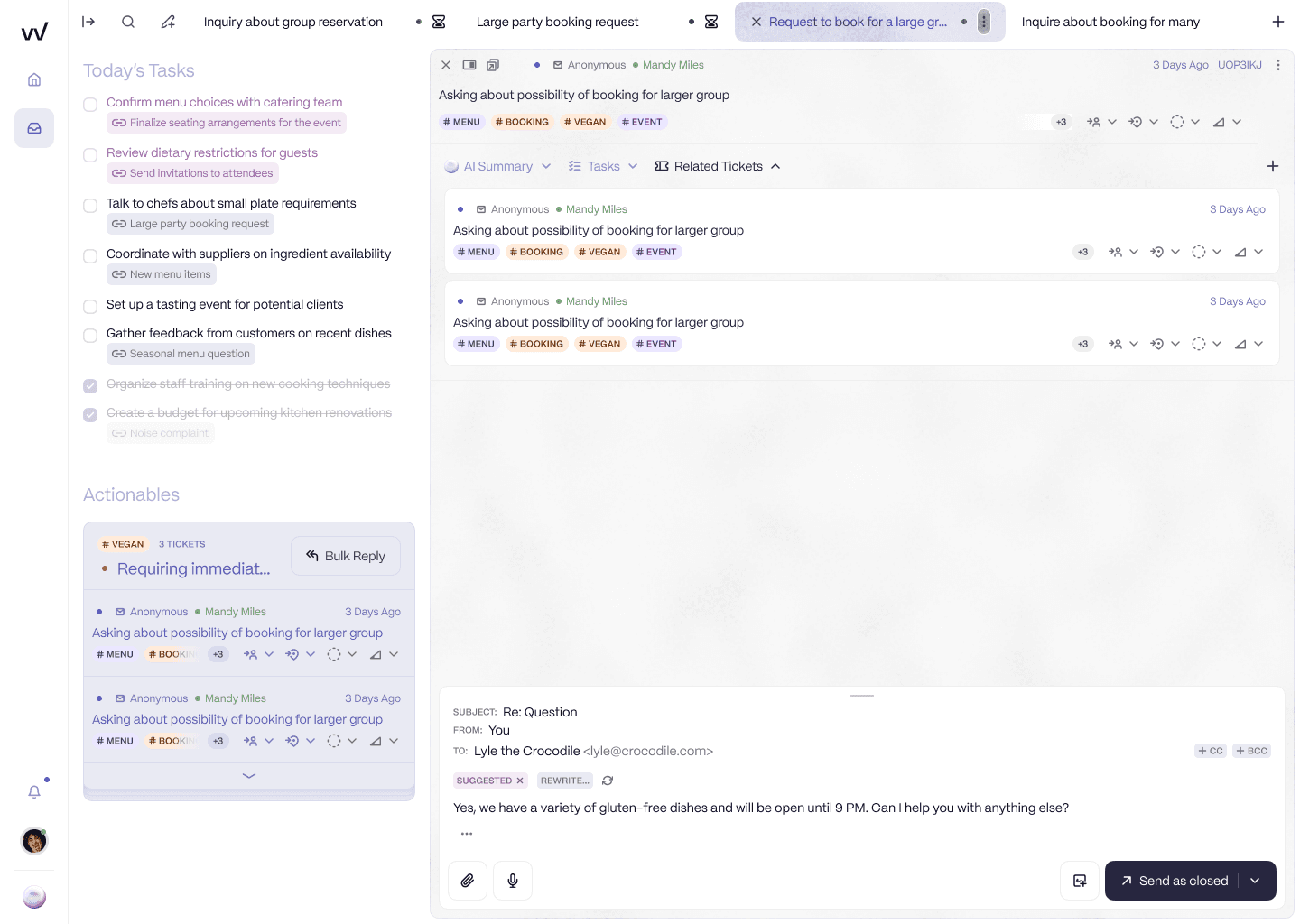
What groups actually do. Even after spending £25,000 to £100,000 or more on Zendesk, most multi-location restaurant groups still run booking enquiries through shared Outlook. The biggest revenue-impacting inbound workload stays slow and unmeasured. The CFO question is the right one: "what does this spend not solve?"
The opportunity cost is the real number. A 25-site group with 500 booking enquiries per week loses 5 to 10 per cent of group bookings to slow response times. Average group booking value £1,000 to £4,000. That is £250,000 to £2,000,000 in annual revenue at risk depending on size. The opportunity cost dwarfs the Zendesk invoice.
RevVue exists for this workload specifically. Booking system integration, location-native data model, per-location pricing. It does not displace Zendesk on customer-service tickets. Our side-by-side RevVue vs Zendesk comparison goes deeper into the architectural argument. The alternative for groups at this scale is to run two tools: RevVue for booking enquiries, Zendesk or Freshdesk for tickets. Whether that is cheaper than running Zendesk alone depends on how much the booking-enquiry workload is actually costing you today.
There is also a structural cost question about which pricing model fits a multi-location operating structure.
Per-agent vs per-location, the structural cost question
Restaurant groups grow by adding locations, not agents. Per-agent pricing fights this structure. Per-location pricing fits it. Honest math below.
With every site GM seat (full access):
Site count | Zendesk | RevVue | Winner |
|---|---|---|---|
10 sites | 13 × £115 × 12 = £17,940 | £9,000 | RevVue |
25 sites | 29 × £115 × 12 = £40,020 | £22,500 | RevVue |
50 sites | 56 × £150 × 12 = £100,800 | £45,000 | RevVue dominates |
RevVue is cheaper at every site count if you want site GMs to have inbox access without per-seat cost. This is not a sales pitch. It is the structure of the two pricing models meeting two different operating models.
The hidden categories from section 2 still apply to Zendesk and not to RevVue. Once you add configuration, integrations, training, and maintenance to the Zendesk number, the gap on real TCO closes further. Verify with both vendors before deciding.
Before you sign or renew, ask eight questions.
What to ask Zendesk sales before signing
What is the all-in year-one price including Professional Services or implementation partner? The list-price-per-agent answer is incomplete. Force the all-in number into the conversation upfront.
What is the configuration scope for location-aware routing and reporting at our site count? Get a written scope. Vague answers usually translate to scope creep on the implementation invoice.
Which booking systems are integrated natively? The honest answer is none. Then: what is the build-or-buy path? Who owns the integration when SevenRooms changes its API?
What happens to per-agent pricing if we want every site manager to see their own venue's inbox? Model both scenarios. The compromise option is not free, it is paid in lost bookings.
What is the renewal pricing trajectory after year one? Zendesk has reset prices for existing customers. Ask whether the price you sign at is locked for the contract term.
What is the cancellation and data export path? What format does data export come in? How long does it take? Multi-year contracts with weak export paths are a switching-cost trap.
Is the Advanced AI add-on included or extra? Most automation worth having is in the AI add-on. Pricing without it understates the cost of getting value.
What is a realistic implementation timeline before we are getting value? Most Zendesk implementations at 10+ sites take three to six months. Find out before you have committed.
Here is what groups at this scale actually do.
What groups actually do at 10+ sites
A UK leisure venue group running multi-site trampoline parks is currently on Zendesk and actively reviewing options. Stated job: reduce Zendesk cost while maintaining ticketing capability. They are looking for either an AI layer that deflects enough routine tickets to justify the spend, or a cheaper alternative built for their leisure-specific product complexity (age limits, weight limits, session types, party packages). This is the typical "we bought the enterprise tool and are now questioning the spend" arc. The broader options are covered in our best Zendesk alternatives for restaurant groups roundup.
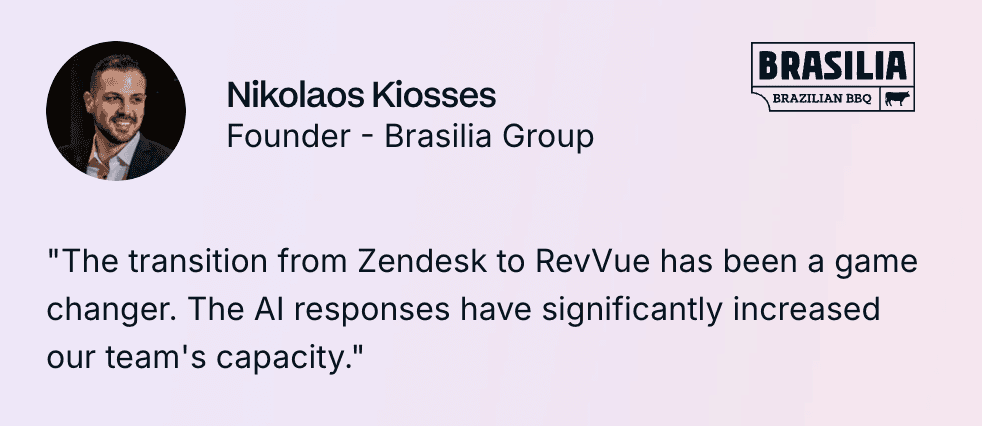
The Brasilia Group migrated from Zendesk to RevVue. Founder Nikolaos Kiosses: "The transition from Zendesk to RevVue has been a game changer." The economic logic was specific. Zendesk could not solve the booking-enquiry problem regardless of how much they spent on configuration. RevVue could. The total cost of running RevVue plus a smaller customer-service footprint was lower than running Zendesk alone and getting half the workload solved.
Model your own TCO before signing or renewing. Use the structure of the tables above, plug in your actual site count and central team size, get a written configuration scope from any implementation partner, and ask the eight questions before committing. If you are weighing this against Freshdesk specifically, our Zendesk vs Freshdesk for restaurant groups head-to-head goes deeper into the cheaper-helpdesk alternative. If you want a walkthrough of the math for your specific group, book a demo and we will model it together.
Frequently asked questions
How much does Zendesk cost for a restaurant group?
Zendesk's headline pricing for restaurant groups starts at £55 per agent per month (Suite Team) and runs to £115 per agent per month (Suite Professional), with Enterprise tiers typically £150+ per agent. The realistic total cost for a multi-location restaurant group at 10+ sites runs £25,000 to £80,000 or more in year one once you include configuration (£10,000 to £40,000), integrations with booking systems (£5,000 to £40,000, because none exist natively), training (£2,500 to £10,000), and ongoing maintenance (20 to 40 per cent of year-one licence cost annually).
What hidden costs are not on the Zendesk pricing page?
Six categories: configuration (location-aware routing, custom fields, triggers, often £10,000 to £40,000 one-off), booking system integration (none exist natively, so build or buy middleware at £5,000 to £40,000), training (£2,500 to £10,000), ongoing maintenance (20 to 40 per cent of year-one licence cost annually), the shadow cost of running shared Outlook in parallel for booking enquiries Zendesk cannot handle, and the per-seat compromise tax that either limits site GM inbox access or adds £6,000 to £35,000 a year in extra seats.
How much does Zendesk configuration cost for a multi-location restaurant?
Configuration cost depends on site count and customisation depth. A 10-site group typically pays £10,000 to £15,000 one-off for location-aware routing, custom fields, automations, and triggers. A 25-site group typically pays £20,000 to £30,000, often through a Zendesk implementation partner. A 50+ site group typically pays £40,000 or more in a multi-month engagement. These costs do not appear on the public Zendesk pricing page.
Does Zendesk pricing include booking system integration?
No. Zendesk does not integrate natively with SevenRooms, OpenTable, Collins, or Roller. Restaurant groups that want their helpdesk to connect to their booking system have to build or buy middleware, typically at £5,000 to £40,000 upfront plus 15 to 25 per cent annually in ongoing maintenance. Most groups skip this and continue running booking enquiries through shared Outlook, which means the largest revenue-impacting workload stays outside Zendesk.
Is per-agent or per-location pricing better for restaurant groups?
Depends on whether you want site GMs to see their own venue's inbox. Per-agent pricing (Zendesk, Freshdesk) is cheaper on raw licence cost if you accept the access compromise and keep the inbox to a small central team. Per-location pricing (RevVue at £75 per location per month) is cheaper at every site count if you want every site manager to have inbox access without per-seat cost. At 25 sites with full site GM access, per-agent runs roughly £40,000 a year versus £22,500 for per-location.
What is the total cost of ownership of Zendesk at 25 sites?
A 25-site restaurant group running Suite Professional with a 4-person central team typically pays £48,000 to £58,000 in year one (licences £5,520, configuration via implementation partner £25,000, integration middleware £10,000 to £20,000, training £5,000, year-one maintenance £3,000). Year two onward runs £15,000 to £25,000 per year. Adding full site GM access (25 extra seats) increases the annual run-rate by another £34,500.